How we make this list: we compare pricing pages, product documentation and public user reviews. Ratings come from G2, Capterra or Trustpilot, with the date we checked them.
Key takeaways
- Peer recognition works best when giving is easy and public, so the strongest tools live inside Slack or Microsoft Teams rather than in a separate portal people must remember to open.
- Published pricing is rare in this category: only Bonusly, Guusto, Matter and Assembly publish a per-user rate, while Nectar, Motivosity, Awardco and Kudos sell on quote.
- The real cost is the reward budget, not the subscription, because most vendors charge the platform fee plus whatever employees redeem.
- Small teams should start with a free or low-cost plan and prove the habit before committing to a multi-year contract with a minimum spend.
Quick comparison
| Tool | Best for | Starting price | Free plan |
|---|
 Bonusly | Small teams starting a daily recognition habit | $3 per user/month (billed annually) | Yes (up to 8 users) |
 Nectar | Midsize teams adding comms and surveys | See website | No |
 Motivosity | Dollar-based recognition with community | See website | No |
 Awardco | Large reward catalogs and global teams | See website | No |
 Guusto | Frontline teams with many receivers | $4.00 per sender/month (billed annually) | Yes |
 Matter | Chat-first teams on a tight budget | $1 per user/month (billed annually) | Yes (unlimited users) |
 Assembly | Automated recognition with workflows | $3 per user/month (billed annually) | No |
 Kudos | Values-based programs at scale | See website | No |
Is your product missing or out of date?
We review this list regularly. Vendors can request a listing, send updated pricing or ask about featured placement.
The best peer to peer recognition software
#1Bonusly
Best for: Small teams starting a daily recognition habit4.7/5 on
G2 (7,394 reviews, checked Oct 2026)
Visit bonusly.com
Starting price$3 per user/month (billed annually)
Free planYes (up to 8 users)
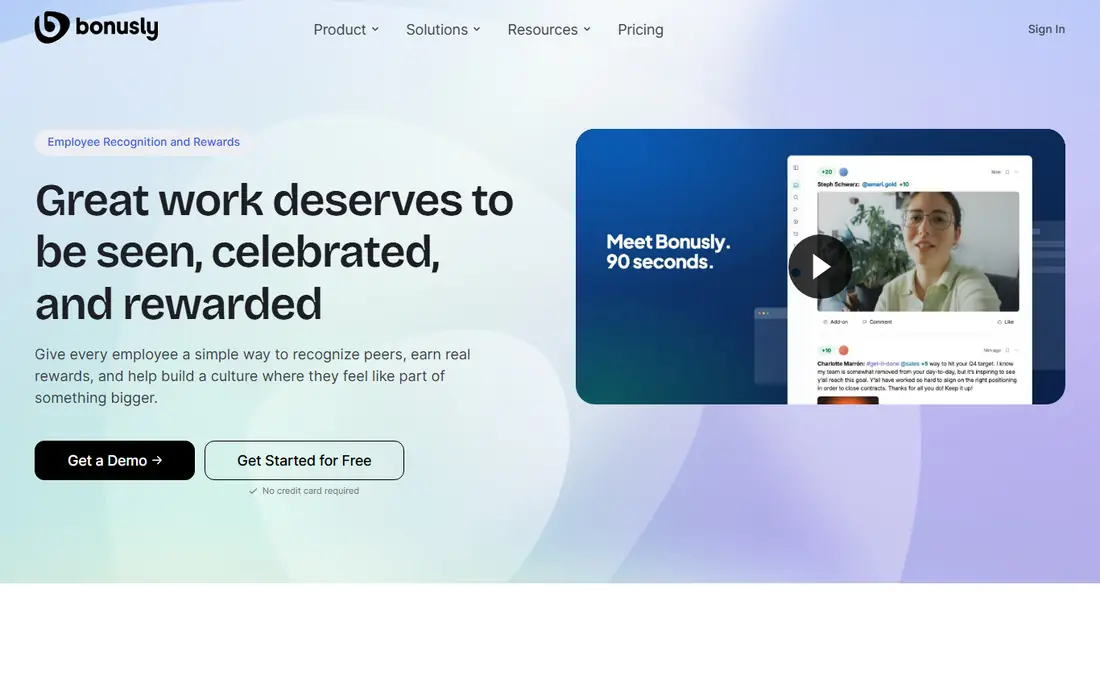
Bonusly is the easiest place to start. Anyone can give points to a colleague with a short note and a company value attached, and the whole feed is visible to the team. That visibility matters more than any single feature, because recognition that nobody sees does not change behavior. The monthly allowance resets each period, which keeps giving frequent instead of letting balances pile up untouched.
The pricing is public and simple, which is unusual here. The free plan covers up to eight users with core recognition, and the Team plan at $3 per user per month adds the habit-building features managers tend to need. One mechanic worth knowing is Points Boost, which lets employees spend earned points to raise their own monthly giving allowance. The catch is that advanced reporting and enterprise controls require the custom Organization plan, so larger buyers should get a quote before assuming the Team price covers everything.
What we like- Free plan for tiny teams
- Monthly giving allowance with manager boosts
- Large reward catalog
Watch out for- Advanced analytics sit on the custom plan
- No built-in surveys
#2Nectar
Best for: Midsize teams adding comms and surveys4.7/5 on
G2 (8,667 reviews, checked Oct 2026)
Visit nectarhr.com
Starting priceSee website
Free planNo
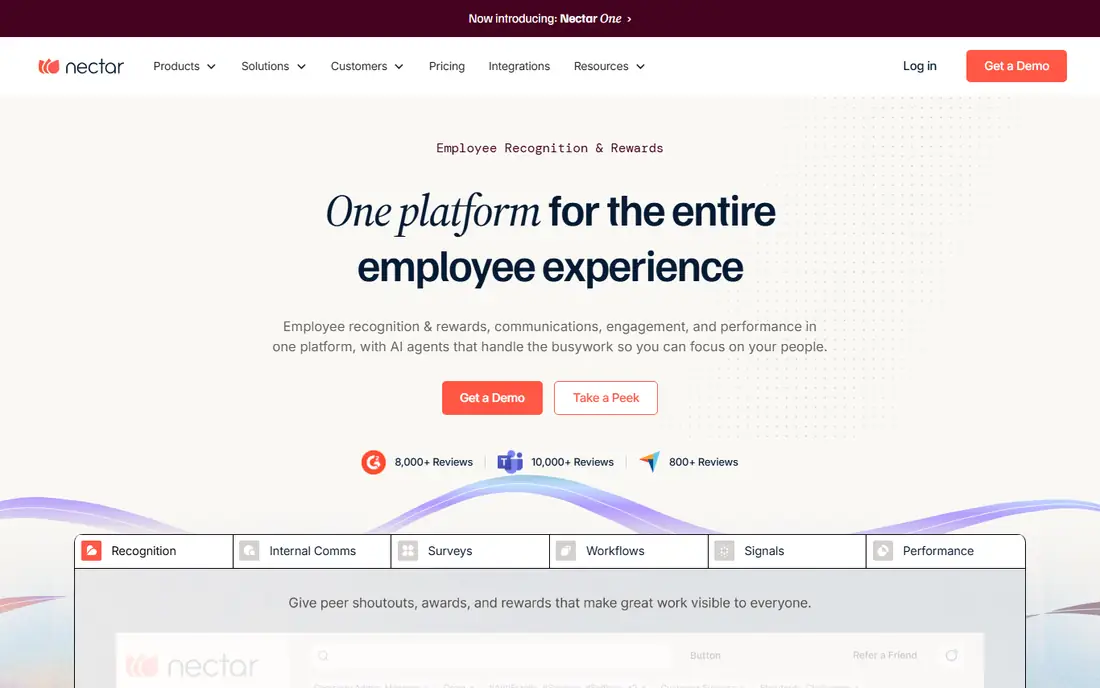
Nectar suits companies that want recognition plus more from one vendor. Alongside peer recognition and a broad reward catalog, it sells internal communications and survey products, so a midsize team can run announcements, recognition and listening in one place. Its Microsoft Teams app is well reviewed, and recognition can be given without leaving chat.
The trade-off is pricing transparency. Nectar moved to quote-based pricing, so buyers cannot compare an entry rate without a sales conversation. Third-party listings historically placed entry plans around $4 to $5 per user per month, but that figure is not current vendor pricing and should not be used for budgeting. Ask for the full bundle price including the reward budget, and confirm whether communications or surveys are included or billed separately.
What we like- Deep reward marketplace
- Optional internal communications and surveys
- Strong Teams presence
Watch out for- Quote-based pricing
- No free plan or self-serve trial
#3Motivosity
Best for: Dollar-based recognition with community4.7/5 on
G2 (3,735 reviews, checked Oct 2026)
Visit motivosity.com
Starting priceSee website
Free planNo
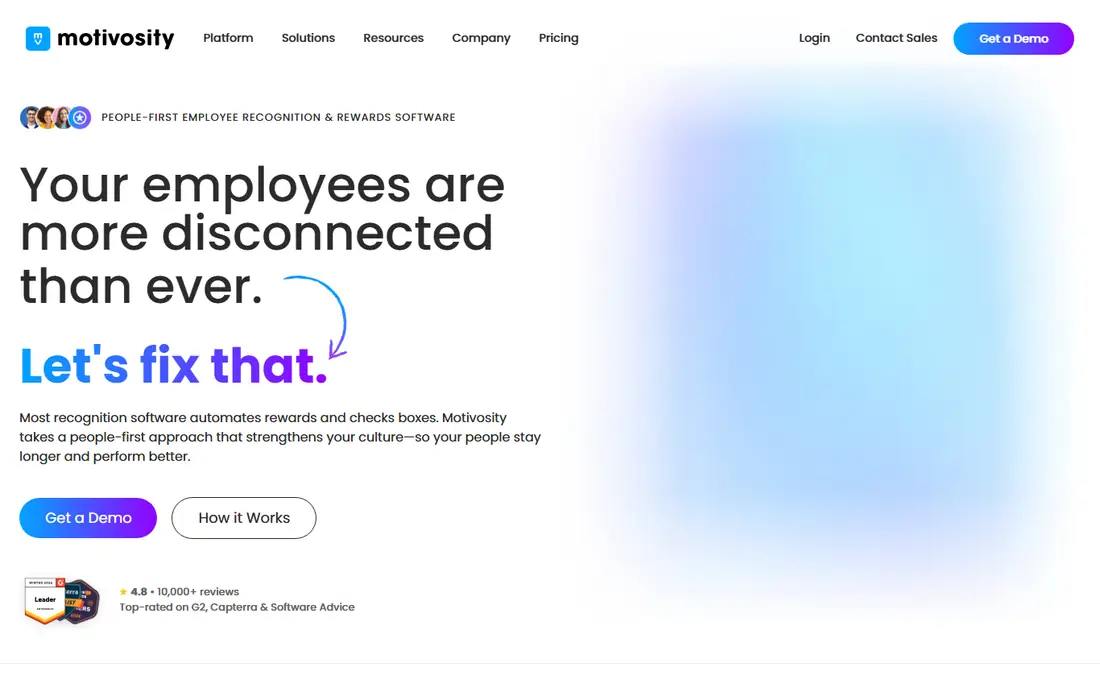
Motivosity takes a different approach to the currency question. One Motivosity buck equals one US dollar, so employees never have to decode a points conversion table. Giving balances reset on the first of each month without rollover, while earned balances generally do not expire. That split keeps giving active while letting people save earned dollars for a reward they actually want.
Beyond recognition, Motivosity adds profiles, community spaces and modular culture tools, which suits companies that want recognition to connect with broader engagement work. The cost structure is modular, roughly $0 to $2 per employee per month for the platform plus about $1 per module in some comparisons, with a $3,000 annual minimum for the small business bundle. Small companies should confirm the minimum against their headcount before falling in love with the feature set.
What we like- Currency is real dollars, no points math
- Profiles and community spaces
- Modular add-ons
Watch out for- $3,000 annual minimum on the small business tier
- No free plan
#4Awardco
Best for: Large reward catalogs and global teams4.9/5 on
G2 (6,539 reviews, checked Oct 2026)
Visit award.co
Starting priceSee website
Free planNo
Awardco is built for organizations that run formal, configurable recognition programs rather than a simple peer feed. Its reward catalog is one of the largest in the category, with Amazon Business as a headline integration, and programs can be shaped around service awards, incentives and manager-led recognition. Global teams benefit from broad redemption options.
Pricing is quote-based, with packages for organizations with 100 or fewer employees starting at $3,000. That floor makes Awardco a poor fit for very small teams, but reasonable for midsize companies that already plan a real reward budget. Buyers should ask what the package includes, how redemption fees work, and whether travel or experience rewards carry extra charges, since catalog breadth alone does not set the total cost.
What we like- Very large reward selection
- Amazon Business integration
- Configurable programs
Watch out for- Quote-based pricing
- Minimum spend for small organizations
#5Guusto
Best for: Frontline teams with many receivers4.9/5 on
G2 (6,133 reviews, checked Oct 2026)
Visit guusto.com
Starting price$4.00 per sender/month (billed annually)
Free planYes
Guusto is designed for workforces where few people send and many receive, which is common in retail, hospitality and field services. Instead of charging for every employee, the Essential plan charges $4.00 per sender seat plus $0.70 per recipient seat per month, billed annually. A free plan covers basic sending and redemption, and a mobile app lets deskless workers take part without a company laptop.
The model is refreshingly simple because there is no points economy to manage: managers send gift cards directly. The limits are the monthly contract minimums, $200 per month on Essential and $500 on Premium, and a catalog that leans on gift cards rather than merchandise or experiences. If your team wants elaborate reward choices, a points platform may fit better, but if you want frontline recognition with almost no training, Guusto is hard to beat.
What we like- Sender-based pricing fits frontline workforces
- Simple gift card rewards
- No points system
Watch out for- Monthly contract minimums
- Gift card catalog is narrower than points platforms
#6Matter
Best for: Chat-first teams on a tight budget4.7/5 on
G2 (1,190 reviews, checked Oct 2026)
Visit matterapp.com
Starting price$1 per user/month (billed annually)
Free planYes (unlimited users)
Matter is the cheapest credible path to a real program. The free plan supports unlimited users with kudos recognition, a template library and Slack and Teams integration. Paid plans start at $1 per user per month for Basic and $3 for Pro on annual billing, which undercuts every other tool in this list. For a startup or a small team testing whether peer recognition sticks, that price removes the usual excuse.
The trade-offs are scale and depth. The reward catalog is thinner than Awardco or Nectar, and the more advanced survey and analytics features sit on higher tiers. Matter also works best for teams that already live in Slack or Teams, since chat is where the product lives. If your workforce is mostly deskless, a mobile-first tool like Guusto will reach more people.
What we like- Free plan with unlimited users
- Lives inside Slack and Teams
- Lowest paid entry price here
Watch out for- Surveys and advanced features cost more
- Reward catalog is thinner than enterprise rivals
#7Assembly
Best for: Automated recognition with workflows4.8/5 on
G2 (4,186 reviews, checked Oct 2026)
Visit joinassembly.com
Starting price$3 per user/month (billed annually)
Free planNo
Assembly, now part of Quantum Workplace, focuses on making recognition automatic rather than relying on memory. Birthdays, work anniversaries and milestones can trigger recognition without a manager remembering the date, and workflows can route nominations through approvals. That automation matters for teams where good intentions fade after the launch month.
Pricing starts at $3 per user per month on annual billing, with a free trial available. Custom rewards and AI-assisted insights round out the package. The main weakness is analytics depth, which some reviewers rate below enterprise rivals, and there is no free plan for tiny teams. Assembly fits best in the middle of the market: companies large enough to pay per user, but not so large that they need the governance machinery of Workhuman or Achievers.
What we like- Workflow automation for birthdays and milestones
- AI-assisted insights
- Custom rewards
Watch out for- No free plan
- Analytics depth trails enterprise platforms
#8Kudos
Best for: Values-based programs at scale4.8/5 on
G2 (3,135 reviews, checked Oct 2026)
Visit kudos.com
Starting priceSee website
Free planNo
Kudos builds recognition around company values, so each message is tagged to a value the organization actually claims to hold. That structure helps larger companies keep recognition consistent across offices and countries instead of drifting into generic praise. The platform supports custom rewards and scaled programs, and its review scores sit near the top of this list.
Pricing is quote-based with no published entry rate, and third-party comparisons place its minimum fee around $4,000 per year. Analytics depth is the most cited limitation, so buyers who need deep reporting should test the dashboards during a demo rather than assuming they match the recognition features. Kudos fits companies that already know their values and want a disciplined, global program built around them.
What we like- Structured values-based recognition
- Scalable global programs
- Strong review scores
Watch out for- Quote-based pricing
- Analytics depth cited as a limit by some reviewers
How we chose
We compared tools on the things a buyer can verify: whether pricing is published, whether a free plan or trial exists, how recognition is given, where the product lives day to day, and what limits reviewers and comparison guides cite most often. We used vendor pricing pages, public reviews on G2 and Capterra, and independent comparison guides checked in October 2026. We did not claim hands-on testing, and we treated third-party price figures as guides only where the vendor does not publish a rate. Where a price could not be verified on the vendor's own page, the article says "See website" instead of repeating a stale number.
What to check before you sign
A recognition platform fails in three predictable ways, and each one is easy to test before you pay. First, check where giving happens. If your team lives in Slack or Teams, pick a tool that works inside chat, because a separate portal will see a burst of use at launch and then fade. Ask for a trial with a real team, not just a demo, and watch whether people give recognition without being reminded.
Second, model the total cost, not the subscription alone. Add the platform fee, the reward budget per employee, and any redemption or catalog fees. A $3 per user plan with a $50 annual reward budget per person costs far more than the subscription line suggests, and quote-based vendors may bundle these differently. Get the renewal terms in writing, including any minimum spend and what happens to unredeemed balances if you leave.
Third, decide how much structure you want. A simple peer feed works for small teams, while larger companies need values tagging, approval workflows and reporting by department and location. If you run frontline teams, sender-based pricing or a mobile app may matter more than any analytics feature. Start small, prove the habit over one quarter, and only then expand to surveys, communications or performance features from the same vendor.
Frequently asked questions
What is peer to peer recognition software?
It is software that lets employees recognize each other, usually with a short public message and sometimes points or rewards, instead of recognition flowing only from managers. Most tools add a social feed, a reward catalog and basic reporting so leaders can see who is being recognized and how often.
How much does peer recognition software cost?
Published entry prices in this list run from $1 to $4 per user per month, while several vendors sell on quote with minimum annual spends around $3,000 to $4,000. The reward budget is usually the larger cost, so add the planned spend per employee per year to the subscription before comparing vendors.
Is there a free peer recognition tool?
Yes. Bonusly offers a free plan for up to eight users, Matter offers a free plan with unlimited users, and Guusto offers a free plan for basic sending and redemption. Free plans cover recognition itself, while advanced analytics, surveys and larger catalogs usually require a paid tier.
Do employees actually use these tools?
Adoption depends on where giving happens and whether managers take part. Tools inside Slack or Teams tend to see more activity than separate portals, and programs with a monthly giving allowance keep recognition frequent. A short trial with one real team will tell you more than any vendor demo.
Should recognition use points or real dollars?
Points let you tune the value of a reward and run a catalog, but employees must learn the conversion. Dollar-based tools like Motivosity remove that confusion, while direct gift card tools like Guusto remove the points layer entirely. Pick the model your team will understand without training.
Can a small team use an enterprise recognition platform?
It can, but the minimum spend often makes it poor value. Enterprise platforms are built for global catalogs and governance that a 20-person team does not need. Start with a free or low-cost plan, and move up only when headcount or reporting needs force the change.
Sources we checked (5)
- https://www.selectsoftwarereviews.com/buyer-guide/employee-recognition-software
- https://www.motivosity.com/blog/best-employee-recognition-software-2026
- https://matterapp.com/blog/motivosity-vs-nectar
- https://matterapp.com/blog/bonusly-vs-nectar
- https://www.kudoboard.com/blog/employee-rewards-and-recognition-platforms/
Is your product missing or out of date?
We review this list regularly. Vendors can request a listing, send updated pricing or ask about featured placement.

Shihab Mia · Founder, Rankite
Shihab has 5+ years in B2B and SaaS SEO. He writes Rankite's software buying guides from pricing pages, documentation and public user reviews. More about Shihab.