How we make this list: we compare pricing pages, product documentation and public user reviews. Ratings come from G2, Capterra or Trustpilot, with the date we checked them.
Key takeaways
- Illumio and Akamai Guardicore are the most proven choices for host-based segmentation across data centers, clouds, and endpoints.
- Cisco Secure Workload and VMware NSX suit teams already invested in Cisco or VMware infrastructure, where native integration cuts deployment friction.
- Zscaler Workload Segmentation fits organizations already running the Zero Trust Exchange and wanting segmentation as part of a cloud platform.
- ColorTokens and Elisity serve buyers who need compliance-driven policy or identity-based controls without rebuilding the network.
- Almost every vendor here prices by quote, so run a proof of concept on real traffic before comparing costs.
Quick comparison
Is your product missing or out of date?
We review this list regularly. Vendors can request a listing, send updated pricing or ask about featured placement.
Starting priceSee website
Free planFree trial
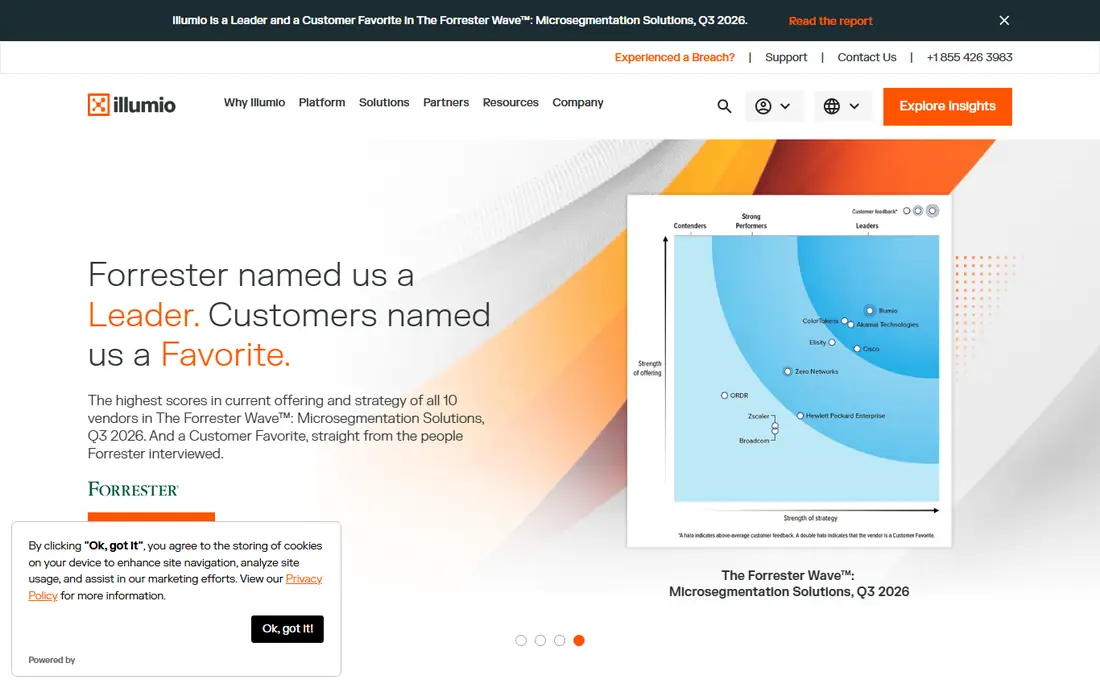
Illumio is the reference point for host-based microsegmentation. It maps traffic between workloads, lets security teams build policy from observed flows, and enforces controls at the host, so segmentation does not depend on VLANs or firewall rule rewrites. Visibility first, then simulation, then enforcement is the workflow most buyers follow, and it reduces the risk of breaking applications during rollout.
The main costs are organizational rather than technical. Agents must be deployed across servers, endpoints, and cloud workloads, and policy owners need time to review simulated results. Illumio prices by protected workload under annual contracts, so get a quote tied to your actual workload count and confirm what is included for cloud and endpoint coverage.
What we like- Traffic visibility across hybrid estates
- Policy simulation before enforcement
- Works without network changes
Watch out for- Quote-only pricing
- Agent deployment takes planning at large scale

#2
Akamai Guardicore Segmentation
Best for: Multi-OS data center segmentation
Visit akamai.com
Starting priceSee website
Free planNo
Guardicore, now part of Akamai, segments data centers and cloud workloads with agent-based enforcement and a clear map of east-west traffic. Its strength is breadth: Windows, Linux, and older systems that many modern tools ignore are covered, which matters for hospitals, manufacturers, and other estates with long-lived servers. Deception capabilities on higher tiers add an extra layer for detecting intruders already inside.
Buyers should expect a sales-led process and a quote based on protected assets. Guardicore works well as a standalone product, but organizations already using Akamai for content delivery or application security may get simpler procurement and support by bundling. Run the proof of concept on legacy systems first, since those are where many rivals fall short.
What we like- Broad operating system coverage including legacy systems
- Visual flow mapping
- Deception features on some tiers
Watch out for- Quote-only pricing
- Best value comes with the wider Akamai platform

#3
Cisco Secure Workload
Best for: Cisco-centric enterprises
Visit cisco.com
Starting priceSee website
Free planFree trial
Cisco Secure Workload, formerly Tetration, combines workload telemetry with segmentation policy for data centers and clouds. It collects detailed flow and process data, recommends least-privilege policies, and enforces them at the workload. For teams that already run Cisco networking and security, the integration story is strong, with shared visibility and incident workflows.
Outside a Cisco estate, the value proposition is less clear, and licensing deserves careful reading before purchase. Some buyers use Secure Workload mainly for visibility and dependency mapping, then enforce gradually. That phased approach suits large environments where a single enforcement switch would be reckless.
What we like- Deep telemetry and policy recommendations
- Strong application dependency mapping
- Integrates with Cisco security products
Watch out for- Most valuable inside a Cisco estate
- Pricing and licensing are complex
Starting priceSee website
Free planNo
VMware NSX brings network virtualization and microsegmentation to virtualized data centers and hybrid clouds. Its distributed firewall enforces policy close to each workload, and administrators manage rules from the same console they use for virtual networking. For a vSphere-heavy estate, that native position is hard to beat, since no separate agent rollout is required for virtual machines.
The limitation is scope. Physical servers, containers outside VMware, and multi-cloud workloads need additional planning, and NSX licensing is tied to the wider VMware stack, which Broadcom now sells. Teams standardizing on VMware will find NSX efficient, while heterogeneous estates should compare it with agent-based rivals that treat every platform equally.
What we like- Native segmentation inside vSphere
- Distributed firewall at the hypervisor
- Consistent policy across clouds
Watch out for- Less natural for non-VMware estates
- Licensing sits inside the broader VMware portfolio

#5
Zscaler Workload Segmentation
Best for: Zero Trust Exchange customers
Visit zscaler.com
Starting priceSee website
Free planNo
Zscaler Workload Segmentation extends the Zero Trust Exchange from users to workloads, controlling east-west traffic between servers and cloud instances. Because it is cloud-delivered, teams avoid much of the hardware and network redesign that older segmentation projects required. Policy can follow identity and workload context rather than IP addresses alone.
The catch is that pricing and packaging are tied to the wider Zscaler platform, so a standalone comparison can mislead. Organizations already paying for Zscaler user access will find workload segmentation a natural extension, while a buyer starting from zero should price the full platform, not just the segmentation add-on. A pilot on one application group is the right way to judge policy behavior.
What we like- Cloud-delivered segmentation
- No major network redesign
- Fits existing Zscaler identity and policy workflows
Watch out for- Sold as part of a platform, not a cheap standalone
- Per-workload economics depend on bundling
Starting priceSee website
Free planNo
ColorTokens positions its Xtended ZeroTrust Platform as a single system for visibility, microsegmentation, zero trust network access, and endpoint protection. That breadth appeals to regulated industries that must show auditors how workloads are isolated and how policy maps to frameworks such as HIPAA and PCI. Seeing process, file, user, and workload communication in one view also helps teams find gaps that a network-only map would miss.
The trade-off is evaluation time. A platform that covers several security jobs needs more stakeholders in the room, and pricing is quoted. Buyers with a narrow segmentation need may prefer a focused tool, while teams consolidating vendors should give ColorTokens a full pilot against their compliance reporting requirements.
What we like- Unified visibility, segmentation, and endpoint protection
- Compliance reporting for regulated industries
- Cloud and on-premises coverage
Watch out for- Quote-only pricing
- Platform breadth means a longer evaluation
Starting priceSee website
Free planNo
Elisity takes an identity-based approach to microsegmentation, tying policy to users, devices, and workload identity rather than to network topology. Its platform is designed to deliver visibility quickly and to enforce policy without the heavy agent rollout some rivals require. For organizations with dynamic cloud and identity-driven estates, that model matches how applications actually run.
As a smaller vendor, Elisity should be judged on proof of concept results and customer references in your industry, not on feature lists alone. Confirm support for your operating systems, cloud providers, and identity providers, and test policy behavior during workload migration. Buyers who want a modern, identity-first alternative to the largest vendors will find it worth that diligence.
What we like- Identity and context-based policy
- Agentless approach in many deployments
- Fast time to visibility
Watch out for- Smaller vendor than Illumio or Cisco
- Enterprise references matter more than marketing claims
Starting priceSee website
Free planFree trial
Prisma Cloud is a cloud-native application protection platform that includes workload segmentation alongside vulnerability management, compliance, and runtime protection. That context is useful: a segmentation rule informed by known vulnerabilities and misconfigurations is easier to defend than one built from traffic alone. Multi-cloud coverage suits teams running AWS, Azure, and Google Cloud together.
The weakness is focus. Prisma Cloud is a platform purchase, and buyers who only need segmentation may pay for breadth they do not use. It makes most sense for teams already standardizing on Palo Alto Networks for cloud security, or for teams consolidating several cloud tools into one contract. Evaluate the segmentation module on its own during a trial, not just the platform dashboard.
What we like- Segmentation inside a broad cloud security platform
- Vulnerability and compliance context
- Multi-cloud coverage
Watch out for- Segmentation is one module among many
- Pricing follows the wider platform
How we chose
We compared vendor documentation, product capabilities, and public reviews on G2, Capterra, and peer comparison sites, and we favored tools with a dedicated microsegmentation capability rather than a firewall feature alone. Pricing in this category is almost always quoted, so we wrote See website where no public list price exists instead of repeating marketplace estimates as list prices. Each tool here supports policy based on observed traffic and enforcement at workload level, which is the core test for this category.
Rolling out segmentation without breaking applications
Start with visibility only. Map traffic for at least two to four weeks, covering month-end, backup, and patching windows, so rare but legitimate flows are not missed. Build policy from observed traffic, then run it in simulation mode and review every denied flow with application owners before enforcing anything.
Phasing enforcement by application group
Enforce one application group at a time, starting with the least critical, and keep a rollback plan for each group. Monitor denied traffic daily during the first weeks, and treat each denial as a question, not an error: is this flow legitimate and missing from policy, or is it traffic that should stop. That discipline is what separates a successful rollout from a project that gets switched off after the first outage.
Agent, agentless, and network approaches
Agent-based tools enforce at the host and work across networks, while agentless tools reduce deployment effort but may depend on network integration. Hypervisor-based tools suit virtualized estates best. Match the enforcement method to your estate mix, and confirm coverage for legacy systems, containers, and cloud workloads separately, since a tool that covers one well may cover another poorly.
Frequently asked questions
What is microsegmentation?
Microsegmentation divides a network into small, isolated zones down to individual workloads, so an attacker who compromises one server cannot move freely to others. Policy controls which workloads may communicate, based on identity, application, and observed traffic. It is a core control in zero trust architectures.
How is microsegmentation different from a firewall?
A traditional firewall usually guards the network perimeter or large segments, while microsegmentation enforces policy between workloads inside the network. Firewalls still matter at boundaries, but they cannot see or control most east-west traffic between servers. The two controls complement each other.
Will microsegmentation slow down applications?
Well-configured host and hypervisor enforcement adds minimal latency, and most performance problems come from badly written policy or overloaded agents, not from segmentation itself. Pilot on representative workloads, measure latency and CPU use, and tune agent settings before wide rollout.
Do I need agents on every server?
It depends on the tool. Illumio and Guardicore use agents, NSX enforces at the hypervisor for virtual machines, and some agentless tools integrate with the network or cloud control plane. Confirm coverage for each platform in your estate, including legacy systems and containers, before you buy.
How long does a microsegmentation project take?
Visibility can arrive in days to weeks, but full enforcement across a large estate often takes months, phased by application group. Rushing enforcement is the most common cause of outages and project failure. Budget time for traffic baselining, policy review with application owners, and simulation.
How much do microsegmentation tools cost?
Almost all vendors price by quote, based on protected workload count, platform scope, and contract length. Published marketplace figures vary widely and are not list prices, so treat them as a rough guide only. Get competing quotes on the same workload count and scope for a fair comparison.
Sources we checked (8)
- https://www.illumio.com/pricing
- https://www.akamai.com/pricing
- https://www.cisco.com/pricing
- https://www.vmware.com/pricing
- https://www.zscaler.com/pricing
- https://colortokens.com/pricing
- https://www.elisity.com/pricing
- https://www.paloaltonetworks.com/pricing
Is your product missing or out of date?
We review this list regularly. Vendors can request a listing, send updated pricing or ask about featured placement.

Shihab Mia · Founder, Rankite
Shihab has 5+ years in B2B and SaaS SEO. He writes Rankite's software buying guides from pricing pages, documentation and public user reviews. More about Shihab.
 Illumio
 VMware NSX
 ColorTokens Xtended ZeroTrust Platform
 Elisity
 Palo Alto Networks Prisma Cloud