How we make this list: we compare pricing pages, product documentation and public user reviews. Ratings come from G2, Capterra or Trustpilot, with the date we checked them.
What is the best medication adherence software?
AdhereHealth is the best pick for health plans and pharmacy benefit managers that need care gap closure across large member populations. Scene Health is the strongest choice when verified daily dosing matters, because its video directly observed therapy confirms that each dose was taken. Medisafe is the best low-cost entry point for teams that want a proven patient app.
Key takeaways:
- AdhereHealth leads for health plans and PBMs that need rules-based outreach tied to claims data.
- Scene Health verifies every submitted dose with asynchronous video, which suits trials and high-risk patients.
- AdhereTech Aidia uses a cellular smart bottle and cap, so patients need no app, no WiFi and no smartphone.
- AiCure is built for clinical trials, where computer vision confirms dosing from a phone camera.
- Medisafe is the only tool with a published consumer price, at $4.99 per month or $39.99 per year for Premium.
How much does medication adherence software cost?
Enterprise medication adherence software is almost always sold on a quote basis, because pricing depends on the number of members or patients, the conditions covered, the length of the program and the level of human staffing included. In this guide, seven of the eight tools publish no starting price and sell through a sales conversation.
Medisafe is the exception. Its consumer Premium plan costs $4.99 per month or $39.99 per year, according to the Medisafe help center, updated 26 October 2026. AdhereTech prices its Aidia program per patient through the sponsoring pharma company, and patients pay nothing. Buyers should ask for three numbers in every quote: the per-member fee, any setup, integration or device cost, and the cost of the human layer, such as pharmacists, nurses and health coaches.
Which adherence approach fits a health plan, a pharma team or a pharmacy?
Health plans and pharmacy benefit managers usually need population coverage first. AdhereHealth fits that brief, because it works from claims data to find members with gaps and runs timed outreach across assigned staff roles. Arine also fits, because it ranks medication-related problems across a whole population and recommends patient-specific interventions. Surescripts fits buyers inside its e-prescribing network that want adherence signals inside existing pharmacy workflows.
Pharma teams need patients to start and stay on one specific therapy, often a specialty drug. AdhereTech Aidia fits that brief, because the smart bottle and cap travel with the drug and report real-time dosing data back to the patient support program. AiCure fits pharma sponsors running clinical trials, where dosing must be verified for the trial data to hold up.
Pharmacies and care teams that work directly with patients should weigh the patient burden of each method. A smart bottle asks almost nothing of the patient, while video directly observed therapy asks for a short video every day. Medisafe suits pharmacies and small care teams that want a proven reminder and tracking app without a hardware rollout.
What should buyers check before signing a contract?
Start with the evidence standard. Self-reported adherence, app taps and bottle openings are all weaker signals than video-confirmed dosing or sensor-verified ingestion. Scene Health and AiCure confirm doses with video, AdhereTech confirms bottle openings with sensors, and most app-based tools rely on patient self-report. Buyers should match the evidence standard to the stakes, using verified methods for trials and high-risk conditions and lighter methods for general reminder programs.
Check integration and data ownership next. Adherence programs only work when they connect to claims, pharmacy and EHR data, so ask which systems each vendor integrates with and how long integration takes. Ask who owns the adherence data, how it can be exported, and what happens to it when the contract ends.
Check the human layer and the measurement plan. Staffed programs such as Scene Health and AdhereHealth deliver better results than software alone, but they cost more and need clear service levels. Ask how outcomes are measured and whether results are tied to HEDIS measures, Star Ratings or trial endpoints.
We started from the vendors that health plans, pharma companies and pharmacies actually buy, then checked each vendor homepage directly on 22 November 2026. We kept only tools with a live, verifiable homepage and a real adherence product aimed at organizations, not only at individual consumers. We excluded AllazoHealth, whose assets were acquired by AssistRx in April 2025 and whose domain no longer resolves, HealthPrize, whose domain no longer resolves and which last raised funding in December 2020, and Pillsy, whose brand was retired when the company became optimize.health and whose site returns a 403 error.
We checked pricing on each vendor site and in the vendor help center where a pricing page exists. Seven of the eight tools publish no price and are listed as quote only. Medisafe is the only tool with a published price, verified in its help center on 22 November 2026.
Quick comparison
| Tool | Best for | Starting price | Free plan |
|---|
 AdhereHealth | Health plans and PBMs that need rules-based care gap closure across large member populations | Quote | No |
 Scene Health | Verified daily dosing for high-risk patients, clinical trials and public health programs | Quote | Free for eligible members through a health plan |
 AdhereTech Aidia | Pharma patient support programs for specialty drugs where patients need no app and no smartphone | Quote | Free for patients, the sponsoring pharma company pays |
 AiCure | Clinical trial sponsors that need verified dosing and digital biomarker data from a smartphone | Quote | No |
 Wellth | Medicaid plans and safety-net populations where small financial rewards drive daily healthy actions | Quote | No |
 Arine | Health plans and care teams that need prioritized medication interventions across large patient populations | Quote | No |
 Medisafe | Low-cost patient engagement with caregiver alerts, and teams that want a proven app before committing to an enterprise platform | $4.99 per month or $39.99 per year for Premium, enterprise quote | Yes, free in the US with a limited number of medications |
 Surescripts | Pharmacies and health systems already inside the Surescripts network that want adherence signals in existing workflows | Quote | No |
Is your product missing or out of date?
We review this list regularly. Vendors can request a listing, send updated pricing or ask about featured placement.
The best medication adherence software
| Tool |
Starting price |
Free plan |
Best for |
Adherence method |
| AdhereHealth |
Quote |
No |
Health plans and PBMs closing care gaps |
Predictive analytics and rules-based outreach |
| Scene Health |
Quote |
Free for eligible members through a health plan |
Verified daily dosing for high-risk patients |
Video directly observed therapy |
| AdhereTech Aidia |
Quote |
Free for patients, pharma sponsors pay |
Pharma patient support for specialty drugs |
Cellular smart bottle and cap |
| AiCure |
Quote |
No |
Clinical trials needing verified dosing |
Computer vision and digital biomarkers |
| Wellth |
Quote |
No |
Medicaid plans and safety-net populations |
Financial rewards for verified actions |
| Arine |
Quote |
No |
Population medication optimization |
AI medication intelligence |
| Medisafe |
$4.99 per month or $39.99 per year for Premium, enterprise quote |
Yes, free in the US |
Low-cost patient app with enterprise options |
Reminders, tracking and caregiver alerts |
| Surescripts |
Quote |
No |
Pharmacies inside the e-prescribing network |
Medication history and real-time benefit data |
#1
AdhereHealth
Best for: Health plans and PBMs that need rules-based care gap closure across large member populations
Visit adherehealth.com
Starting priceQuote
Free planNo
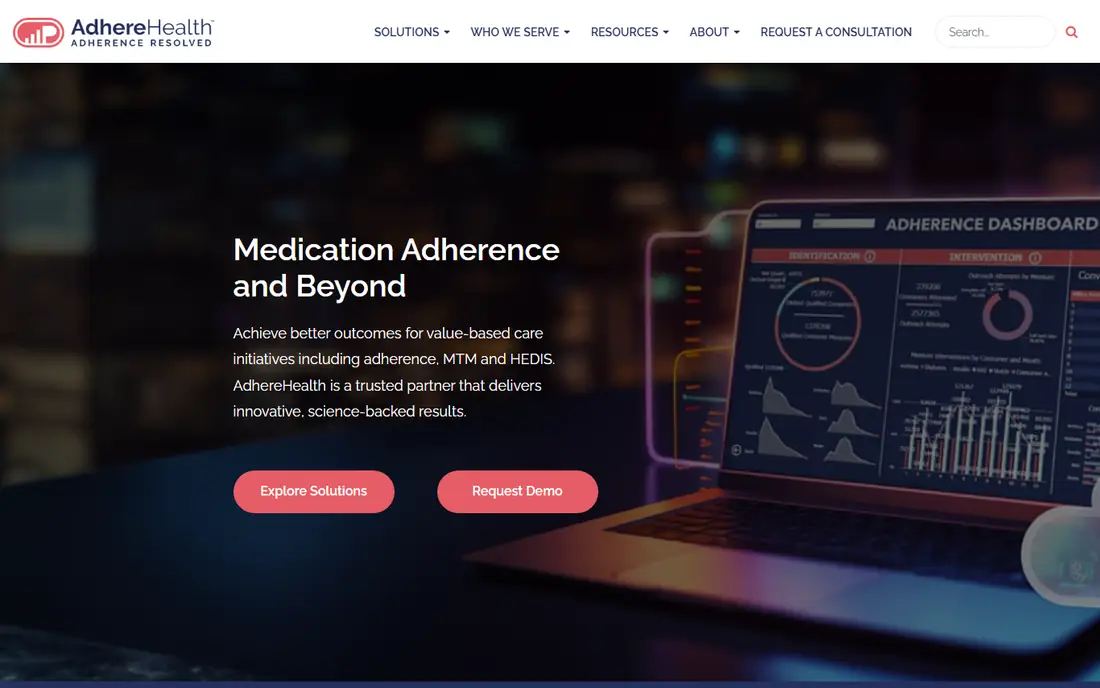
AdhereHealth, formerly PharmMD and based in Nashville, is the most plan-focused platform in this guide. It uses predictive analytics to find members at risk of adherence gaps, then runs rules-based outreach across assigned staff roles, with timed escalation when a member does not respond. The trade-off is access, because the sales-led buying process makes it heavy for a small clinic. Buyers should confirm which claims and pharmacy data feeds the models need, because results depend on data quality.
What we like- Purpose-built for health plans and PBMs, predictive analytics with clinical and behavioral science, covers medication therapy management and social determinants of health, supports value-based care reporting
Watch out for- Enterprise only, with no self-serve trial and no public pricing, so small teams cannot test it without a sales process
#2
Scene Health
Best for: Verified daily dosing for high-risk patients, clinical trials and public health programs
Visit scene.health
Starting priceQuote
Free planFree for eligible members through a health plan
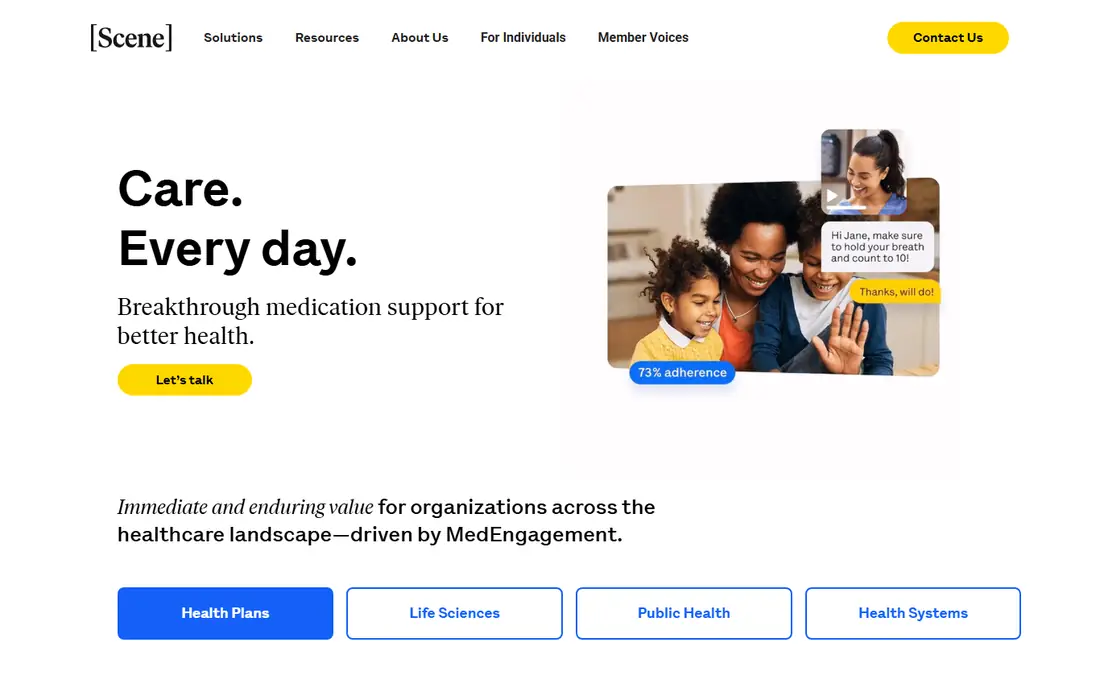
Scene Health, formerly emocha Mobile Health and spun out of Johns Hopkins, is the strongest choice when a buyer needs proof that a dose was taken. Patients film themselves taking medication, and the Scene care team reviews each video and responds with coaching and encouragement. Scene reports savings of $2,750 to $6,300 per engaged member per year for members with type 2 diabetes. The limits are effort and cost, because daily videos suit motivated patients and high-stakes conditions.
What we like- Verifies 100 percent of submitted doses with asynchronous video, CDC-endorsed video directly observed therapy model, staffed by pharmacists, nurses and health coaches, app works in 20 plus languages
Watch out for- Daily video check-ins ask more of patients than a reminder app, and the staffed model costs more than software alone
#3
AdhereTech Aidia
Best for: Pharma patient support programs for specialty drugs where patients need no app and no smartphone
Visit adheretech.com
Starting priceQuote
Free planFree for patients, the sponsoring pharma company pays
AdhereTech Aidia is a smart bottle and cap system that removes almost all patient effort from adherence tracking. The bottle lights up and plays a reminder when a dose is due, and its cellular connection reports every opening to the Aidia platform in real time, with no app download and no WiFi needed. A randomized trial in glaucoma patients showed 20 percent higher adherence with the Aidia bottle than in the control arm. The main limit is what the sensor can see. A bottle opening is strong evidence of a dose, but it is not the same as confirmed ingestion, and the system suits oral solid medicines rather than injections, infusions or inhalers. Note: the AdhereTech homepage returned a 502 error to our direct check on 22 November 2026, but the page loads in a browser.
What we like- No patient app, no WiFi and no setup, cellular connection reports bottle openings in real time, fits multiple prescription bottle cap sizes, proven in randomized trials
Watch out for- Tracks bottle openings rather than confirmed ingestion, covers oral solid medications only, and pricing is per-patient through a pharma sponsor, so there is no direct purchase path for a clinic
#4
AiCure
Best for: Clinical trial sponsors that need verified dosing and digital biomarker data from a smartphone
Visit aicure.com
Starting priceQuote
Free planNo
AiCure is the most trial-oriented tool in this guide. Its platform, known as H.Code, uses a smartphone camera and computer vision to confirm that the right patient took the right medication at the right time, and it captures digital biomarkers that can feed trial endpoints. The trade-off is fit. AiCure is built for trials, not for a health plan that wants to nudge a million members to refill on time.
What we like- Computer vision confirms dosing and medication identity from phone video, captures digital biomarkers for trial endpoints, built for decentralized and hybrid trials
Watch out for- Trial-focused pricing and design make it a poor fit for routine plan adherence programs, and facial recognition raises privacy review requirements with sponsors and ethics boards
#5
Wellth
Best for: Medicaid plans and safety-net populations where small financial rewards drive daily healthy actions
Visit wellthapp.com
Starting priceQuote
Free planNo
Wellth applies behavioral economics to care plans. Members enroll through their health plan, then verify each healthy action, such as taking a prescribed medication, by scanning it in the Wellth app, and they earn small daily financial rewards for doing so. The model targets the hardest adherence problem in healthcare, which is sustained daily behavior in populations facing cost and access barriers, and Wellth reports strong results with Medicaid-eligible populations. The limits are cost structure and fit. The rewards themselves are a real per-member expense, so buyers should model the total program cost including incentives
What we like- Behavioral economics engine with daily financial incentives, members verify actions by scanning medication, covers care plan actions beyond dosing, strong results reported with Medicaid populations
Watch out for- Incentive budgets add a per-member cost on top of the platform fee, and results depend on the population and the reward design, so pilots should be measured before a full rollout
#6
Arine
Best for: Health plans and care teams that need prioritized medication interventions across large patient populations
Visit arine.com
Starting priceQuote
Free planNo
Arine is a medication intelligence platform rather than a patient reminder app. Its Arine Intelligence engine reviews pharmacy and clinical data to find medication-related problems, such as gaps, duplications, interactions and dosing issues, then recommends patient-specific interventions and ranks them so care teams act on the highest-risk patients first. The limit is scope. Arine does not itself engage the patient, so buyers that want direct patient engagement will need to pair it with an outreach tool.
What we like- Arine Intelligence identifies medication-related problems and recommends patient-specific interventions, population-level prioritization focuses staff time on the highest-risk patients, fits inside population health workflows
Watch out for- Adherence is one part of a broader medication optimization platform, so buyers that want a patient-facing engagement tool will need a second product
#7
Medisafe
Best for: Low-cost patient engagement with caregiver alerts, and teams that want a proven app before committing to an enterprise platform
Visit medisafe.com
Starting price$4.99 per month or $39.99 per year for Premium, enterprise quote
Free planYes, free in the US with a limited number of medications
Medisafe is the best-known medication app in this guide and the only tool with a published price. Premium costs $4.99 per month or $39.99 per year, according to the Medisafe help center, updated 26 October 2026 and checked on 22 November 2026. The app offers reminders, refill tracking, drug interaction checks and Medfriend alerts that notify a chosen contact about an hour after a missed dose. Note the price conflict. The Medisafe help center lists $4.99 per month or $39.99 per year, but the US App Store listing shows other Premium price points, from $2.99 to $9.99 a month and $27.99 to $39.99 a year, which appear to vary by region or promotion.
What we like- Widely used app with drug interaction checks, refill tracking and Medfriend caregiver alerts, enterprise offerings for pharma and health plans, clear published consumer price, available on iPhone and Android
Watch out for- Consumer app first, so enterprise reporting and population analytics need a separate agreement, and the free tier caps the number of medications, which pushes most multi-drug patients to Premium
#8
Surescripts
Best for: Pharmacies and health systems already inside the Surescripts network that want adherence signals in existing workflows
Visit surescripts.com
Starting priceQuote
Free planNo
Surescripts is the network layer underneath much of US e-prescribing, and its adherence value comes from data rather than from a patient app. Medication history shows what was actually dispensed, real-time prescription benefit checks show cost and coverage at the point of prescribing, and refill signals reveal gaps before they become hospital visits. The limit is scope. Surescripts does not run patient outreach, coaching, video verification or incentive programs, so a buyer that wants to change patient behavior directly will need a second tool.
What we like- Largest e-prescribing network in the United States, medication history and real-time prescription benefit data surface adherence gaps inside pharmacy workflows, deep integration with EHR and pharmacy systems
Watch out for- Adherence is a capability inside a large network, not a standalone patient engagement platform, so buyers that want outreach, coaching or incentives need another tool
Frequently asked questions
What is medication adherence software?
Medication adherence software helps organizations make sure patients take prescribed medicines as directed. It covers patient reminders, refill monitoring, claims and pharmacy data analysis, verified dosing through video or smart packaging. Health plans, PBMs, pharma companies, pharmacies and care teams buy it to reduce avoidable hospital visits, improve quality measures and support clinical trials.
How is enterprise adherence software different from a reminder app?
A reminder app helps one person remember doses, while enterprise adherence software works across a population and connects to claims, pharmacy and EHR data. Enterprise tools add risk scoring, care team workflows, outcome reporting and compliance controls such as HIPAA safeguards and audit logs. Buyers should decide whether they need population management or a single patient app.
Which medication adherence software is best for health plans?
AdhereHealth is the best fit for most health plans, because it is built around claims data, predictive analytics and rules-based care gap closure, with reporting tied to Star Ratings and value-based care. Arine suits plans that want population medication optimization, and Scene Health suits plans with high-risk members who need verified daily dosing and staffed coaching.
Which medication adherence software is best for clinical trials?
AiCure is the best fit for most clinical trials, because its computer vision confirms the right patient took the right medication, and it captures digital biomarkers that feed trial endpoints. Scene Health is the best alternative when a trial needs video directly observed therapy with human review, and AdhereTech Aidia suits trials where a cellular smart bottle can track dosing without asking patients to use an app.
How do buyers measure whether adherence software works?
Buyers should track the proportion of days covered for key drug classes, refill rates, gap closure rates and, for trials, verified dosing rates. Health plans should also track Star Ratings adherence measures, HEDIS measures and avoidable hospital use. A credible vendor should report these numbers for a defined population and time period,
Sources we checked (13)
- https://adherehealth.com
- https://www.scene.health
- https://www.scene.health/for-health-plans
- https://adheretech.com
- https://www.aicure.com
- https://www.wellthapp.com
- https://www.arine.com
- https://www.medisafe.com
- https://help-center.medisafe.com/en/articles/8102603-how-much-does-medisafe-premium-cost
- https://surescripts.com
- https://www.cbinsights.com/esp/healthcare-&-life-sciences/monitoring,-imaging-&-diagnostics-tech/medication-adherence-solutions
- https://rss.globenewswire.com/news-release/2025/04/02/3054395/0/en/AssistRx-Completes-Asset-Acquisition-from-AllazoHealth-Strengthening-its-Advanced-Tech-Talent-Patient-Support-Services.html
- https://gitnux.org/best/medication-adherence-software/
Is your product missing or out of date?
We review this list regularly. Vendors can request a listing, send updated pricing or ask about featured placement.

Shihab Mia · Founder, Rankite
Shihab has 5+ years in B2B and SaaS SEO. He writes Rankite's software buying guides from pricing pages, documentation and public user reviews. More about Shihab.