How we make this list: we compare pricing pages, product documentation and public user reviews. Ratings come from G2, Capterra or Trustpilot, with the date we checked them.
Key takeaways
- Bubble is the most capable pure no-code builder for full apps; OutSystems and Mendix are the enterprise low-code platforms with governance baked in.
- Zapier is the automation layer that connects everything, not an app builder; pair it with a builder rather than comparing it head-to-head.
- Retool fits engineering-led teams that want code access; Glide and Softr fit operators who want a working app this week.
- Pricing models differ wildly: per-seat (Airtable, Retool), task-based (Zapier), update-metered (Glide), and flat tiers (Softr). Model your real usage.
- Almost every platform here now ships AI-assisted building; the difference is whether AI output stays editable and governable.
Quick comparison
| Tool | Best for | Starting price | Free plan |
|---|
 Bubble Bubble | Building full web and mobile apps visually | $29/month (Starter plan) | Yes |
 Airtable Airtable | Data-driven workflows and team databases | $20/user/month (Team plan, billed annually) | Yes |
 Zapier Zapier | Automating workflows across 9,000+ apps | $19.99/month (Professional plan, billed annually) | Yes |
 OutSystems OutSystems | Enterprise-grade app development | See website | Free edition |
 Mendix Mendix | Governed low-code for large organizations | See website | Free tier |
 Retool Retool | Internal tools for engineering-led teams | $10/user/month (Team plan, per builder, billed annually) | Yes |
 Glide Glide | Spreadsheet-to-app in minutes | $25/month (Basic plan) | Yes |
 Softr Softr | Client portals and internal tools, fast | $19/month (Basic plan, billed annually) | Yes |
Is your product missing or out of date?
We review this list regularly. Vendors can request a listing, send updated pricing or ask about featured placement.
Your ops manager tracks inventory in a spreadsheet that three people edit at once. Your sales lead wants a client portal where customers can see their orders. Your one developer is booked solid for six weeks. This is the exact situation low-code and no-code platforms exist for: building working software without waiting on an engineering queue.
The category splits by who does the building. Pure no-code tools (Bubble, Glide, Softr) let non-technical people ship apps. Low-code platforms (OutSystems, Mendix, Retool) give developers speed with code access and governance. In the middle sit the data and automation layer (Airtable, Zapier) that every serious setup ends up needing. Here are the eight strongest options.
#1
Bubble
Best for: Building full web and mobile apps visually
Visit bubble.io
Starting price$29/month (Starter plan)
Free planYes
Bubble is the closest thing to a complete replacement for a development team in this category. It is a fully visual, AI-assisted app builder where you design the interface, model the database, and write business logic as plain-language workflows, with hosting, security, and deployment handled by the platform. Bubble AI can generate an app foundation in minutes, and everything it creates stays visual and editable. Native iOS and Android apps ship from the same editor, sharing one database and workflow set.
The free plan lets you build for as long as you want, and paid plans start at $29 a month on Starter. The honest catch is that Bubble is a real platform with real depth, which means a real learning curve: simple directory apps are quick, but marketplaces and SaaS products take study. For founders and teams who want maximum capability without writing code, nothing else in the pure no-code camp goes as far.
What we like- True full-stack visual builder with database, hosting and deployment included
- Native iOS and Android apps from the same editor
- 6 million builders and a huge plugin marketplace
Watch out for- Steeper learning curve than simpler builders
- Usage-based pricing needs watching as apps grow
Starting price$20/user/month (Team plan, billed annually)
Free planYes
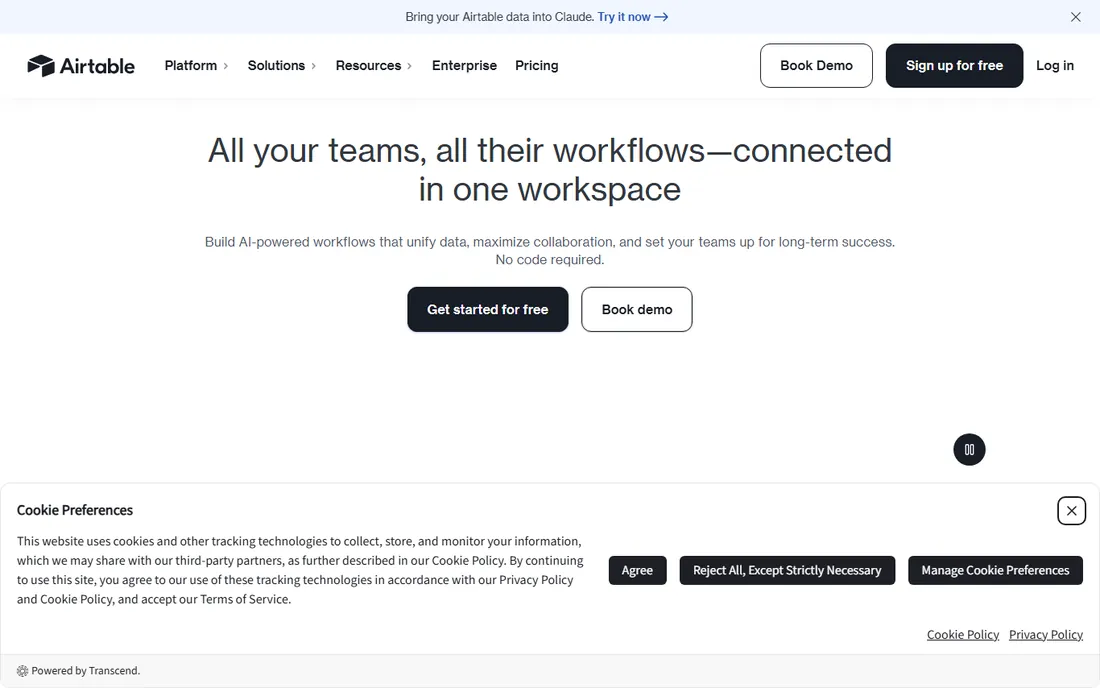
Airtable looks like a spreadsheet and behaves like a database, which is why it became the default structured-data tool for operations teams. Bases hold tables with relationships, attachments, and rich field types, and Interface Designer turns that data into dashboards, forms, and lightweight apps. The platform has moved hard into AI: agents that work across thousands of records, Omni for conversational app building, and monthly AI credits on every plan.
Pricing is per seat: Free covers 1,000 records per base, Team runs $20 per user a month billed annually with 50,000 records per base, and Business is $45 with 125,000 records. Read-only collaborators stay free, which matters for cost planning. The catch is the well-documented pricing cliff between Free and Team, and the seat rules that bill commenters on Team but not on Business. For teams that live in structured data, Airtable remains the strongest foundation in the category.
What we like- Familiar spreadsheet interface backed by a real relational database
- AI agents and workflow automation built in
- 500,000 teams use it daily
Watch out for- Seat pricing climbs fast for larger teams
- Record limits push growing bases toward higher plans
Starting price$19.99/month (Professional plan, billed annually)
Free planYes
Zapier is not an app builder; it is the automation layer that connects the apps you build or buy. Zaps move data between tools on triggers you define, and the 2026 product has expanded into agents, chatbots, and AI workflow building with governance controls for IT. The integration library is the moat: 9,000+ apps with 66,000+ triggers and actions, trusted by over 3 million businesses.
The free plan covers 100 tasks a month with two-step Zaps. Professional starts at $19.99 a month billed annually for 750 tasks, and Team is $69 for 2,000 tasks with shared workspaces. The catch is that a task is every successful action step, so multi-step workflows at volume burn through allowances fast. Zapier is the easiest automation tool to start with and the priciest to scale with; budget accordingly and compare against Make or n8n if volume is your reality.
What we like- Largest app integration library in the business at 9,000+ apps
- Natural-language workflow creation
- New AI agents and MCP support for agentic workflows
Watch out for- Task-based pricing gets expensive at high volume
- Cloud-only with no self-hosting option
Starting priceSee website
Free planFree edition
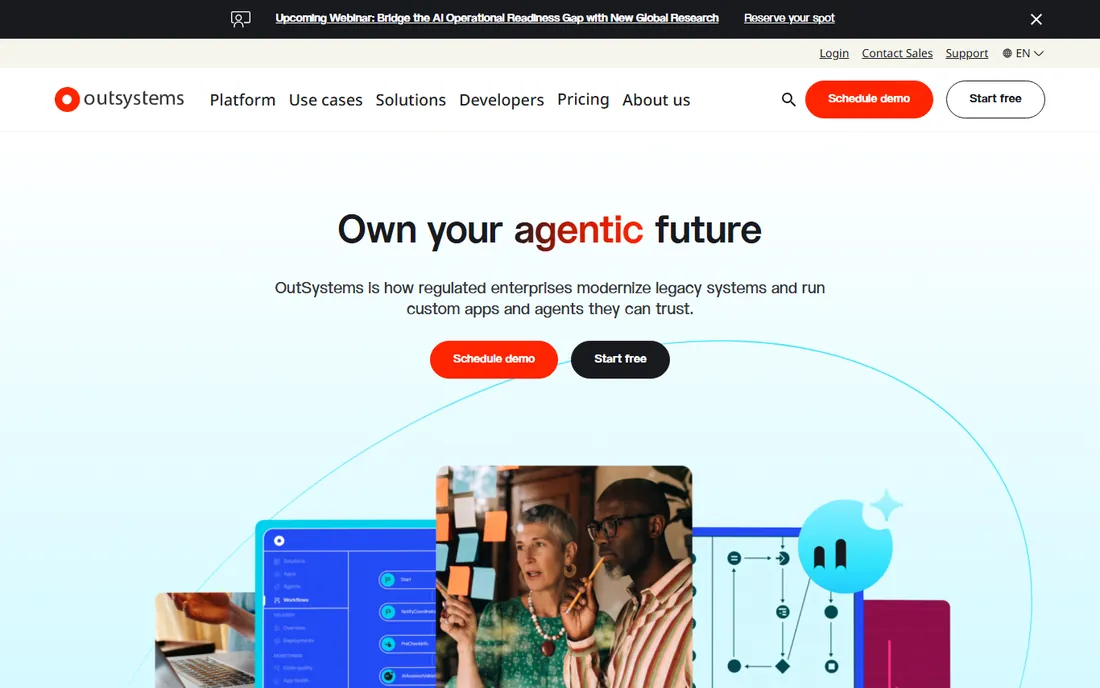
OutSystems is the enterprise end of low-code, and it now pitches itself as an agentic systems platform: visual development, pre-built components, and AI assistance across the whole software lifecycle, with the governance large organizations require. Customer stories on the homepage cite Heineken's million-hours-saved automation program and Bosch's four-day team ramp-up. Gartner named it a Leader in the 2026 Magic Quadrant for AI-Augmented Low-Code Application Platforms, and Forrester did the same in its 2025 Wave.
There is no published pricing; everything runs through sales, and the company's own site labels the price range with three dollar signs. A free edition exists for learning and small experiments. OutSystems fits organizations that need mission-critical apps with audit trails, role-based access, and DevOps discipline, and it is the wrong choice for a five-person team building a portal. If IT owns the decision, this is the category leader to evaluate first.
What we like- Full lifecycle low-code platform with strong governance and security
- AI-assisted development across the SDLC
- Named a leader by Gartner and Forrester
Watch out for- Enterprise pricing with no public numbers
- Overkill for small teams and simple apps
Starting priceSee website
Free planFree tier
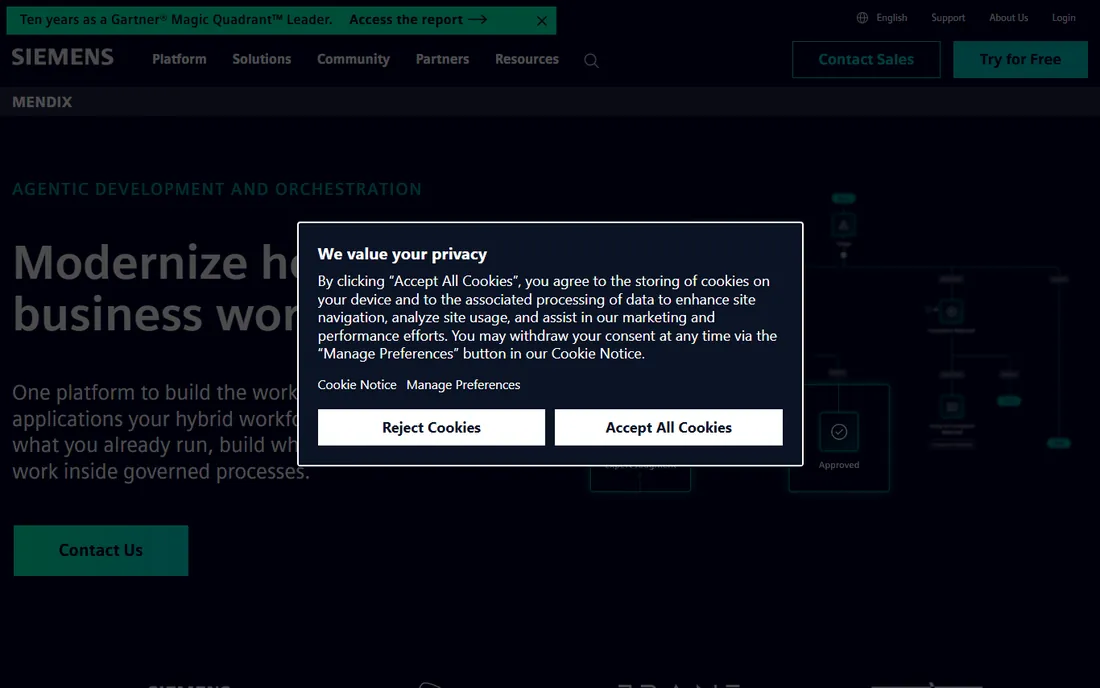
Mendix, part of Siemens, takes the governed-enterprise approach to low-code: one platform for building the workflows, agents, and applications a hybrid workforce runs on. The 2026 positioning centers on agentic development, where teams generate applications from prompts or requirements documents, review the logic visually rather than line by line, and deploy with security and lifecycle controls built in. It connects to existing systems of record instead of demanding a rip-and-replace, which is exactly what large IT departments want to hear.
Like OutSystems, pricing is quote-only, with a free tier for evaluation. The platform deploys to public cloud, private cloud, or air-gapped environments and works with the AI models and coding agents teams already use. Mendix fits organizations modernizing around legacy systems where governance is non-negotiable. Smaller teams will find the enterprise sales motion and platform depth more than they need.
What we like- Agentic development with visual logic review anyone can understand
- Deploys to public, private, or air-gapped environments
- Backed by Siemens with deep enterprise roots
Watch out for- Quote-only pricing
- Learning curve for advanced modeling
- Some risk of platform lock-in
Starting price$10/user/month (Team plan, per builder, billed annually)
Free planYes
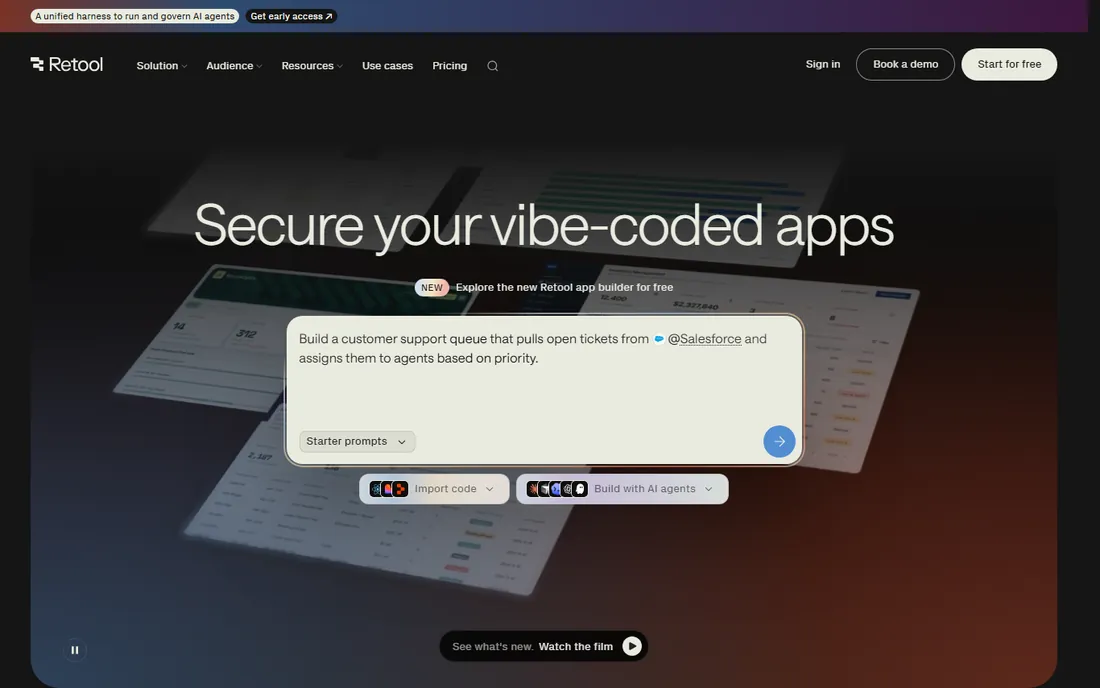
Retool started with a specific bet: give professional developers a fast way to ship internal tools without giving up code access. That foundation holds in 2026. You drag pre-built components onto a canvas, wire them to queries written in SQL or JavaScript, and ship admin panels, dashboards, and approval queues in hours. The IDE now offers three development modes, natural language, visual canvas, and code, and the platform has expanded into AI app generation with governance built in. Amazon, Lyft, Stripe, and OpenAI appear among the 10,000+ teams it cites.
Pricing splits builders from internal users: Free covers up to 5 users, Team is $10 per builder and $5 per internal user a month billed annually, and Business jumps to $50 and $15 with permissions and audit logs. Self-hosting now sits on Enterprise. The consistent complaint on G2 and Reddit is per-user pricing at scale, and fair warning: real projects almost always drop into code. Retool is the right pick when engineers own internal tooling and want speed without surrendering control.
What we like- Real code access with JavaScript and SQL alongside drag-and-drop
- 90+ UI components and deep database connectivity
- Enterprise governance on higher tiers
Watch out for- Per-seat pricing adds up as teams grow
- It is low-code for people who touch data, not pure no-code
Starting price$25/month (Basic plan)
Free planYes
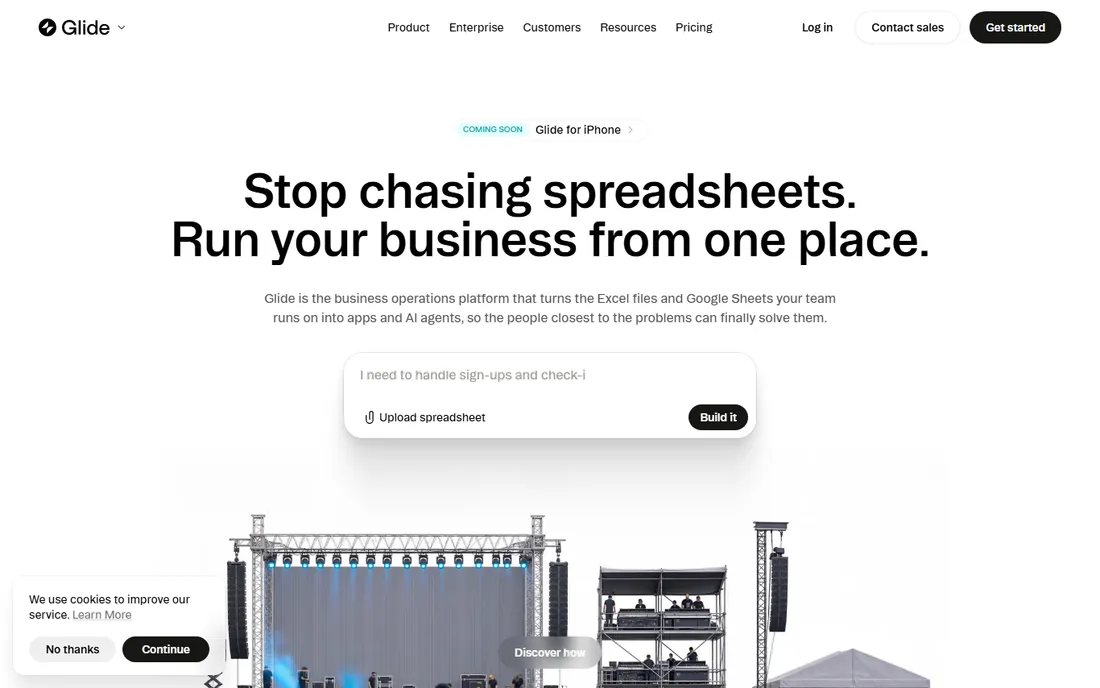
Glide is the spreadsheet-to-app specialist. Point it at a Google Sheet, an Excel file, or an Airtable base and it reads the structure, data, and relationships, then gives you a mobile- and desktop-ready app: a field app for technicians, an inventory tracker, a lightweight CRM. Edits sync back to the source, so the spreadsheet your team already trusts stays the system of record. The current platform, GlideOS, adds an AI build agent that lays down the foundation from a prompt or a file.
Vendor pricing runs Free at $0, Basic at $25 a month with 2 published apps, Plus at $50, and Pro at $125 with unlimited published apps, plus a custom Enterprise tier. The catch is update metering: data syncs count as updates, and heavy apps can push costs up. Glide is the quickest win on this list for data-driven internal apps, and the one to price carefully if your app will see constant activity.
What we like- Fastest path from a Google Sheet to a working app
- Clean mobile-friendly output with little effort
- 100,000+ organizations use it
Watch out for- Update-metered pricing can surprise high-activity apps
- Design flexibility is more limited than Bubble
#8
Softr
Best for: Client portals and internal tools, fast
Visit softr.io
Starting price$19/month (Basic plan, billed annually)
Free planYes
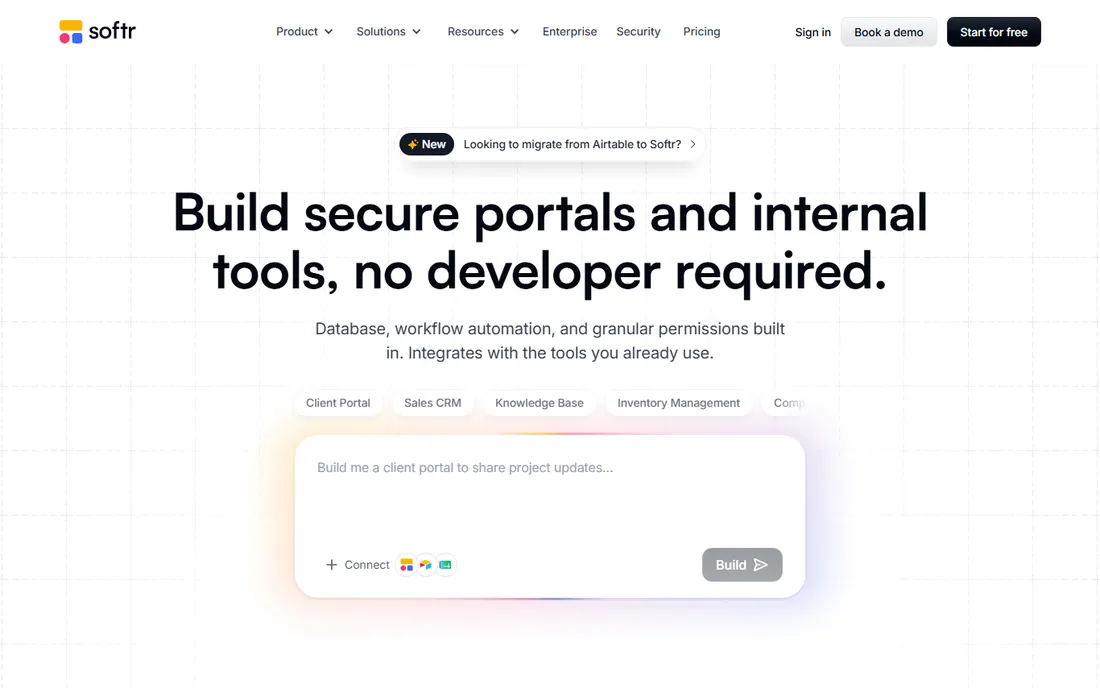
Softr turns your existing data into working web apps: connect Airtable, Google Sheets, Notion, HubSpot, or its own native database, and build client portals, internal dashboards, CRMs, and directories with drag-and-drop blocks. The AI Co-Builder generates the database, pages, user roles, and business logic from a description, and everything stays editable through visual controls. The homepage cites 1 million builders and 7,000 organizations, including names like Netflix, Google, Stripe, and UPS.
Pricing is the friendliest here: Free at $0 with unlimited apps, Basic at $19 a month billed annually, Pro at $99, and Business at $329, per the vendor's own homepage. Softr charges by app user rather than per seat, which keeps portal costs predictable. The limits are clear: web apps only, no native mobile publishing, and per-user costs climb for huge audiences. For client portals and internal tools built by non-developers, Softr is the fastest path from data to deployed app.
What we like- Client portals live in hours with auth and permissions built in
- Generous free tier with unlimited apps
- Lowest entry price among the portal builders
Watch out for- Web apps only, no native mobile publishing
- Per-user pricing scales steeply for large audiences
Who should build it, and how much code should they touch?
The first question is not which platform is best in the abstract. It is who will build the thing and what they are comfortable with.
Match the builder to the platform
If a non-technical operator needs a working portal this week, start with Softr or Glide. If a founder wants to ship a real product without hiring developers, Bubble is the deepest no-code option. If engineers own internal tooling, Retool gives them speed with code access intact. If IT owns the decision and governance is mandatory, evaluate OutSystems and Mendix through their sales teams.
Model the pricing the way you will actually pay
The four pricing models on this list behave very differently at scale. Per-seat pricing (Airtable, Retool) grows with headcount. Task-based pricing (Zapier) grows with automation volume. Update-metered pricing (Glide) grows with data activity. Flat tiers (Softr, Bubble) grow with features and usage caps. Take your realistic 12-month user count and activity level and run it through each model before you commit.
Plan for governance before you need it
Shadow apps built by enthusiastic operators are how companies end up with five overlapping tools and no audit trail. If the app will touch customer data, payments, or regulated processes, weight SSO, audit logs, role-based permissions, and data residency from day one. The enterprise platforms charge for these because they cost real engineering to build; the simpler builders may not offer them at all.
How we chose
We started with the low-code and no-code platforms that appear most often in buyer shortlists, G2 and Capterra rankings, and community discussions in 2026, then narrowed to eight covering the full spectrum: pure no-code builders, developer-oriented low-code, enterprise platforms, and the data and automation layer. For each tool we checked the vendor's own pricing page or current public pricing documentation, reviewed feature documentation and security pages, and read public user feedback on G2, Capterra, Reddit, and review sites. We weighted fit for small and mid-size US businesses, pricing transparency, the realistic learning curve for the intended builder, and governance depth for tools that touch production data. We did not run hands-on trials; our assessments come from vendor materials and verified public sources.
Every platform on this list now offers some form of AI-assisted building, and the marketing blurbs sound similar. The practical difference is what happens after the AI generates something. On Bubble, Retool, and Softr, the AI output stays editable through the platform's own visual controls, so a human can inspect and fix it. On the enterprise platforms, AI-generated components inherit governance, audit trails, and permission models automatically. Pure vibe-coding tools generate a codebase you then have to host, debug, and maintain yourself. When you evaluate an AI builder, ask three questions: can I see and edit what it made, does it inherit my security rules, and who maintains the output in six months. The platforms that answer all three are the ones worth building a business on.
Frequently asked questions
What is the difference between low-code and no-code?
No-code platforms let you build applications entirely through visual interfaces with no programming, which suits non-technical builders. Low-code platforms provide visual building plus the option to drop into code for custom logic, which suits developers who want speed without giving up control. In practice the line blurs: Bubble is no-code with deep capabilities, while Retool is low-code that often involves JavaScript and SQL.
Which no-code platform is best for beginners?
Softr and Glide are the gentlest starting points: connect a spreadsheet or Airtable base and have a working portal or app the same day. Bubble is more capable but has a steeper learning curve. If your goal is automating tasks between existing apps rather than building an app, Zapier is the beginner-friendly pick.
Can you build a real business on a no-code platform?
Yes, with the right platform and expectations. Bubble supports marketplaces and SaaS products with 6 million builders, and Softr and Glide power real client portals and internal tools at thousands of companies. The limits appear at extreme scale, highly custom logic, or strict compliance needs, which is where low-code platforms like Retool, OutSystems, and Mendix take over.
How much do low-code platforms cost?
It depends on the pricing model. Entry points here range from $19/month (Softr) to $29/month (Bubble), $20/user/month (Airtable), $19.99/month (Zapier), and $10/user/month (Retool), all with free tiers. Enterprise low-code from OutSystems and Mendix is quote-only and priced for large organizations. Always model your user count and usage, not just the headline price.
Do low-code platforms replace developers?
They replace specific kinds of development work: internal tools, portals, dashboards, and standard business apps that would otherwise wait in an engineering queue. They do not replace developers for novel products, complex systems, or anything where custom architecture matters. Most successful setups use low-code to free developers for the work only developers can do.
Is my data safe on a no-code platform?
The established platforms take security seriously: SOC 2 compliance is common (Softr, Glide, Zapier, Retool, OutSystems, and Mendix all claim it), with encryption, role-based permissions, and SSO on higher tiers. The risk is usually governance, not breaches: apps built without IT oversight can expose data through misconfigured permissions. If the app touches sensitive data, involve IT and check the platform's permission model before building.
Sources we checked (15)
- https://bubble.io
- https://airtable.com/
- https://zapier.com
- https://www.outsystems.com
- https://mendix.com/
- https://retool.com
- https://www.glideapps.com/
- https://www.glideapps.com/pricing
- https://www.softr.io
- https://droidcrunch.com/softr-vs-bubble/
- https://www.appypie.com/blog/airtable-alternatives
- https://dev.to/stimlau/zapier-vs-make-in-2026-which-automation-tool-is-worth-the-credits-4bj1
- https://www.activepieces.com/blog/zapier-pricing
- https://www.jetadmin.io/blog/retool-pricing-2026-plans-user-costs-add-ons/
- https://www.vendr.com/marketplace/retool
Is your product missing or out of date?
We review this list regularly. Vendors can request a listing, send updated pricing or ask about featured placement.

Shihab Mia · Founder, Rankite
Shihab has 5+ years in B2B and SaaS SEO. He writes Rankite's software buying guides from pricing pages, documentation and public user reviews. More about Shihab.