How we make this list: we compare pricing pages, product documentation and public user reviews. Ratings come from G2, Capterra or Trustpilot, with the date we checked them.
What is license compliance software, and how is it different from software asset management?
License compliance software answers one question: can we legally ship this code under the licenses of the open-source components inside it. It scans a codebase and its dependencies, identifies each license, flags obligations such as attribution or source disclosure, and enforces license policies before a release goes out. This is different from software asset management and commercial license management. Tools such as Flexera, Snow and Zluri manage purchased commercial licenses, track how many seats a company owns, and prepare for vendor audits. Those tools do not check whether the open-source code in your product can be shipped under its license. The two categories solve different problems, and this guide covers only open-source license compliance.
Which open-source licenses create the most risk for a shipping product?
Permissive licenses such as MIT, BSD and Apache 2.0 create the least risk. They usually ask for attribution, which means keeping the license text and copyright notice with the code you ship. Copyleft licenses create more risk. GPL requires that modified versions of the licensed code be shared under the same license, and AGPL extends that duty to software used over a network. A team that ships a product containing GPL code without meeting its terms can face a demand to release its own source code or stop distributing the product. The risk grows with transitive dependencies, which are the dependencies of your dependencies. A project can pull in hundreds of them without any developer noticing, and any one of them can carry a license that conflicts with company policy.
Start with the buyer question, not the feature list. A small team shipping a few products needs accurate detection, a free or low-cost start, and attribution reports. A large company with a legal team needs policy rules, approval workflows, audit trails, and reports a lawyer can sign off on. Check four things before buying. First, does the tool detect licenses from file text and not only from package metadata, because metadata is often missing or wrong. Second, does it scan transitive dependencies and binaries, not just the top-level packages listed in a manifest. Third, can it block a build or a pull request when a forbidden license appears, or does it only produce a report someone must read. Fourth, does the price fit the way your team works, and what happens to the price when the team grows.
The eight tools split into three groups. FOSSA and Snyk publish a starting price and offer a free tier, so a small team can start without a sales call. Black Duck, Revenera and Sonatype Lifecycle are sold by quote, which suits enterprises with formal governance programs but makes budgeting harder. ScanCode and ORT are free open-source tools that cost nothing in license fees but need engineering time to run. The table below shows the starting price of each tool as checked on 21 Nov 2026. Where a vendor hides the price behind sales, the table says quote.
| Tool | Best for | Starting price (checked 21 Nov 2026) | Free plan |
| FOSSA | License-first compliance for small and mid-size teams | $20 per project per month, billed annually | Yes |
| Black Duck (Synopsys) | Large enterprises with formal open-source governance | Quote | No |
| Mend | Deep license policy control plus automated updates | Up to $1,000 per contributing developer per year | No permanent free plan for AppSec |
| Revenera | Software vendors shipping products with embedded open source | Quote | No |
| Snyk | Developer teams that want license checks in the developer workflow | $25 per contributing developer per month, Team plan | Yes |
| Sonatype Lifecycle | Regulated teams that need policy enforcement across the build | Quote, consumption-based via Sonatype Guide | Yes, Guide Free tier with 500 credits |
| ScanCode (nexB) | Technical teams that want a free, scriptable license detector | Free, Apache-2.0 open source | Yes, fully free |
| OSS Review Toolkit (ORT) | Teams that want a complete self-hosted compliance pipeline at no license cost | Free, Apache-2.0 open source | Yes, fully free |
Quick comparison
| Tool | Best for | Starting price | Free plan |
|---|
 FOSSA | Small and mid-size teams that need license-first compliance with a published price | $20 per project per month, billed annually (Business plan) | Yes, free plan for up to 5 projects and 10 contributing developers |
 Black Duck (Synopsys) | Large enterprises with a formal open-source governance program and legal review | quote | No free plan |
 Mend | Teams that want deep license policy control combined with automated dependency updates | Up to $1,000 per contributing developer per year (Mend AppSec) | No permanent free plan for Mend AppSec; Mend Renovate (open source) is free |
 Revenera | Software vendors that ship products containing embedded open-source components | quote | No free plan for Code Insight |
 Snyk | Developer teams that want license checks inside the tools developers already use | $25 per contributing developer per month, Team plan, minimum 5 developers, billed annually | Yes, free plan with 200 open source tests per month |
 Sonatype Lifecycle | Regulated teams that need license and security policies enforced across the build pipeline | quote (consumption-based pricing, sold as Sonatype Guide for new customers) | Yes, Guide Free tier with 500 credits for evaluation |
 ScanCode (nexB) | Technical teams that want a free, scriptable license detector they can run themselves | Free (Apache-2.0 open source) | Yes, fully free open source |
 OSS Review Toolkit (ORT) | Teams that want a complete self-hosted compliance pipeline at no license cost | Free (Apache-2.0 open source) | Yes, fully free open source |
Is your product missing or out of date?
We review this list regularly. Vendors can request a listing, send updated pricing or ask about featured placement.
The tools below are ordered for a buyer who starts with license compliance as the main need and then weighs price, depth and effort. Each entry gives the starting price from the vendor pricing page as checked on 21 Nov 2026, or says quote where the vendor hides the price behind sales.
#1
FOSSA
Best for: Small and mid-size teams that need license-first compliance with a published price
Visit fossa.com
Starting price$20 per project per month, billed annually (Business plan)
Free planYes, free plan for up to 5 projects and 10 contributing developers
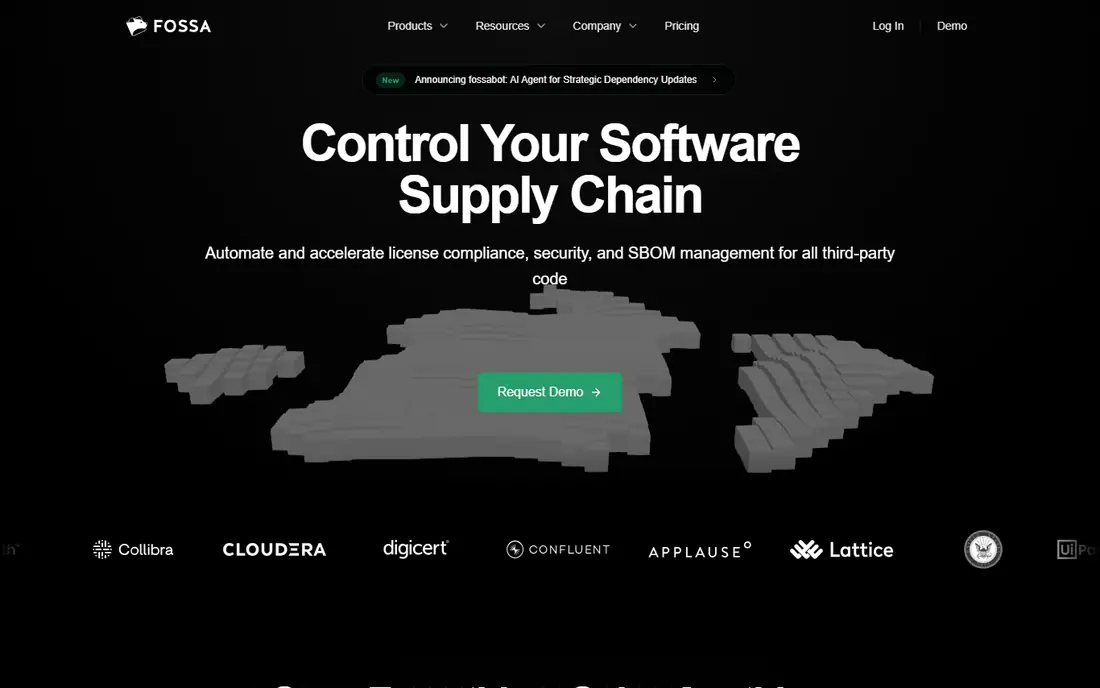
FOSSA is the most license-focused commercial tool in this list, and it shows in the way the product is built. It scans dependencies at any depth, records the license of each component, flags licenses that conflict with company policy, and produces the attribution notices and SBOM files that customers and auditors ask for. One price conflict is worth noting: the vendor pricing page shows $20 per project per month billed annually, while some third-party listings still show an older figure of $230 per month. The vendor page figure is the one used here. A team with many small repositories should work out the total across all projects before committing, since the bill follows project count rather than developer count.
What we like- License-first scanning with accurate detection, automatic attribution notices, SPDX and CycloneDX SBOM export, a usable free tier for small teams
Watch out for- The Business plan caps at 10 projects and 10 contributing developers, so a growing team must move to custom Enterprise pricing, and per-project pricing can climb fast as the number of repositories grows
#2
Black Duck (Synopsys)
Best for: Large enterprises with a formal open-source governance program and legal review
Visit blackduck.com
Starting pricequote
Free planNo free plan
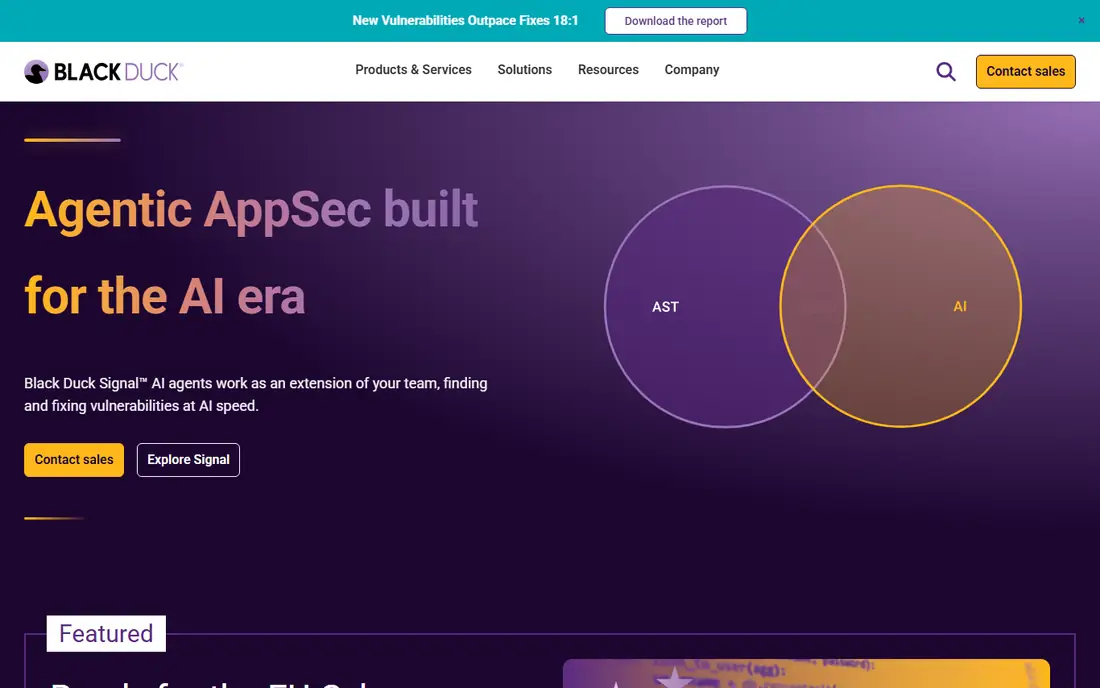
Black Duck is the long-running standard for open-source governance in large organizations, and it goes deeper than any other tool here. It finds open-source components through package managers, file signatures, snippet matching and binary analysis, which matters when a codebase contains copied or vendored code that a manifest scan would miss. It identifies declared and undeclared licenses, flags obligations and conflicts, and produces reports for legal teams. The price is quote only, and third-party estimates of typical contracts range widely, from around $50,000 to more than $200,000 a year, so buyers should treat those figures as rough ranges rather than prices. Black Duck was acquired by Synopsys in 2017 and the application security business was sold to Clearlake Capital in 2024, so the product now operates as Black Duck Software.
What we like- The deepest license detection in this list, with binary and snippet scanning, a knowledge base covering more than 2,750 licenses, and compliance reports built for legal teams
Watch out for- Quote-only pricing with no published starting figure, and the platform needs dedicated staff time to set policies, review findings and manage the component inventory
#3Mend
Best for: Teams that want deep license policy control combined with automated dependency updates4.7/5 on
G2 (133 reviews, checked Oct 2026)
Visit mend.io
Starting priceUp to $1,000 per contributing developer per year (Mend AppSec)
Free planNo permanent free plan for Mend AppSec; Mend Renovate (open source) is free
Mend, formerly WhiteSource, built its reputation on license compliance before expanding into a broader application security platform. Its license database and policy engine are among the deepest available, and it lets teams write granular rules about which licenses are allowed, which need legal approval, and which block a build. The vendor pricing page lists Mend AppSec at up to $1,000 per contributing developer per year, with Mend AI at up to $300 and Mend Renovate Enterprise at up to $250 per contributing developer per year. One conflict to note: some third-party listings show a starting figure of $4,000, which does not match the vendor page cap and appears to refer to a different edition. The vendor page figure is used here.
What we like- Granular license policy management, a deep license database, Mend Renovate for automated dependency updates, and reachability-aware prioritization of findings
Watch out for- The full platform is sold through a sales conversation, and the per-developer price means the bill grows with every contributor, so a written quote is needed before budgeting
#4
Revenera
Best for: Software vendors that ship products containing embedded open-source components
Visit revenera.com
Starting pricequote
Free planNo free plan for Code Insight
Revenera Code Insight is the license compliance product inside Revenera, a company also known for software monetization and installation tools. Its clearest strength is discovery: it examines source and binary files to find open-source components, licenses and vulnerability information that a package inventory alone would miss. Code Insight supports license policies, component approval workflows, and SBOM generation, which gives legal and engineering teams a shared record of what is in a release. The price is quote only, with no public list price on the product page, so buyers should confirm deployment, scan profiles, integrations, support and SBOM scope in the quote.
What we like- Discovers open-source material in source and binary files, tracks licenses and vulnerabilities, and supports component approval workflows and SBOM output
Watch out for- No public list price for Code Insight, so buying means a sales conversation, and the deeper analysis takes more scan time than a manifest-only scan
#5
Snyk
Best for: Developer teams that want license checks inside the tools developers already use
Visit snyk.io
Starting price$25 per contributing developer per month, Team plan, minimum 5 developers, billed annually
Free planYes, free plan with 200 open source tests per month
Snyk is a developer security platform rather than a license-only tool, and that shapes how it handles compliance. Snyk Open Source scans dependencies for vulnerabilities and licenses, flags policy violations in pull requests, and offers fix pull requests that update a dependency to a safe version. The Team plan starts at $25 per contributing developer per month with a minimum of 5 developers, and the vendor Team page lists $1,375 annually for 5 developers, which is less than 12 months at $125 a month and reflects the annual billing discount. The main limit is the Team cap of 10 contributing developers, after which a team must move to Enterprise pricing, which is quote only and uses a credit model.
What we like- Developer-first workflow with license checks in CI and pull requests, automatic fix pull requests, and a free tier that covers small projects
Watch out for- The Team plan caps at 10 contributing developers, so larger teams must move to Enterprise pricing, and some sources report that full license compliance depth sits on Enterprise, so buyers should confirm which tier covers their policy needs before buying
#6
Sonatype Lifecycle
Best for: Regulated teams that need license and security policies enforced across the build pipeline
Visit sonatype.com
Starting pricequote (consumption-based pricing, sold as Sonatype Guide for new customers)
Free planYes, Guide Free tier with 500 credits for evaluation
Sonatype Lifecycle applies security and license policies to every component in a build, using a database of component intelligence that covers more than 2,000 licenses. The vendor pricing page now sells on a consumption-based model, with usage metrics defined in the quote, and states that all Lifecycle capabilities sit inside Sonatype Guide, which new customers must buy. The Advanced Legal Pack add-on is aimed at legal compliance work and requires a Lifecycle license. One conflict is worth noting: third-party trackers still list older starting prices of $690 to $775 per year, and Guide Pro from $1,200 per year, but the vendor page itself publishes no per-user price and directs buyers to contact sales. The vendor position is used here, so the starting price is quote.
What we like- Policy enforcement at build time, an Advanced Legal Pack add-on for legal compliance, a large component intelligence database, and integrations across 50 or more languages
Watch out for- No published per-user list price, new customers must buy Sonatype Guide rather than Lifecycle on its own, and consumption credit pricing makes the bill hard to predict before use
#7
ScanCode (nexB)
Best for: Technical teams that want a free, scriptable license detector they can run themselves
Visit scancode.io
Starting priceFree (Apache-2.0 open source)
Free planYes, fully free open source
ScanCode Toolkit, an AboutCode project from nexB, is the most accurate free license detector available, and it is the engine inside several commercial tools, including ORT. Rather than relying on approximate patterns, it does a full comparison between your code and a database of license texts, which gives it strong results on real codebases, including code where the license is only stated inside a file rather than in package metadata. It detects licenses, copyrights, package manifests and dependencies in source and binary files, and writes JSON, YAML, HTML, CycloneDX or SPDX output. The tool is free under the Apache-2.0 license, so the cost is engineering time rather than a subscription.
What we like- Full-text license comparison against a database of more than 2,000 license texts, SPDX and CycloneDX output, runs fully offline, and is used as the detection engine inside other tools
Watch out for- It reports what it finds and leaves policy enforcement and review to you, so a team must build its own workflow around it, and there is no vendor support contract included
#8
OSS Review Toolkit (ORT)
Best for: Teams that want a complete self-hosted compliance pipeline at no license cost
Visit oss-review-toolkit.org
Starting priceFree (Apache-2.0 open source)
Free planYes, fully free open source
OSS Review Toolkit, known as ORT, is a policy automation and orchestration toolkit for managing open-source dependencies, and it is the closest open-source equivalent to a commercial platform in scope. The Analyzer works out a project's dependencies across package managers, the Downloader fetches their source, the Scanner runs a license scanner such as ScanCode, the Advisor pulls vulnerability data, the Evaluator checks the results against policy rules written as code, and the Reporter writes CycloneDX and SPDX SBOMs and NOTICE files. ORT is free under the Apache-2.0 license and is built to run headless in CI, so it fits automated compliance well. The cost is the effort to configure it, and it rewards a team with a capable engineer who can own it.
What we like- A full pipeline from dependency analysis to policy evaluation and NOTICE files, policy as code through the Evaluator, SPDX and CycloneDX output, and a Linux Foundation project with a large user base
Watch out for- It takes real engineering effort to configure and run, it is effectively a build tool in its own right, and there is no hosted option or vendor support included
Frequently asked questions
What is the difference between license compliance software and software asset management?
License compliance software checks whether the open-source code in your product can be shipped under its license. It scans dependencies, identifies licenses such as MIT, Apache, GPL and AGPL, flags obligations such as attribution or source disclosure, and blocks builds that break policy. Software asset management tools such as Flexera, Snow and Zluri manage purchased commercial licenses, count seats, and prepare for vendor audits.
Which open-source licenses create the most risk for a shipping product?
Copyleft licenses create the most risk, above all GPL and AGPL. GPL requires that modified versions of the licensed code be shared under the same license, and AGPL extends that duty to software used over a network. Shipping GPL code without meeting its terms can bring a demand to release source code or stop distribution. Permissive licenses such as MIT, BSD and Apache 2.0 usually ask only for attribution.
Can a free tool handle license compliance for a small team?
Yes, for a small team with technical skills. ScanCode detects licenses accurately and writes SPDX and CycloneDX output at no cost, and ORT adds a full pipeline with policy checks and NOTICE files. The trade is effort: the team must configure the tools, run them in CI, and triage the findings itself. A team without that time should start with a free tier of a commercial tool such as FOSSA or Snyk, which adds policy enforcement and support.
Do these tools check transitive dependencies, or only the packages listed in a manifest?
The better tools check transitive dependencies, which are the dependencies of your dependencies. A project can pull in hundreds of them without any developer noticing, and any one can carry a license that conflicts with company policy. FOSSA, Black Duck, Mend, Sonatype Lifecycle and ORT all scan dependency trees, and Black Duck and Revenera also scan binaries and copied code.
What should a team ask for in a trial or proof of concept?
Run the tool against a real repository that includes at least one GPL and one AGPL component, and check that the tool finds them. Ask whether the tool detects licenses from file text or only from package metadata, whether it can block a build on a forbidden license, and whether it produces attribution notices and an SBOM in SPDX or CycloneDX format. Get the price in writing for your team size.
Sources we checked (8)
- https://fossa.com/pricing/
- https://www.blackduck.com
- https://www.mend.io/pricing/
- https://www.revenera.com
- https://snyk.io/plans
- https://www.sonatype.com/products/pricing
- https://www.scancode.io
- https://oss-review-toolkit.org
Is your product missing or out of date?
We review this list regularly. Vendors can request a listing, send updated pricing or ask about featured placement.

Shihab Mia · Founder, Rankite
Shihab has 5+ years in B2B and SaaS SEO. He writes Rankite's software buying guides from pricing pages, documentation and public user reviews. More about Shihab.