How we make this list: we compare pricing pages, product documentation and public user reviews. Ratings come from G2, Capterra or Trustpilot, with the date we checked them.

Key takeaways
- Clio leads for most firms, with timers, matter based entry, billing and trust accounting in one system.
- TimeSolv suits firms with case management that want a dedicated billing tool.
- Starting prices here run from about 19.95 dollars to 59 dollars per user per month, before processing and add-ons.
- Smokeball does not publish dollar prices, so get a written quote before you compare it with published prices.
- Check which plan includes trust accounting, LEDES billing and e-billing.
What makes time tracking different for law firms?
Law firm time tracking differs from general time tracking because every entry must turn into a billable record that a client can read and a court or insurer can accept. A general timer records minutes. A law firm tool records who did the work, which matter it belongs to, which task code applies, what rate applies, and whether the time is billable, non-billable or written off.
Trust accounting is the part that carries real risk. Client funds held in trust must stay separate from firm funds, and every payment from trust must link to a matter and a ledger. A tool that cannot produce a three way reconciliation creates work for the bookkeeper and risk for the firm, and state rules differ, so confirm that the tool supports the firm jurisdiction before signing. Entries must attach to the right matter, so a tool that pulls the matter list from the case file keeps data clean. If the app is slow or cannot work offline, entries get written from memory at the end of the week, and that is when hours go missing.
How should a firm choose law firm time tracking software?
Start with the billing model, not the feature list. A firm that bills by the hour needs timers, task codes, LEDES output and pre-bill review. A firm that works on contingency needs cost tracking and case expenses. A firm that uses flat fees needs task tracking and a way to show work done against a fixed price. Write down the three billing situations the firm handles most, then test each shortlisted tool against those three cases in a trial. Check who will use it every day, because partners, associates and support staff record time in different ways.
Integration is the next test. The time tool must pass entries to billing without retyping, and billing must pass payments to accounting without a manual export. Ask how long setup takes, what migration costs, and whether training is included. A trial should include a real invoice run, because month end is when weak billing tools fail.
What does law firm time tracking software cost in 2026?
Entry prices for the tools in this guide start at about 19.95 dollars per user per month for TimeSolv Pro and rise to 59 dollars for Rocket Matter Essentials. Most firms do not pay the entry price. The plan with trust accounting, LEDES billing or workflow automation usually costs 89 to 130 dollars per user per month. A five lawyer firm at 89 dollars per user per month pays 445 dollars per month, or 5,340 dollars per year, before taxes and processing. Payment processing is a separate cost. Card payments often carry a fee near 2.99 percent plus 30 cents per payment, so a firm that collects 50,000 dollars a month by card can pay close to 1,500 dollars a month in fees.
Contract terms change the total as well. Annual billing usually saves about 10 to 20 percent against monthly billing, which is 120 dollars per user per year on a 50 dollar plan. Implementation fees also vary. Some vendors include setup and migration, while others charge 500 to 2,000 dollars per user. Get the full first year cost in writing, with seats, processing, add-ons and setup on one page, before comparing two tools on price alone.
How do you get lawyers to record time every day?
Make entry take less than a minute and make missing time visible. A timer that starts from the matter page, a mobile app that works offline, and a daily reminder at the end of the day all help. Automatic capture helps more, because it records work in Word, Outlook and the browser and turns it into draft entries that a lawyer can accept or delete. The lawyer still reviews each entry, but the starting point is a real record, not a blank page at 6 pm on a Friday. A daily close catches missing entries while the work is fresh.
Training should focus on the three actions lawyers use most: start a timer, switch a matter, and write a clear note. A note that says "reviewed discovery" is weak. A note that names what was done helps the partner approve the entry. Short training sessions and a one page guide for each practice group will do more than a long manual that nobody reads.
Do you need matter management or just billing?
A firm that already runs a case management system may only need billing. TimeSolv and LeanLaw fit that shape, because they focus on time, billing and accounting and leave case files to another tool. That split works when the two tools share matter data cleanly, either through a direct integration or a shared matter list. It fails when lawyers must keep the same matter in two places, because one list will drift and entries will land on the wrong file. A firm with no case system should look at an all in one platform. Clio, MyCase, CosmoLex, PracticePanther, Smokeball and Rocket Matter all cover matters and billing in one place.
The trade off is depth, so a firm should list the five tasks it does every day and check each one in the trial. That path is fine when the billing tool exports clean data and the firm keeps matter names consistent. It becomes costly when the firm grows and must move years of time entries into a new system, so ask what migration costs and whether entries keep their history after a move.
Quick comparison
| Tool | Best for | Starting price | Free plan |
|---|
 Clio | Most firms that want matters, time, billing and trust in one system | $49/user/mo, Starter plan, annual billing; higher tiers quote only | No free plan; 7-day free trial |
 MyCase | Solo and small firms that want a simple all in one system with built in intake and payments | $50/user/mo, Basic plan, annual billing ($60 billed monthly) | No free plan; free trial available |
 TimeSolv | Firms that already have case management and want a dedicated time and billing system | $34.95/user/mo, Legal plan, monthly billing ($31.46 on annual billing) | No free plan; free trial available |
 LeanLaw | Firms that run QuickBooks Online and want legal billing and trust accounting on top of it | $55/user/mo, Core plan; Pro $75/user/mo | No free plan; free trial available |
 CosmoLex | Small and midsize firms that want practice management with built in business and trust accounting | $49/user/mo, Launch plan, annual billing ($59 billed monthly) | No free plan; 10-day free trial, no credit card required |
 PracticePanther | Solo and small firms that want an easy to learn system with clear published prices | $49/user/mo, Solo plan, annual billing ($59 billed monthly) | No free plan; 7-day free trial, no credit card required |
 Smokeball | Document heavy firms that want automatic time capture from Word and Outlook | quote | No free plan; free trial available |
 Rocket Matter | Firms with complex billing, flat fees and contingency work that need flexible rate and invoice rules | $59/user/mo, Essentials plan, annual billing | No free plan; free trial available |
Is your product missing or out of date?
We review this list regularly. Vendors can request a listing, send updated pricing or ask about featured placement.
#1Clio
Best for: Most firms that want matters, time, billing and trust in one system4.6/5 on
G2 (997 reviews, checked Oct 2026)
Visit clio.com
Starting price$49/user/mo, Starter plan, annual billing; higher tiers quote only
Free planNo free plan; 7-day free trial

Clio is the most widely used cloud practice management platform for law firms. Lawyers can start a timer from a matter, enter time in six minute increments, and edit entries with notes that carry through to the pre-bill. The price picture changed in 2026. Older guides list EasyStart at 39 dollars per user per month, while the vendor page now lists Starter at 49 dollars and shows higher tiers as quote only.
What we like- Broad practice management, timers and matter based entry, trust accounting, large integration library
Watch out for- Higher tiers are quote only, and intake is a separate product that adds cost
#2MyCase
Best for: Solo and small firms that want a simple all in one system with built in intake and payments4.4/5 on
G2 (390 reviews, checked Oct 2026)
Visit mycase.com
Starting price$50/user/mo, Basic plan, annual billing ($60 billed monthly)
Free planNo free plan; free trial available
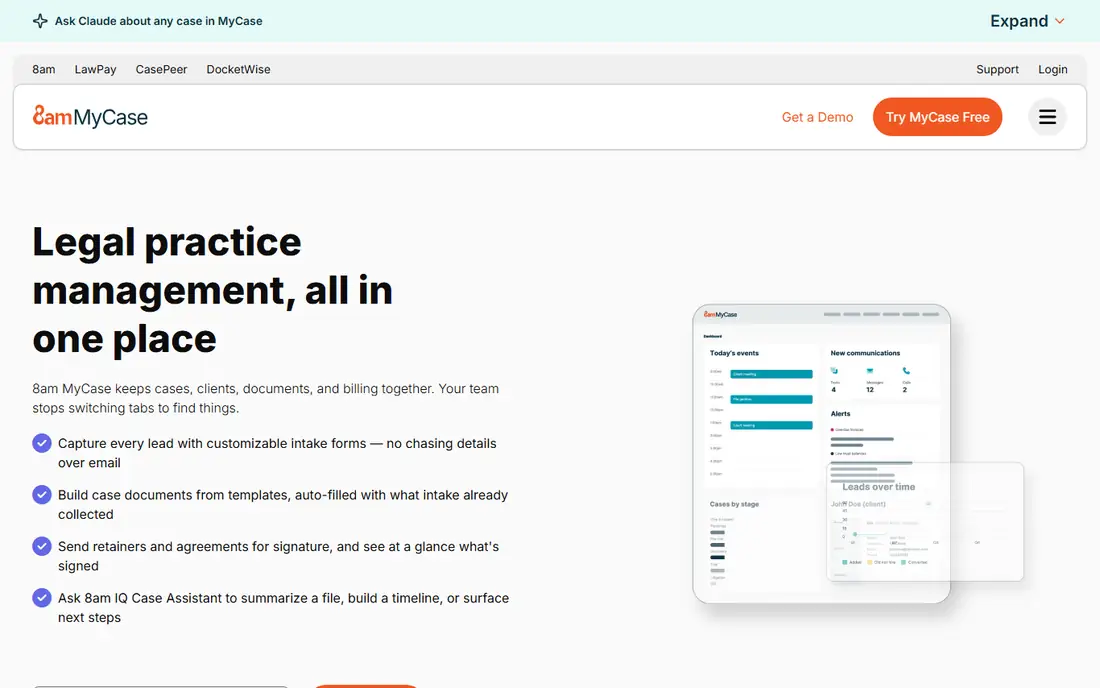
MyCase covers cases, time entry, invoicing, trust accounting and a client portal for solo and small firms. Clients can pay online through LawPay. The 2026 price rise is a real caveat: a firm that needs accounting pays 39 dollars more per user per month. Even with that rise, MyCase remains one of the clearest priced options here, and staff can learn it in a day.
What we like- Clear tier prices, built in intake forms and e-signature on higher tiers, trust accounting, unlimited document storage
Watch out for- Prices rose in August 2026 from 39, 89 and 109 dollars to 50, 100 and 130 dollars, and accounting costs 39 dollars more per user per month
#3TimeSolv
Best for: Firms that already have case management and want a dedicated time and billing system4.5/5 on
G2 (427 reviews, checked Oct 2026)
Visit timesolv.com
Starting price$34.95/user/mo, Legal plan, monthly billing ($31.46 on annual billing)
Free planNo free plan; free trial available

TimeSolv is a specialist, not an all in one platform. It focuses on time entry, billing, e-billing and trust accounting, and it pairs with a separate case system. Its TimeSync desktop tool captures work without a browser open and keeps working offline, which helps lawyers who work in court or on a plane. The vendor lists Legal at 34.95 dollars per user per month for a single timekeeper, with lower rates for larger firms. Ask for a quote that states seat count, billing cycle and e-billing fees.
What we like- Focused time and billing, offline capture with TimeSync, LEDES e-billing, trust accounting, no case management bloat
Watch out for- Prices conflict across sources, with third party pages listing 43 dollars for Pro and 58 dollars for Legal, so confirm your band in writing
#4LeanLaw
Best for: Firms that run QuickBooks Online and want legal billing and trust accounting on top of it4.5/5 on
G2 (1 reviews, checked Oct 2026)
Visit leanlaw.co
Starting price$55/user/mo, Core plan; Pro $75/user/mo
Free planNo free plan; free trial available
LeanLaw builds legal billing and trust accounting on QuickBooks Online, which is the general ledger many small firms already use. Time entries flow into invoices, invoices flow into QuickBooks, and trust balances stay in sync, so the bookkeeper does not retype figures. The model suits firms that like QuickBooks and want legal rules added to it, rather than a new ledger. Older pages list Core at 40 or 45 dollars, while the vendor and its own guides now list 55 dollars for Core and 75 dollars for Pro.
What we like- Two way QuickBooks Online sync, trust accounting on every plan, real time reporting, LEDES billing on Pro
Watch out for- It needs a separate QuickBooks Online subscription, and it has no case management
#5CosmoLex
Best for: Small and midsize firms that want practice management with built in business and trust accounting4.2/5 on
G2 (331 reviews, checked Oct 2026)
Visit cosmolex.com
Starting price$49/user/mo, Launch plan, annual billing ($59 billed monthly)
Free planNo free plan; 10-day free trial, no credit card required
CosmoLex is an all in one platform that keeps matters, time, billing, business accounting and trust accounting in one ledger. The Launch plan at 49 dollars per user per month on annual billing is a fair entry point for a small firm, but a firm that needs fuller accounting should budget for Core at 99 dollars or Pro at 129 dollars. Older pages list CosmoLex from 89 dollars, which reflects an earlier plan structure.
What we like- Built in general ledger and trust accounting, three way reconciliation, practice management and billing in one system
Watch out for- Full accounting sits in the higher plans, Core at 99 dollars and Pro at 129 dollars
#6PracticePanther
Best for: Solo and small firms that want an easy to learn system with clear published prices4.3/5 on
G2 (113 reviews, checked Oct 2026)
Visit practicepanther.com
Starting price$49/user/mo, Solo plan, annual billing ($59 billed monthly)
Free planNo free plan; 7-day free trial, no credit card required
PracticePanther covers matters, calendars, documents, time tracking, billing and payments in a clean layout that new staff learn fast. The Solo plan at 49 dollars per user per month on annual billing suits a solo lawyer, while Essential at 69 dollars and Business at 89 dollars add custom fields, security roles, intake forms and LEDES billing. Business Pro at 114 dollars adds PantherAccounting Plus, with trust and operating accounting. A firm that needs trust accounting should price Business Pro, not Solo.
What we like- All four plan prices are published, easy matter and time entry, native payments, intake forms and e-signature on higher tiers
Watch out for- Full trust accounting is limited to Business Pro at 114 dollars per user per month, which is 65 dollars more than the entry plan
#7Smokeball
Best for: Document heavy firms that want automatic time capture from Word and Outlook4.7/5 on
G2 (388 reviews, checked Oct 2026)
Visit smokeball.com
Starting pricequote
Free planNo free plan; free trial available
Smokeball suits firms that draft many documents and want Word and Outlook time to turn into billable entries. Its AutoTime feature records work as it happens and turns it into draft entries that a lawyer can accept, edit or delete. The form library, with more than 20,000 legal forms, cuts drafting time on form heavy work. Third party pages report Bill near 49 dollars and Boost near 89 dollars per user per month, with Grow and Prosper+ sold by quote, and the vendor page shows no dollar figures. Get a written quote that states which tier includes AutoTime and any setup fee.
What we like- AutoTime automatic capture, large legal form library, document automation, matter based billing and trust accounting
Watch out for- The vendor pricing page shows plan names with no dollar figures, so every price is third party reported, and AutoTime sits in the higher tiers or as an add-on
#8Rocket Matter
Best for: Firms with complex billing, flat fees and contingency work that need flexible rate and invoice rules4.3/5 on
G2 (173 reviews, checked Oct 2026)
Visit rocketmatter.com
Starting price$59/user/mo, Essentials plan, annual billing
Free planNo free plan; free trial available
Rocket Matter was built billing first, and it shows in the way it handles rates, invoices and fee arrangements. The current vendor list shows Essentials at 59 dollars, Pro at 95 dollars, Premier at 115 dollars and Elite at 145 dollars per user per month on annual billing. Older pages still show 49, 79 and 99 dollars. Rocket Matter is owned by ProfitSolv, the group behind CosmoLex and TimeSolv, so ask about bundle terms if you use one of those.
What we like- Billing first design, flexible fee arrangements, matter based time entry, trust accounting, strong invoice templates
Watch out for- Older pages list Essentials at 49 dollars and Pro at 79 dollars, while the current vendor list shows 59, 95, 115 and 145 dollars, so older price guides understate the cost
Comparison table
| Tool |
Best for |
Starting price |
Free plan |
| Clio |
Most firms |
$49/user/mo |
No free plan; 7-day trial |
| MyCase |
Small firms |
$50/user/mo |
No free plan; trial |
| TimeSolv |
Billing only |
$34.95/user/mo |
No free plan; trial |
| LeanLaw |
QuickBooks firms |
$55/user/mo |
No free plan; trial |
| CosmoLex |
Built in accounting |
$49/user/mo |
No free plan; 10-day trial |
| PracticePanther |
Easy adoption |
$49/user/mo |
No free plan; 7-day trial |
| Smokeball |
Automatic capture |
quote |
No free plan; trial |
| Rocket Matter |
Complex billing |
$59/user/mo |
No free plan; trial |
How we picked
We picked tools built for law firms, with matter based time entry, billing, trust accounting or a clear path to it, and a working official website. We checked each vendor pricing page or a dated pricing guide that cites the vendor page, on 12 Nov 2026, and recorded conflicts where sources disagreed.
Frequently asked questions
What is the best law firm time tracking software for a solo lawyer?
Clio is a strong pick for a solo lawyer who wants one system for matters, time, billing and trust accounting, with a Starter plan at 49 dollars per user per month. MyCase at 50 dollars and PracticePanther Solo at 49 dollars are close alternatives with simpler layouts. A solo on QuickBooks Online may prefer LeanLaw, while a solo who only needs billing may prefer TimeSolv Legal at 34.95 dollars.
How much does law firm time tracking software cost per month?
Most firms pay 49 to 59 dollars per user per month for an entry plan, and 89 to 130 dollars for a mid tier plan with trust accounting or LEDES billing. A five user firm on a mid tier plan at 89 dollars pays 445 dollars per month before taxes and payment processing. Card processing often adds about 2.99 percent plus 30 cents per payment. Compare the full first year cost, not the headline price.
Does law firm time tracking software include trust accounting?
Some tools include trust accounting on every plan, and others limit it to a higher tier. LeanLaw includes trust accounting on every plan, and CosmoLex includes it in its higher plans. Clio, MyCase and Rocket Matter include it, while PracticePanther limits full trust accounting to Business Pro at 114 dollars per user per month. Check which plan includes trust ledgers, and confirm that the tool supports your state rules.
Can law firm time tracking software capture time automatically?
Yes, some tools capture time automatically, but a lawyer should still review each entry before it is billed. Smokeball AutoTime records work in Word and Outlook and turns it into draft entries. TimeSolv TimeSync captures desktop work offline and without a browser open. Automatic capture recovers hours that manual entry misses, yet it does not replace the review step that keeps an invoice accurate.
What is LEDES billing, and do small firms need it?
LEDES is a standard format for electronic legal invoices, used by insurers, corporate clients and other large bill payers. A small firm that bills only private clients may not need LEDES, but a firm that bills insurers or companies often must produce it. TimeSolv, LeanLaw Pro, Clio, PracticePanther Business and Rocket Matter all support LEDES billing, so check which plan includes it.
Sources we checked (8)
- https://www.clio.com
- https://www.mycase.com/pricing
- https://www.timesolv.com
- https://www.leanlaw.co/pricing
- https://www.cosmolex.com
- https://www.practicepanther.com/pricing
- https://www.smokeball.com
- https://www.rocketmatter.com/pricing
Is your product missing or out of date?
We review this list regularly. Vendors can request a listing, send updated pricing or ask about featured placement.

Shihab Mia · Founder, Rankite
Shihab has 5+ years in B2B and SaaS SEO. He writes Rankite's software buying guides from pricing pages, documentation and public user reviews. More about Shihab.