How we make this list: we compare pricing pages, product documentation and public user reviews. Ratings come from G2, Capterra or Trustpilot, with the date we checked them.
Key takeaways
- Epic dominates large US health systems with unmatched clinical depth, but its cost and implementation put it out of reach for smaller facilities.
- Oracle Health and MEDITECH serve the mid-to-large tier, with Oracle leaning on cloud AI and MEDITECH on cost-effective community hospital fit.
- eClinicalWorks, athenahealth and AdvancedMD target independent practices and mid-size groups with cloud EHR and revenue cycle tools.
- CareCloud, DrChrono and Azalea Health focus on independent practices, rural hospitals and specialty clinics that need affordability without enterprise overhead.
- Every platform here is quote-priced; expect demos, RFPs and reference calls rather than self-serve signup.
Quick comparison
| Tool | Best for | Starting price | Free plan |
|---|
 Epic Systems Epic Systems | Large health systems and academic medical centers | See website | No |
 Oracle Health Oracle Health | Multi-facility systems modernizing on Oracle cloud | See website | No |
 MEDITECH MEDITECH | Community hospitals that need value without Epic-scale cost | See website | No |
 eClinicalWorks eClinicalWorks | Ambulatory practices that want a proven cloud EHR | See website | No |
 athenahealth athenahealth | Independent practices focused on getting paid faster | See website | No |
 AdvancedMD AdvancedMD | Independent practices that want EHR, billing and engagement unified | See website | No |
 CareCloud CareCloud | Practices that want AI across the revenue cycle | See website | No |
 DrChrono DrChrono | Independent practices that live on mobile | See website | No |
 Azalea Health Azalea Health | Rural hospitals and community clinics watching every dollar | See website | No |
Is your product missing or out of date?
We review this list regularly. Vendors can request a listing, send updated pricing or ask about featured placement.
The best hospital management software
#1
Epic Systems
Best for: Large health systems and academic medical centers
Visit epic.com
Starting priceSee website
Free planNo
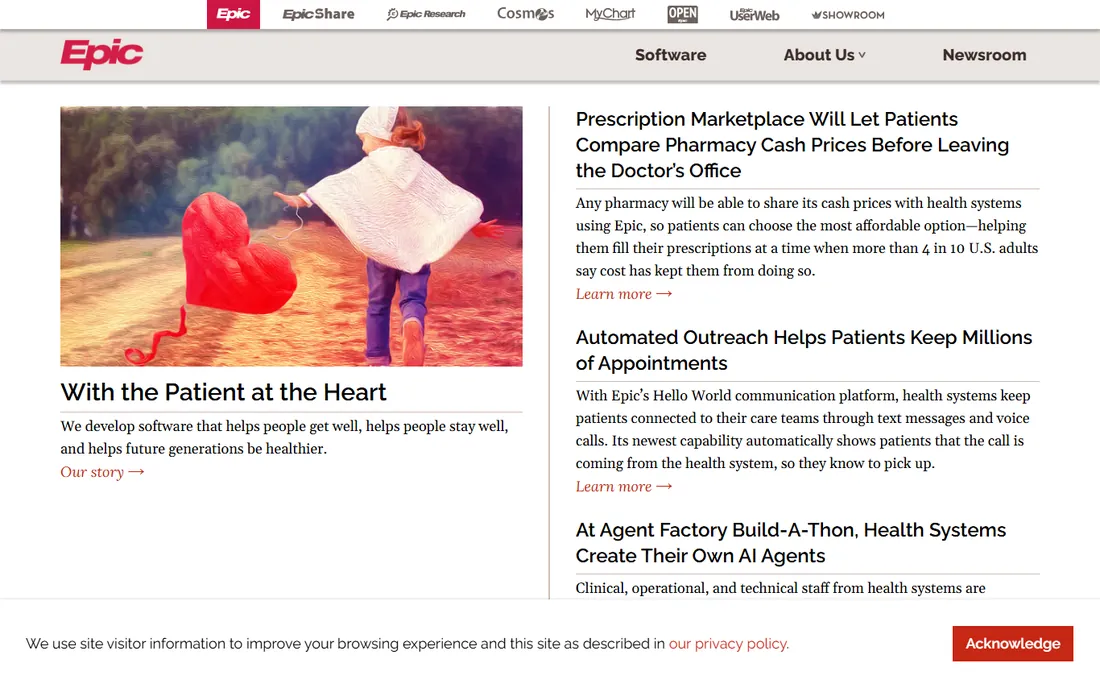
Epic is the benchmark. Around 36% of US acute care hospitals run it, including most of the largest academic medical centers. The platform covers the full continuum: clinical documentation, order entry, revenue cycle, population health analytics, telehealth and the MyChart patient portal that patients actually use.
Clinical decision support is where Epic earns its reputation. SmartPhrases, order sets and predictive models cut routine order entry time significantly, and the interoperability framework exchanges data with non-Epic systems through modern FHIR standards.
The honest reality is scale. Epic implementations cost millions and take years, with dedicated analyst teams needed to build and maintain the system. Community hospitals and independent practices should look further down this list. For large systems that can invest, nothing else matches the depth.
What we like- The deepest clinical functionality in the industry
- MyChart is the top-rated patient portal
- Strong interoperability via FHIR standards
Watch out for- Cost-prohibitive for small and mid-size hospitals
- Implementation is a multi-year project
- Customization requires dedicated build teams
#2
Oracle Health
Best for: Multi-facility systems modernizing on Oracle cloud
Visit oracle.com
Starting priceSee website
Free planNo
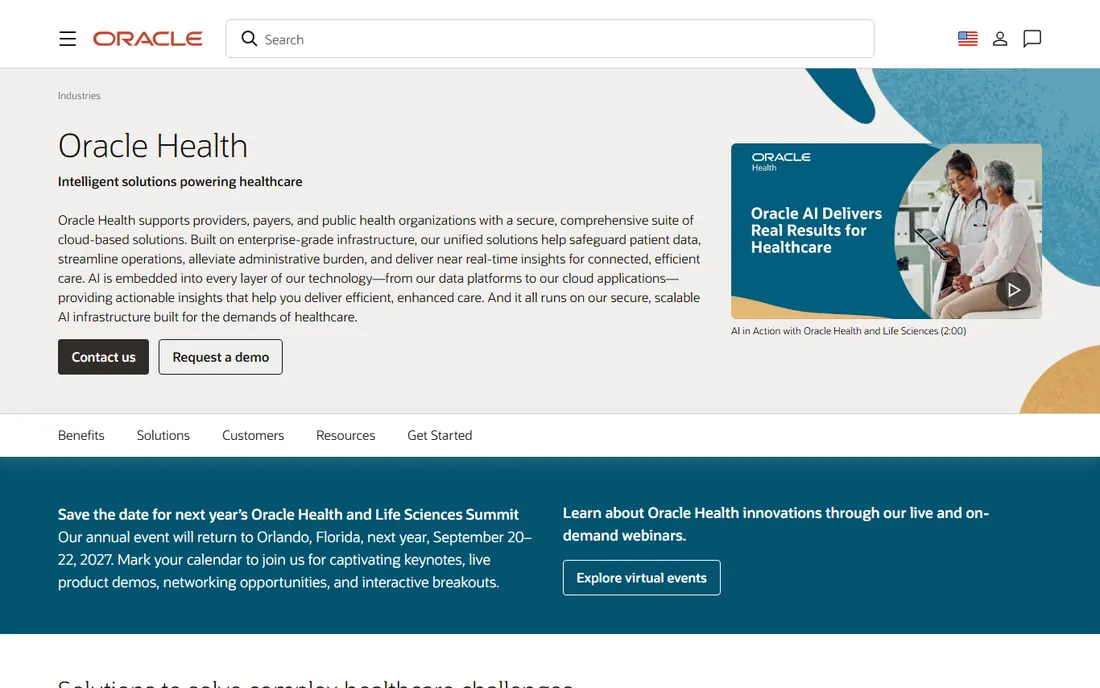
Oracle Health, formerly Cerner, remains one of the largest hospital platforms in the US. Since Oracle's 2022 acquisition, the roadmap has centered on cloud modernization and embedded AI: clinical documentation assistance, predictive analytics and revenue cycle automation running on Oracle Cloud Infrastructure.
The platform suits multi-facility systems that want an integrated clinical and financial suite with strong interoperability. Open APIs connect third-party systems, and the population health tools serve value-based care contracts. A managed delivery model helps community and critical access hospitals limit IT complexity.
The caveat is transition risk. Longtime Cerner customers have watched roadmaps shift under Oracle ownership, so reference calls with recent go-lives matter. Pricing is enterprise and quote-based. Systems already invested in Oracle infrastructure get the most from this pick.
What we like- Deep Oracle cloud and AI integration
- Strong open APIs for multi-vendor environments
- Population health and analytics strengths
Watch out for- The Cerner transition is still settling for some customers
- Implementation costs remain enterprise-grade
- Training demands are significant
#3
MEDITECH
Best for: Community hospitals that need value without Epic-scale cost
Visit meditech.com
Starting priceSee website
Free planNo
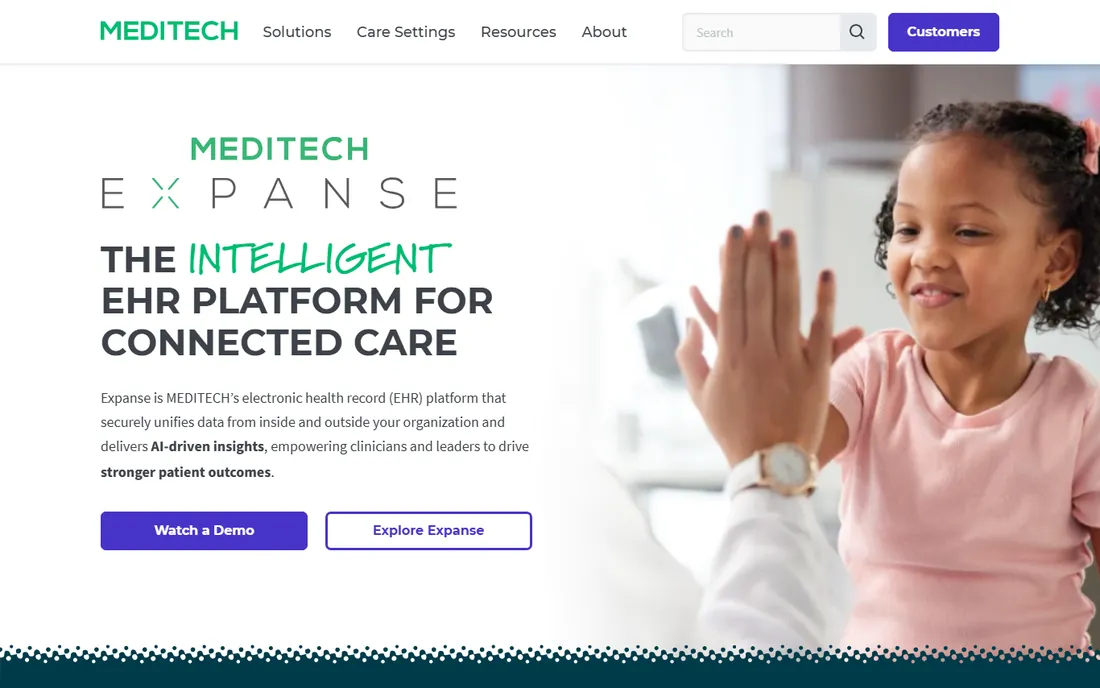
MEDITECH has served community hospitals for decades, and its Expanse platform modernized the offering for the cloud and mobile era. It unifies clinical, financial and operational data with AI-driven insights, ambient documentation and interoperability through the Traverse Exchange network.
The value proposition is independence. Community hospitals get a full EHR without the build-team overhead Epic demands, and MEDITECH's customer base skews toward organizations that stay for decades. Recent updates added mobile physician access and therapy-specific modules.
The trade-off is ceiling. Highly complex academic workflows and advanced AI research integrations fit Epic better. For the community hospital that needs reliability, reasonable cost and a vendor that answers the phone, MEDITECH is the pragmatic choice.
What we like- Cost-effective for community and mid-size hospitals
- Expanse platform is modern and mobile-friendly
- Reputation for stable, long-term partnerships
Watch out for- Less flexibility for highly complex academic workflows
- AI and analytics trail Epic and Oracle
- Customization is menu-driven rather than open
Starting priceSee website
Free planNo
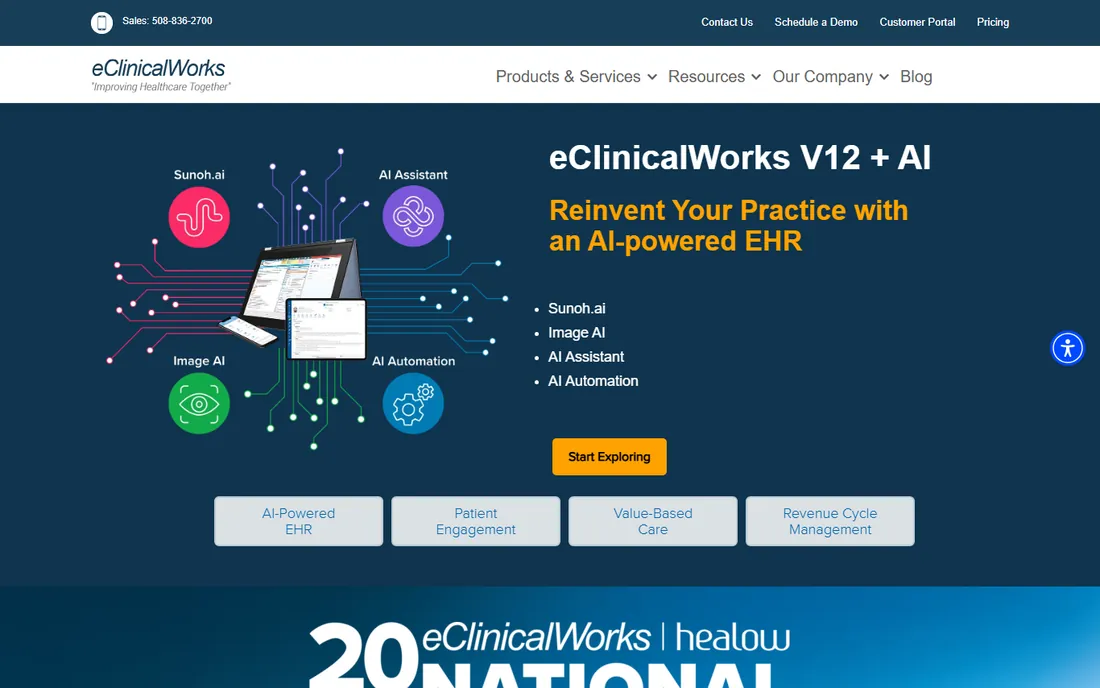
eClinicalWorks runs in over 110,000 facilities with 180,000-plus physicians and NPs on the platform, making it the most widely deployed cloud EHR in the US ambulatory market. The suite covers EHR, practice management, telehealth, revenue cycle and the healow patient engagement platform.
The AI story is practical. Sunoh.ai provides ambient documentation that drafts notes from patient conversations, and healow Genie runs an AI-powered contact center for after-hours patient calls. Specialty-specific workflows cover the range from primary care to behavioral health.
The honest limit is the hospital side. eClinicalWorks is ambulatory-first; inpatient hospitals needing full hospital information system depth should evaluate Epic, Oracle or MEDITECH. For clinics, group practices and specialty groups, it is a proven workhorse.
What we like- The largest cloud-based EHR footprint in the US
- Healow patient engagement suite
- AI scribe integration via Sunoh.ai
Watch out for- Hospital inpatient depth lags the enterprise platforms
- Interface feels dated in places
- Pricing is quote-based and opaque
Starting priceSee website
Free planNo
athenahealth built its reputation on one promise: practices collect more with less billing hassle. The athenaOne suite combines EHR, practice management and patient engagement with a rules engine that scrubs claims before submission. Practices switching to athenaOne report collection increases in the 2-6% range.
The network effect matters. Because athenahealth processes claims across thousands of practices, its rules engine learns payer behavior continuously. Embedded ambient AI reduces documentation work, and the platform earned Best in KLAS for the independent physician practice suite three years straight.
The catch is the model. Revenue cycle services mean giving up some control, and pricing tied to collections needs careful modeling. It is ambulatory-focused, so hospitals need the bigger platforms. For independent practices where cash flow is the mission, athenahealth delivers.
What we like- Revenue cycle performance with 2-6% collection lifts reported
- Best in KLAS for independent practice three years running
- Embedded ambient documentation
Watch out for- Less control over the revenue cycle than in-house billing
- Pricing tied to collections can surprise
- Hospital inpatient is not the focus
#6
AdvancedMD
Best for: Independent practices that want EHR, billing and engagement unified
Visit advancedmd.com
Starting priceSee website
Free planNo
AdvancedMD targets independent practices with a single cloud suite: AI-enabled EHR, practice management, patient engagement and revenue cycle management. Configurable workflows by specialty, intelligent scheduling and real-time insurance eligibility verification aim at the daily friction points of running a practice.
Support is a selling point. The company promises 90-second average response times with 24/7 live chat and dedicated success partners, plus personalized onboarding. With 13,000-plus practices and 9.5 million claims processed monthly, the scale is proven.
The honest caveats are pricing opacity and fit. Everything is quote-based, and the suite is built for independent practices, not hospital inpatient operations. Practices that want one vendor for the whole front-to-back office will find it compelling.
What we like- Unified EHR, practice management and patient engagement
- Strong support with 90-second response claims
- Trusted by 13,000+ practices
Watch out for- Quote-based pricing with no public numbers
- Implementation needs workflow planning
- Smaller AI footprint than Oracle or Epic
Starting priceSee website
Free planNo
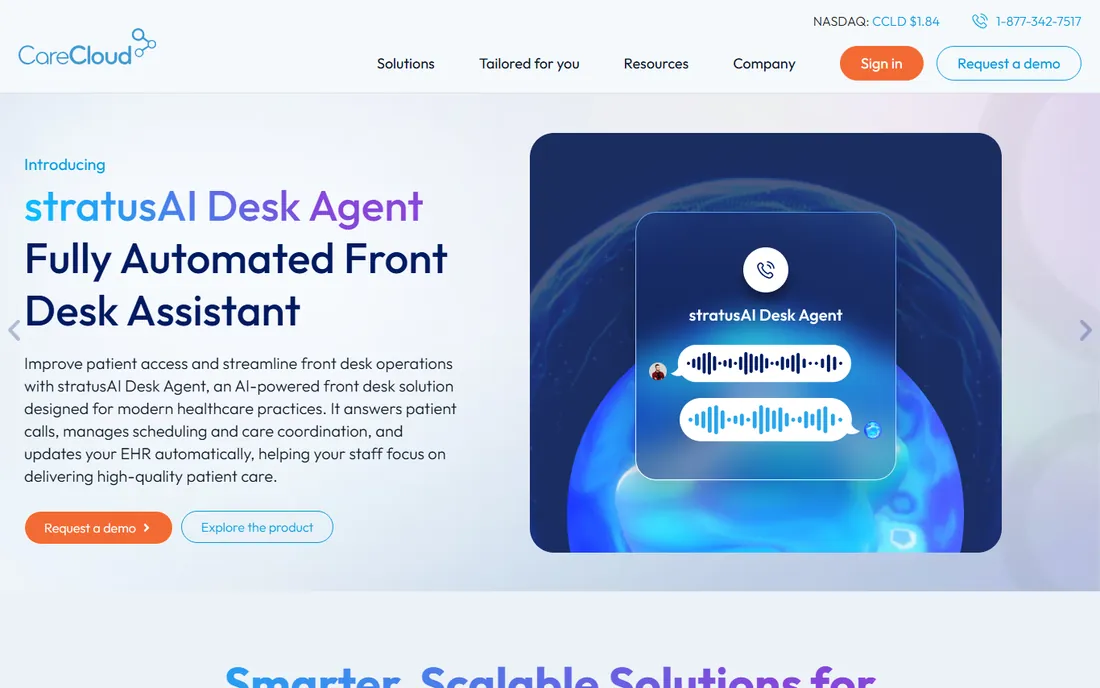
CareCloud positions itself as the AI-powered healthcare platform, with intelligence embedded from clinical documentation to billing to an AI call agent for patient communication. The company serves small medical practices, large groups, academic institutions and health systems with specialty-specific solutions.
The case studies emphasize revenue cycle results: faster payments, lower days in A/R and reduced billing costs. The cirrusAI layer and AI call agent handle work that used to need front-desk staff, which matters for practices struggling to hire.
The caveat is the company's acquisitive history, which means evaluating exactly which product line you are buying matters. Demos should cover your specialty's actual workflows. For practices that want AI doing real administrative work, CareCloud is worth a serious look.
What we like- AI woven through clinical, billing and patient communication
- Strong revenue cycle outcomes in case studies
- Serves small practices to health systems
Watch out for- Acquisitive history means some product lines feel stitched together
- Pricing is entirely quote-based
- Smaller practices may find it complex
Starting priceSee website
Free planNo
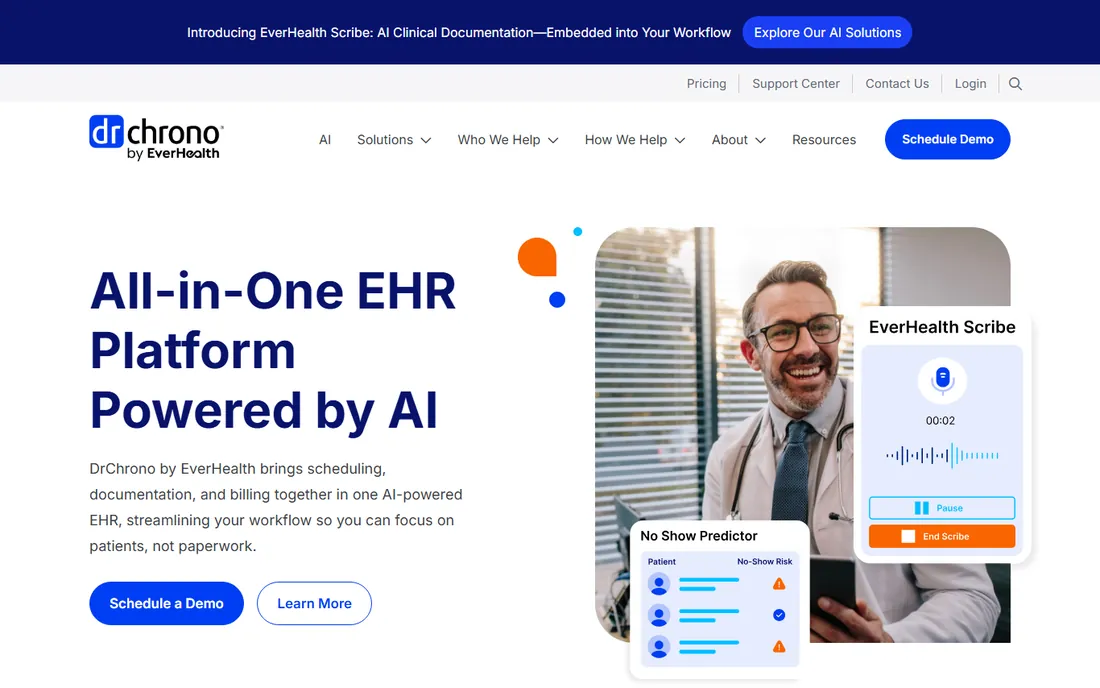
DrChrono pioneered the mobile EHR and still leads it, ranked the number one mobile EHR by Black Book from 2013 through 2026. The all-in-one platform combines clinical workflows, patient engagement and billing management designed for how independent providers actually work, on iPad and iPhone as much as desktop.
Billing profiles are a practical standout: procedure sets pre-fill based on visit type, cutting billing work significantly. Telehealth launches from inside the chart with no downloads, and specialty templates adapt the system across dozens of fields.
The honest limits are scale and change. Complex hospital organizations need the enterprise platforms, and DrChrono's acquisition by EverHealth means the roadmap is still settling. For independent practices that want to run from a tablet, it remains the best fit.
What we like- The leading mobile EHR, an Apple Mobility Partner
- Customizable specialty templates
- Telehealth built in with no setup
Watch out for- Depth trails enterprise EHRs for complex organizations
- Pricing is quote-based
- Now part of EverHealth, so roadmap is evolving
Starting priceSee website
Free planNo
Azalea Health exists for the facilities the big vendors underserve: rural hospitals, critical access hospitals, rural health clinics and independent specialty practices. The 100% cloud-based platform combines EHR, patient accounting, practice management and revenue cycle services with no servers and no added IT staff.
The pitch is full functionality without enterprise overhead. AI clinical note capture and billing assistance reduce charting and coding work, one-screen workflows keep small teams efficient, and US-based billers handle revenue cycle for practices that cannot staff it.
The catch is scope. Large health systems with complex service lines need Epic or Oracle. But for the CAH administrator choosing between Azalea and an enterprise platform that costs multiples more, Azalea's rural focus is exactly the point.
What we like- Built for rural and critical access hospitals
- Full EHR and billing without enterprise price tag
- Fast implementation with no servers needed
Watch out for- Not designed for large academic systems
- Smaller ecosystem of third-party integrations
- Quote-based pricing
How we chose
We compared vendor platforms, documentation and feature sets against public analyses, KLAS recognitions and healthcare-IT community discussions, plus pricing and deployment data from G2, Capterra and TrustRadius. We favored platforms with a real US hospital or practice footprint and transparent current positioning. Hospital software is almost entirely quote-priced, so we verified each vendor's official homepage rather than repeating third-party price claims. We did not test any platform hands-on; treat this as research synthesis and run live demos on your own clinical scenarios before deciding.
What to check before you buy
Match the platform to your facility type first. Inpatient hospitals need a full hospital information system; ambulatory practices need EHR plus revenue cycle; rural facilities need simplicity and cost control. Buying Epic for a 25-bed hospital or a clinic EHR for inpatient care are both expensive mistakes.
Demand reference customers like you. Ask each vendor for three organizations of your size, specialty mix and IT staffing that went live in the last two years, then call them. Implementation quality varies more than feature lists suggest.
Model the total cost honestly. License fees are the smallest line: implementation, data migration, interfaces to lab and pharmacy, training, lost productivity during go-live and ongoing analyst staffing dwarf the subscription. Get the five-year number in writing.
Finally, evaluate interoperability now. Your EHR must exchange data with labs, imaging, pharmacies, payers and public health registries through HL7 and FHIR. Test the specific interfaces you need during the demo, not after signing.
The EHR is only half the system
Hospital management extends past the EHR. Revenue cycle performance decides whether the organization survives, patient engagement decides whether schedules stay full, and analytics decide whether leadership sees problems in time. The best hospital management software is the platform your clinicians will actually use, your billers can actually collect with, and your IT team can actually support. Optimize for adoption, not feature count.
Frequently asked questions
What is the best hospital management software?
For large US health systems, Epic Systems leads on clinical depth. Oracle Health and MEDITECH serve the mid-to-large tier, while eClinicalWorks, athenahealth and AdvancedMD fit independent practices. Rural hospitals should evaluate Azalea Health.
How much does hospital management software cost?
Hospital EHR implementations are quote-priced and range from tens of thousands for small clinics to tens of millions for large health systems, including implementation, migration and training. No major vendor publishes list prices, so expect an RFP process.
What is the difference between an EHR and hospital management software?
An EHR manages clinical records and documentation. Hospital management software, or a hospital information system, adds scheduling, billing, pharmacy, lab, inventory and administration. Most modern platforms bundle both, but ambulatory EHRs lack full inpatient depth.
Which hospital software is best for small hospitals?
MEDITECH and Azalea Health are built for community and rural hospitals that need full functionality without enterprise cost and complexity. Both offer faster implementations and lower IT overhead than Epic or Oracle Health.
Do these platforms integrate with labs and pharmacies?
Yes, all major platforms support HL7 and FHIR interfaces for lab, imaging, pharmacy and payer connections. Confirm your specific interfaces during the demo, since interface costs and timelines vary by vendor.
How long does hospital software implementation take?
Small clinic deployments can go live in weeks. Community hospital EHR implementations typically take 6-12 months, and large health system rollouts run 18-36 months. Data migration and staff training drive most of the timeline.
Sources we checked (10)
- https://www.epic.com
- https://www.oracle.com/health/
- https://meditech.com/
- https://www.eclinicalworks.com
- https://www.athenahealth.com
- https://www.advancedmd.com
- https://carecloud.com/
- https://www.drchrono.com
- https://azaleahealth.com/
- https://entri.app/blog/epic-vs-cerner-vs-meditech-hms-comparison/
Is your product missing or out of date?
We review this list regularly. Vendors can request a listing, send updated pricing or ask about featured placement.

Shihab Mia · Founder, Rankite
Shihab has 5+ years in B2B and SaaS SEO. He writes Rankite's software buying guides from pricing pages, documentation and public user reviews. More about Shihab.