How we make this list: we compare pricing pages, product documentation and public user reviews. Ratings come from G2, Capterra or Trustpilot, with the date we checked them.
Key takeaways
- Star Health and Niva Bupa are the strongest standalone health insurers, with in-house claims teams and very large cashless hospital networks.
- HDFC ERGO and ICICI Lombard suit buyers who want health cover from a large general insurer with a wide product range.
- Premiums depend on age, city, sum insured and medical history, so every price in this guide is quoted as "See website" and must be confirmed with a personal quote.
- Cashless network size, waiting periods and the claim settlement process matter more than a low first-year premium.
- Read the policy wording before buying, since exclusions and sub-limits decide what actually gets paid.
A hospital bill in India can run into lakhs of rupees in a single admission, and that is why the insurer behind the policy matters as much as the plan itself. The companies below are all regulated by the Insurance Regulatory and Development Authority of India (IRDAI), and each one sells health policies online across most Indian states. They differ in how claims are handled, how large their cashless networks are, and which groups they serve best, from young families to senior citizens.
This guide compares eight insurers on the points a buyer can check before paying: network hospitals, claim handling, flagship plans, waiting periods and room rent rules. Prices are not fixed for health insurance the way they are for software, because the premium changes with age, location, sum insured and health history. Every company here asks for a quote before showing a final price, so the comparison table marks starting prices as "See website" rather than printing a figure that would be wrong for most readers. This guide is for general information only and is not a substitute for reading the policy wording.
Quick comparison
Is your product missing or out of date?
We review this list regularly. Vendors can request a listing, send updated pricing or ask about featured placement.
The best health insurance companies in India
Starting priceSee website
Free planNo
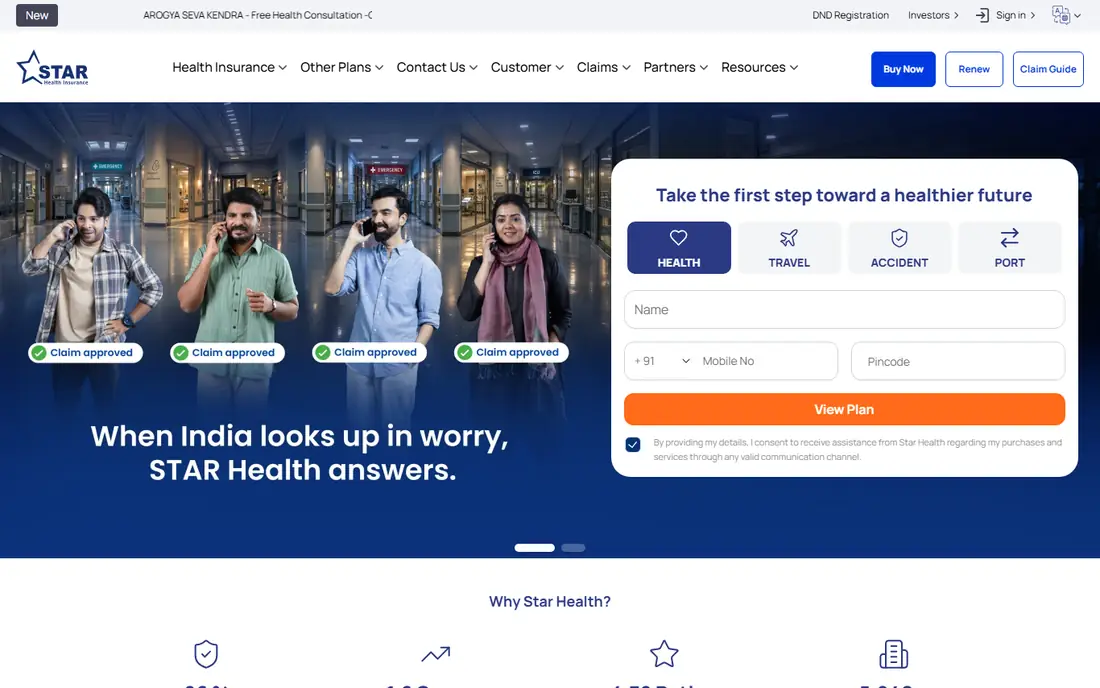
Star Health is a standalone health insurer, which means health policies are its whole business rather than one line among many. That focus shows up in claims: the company settles claims with its own team instead of handing them to a third-party administrator, and it reports that 96 percent of cashless final approvals come through within 3 hours. Its network covers more than 16,000 hospitals, and its long-running plans include Star Comprehensive and Family Health Optima for families, plus the Senior Citizens Red Carpet plan for older buyers.
The trade-off is price. Star Health premiums sit at the higher end for older age bands, and buyers with pre-existing conditions should check waiting periods and any co-payment clauses carefully. For a family that wants a health-first insurer with a large cashless network and a direct claims desk, it remains the most common first shortlist name in India.
What we like- Claims handled in-house with no third-party administrator
- 16,000 plus network hospitals
- 96 percent of cashless final approvals within 3 hours
Watch out for- Premiums can be high for senior citizens
- Some plans carry disease-specific waiting periods
Starting priceSee website
Free planNo

HDFC ERGO is one of India's largest general insurers, and its health range is built around the Optima family of plans. Optima Secure promises four times coverage growth at no extra cost, while Optima Secure Plus adds an unlimited restore benefit that refills the sum insured after a claim. The company lists more than 16,000 cashless network providers across India and more than 200 branches, which helps buyers outside the big metros.
Buyers should read how the restore benefit works before counting on it, since refills apply under specific conditions and do not cover every claim type. Premiums also vary sharply by zone, with metro cities priced higher. For buyers who want a big, stable insurer and a plan that grows with them, HDFC ERGO is a solid pick.
What we like- Optima Secure offers 4X coverage growth
- 16,000 plus cashless network providers
- No-cost installment option on some plans
Watch out for- Health is one of many product lines, so service depth varies by branch
- Restore benefits carry conditions
Starting priceSee website
Free planNo
ICICI Lombard sells health cover alongside motor, travel and home insurance, which makes it convenient for buyers who want several policies from one company. Its health range includes Complete Health Insurance for families and Golden Shield for senior citizens, with cashless treatment at network hospitals and options for different budgets. The company also promotes an AI-backed claims process for faster handling of simpler claims.
The weak point is choice overload. With many plan variants and add-ons, two quotes that look similar can differ in room rent limits or waiting periods. Buyers should compare the policy brochure line by line rather than the headline sum insured. For someone who already banks or insures with the ICICI group, the convenience factor is real.
What we like- Very large general insurer with broad distribution
- Cashless treatment at network hospitals
- Personalised plans for many budgets and ages
Watch out for- Plan names and variants can be confusing to compare
- Health is one line among motor, travel and home
Starting priceSee website
Free planNo
Care Health Insurance, formerly Religare Health, is another standalone health insurer with a wide family plan range led by Care Supreme. Its plans cover AYUSH treatments (Ayurveda, Yoga, Unani, Siddha and Homoeopathy), which matters to buyers who use traditional treatment alongside modern medicine. Pre- and post-hospitalisation expenses are covered as standard on its main plans, and sum insured options run high enough for metro hospital costs.
As with most standalone health insurers, waiting periods for named illnesses deserve a close look, and older buyers face higher premiums. Care also sells through a large agent and partner network, so buyers who prefer buying with help rather than online will find support. For families who want AYUSH cover bundled into a mainstream policy, Care is one of the few names that does it well.
What we like- Care Supreme covers AYUSH treatments
- Strong focus on pre- and post-hospitalisation expenses
- Wide range of sum insured options
Watch out for- Some plans have long waiting periods for specific illnesses
- Premium rises steeply at older ages
Starting priceSee website
Free planNo

Niva Bupa has built its name on speed. The company commits to processing cashless pre-authorisation requests within 30 minutes for active policies, subject to documents being in order, and it reports a claim settlement ratio of 95.6 percent. Its network spans more than 19,000 healthcare providers, and its ReAssure range, including ReAssure 3.0, is popular with young families because of unlimited sum insured options and a direct online discount of 5 percent.
The catch is reimbursement claims, where a 20 percent co-payment applies. Buyers who often use non-network hospitals should weigh that clause carefully. Zone-based pricing also means the same plan can cost more in some cities. For buyers who value a quick cashless experience at network hospitals, Niva Bupa is hard to beat.
What we like- 30-minute cashless pre-authorisation commitment
- 19,000 plus network providers
- 5 percent direct online discount
Watch out for- 20 percent co-payment applies on reimbursement claims
- Some variants carry zone-based pricing
Starting priceSee website
Free planNo

Tata AIG is a joint venture between the Tata group and AIG, and it has sold general insurance in India since 2001. Its health plans start at a low advertised entry point of 15 rupees per day, which makes it a practical choice for first-time buyers and young professionals. The network covers more than 13,000 hospitals, and the Medicare range offers family floater and individual options with common add-ons.
Budget plans keep costs down by limiting some benefits, so buyers who want maternity cover, global treatment or high room rent limits will need to step up to higher variants or add riders. Service runs through a large agent and branch network as well as online. For a first policy on a tight budget, Tata AIG gives a low-cost way in without going to an unknown insurer.
What we like- Health plans advertised from 15 rupees per day
- 13,000 plus network hospitals
- Backed by the Tata group and AIG
Watch out for- Entry plans have lower limits than premium plans
- Add-ons needed for wider cover
Starting priceSee website
Free planNo
Bajaj General Insurance, formerly Bajaj Allianz General Insurance, is one of India's biggest general insurers by network size, with more than 18,400 cashless hospitals. Its health range includes the My Health Care Plan family covers, the Extra Care Plus top-up and Criti Care for critical illness. The company also runs a health companion app for policy management and wellness tracking.
The recent name change from Bajaj Allianz to Bajaj General has confused some long-time customers, though policies and servicing continue as before. Top-up plans like Extra Care Plus only make sense alongside a base policy, so buyers should not purchase them alone. For buyers who want the widest possible hospital choice for cashless treatment, this network is the strongest argument in its favour.
What we like- 18,400 plus cashless hospitals
- Health Care Supreme family plans
- Quick claim settlement process
Watch out for- Brand recently renamed from Bajaj Allianz, which confuses some older policyholders
- Top-up plans need a base policy to work well
Starting priceSee website
Free planNo
Aditya Birla Health Insurance sells through Aditya Birla Capital, and its Activ Health and Activ Fit plans stand out for wellness-linked benefits. The Health Returns program gives premium-linked rewards for staying active, with each family member able to follow their own activity of choice. Chronic care management is built into several plans, which suits buyers managing diabetes, asthma or similar long-term conditions.
The wellness angle is not for everyone. Rewards depend on tracked activity, and buyers who dislike fitness tracking will get less value from these plans. Distribution runs through the group's financial advisors and online channels. For buyers who already track activity and want their effort reflected in their policy, Aditya Birla turns a health plan into something closer to a wellness program.
What we like- Health Returns program rewards active lifestyles
- Chronic care management on Activ plans
- Part of the large Aditya Birla Capital group
Watch out for- Wellness rewards depend on tracked activity, which not every buyer wants
- Health is sold through a financial group, not a standalone health brand
How we chose
We compared insurers on their own published plan details, network hospital counts, claim handling descriptions and regulator-facing disclosures, along with public customer feedback on review sites and forums. We favoured companies with large cashless networks, in-house or clearly described claim processes, and plan ranges that cover families, individuals and senior citizens. Premiums were left as "See website" because health premiums are personal quotes that change with age, city, sum insured and medical history, and printing one figure would mislead most readers.
What to check before you buy
Start with the sum insured, not the premium. A 5 lakh cover looks cheap until a metro hospital bill crosses it in one admission, so families in large cities often need 25 lakh or more, sometimes through a base plan plus a top-up. Next, check the waiting period for pre-existing diseases, which usually runs two to four years, and confirm whether the plan has a co-payment clause that forces you to pay part of every claim.
Room rent limits deserve attention too. A plan with a single private room limit can cut your whole claim proportionally if you stay in a higher category room, so no-room-rent-limit plans are worth the extra premium for many buyers. Finally, confirm that hospitals near your home are in the cashless network, since a large national network does not help if your local hospital is not in it. Ask for the policy wording and read the exclusions page before paying.
Frequently asked questions
What is the best health insurance company in India for families?
There is no single winner for every family. Star Health and Niva Bupa suit families that want a health-focused insurer with fast cashless claims, while HDFC ERGO and ICICI Lombard suit buyers who prefer a large general insurer. Compare sum insured, network hospitals near your home and waiting periods before deciding.
How much health cover does a family need in India?
A family in a metro city should usually consider at least 25 lakh of cover, since a single major surgery can cost several lakhs. Families in smaller cities can often manage with 10 to 15 lakh. A base plan plus a top-up plan is a common way to reach a high total at a lower premium.
What is a cashless network hospital?
A cashless network hospital has an agreement with your insurer, so the insurer pays the hospital directly for covered treatment after approval. You still pay for items the policy excludes, such as some consumables, but you do not need to arrange the full bill amount upfront. Always confirm the hospital is in the network before admission.
What is a waiting period in health insurance?
A waiting period is the time after buying a policy during which certain claims are not paid. Initial waiting periods usually last 30 days, while pre-existing diseases often carry a waiting period of two to four years. Named illnesses such as cataract or joint replacement may have their own waiting periods.
Can senior citizens buy health insurance in India?
Yes, several insurers sell plans designed for senior citizens, including Star Health Senior Citizens Red Carpet and ICICI Lombard Golden Shield. Premiums are higher and co-payment clauses are common at older ages, so compare at least two senior plans before buying. Entry ages and medical check-up rules vary by insurer.
Is health insurance premium tax deductible in India?
Premiums paid for health insurance for self, family and parents can qualify for tax deduction under Section 80D of the Income Tax Act, subject to limits and conditions. The deduction amount depends on the age of the insured persons and the premium paid. Check the current rules or ask a tax advisor before relying on the deduction.
Sources we checked (8)
- https://www.starhealth.in
- https://www.hdfcergo.com
- https://www.icicilombard.com
- https://www.careinsurance.com
- https://www.nivabupa.com
- https://www.tataaig.com
- https://www.bajajallianz.com
- https://www.adityabirlacapital.com
Is your product missing or out of date?
We review this list regularly. Vendors can request a listing, send updated pricing or ask about featured placement.

Shihab Mia · Founder, Rankite
Shihab has 5+ years in B2B and SaaS SEO. He writes Rankite's software buying guides from pricing pages, documentation and public user reviews. More about Shihab.
 Star Health
 HDFC ERGO
 ICICI Lombard
 Care Health Insurance
 Niva Bupa
 Tata AIG
 Bajaj General Insurance
 Aditya Birla Health Insurance