How we make this list: we compare pricing pages, product documentation and public user reviews. Rankite is independent; if a vendor ever pays for a featured spot, that listing is clearly labeled Partner.
Key takeaways
- Most retained search firms do best with software built for search workflows, not generic ATS products adapted from corporate HR.
- Loxo suits firms that live in sourcing and outreach, while Clockwork fits firms that sell a strict retained methodology to clients.
- Per-user pricing in this category runs from about $85 to $215 a month, and the enterprise options are quote-only.
- If your partners will not leave email, Thrive TRM and Tracker are the two strongest picks for Outlook and Gmail-centric teams.
Quick comparison
| Tool | Best for | Starting price | Free plan |
|---|
 Loxo Loxo | Search firms built around sourcing and outreach | $149 per user/month (billed annually) | Free trial |
 Thrive TRM Thrive TRM | Relationship-driven retained search teams | See website | No |
 Tracker Tracker | Agencies wanting ATS, CRM and back office in one | See website | No |
 Crelate Crelate | Firms that want a deeply configurable CRM | $85 per user/month | Free trial |
 Clockwork Clockwork | Methodology-first executive search boutiques | $1,800 per user/year | No |
 Invenias Invenias | Enterprise and global search practices | See website | No |
 PCRecruiter PCRecruiter | Veteran agencies and firms wanting on-premises control | See website | No |
 Vincere Vincere | Modern firms that want a clean all-in-one | See website | Free trial |
 Recruit CRM Recruit CRM | Small and startup search firms on a budget | $95 per user/month | No |
Is your product missing or out of date?
We review this list regularly. Vendors can request a listing, send updated pricing or ask about featured placement.
The best executive search software
#1
Loxo
Best for: Search firms built around sourcing and outreach
Visit loxo.co
Starting price$149 per user/month (billed annually)
Free planFree trial
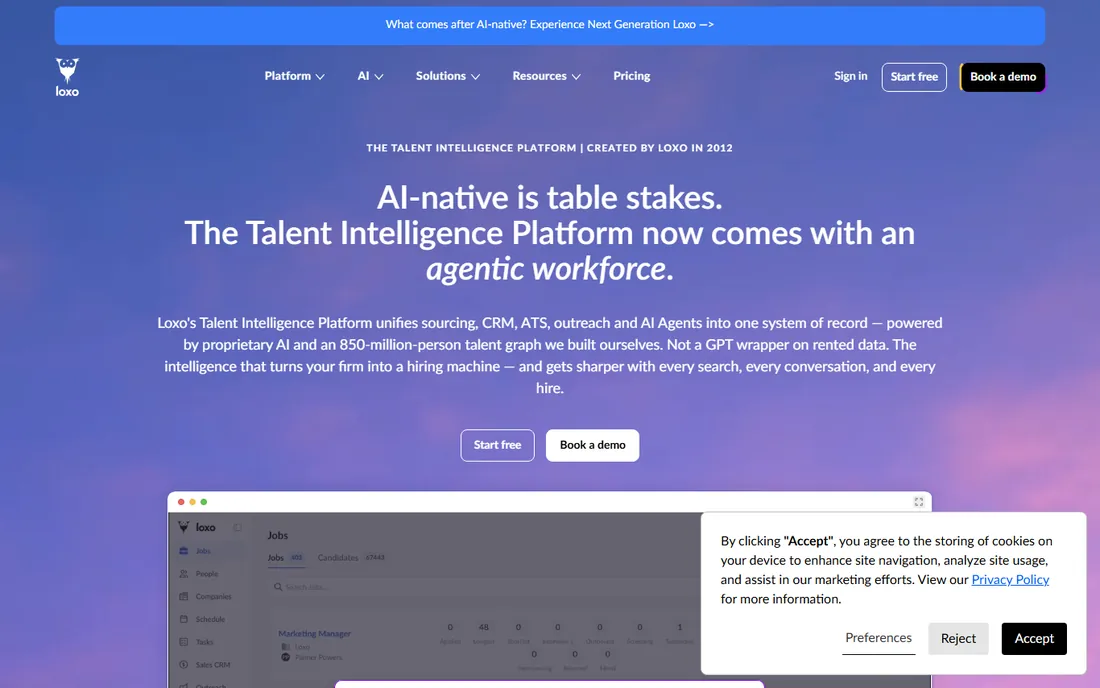
Sourcing is where retained searches are won or lost, and Loxo puts the candidate database, the outreach sequences and the pipeline in a single workflow. A partner can run a full-market search, pull contact data, and launch a multi-channel campaign without exporting a single spreadsheet. The AI agents that screen longlists and rank shortlists across several dimensions save real hours on large searches, though you still need a human reading every profile that matters.
The trade-off is breadth over depth. If your firm needs best-in-class interview scheduling or deep compensation analytics, Loxo will feel thin in those corners. Pricing is per user per month, with Core at $149 and Professional at $199 when billed annually, so a five-person boutique is looking at a serious line item before any contact-data overages. Ask on the demo what is included in AI agent credits, because overages can add $50 to $300 or more per seat per month on heavy usage.
What we like- ATS, CRM, sourcing database and outreach sequences in one login
- AI agents that build longlists and rank candidates
- 7-day free trial to test the real product
Watch out for- Each module is shallower than a best-of-breed point tool
- The learning curve is real when you turn everything on at once
- Full database access sits on higher tiers
Starting priceSee website
Free planNo
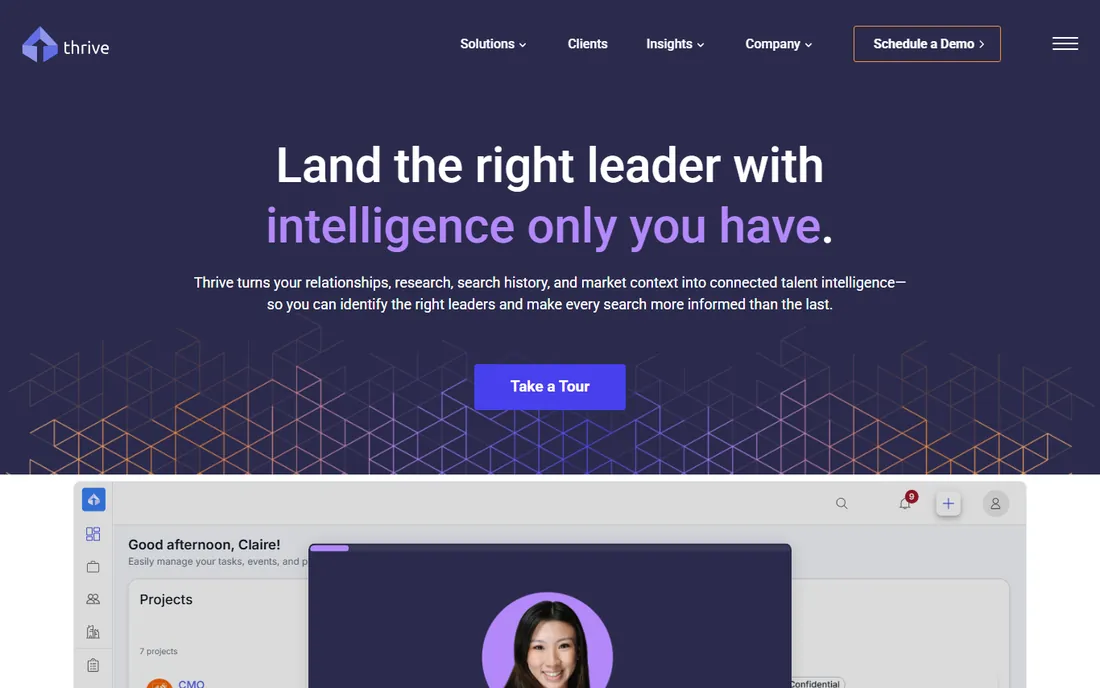
Thrive TRM was designed for the way retained partners actually work, which is relationship first and requisition second. The platform folds candidate relationship management into an applicant tracking workflow, so the network a partner has built over twenty years lives in the system instead of in a Rolodex of LinkedIn messages. Search teams that run collaborative, multi-partner engagements tend to adopt it faster than generic CRMs because the screens match the retained process.
The catch is transparency. With no public pricing and a quote-based model, you cannot budget without talking to sales, and smaller firms sometimes discover the numbers only after weeks of evaluation. It is also a Philadelphia-based independent vendor, which is a plus for support responsiveness but means fewer third-party integrations than the big platforms. Thrive fits best when your partners think in relationships and the CRM is the product, not an afterthought.
What we like- Built around talent relationships and network development rather than requisitions
- Strong collaboration features for partners working one search together
- Clean interface that partners actually open
Watch out for- Pricing is not published, so budgeting takes a sales call
- Smaller vendor with a narrower integration ecosystem
- Less depth on high-volume agency workflows
Starting priceSee website
Free planNo
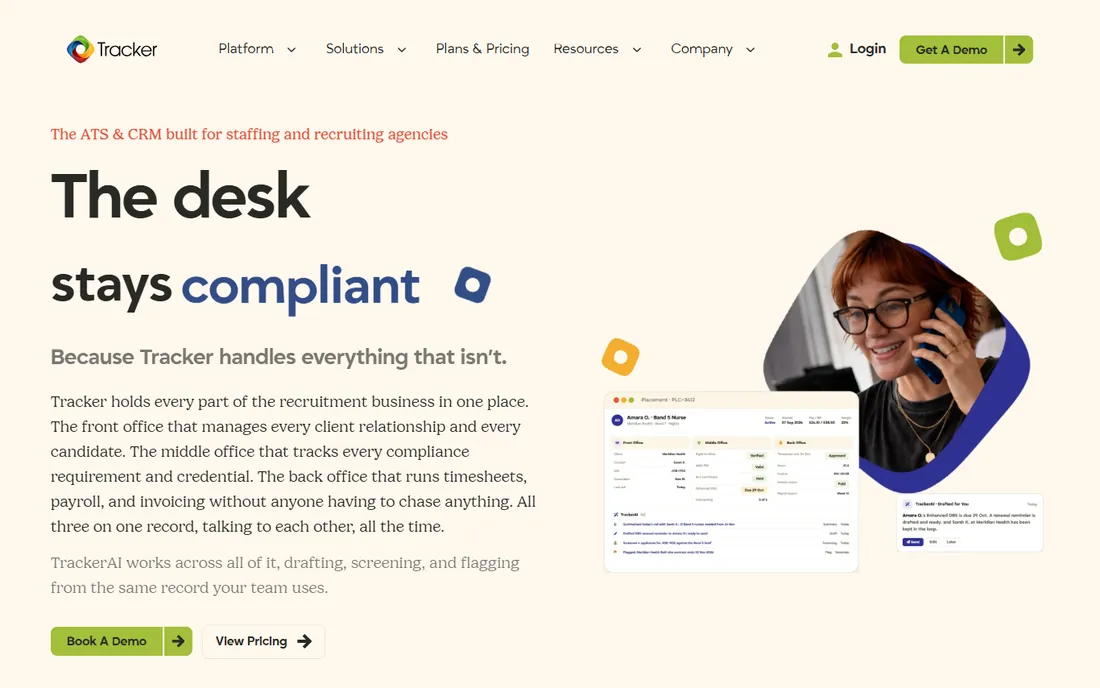
Twenty years of focus on staffing and recruiting agencies shows in Tracker's depth. The platform covers temp, contract, perm and executive search in one instance, with timesheets, invoicing and onboarding sitting next to the ATS instead of in a separate tool. For a search firm that also runs contract placements, that consolidation is the whole argument: one database, one login, one vendor relationship.
Tracker's newer AI layer is genuinely ahead of most competitors, with generative candidate scoring and a conversational assistant grounded in your own data. Reviewers consistently praise the support team, which matters when your partners call at 9pm before a client presentation. The honest downside is that pricing is entirely quote-based, and the implementation and migration costs (published ranges run from about $1,000 to $8,000) mean you should budget the project, not just the subscription. Firms that only do retained search may find half the platform irrelevant.
What we like- Front office, back office and reporting in a single system
- Strong AI layer with candidate scoring and a conversational assistant
- Highly rated support from people who know recruiting
Watch out for- No published pricing, which slows down comparison shopping
- The all-in-one scope can overwhelm small teams that only need search
- Migration projects run one to several thousand dollars
Starting price$85 per user/month
Free planFree trial
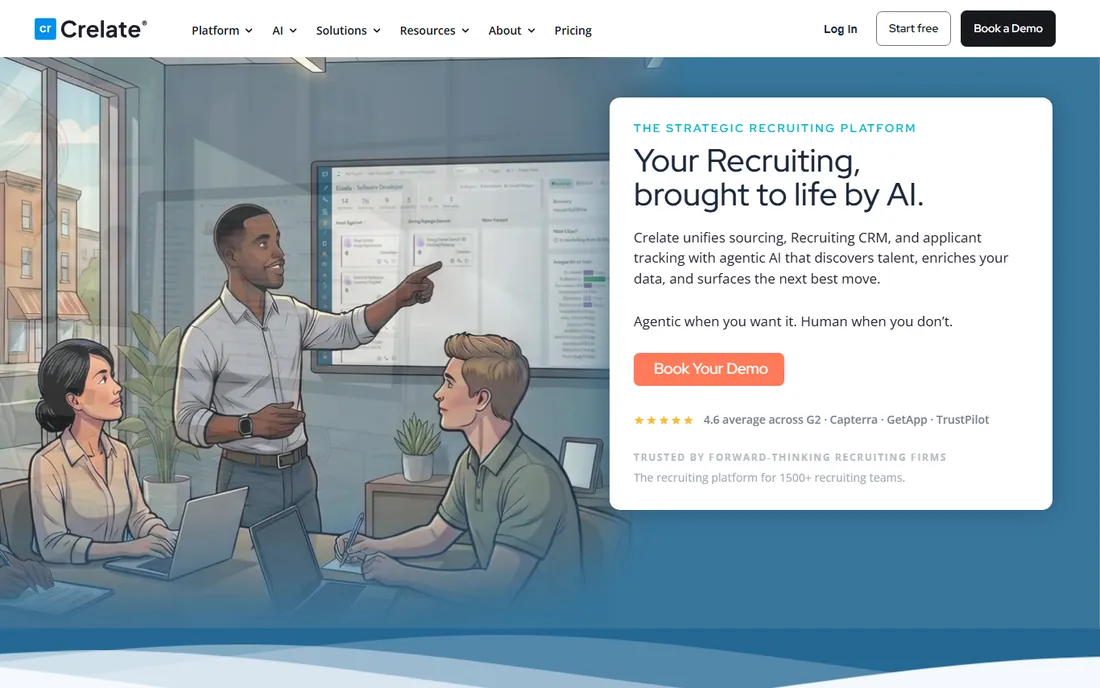
Some search firms have a process that no off-the-shelf screen matches, and Crelate is the answer for them. Almost everything about the data model, the pipeline stages and the fields can be bent to your methodology, which is why it keeps showing up in executive search shortlists. At $85 per user per month to start, it is also one of the more affordable serious options, with a free trial so you can test the configuration before committing.
That configurability is a double-edged sword. Out of the box, Crelate feels generic, and it takes real admin effort to turn it into a system your partners love. Firms without someone willing to own that setup work should look at a more opinionated product like Clockwork instead. But if you have a defined process and want software to match it rather than the other way around, Crelate is hard to beat at this price.
What we like- Very flexible data model you can shape to your search process
- Published pricing starting at $85 per user per month
- Strong fit for executive search, direct hire and lighter staffing
Watch out for- Flexibility means setup work before it feels like yours
- The interface shows its configurability and is less polished than newer rivals
- Advanced reporting can require help to build
Starting price$1,800 per user/year
Free planNo
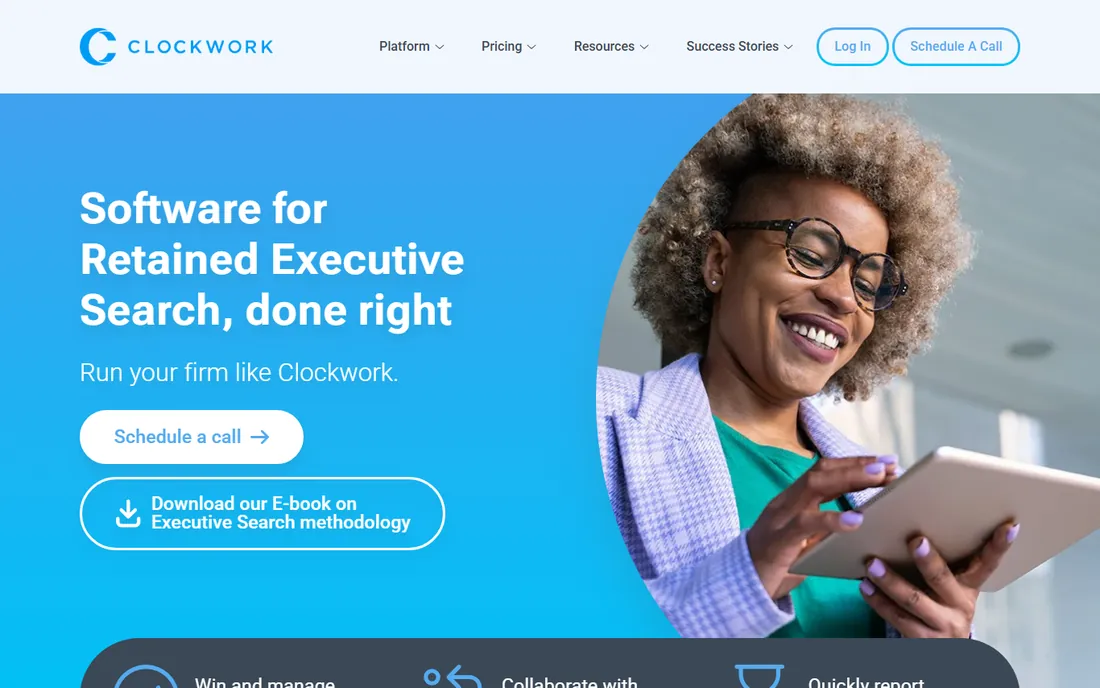
Clockwork sells a point of view, not just software. The platform encodes a specific retained search process, from research through shortlist, and the client collaboration portal lets the hiring team watch that process unfold. For boutiques that win business by selling their methodology, that alignment is the product: the software demonstrates the discipline the client is paying for.
Pricing is simple and steep at the same time. One plan, all features, $1,800 per user per year, with a monthly payment option. There is no cheaper tier to hide in, which keeps the decision honest but rules out firms that want to start small. And because the workflow is opinionated, a firm with its own well-worn process will fight the tool. Clockwork is for firms that want to adopt the Clockwork way, not customize around it.
What we like- Built around a defined retained search methodology your clients can see
- One plan with every feature included, no tier games
- Client collaboration portal that makes the process visible to hiring teams
Watch out for- Annual-only style pricing at $1,800 per user per year is a commitment
- The opinionated workflow frustrates firms that do not work that way
- Smaller ecosystem than the big agency platforms
Starting priceSee website
Free planNo
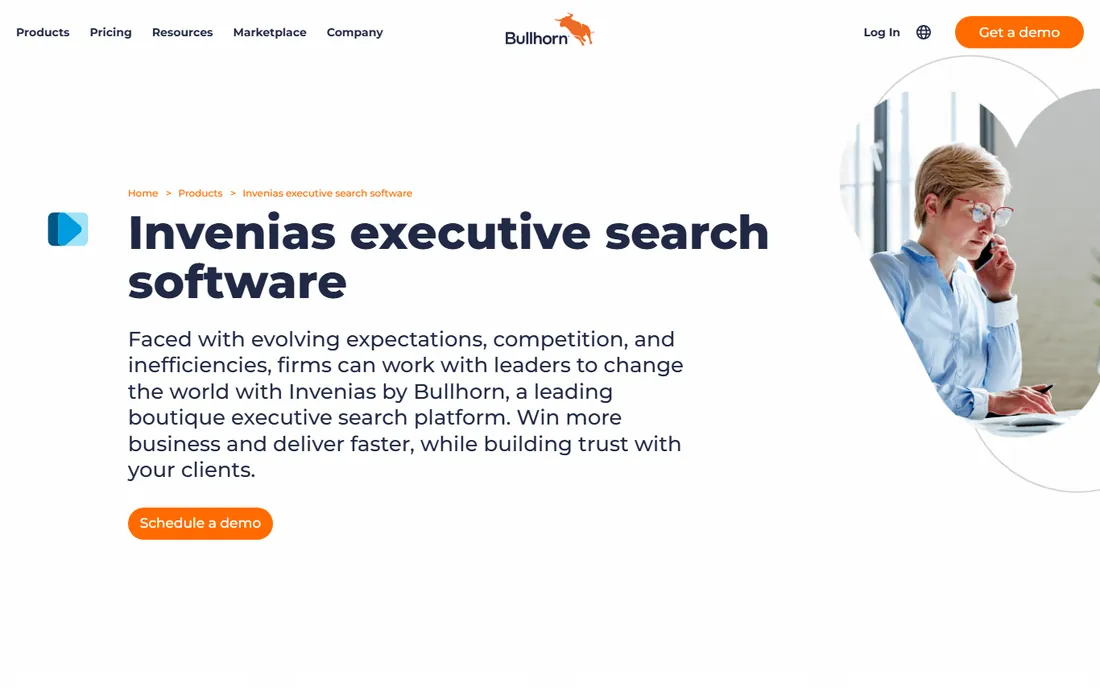
Invenias is the enterprise answer in this list. Now part of Bullhorn, it is designed for large and global executive search practices that need proper permissions, audit trails, multi-office structures and the kind of security review that makes a general counsel comfortable. If your firm pitches Fortune 500 boards, the compliance story alone can justify the shortlist.
Everything else about Invenias follows from that positioning. Pricing is quote-only and sits at the enterprise end of the market. Rolling it out is an implementation project with training and change management, not a self-serve signup. A five-person boutique would be paying for governance it will never use. But for practices where the client list includes regulated industries and global rollouts, Invenias is the safe, serious choice.
What we like- Purpose-built for executive search inside the Bullhorn family
- Handles complex global practices with multiple offices and currencies
- Deep security and compliance posture for enterprise buyers
Watch out for- Quote-only pricing that trends enterprise
- Implementation is a project, not a signup
- Overkill for boutiques under ten people
Starting priceSee website
Free planNo
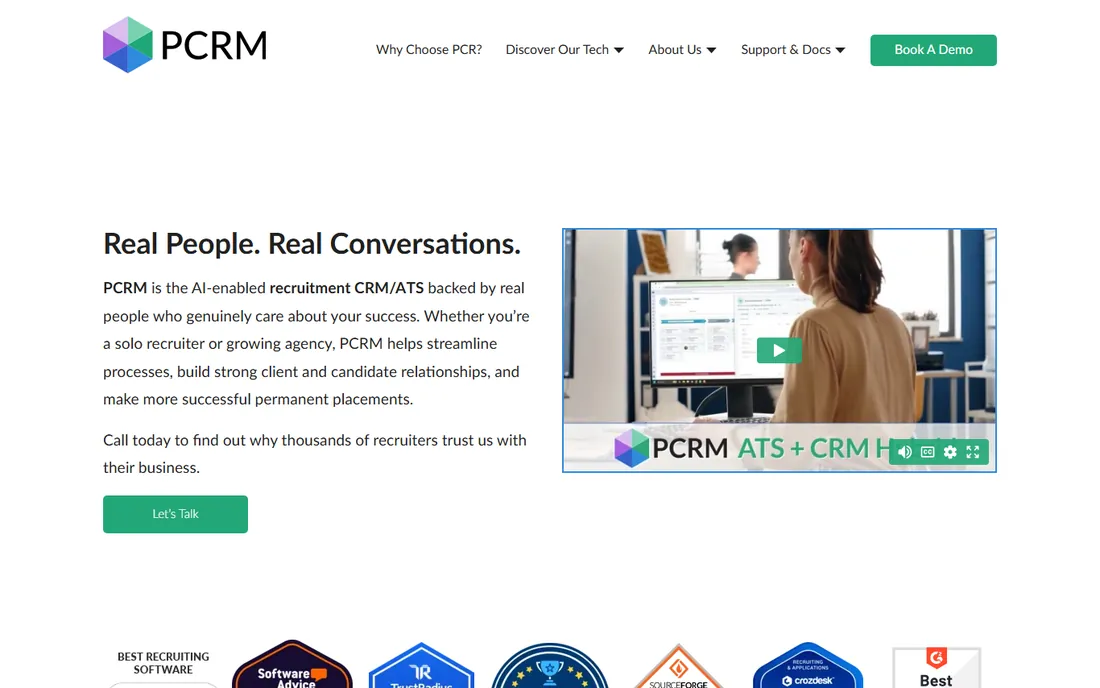
PCRecruiter has been running recruiting agencies since 1998, and it shows in the depth of the workflow coverage. This is the system for the firm that values stability over shine: decades of edge cases handled, support staff who have seen your exact problem before, and an on-premises option for firms whose clients or regulators will not accept cloud-only data storage. It was acquired by Recur Software in 2026, which has promised long-term investment in the product.
The trade-offs are visible on screen. The interface feels dated compared to Loxo or Vincere, and younger recruiters sometimes resist it. Pricing has historically been contract-based, with accounts starting around $85 per user per month on longer terms, so you negotiate rather than click to buy. PCRecruiter fits the established firm that wants a system of record for the next decade, not the newest interface.
What we like- In continuous use since 1998, one of the most proven codebases in recruiting
- On-premises deployment option for firms with strict data policies
- Famously responsive, human support
Watch out for- The interface looks its age next to modern competitors
- Pricing is contract-based and historically runs on multi-year terms
- Innovation pace is slower than VC-backed rivals
Starting priceSee website
Free planFree trial
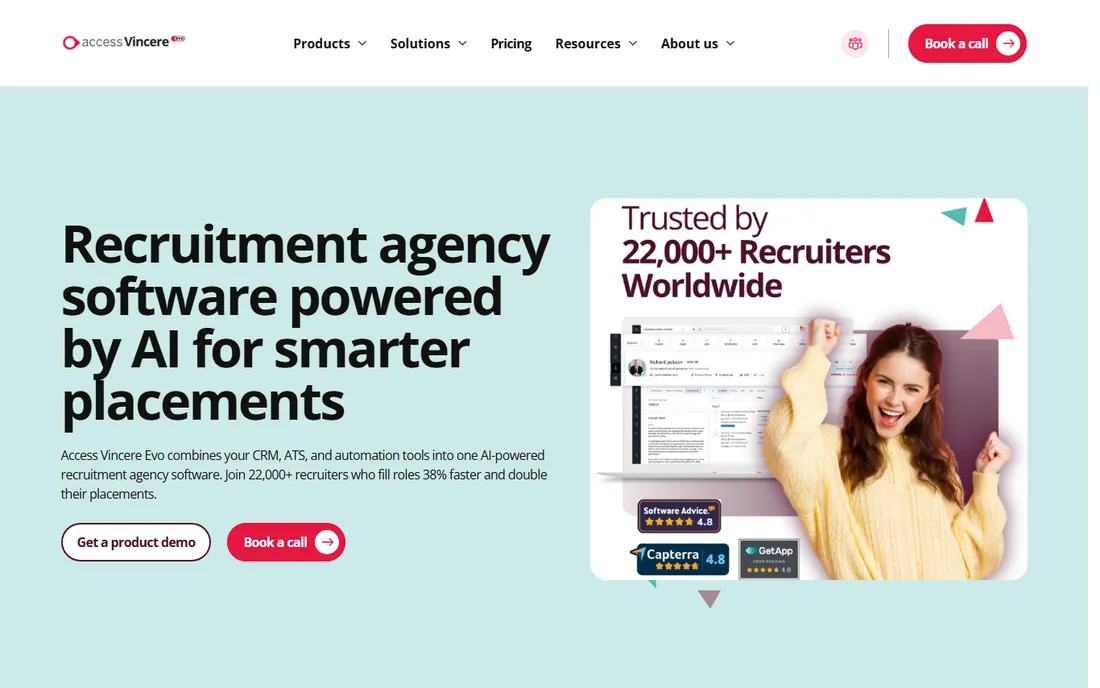
Vincere is what you get when an agency platform is designed in the modern era rather than adapted into it. The interface is clean, the workflows for perm, contract and search sit in one database, and new recruiters get productive quickly. It has grown into a genuinely global product with strong adoption among mid-size agencies in the UK, Australia and the US.
The main frustration is pricing opacity. Vincere does not publish its rates, so every evaluation starts with a sales conversation, and the numbers trend toward the mid-market rather than the budget end. Feature depth in areas like enterprise compliance and advanced analytics trails Bullhorn and Invenias. For a growing search firm that wants one modern system without enterprise complexity, though, Vincere deserves a demo slot.
What we like- Modern, clean interface that new recruiters pick up fast
- Single platform covering front, middle and back office
- Strong presence in the UK, APAC and US agency markets
Watch out for- Pricing is not published on the site
- Some advanced features lag the biggest enterprise platforms
- Support hours can be a consideration for US-only teams
Starting price$95 per user/month
Free planNo
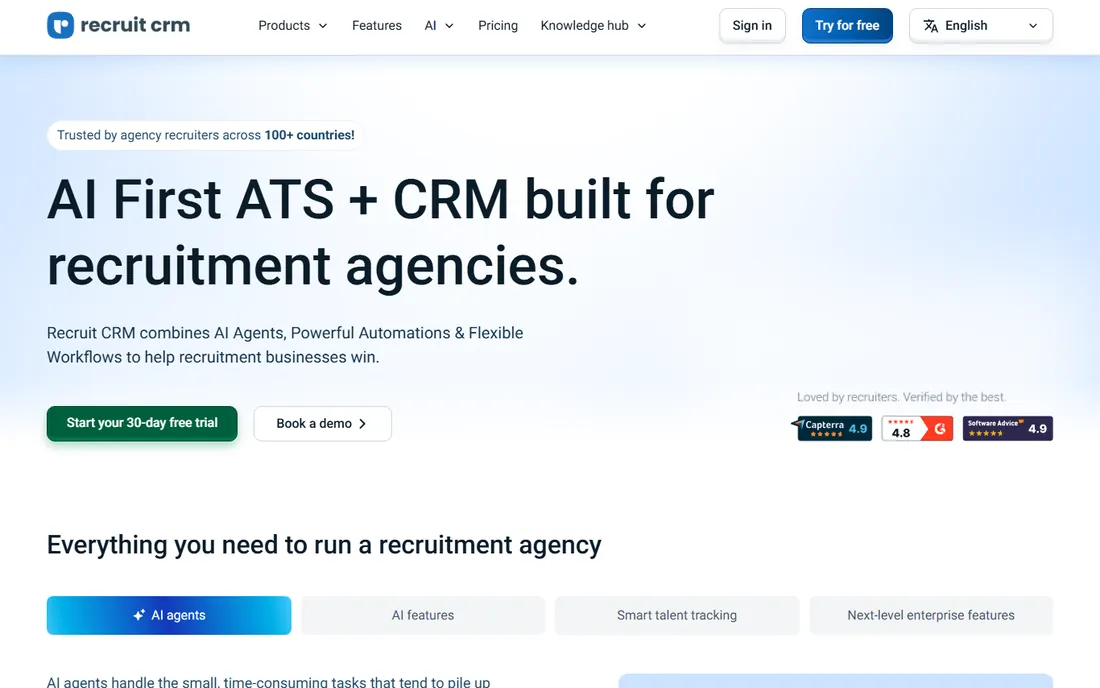
Starting a search firm is expensive enough without enterprise software bills, and Recruit CRM prices for that reality. The Pro plan starts at $95 per user per month with AI-assisted resume parsing, candidate submissions and pitching agents included, which is a lot of capability for a two-person boutique. Business at $135 and Enterprise at $215 add bigger credit pools for SMS, calling and enrichment, pooled across the account.
The honest catch is scale. Recruit CRM is built for startup and small recruitment businesses, and firms that grow into multi-office operations with strict compliance needs will eventually outgrow it. The credit system for calls and texts is fair but adds a usage line to your budget that pure subscriptions do not have. For a new or small search firm that wants modern tooling without a sales negotiation, it is the most accessible serious option here.
What we like- Transparent pricing starting at $95 per user per month
- AI features like resume parsing and candidate pitching included in plans
- Generous credit pools for calls, texts and enrichment on higher tiers
Watch out for- Built for smaller teams, so enterprise governance is thin
- The credit-based model for calls and texts adds a variable cost to watch
- Less proven at large, multi-office scale
How we chose
We started with the search terms a buyer actually types, then checked each vendor's own site to confirm the product exists today and fits executive search rather than general HR. Pricing figures come only from the vendors' own pricing pages, captured in October 2026; where a vendor does not publish pricing, the listing says so instead of repeating a third-party estimate. We read public reviews on G2 and Capterra and recruiter discussions on Reddit for the honest weaknesses, and we favored tools with a real search-firm customer base over generic CRMs with a recruiting template.
Retained search is not high-volume recruiting, so judge these tools on search-specific work. First, relationship history: can a partner see every touch with a candidate and a client over five years, including the searches that did not close? Second, research workflow: longlists, shortlists, client-ready profiles and a collaboration portal the client can actually use. Third, data quality: contact data accuracy and deduplication matter more than a big database number, because one wrong email to a sitting CEO costs you.
Then the commercial questions. Per-user pricing punishes the partner-heavy model where everyone needs a seat, so ask about read-only or occasional-user options. Check contract length, because several vendors in this category sell one- and two-year terms with auto-renewal. Confirm data export: if you leave, your candidate relationships must come with you in a usable format, not a PDF. And ask who owns implementation, because the difference between a two-week setup and a three-month project is usually your calendar, not theirs.
Questions to ask on the demo call
Vendors demo the happy path, so bring your own script. Ask to see a full retained search run end to end: research, longlist, outreach, shortlist, client presentation, placement. Ask how the system handles a candidate who appears in three different searches over two years, because duplicate handling is where cheap systems fall apart. Ask what happens to your data, in what format and at what cost, if you cancel.
Two more questions separate the serious tools from the slideware. Ask which parts of the demo were real product and which were roadmap, and get the roadmap items in writing. Ask for two reference customers who are retained search firms of your size, not staffing agencies, and actually call them. A thirty-minute reference call will tell you more than three vendor demos.
Frequently asked questions
What is the difference between executive search software and a regular ATS?
A regular ATS is built around job requisitions and applicant flow, usually for corporate HR teams. Executive search software is built around relationships, research and long-cycle placements: candidate networks that persist for years, longlist and shortlist workflows, client collaboration, and outreach to passive candidates who never applied.
How much does executive search software cost?
For published per-user pricing, expect roughly $85 to $215 per user per month, usually billed annually. Enterprise options like Invenias and quote-based platforms like Tracker and Thrive TRM are priced by negotiation and trend higher. Always budget implementation, data migration and any contact-data overages on top of the subscription.
Can a small boutique use these tools, or are they only for big firms?
Several are built for small firms. Recruit CRM starts at $95 per user per month with transparent pricing, and Crelate offers a free trial at $85 per user per month to start. The enterprise options are the ones that assume scale, so match the tool to your headcount rather than your ambition.
Do I need the sourcing database, or can I keep using LinkedIn?
LinkedIn Recruiter remains the primary sourcing channel for most search firms, and several of these tools integrate with it. The built-in databases in platforms like Loxo are best seen as a complement: useful for enrichment and contact data, rarely a full replacement. Ask each vendor about their LinkedIn integration specifically.
How long does implementation usually take?
Self-serve style tools can be running in days to two weeks. Configurable platforms like Crelate and Tracker typically take several weeks including data migration. Enterprise rollouts like Invenias are multi-month projects. Whatever the vendor says, add time for cleaning your existing candidate data, because that is always the slow part.
What should I check before signing a contract?
Confirm the renewal terms and notice period, the data export format if you leave, which features cost extra (contact data, AI credits, phone and SMS), and the support hours in your timezone. Get any roadmap promises in writing, and make sure the per-user count in the quote matches the number of partners and researchers who actually need seats.
Sources we checked (9)
- https://loxo.co/pricing
- https://recruitcrm.io/pricing
- https://www.clockworkrecruiting.com/pricing
- https://crelate.com/pricing
- https://tracker-rms.com/
- https://thrivetrm.com/
- https://www.pcrecruiter.net/site/
- https://vincere.io/
- https://www.bullhorn.com/products/invenias-executive-search/
Is your product missing or out of date?
We review this list regularly. Vendors can request a listing, send updated pricing or ask about featured placement.

Shihab Mia · Founder, Rankite
Shihab has spent more than a decade helping SaaS and e-commerce brands grow through search. He writes Rankite's software buying guides from pricing pages, documentation and public user reviews. More about Shihab.