How we make this list: we compare pricing pages, product documentation and public user reviews. Ratings come from G2, Capterra or Trustpilot, with the date we checked them.
Key takeaways
- This is a quote-based category: eight of nine vendors publish no buyer-platform pricing, so every enterprise evaluation starts with a sales conversation.
- The one exception is Precoro: Core $499/month and Automation $999/month billed annually, with a 2-8 week go-live, the transparent mid-market pick.
- Enterprise suites (Coupa, SAP Ariba, Oracle, JAGGAER, Ivalua, Zycus, GEP SMART) cover full source-to-pay; expect 4-12 month implementations and multi-year contracts.
- Procurify bridges the gap: modular purchasing with unlimited free Basic requesters, custom quotes, onboarding in weeks.
The best eProcurement software
Nobody knows what e-procurement software costs until they ask. In this category, the price list is a sales call: eight of the nine platforms below are custom-quoted, and implementations run months, not days. That opacity is the first thing to understand, because it changes how you evaluate: you shortlist on capability and fit, then run demos in parallel so vendors compete.
The nine tools below span mid-market purchasing platforms to full source-to-pay suites. Prices are from the vendors' own pages, checked in October 2026.

#1
Precoro
Best for: Mid-sized companies with purchasing spread across locations, projects or entities that need centralized control without enterprise complexity
Visit precoro.com
Starting price$499 per month billed annually (Core); $999 per month billed annually (Automation)
Free planNo
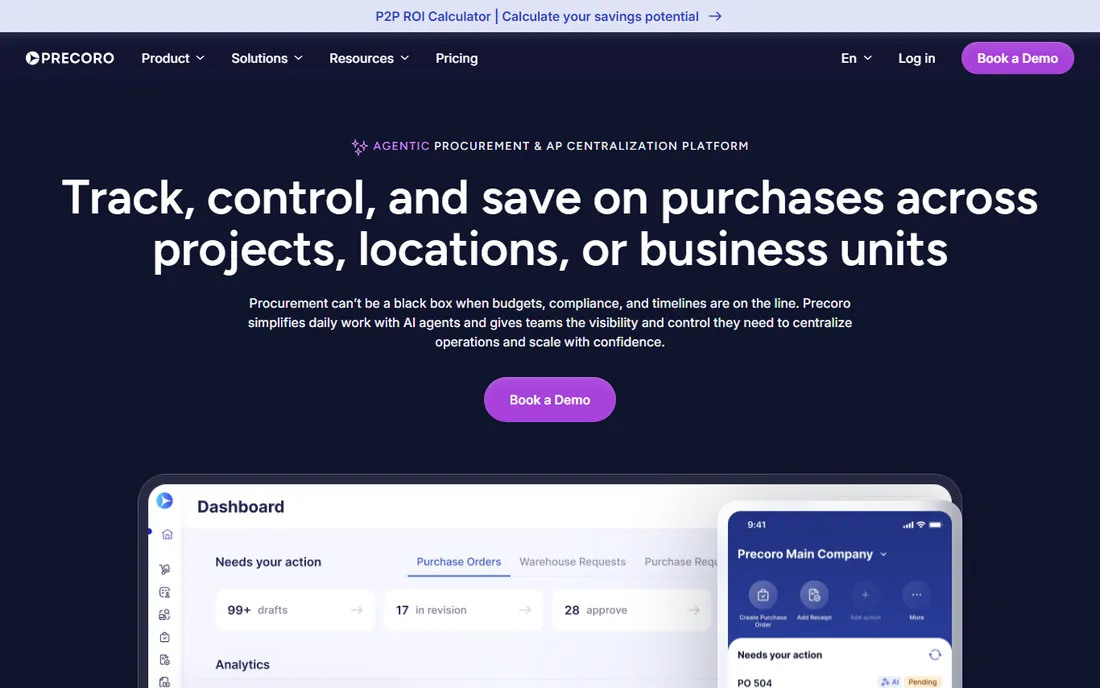
Precoro is the transparent pick. Core at $499 a month billed annually covers intake, purchasing, approvals, budgets and supplier management; Automation at $999 adds deeper automation; Enterprise is custom; a standalone AP Automation plan also starts at $499 a month. No-IT setup in 2-8 weeks delivers real budget enforcement from day one.
The honest catch is the ceiling: it is purpose-built for the mid-market, with PunchOut catalogs (Amazon Business, Grainger, Staples) and integrations for QuickBooks Online, Xero, NetSuite and Sage Intacct. For a mid-sized company that wants spend control without a consulting engagement, it is the fastest path to value.
What we like- Transparent published pricing with clear plan tiers, rare in this category
- Fast go-live: 2-8 weeks with no IT involvement required
- Multi-entity and multi-currency support with AI crews for invoice extraction and matching
Watch out for- Inventory is lightweight tracking, not full warehouse management
- Very small teams may find it less cost-effective while huge enterprises will outgrow it

#2
Procurify
Best for: Mid-market finance and operations teams that want spend control without enterprise overhead
Visit procurify.com
Starting priceSee website (modular, custom quotes; unlimited Basic users free)
Free planNo
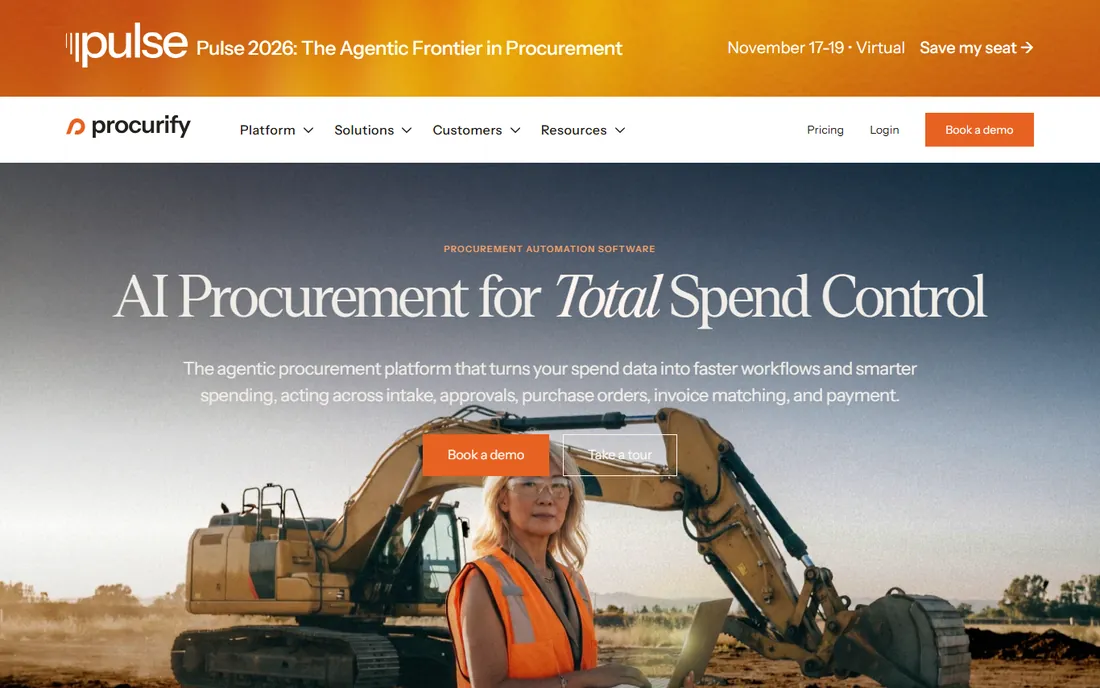
Procurify is the modular mid-market bridge. Every customer starts with Purchasing; unlimited Basic users are free, and pricing is driven by Pro users, products, add-ons and integrations. The full intake-to-pay lifecycle (requests, POs, invoices, payments, spending cards) runs in one system with a strong mobile app.
The honest catch is pricing opacity and depth: sourcing capabilities are lighter than the enterprise suites, and comparison shopping requires a quote. Onboarding runs 4-6 weeks with a dedicated team. For a growing company that has outgrown spreadsheets but not its budget, the modular model keeps the entry point sane.
What we like- Modular model: start with Purchasing, add AP or Expense and Card later
- Unlimited free Basic requesters means wide adoption without per-seat bloat
- Fast onboarding measured in weeks with no engineering resources required
Watch out for- No public pricing
- Every deal requires a sales conversation
- Strategic sourcing depth is lighter than the full source-to-pay suites

#3
Coupa
Best for: Mid-market to large enterprises that want one spend platform with high user adoption
Visit coupa.com
Starting priceSee website (custom quote; usage-based model with unlimited users)
Free planNo
Coupa is the spend-management standard. The buyer platform is custom-quoted with a usage-based model and unlimited users, covering the full source-to-pay lifecycle plus supply chain. Community-generated spend benchmarking helps teams negotiate from real market data.
The honest catch is total cost: implementation often equals or exceeds first-year licensing, and deals are multi-year. Setup is a months-long enterprise rollout, not a self-serve signup. For organizations that want one platform for all spend with the adoption rates to match, it remains the benchmark.
What we like- AI-native total spend management covering procurement, finance and supply chain on one platform
- Community spend intelligence from a large buyer/supplier network for benchmarking
- ERP-agnostic with connectors for SAP, Oracle, NetSuite, Dynamics, QuickBooks and Xero
Watch out for- Enterprise cost and long implementations (third-party analyses report 6-12+ month rollouts)
- The interface can feel heavy for occasional requesters

#4
SAP Ariba
Best for: Large enterprises, especially those already running SAP, where native ERP integration shortens the data-integration path
Visit sap.com
Starting priceSee website (custom quote)
Free planNo
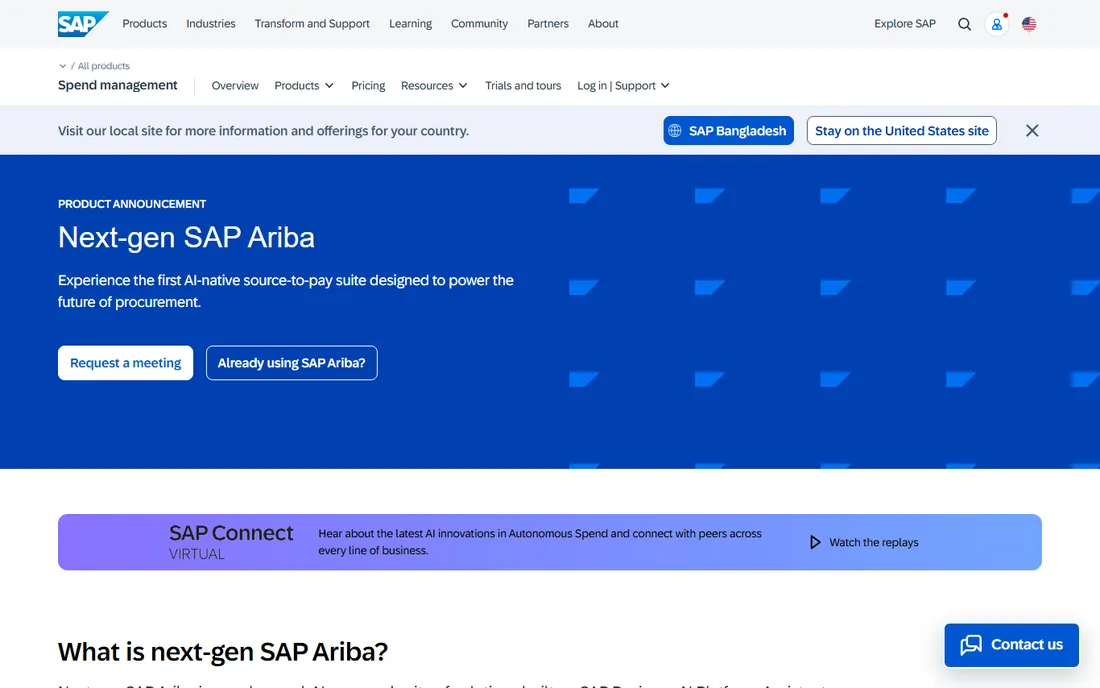
SAP Ariba is the enterprise network play. The next-gen rebuild runs on the SAP Business AI Platform with agents across the source-to-pay lifecycle, and the Business Network gives immediate access to millions of trading partners for transactions and collaboration.
The honest catch is complexity and cost: expect a consulting-led deployment and custom-quoted multi-year contracts. SAP advertises guided deployments with trial environments to ease the transition. For SAP shops, the native integration is the deciding factor; for everyone else, the learning curve is the tax.
What we like- Largest supplier network via SAP Business Network for supplier discovery and collaboration
- AI-native rebuild with Joule assistants and agents across intake, sourcing, contracts and invoicing
- Deepest integration for SAP-standardized companies
Watch out for- Heavy implementation and a real learning curve
- Cost is prohibitive for small businesses

#5
Oracle Fusion Cloud Procurement
Best for: Organizations standardized on Oracle Fusion for finance or supply chain, where procurement arrives as a native module
Visit oracle.com
Starting priceSee website (commercial pricing is quote-based)
Free planNo
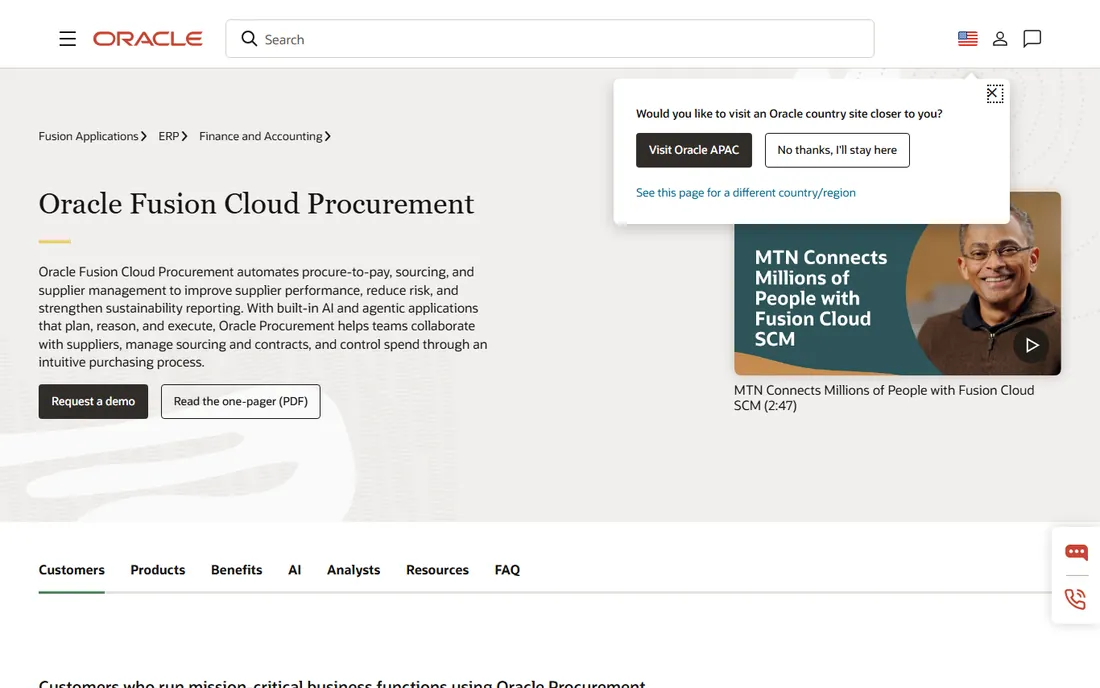
Oracle Procurement is the suite-native answer. Requisitions, sourcing, contracts and AP automation flow into the same financials without middleware, and the connected suite means one data model from purchase request to payment.
The honest catch is ecosystem lock-in: the shortest path to value assumes Oracle Fusion underneath. Setup is an ERP-module implementation measured in months. For Oracle-standardized organizations, it is the obvious choice; for mixed estates, evaluate the integration tax against best-of-breed alternatives.
What we like- Native module inside Oracle Fusion Cloud Applications: procurement, financials and SCM share one data model
- Redwood interface with built-in AI and agentic apps for approvals and sourcing
- Covers sourcing, contracts, purchasing, self-service procurement and supplier management
Watch out for- Makes the most sense inside an Oracle Fusion estate
- Standalone value is weaker for non-Oracle shops
- Enterprise-weight rollout with real change management

#6
JAGGAER
Best for: Mid-market to large enterprises with complex direct spend, especially manufacturing, public sector and higher education
Visit jaggaer.com
Starting priceSee website (custom, module-based quotes)
Free planNo
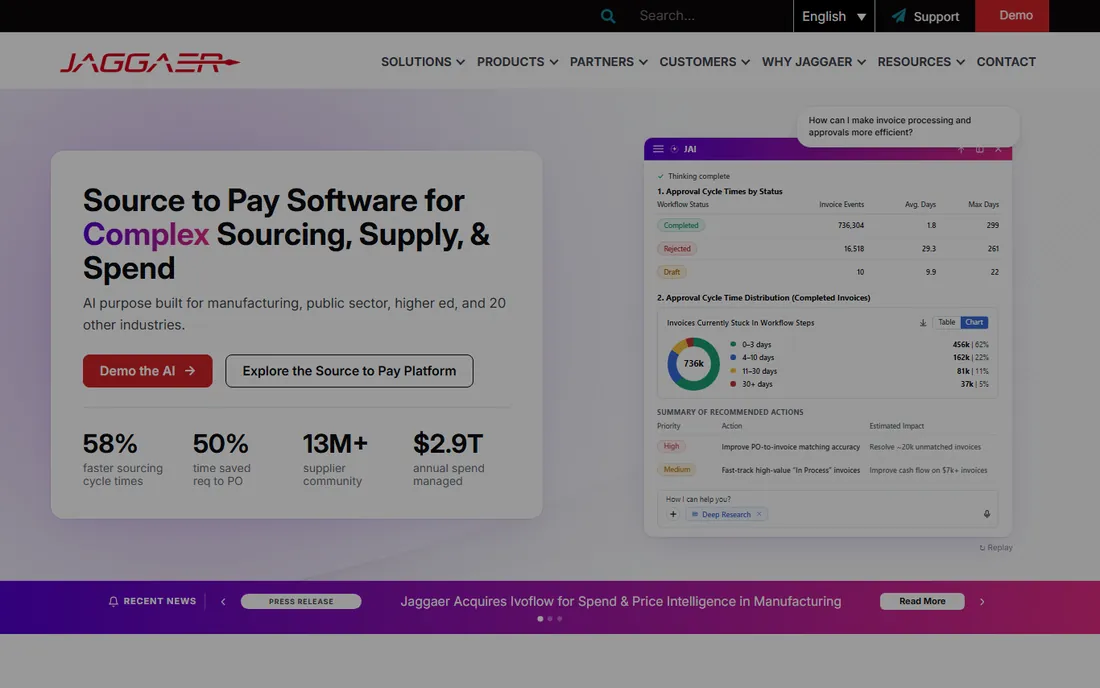
JAGGAER is the direct-spend specialist. Where most rivals are indirect-spend-first, JAGGAER handles structured category strategy and direct-materials sourcing on one data layer, with industry-specific configurations for manufacturing, public sector and higher education.
The honest catch is implementation: JAGGAER itself cites 12-16 weeks per module with a dedicated team. The modular pricing is a genuine plus: buy only the functions you need (sourcing, CLM, P2P) and add modules later. For organizations with real direct-materials complexity, it is the deepest fit.
What we like- Deepest direct-materials capability: BOM-driven sourcing, supplier quality and supply-chain collaboration
- Strong footprint in manufacturing, public sector and higher ed
- 40-plus native ERP connectors extending to 1,000-plus connected platforms
Watch out for- Steep learning curve and slow, configuration-heavy setup
- Vendor support responsiveness draws criticism in user reviews

#7
Ivalua
Best for: Large enterprises whose procurement processes do not fit standard templates and need real configurability
Visit ivalua.com
Starting priceSee website (quote-based)
Free planNo
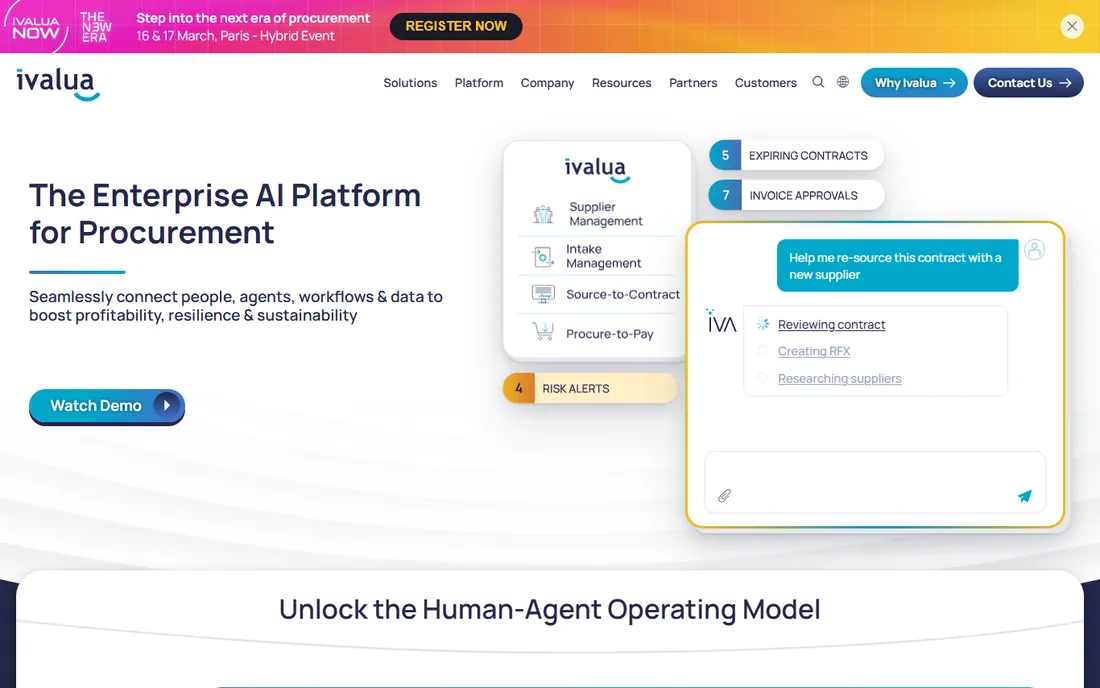
Ivalua is the configurability pick. The single-code-base platform combines pre-packaged best practices with no-code/low-code tailoring, so unique processes do not require a forked codebase. All spend (indirect, direct, services) runs on one data model.
The honest catch is that this flexibility is consulting-heavy: budget for specialized help to design and maintain custom workflows, and expect an enterprise engagement rather than weeks. For organizations whose procurement genuinely does not fit templates, it is the most adaptable platform here.
What we like- Single-code-base platform with no-code/low-code configurability for non-standard processes
- Complete source-to-pay on one data model: sourcing, contracts, eProcurement, invoicing, supplier management
- Long customer-retention track record
Watch out for- Flexibility raises implementation complexity and cost
- Customizations often need IT or consultants
- Feature breadth can overwhelm new users

#8
Zycus
Best for: Complex global enterprises that want AI agents operating inside procurement governance rather than as bolt-on assistants
Visit zycus.com
Starting priceSee website (suite is quote-based; Autonomous Negotiation Agent add-on ~$15 per tail-spend PO)
Free planNo
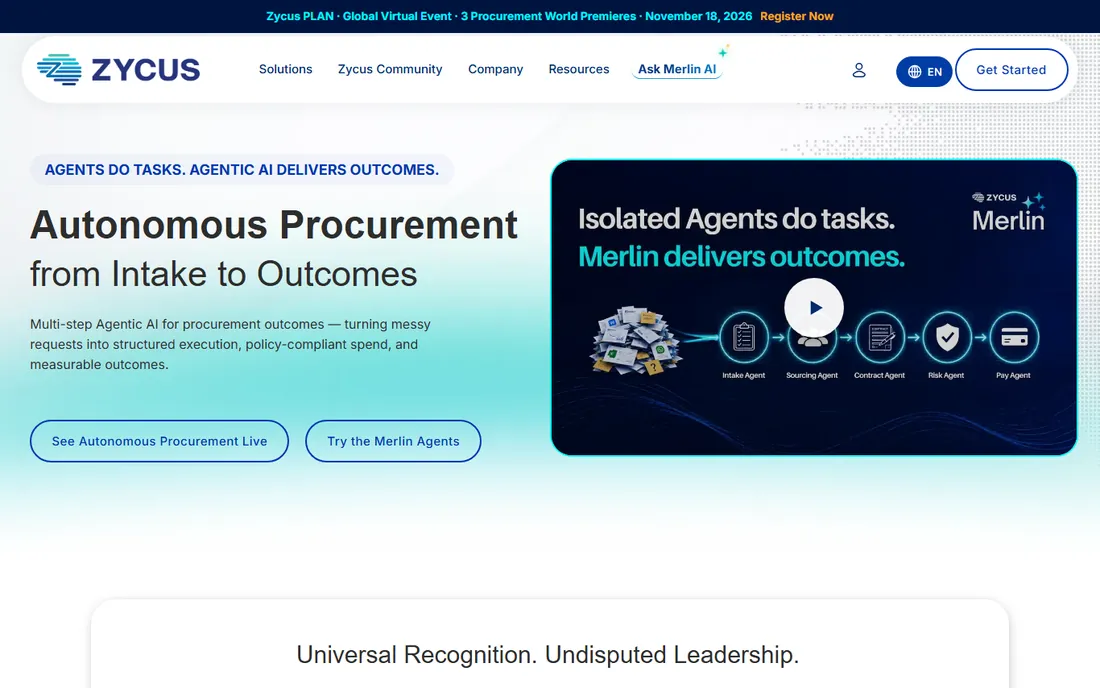
Zycus is the autonomous-procurement bet. The Merlin agents execute inside policy: intake takes requests from Teams or Slack, autonomous sourcing builds the strategy, and the Negotiation Agent runs tail-spend negotiations on price, payment terms and warranties. The ANA add-on's consumption model (~$15 per tail-spend PO) is unusually transparent for the category.
The honest catch is rollout length: this is a 4-6 month transformation program, not a quick deploy. For enterprises that want AI doing procurement work inside governance guardrails, the agentic architecture is the most advanced here.
What we like- Agentic AI built natively into one architecture: Merlin Intake, Merlin Autonomous Sourcing and the Autonomous Negotiation Agent
- Intake-to-outcomes model connects intake through negotiation to payment with one data model and audit trail
- Prebuilt connectors for SAP, Oracle and NetSuite
Watch out for- Rollouts average 4-6 months, longer for complex multi-module deployments
- Supplier-network reach is smaller than SAP Ariba's or Coupa's

#9
GEP SMART
Best for: Large enterprises running advisory-led transformation programs that want software and services from one vendor
Visit smartbygep.com
Starting priceSee website (quote-based)
Free planNo
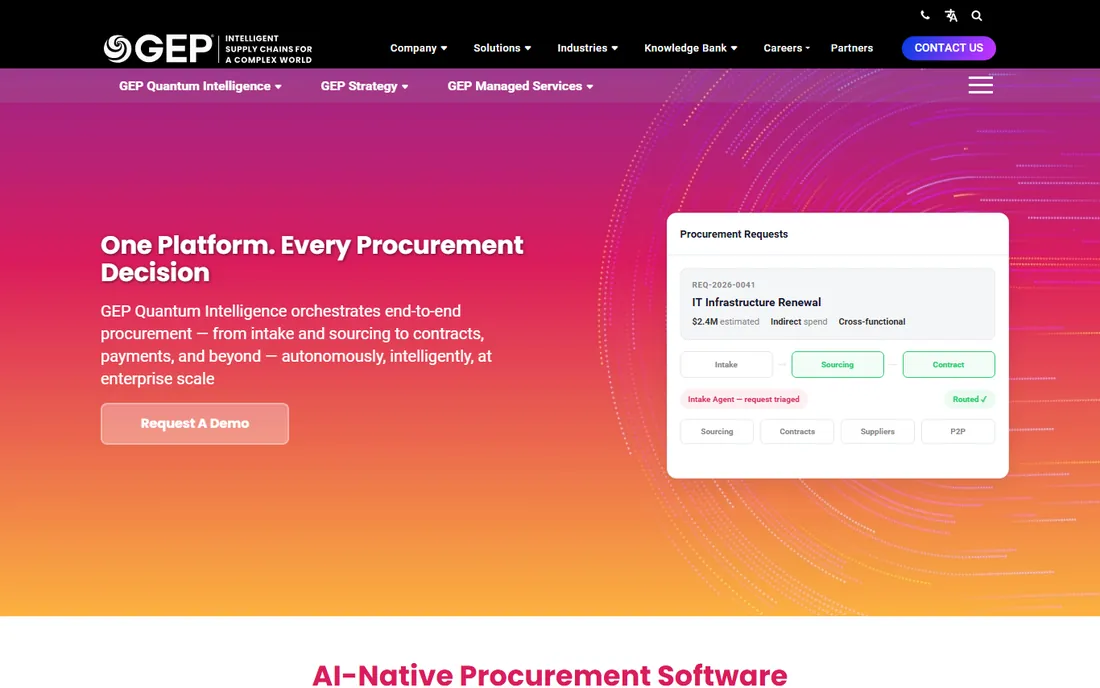
GEP SMART (now branded around GEP Quantum Intelligence) is the services-led pick. The platform's heritage is sourcing: spend analysis, RFx and supplier intelligence, now with autonomous agents across the lifecycle. Buying software and consulting from one vendor simplifies accountability.
The honest catch is the services-led model: expect a consulting engagement (typically 6-8 month implementations) rather than a pure SaaS purchase. For enterprises that want a transformation partner, not just software, the combined model is the point.
What we like- Unified source-to-pay with an agentic AI layer spanning sourcing, contracts, suppliers, purchasing and payments
- 1,000-plus out-of-the-box ERP connectors (SAP, Oracle, JD Edwards, PeopleSoft)
- Software paired with GEP's consulting and managed services
Watch out for- Enterprise-weight, services-led engagements
- Not a fit for teams wanting lightweight self-serve
- Smaller independent review base than Coupa or SAP Ariba
How we chose
We started with the categories buyers search: eprocurement software, source-to-pay software and procurement software. For each candidate we opened the vendor's official pages, checked capabilities against analyst coverage (Gartner, Forrester, Hackett) and practitioner reviews on G2 and Capterra, and compared functional depth, implementation reality and pricing transparency. Where no price is published we wrote "See website" rather than guessing.
Quick comparison
| Tool | Best for | Starting price | Free plan |
|---|
| Precoro | Mid-sized companies with purchasing spread across locations, projects or entities that need centralized control without enterprise complexity | $499 per month billed annually (Core); $999 per month billed annually (Automation) | No |
| Procurify | Mid-market finance and operations teams that want spend control without enterprise overhead | See website (modular, custom quotes; unlimited Basic users free) | No |
| Coupa | Mid-market to large enterprises that want one spend platform with high user adoption | See website (custom quote; usage-based model with unlimited users) | No |
| SAP Ariba | Large enterprises, especially those already running SAP, where native ERP integration shortens the data-integration path | See website (custom quote) | No |
| Oracle Fusion Cloud Procurement | Organizations standardized on Oracle Fusion for finance or supply chain, where procurement arrives as a native module | See website (commercial pricing is quote-based) | No |
| JAGGAER | Mid-market to large enterprises with complex direct spend, especially manufacturing, public sector and higher education | See website (custom, module-based quotes) | No |
| Ivalua | Large enterprises whose procurement processes do not fit standard templates and need real configurability | See website (quote-based) | No |
| Zycus | Complex global enterprises that want AI agents operating inside procurement governance rather than as bolt-on assistants | See website (suite is quote-based; Autonomous Negotiation Agent add-on ~$15 per tail-spend PO) | No |
| GEP SMART | Large enterprises running advisory-led transformation programs that want software and services from one vendor | See website (quote-based) | No |
Is your product missing or out of date?
We review this list regularly. Vendors can request a listing, send updated pricing or ask about featured placement.
Buying in a quote-only category
With eight of nine vendors quote-based, the buying process is the product decision. Three rules help. First, shortlist on fit before price: direct vs. indirect spend, ERP estate, implementation appetite. A perfect-fit platform at a higher quote beats a cheap misfit that fails adoption.
Second, run two or three demos in parallel with the same scenario: your top three procurement workflows, your ERP, your approval chains. Vendors compete harder when they know they are being compared, and identical scenarios make the comparison honest.
Third, price the total: license, implementation, integration, change management, and year-two renewal. In this category the license is often the smallest line item. Ask every vendor for implementation timeline and cost separately from the license, reference customers in your industry, and the renewal terms in writing. Precoro's published pricing is the one anchor: if an enterprise quote is ten times Precoro's $499 a month, the vendor needs to justify the other nine.
Mid-market vs. enterprise: where the line sits
Precoro and Procurify define the mid-market: published or modular pricing, weeks to go live, no consulting army. The enterprise suites define the other end: full source-to-pay, AI agents, supplier networks, months of implementation, multi-year contracts.
The line is not company size alone. A 500-person manufacturer with complex direct spend needs JAGGAER's BOM-driven sourcing more than a 5,000-person services company needs any of it. A mid-sized company with purchasing across ten entities needs Precoro's multi-entity control more than a larger single-site business. Map the complexity of your spend, not just your headcount, to the platform.
Frequently asked questions
What is eProcurement software?
E-procurement software digitizes the purchasing process: requisitions, approvals, purchase orders, invoicing and payments. Full source-to-pay suites add strategic sourcing, contract lifecycle management, supplier management and spend analytics. The tools here range from purchasing-focused platforms (Precoro, Procurify) to complete suites (Coupa, SAP Ariba, Oracle, JAGGAER, Ivalua, Zycus, GEP SMART).
How much does eProcurement software cost?
Almost every vendor is custom-quoted. The one published anchor is Precoro: Core $499/month and Automation $999/month billed annually. Enterprise suites typically run into six figures annually plus implementation, with multi-year contracts. Zycus publishes one transparent data point: its Autonomous Negotiation Agent add-on at ~$15 per tail-spend PO.
What is the difference between source-to-pay and procure-to-pay?
Source-to-pay (S2P) is the complete lifecycle: sourcing, supplier selection, contracts, purchasing, invoicing and payment. Procure-to-pay (P2P) is the downstream subset: requisition through payment once suppliers are contracted. The enterprise suites here cover full S2P; Precoro and Procurify focus more on the P2P and purchasing side.
Which eProcurement software is best for mid-sized companies?
Precoro (published pricing from $499/month, 2-8 week go-live) and Procurify (modular, unlimited free requesters) are the mid-market picks. The enterprise suites are overkill for most mid-sized companies in both cost and implementation effort.
Do I need eProcurement software if I already have an ERP?
It depends on the ERP. Oracle Fusion shops get procurement as a native module. SAP shops get Ariba's deep integration. For other ERPs, a best-of-breed platform (Coupa, Ivalua, Precoro) layers over the ERP with prebuilt connectors, adding guided buying, intake and sourcing depth the ERP lacks. The ERP handles the ledger; the procurement platform handles the buying experience.
How long does eProcurement implementation take?
Precoro: 2-8 weeks. Procurify: 4-6 weeks. JAGGAER: 12-16 weeks per module. Zycus: 4-6 months. Coupa: 6-12+ months. GEP SMART: 6-8 months as a services engagement. Budget the implementation cost separately from the license: in enterprise deals it often equals or exceeds first-year licensing.
Sources we checked (11)
- https://precoro.com/pricing
- https://www.procurify.com/pricing/
- https://www.coupa.com/
- https://www.sap.com/products/spend-management/smart-source-to-pay-procurement-software.html
- https://www.oracle.com/erp/procurement
- https://jaggaer.com/
- https://ivalua.com/
- https://www.zycus.com/
- https://www.smartbygep.com/procurement-software
- https://www.g2.com/categories/e-procurement
- https://www.capterra.com/procurement-software/
Is your product missing or out of date?
We review this list regularly. Vendors can request a listing, send updated pricing or ask about featured placement.

Shihab Mia · Founder, Rankite
Shihab has 5+ years in B2B and SaaS SEO. He writes Rankite's software buying guides from pricing pages, documentation and public user reviews. More about Shihab.