How we make this list: we compare pricing pages, product documentation and public user reviews. Ratings come from G2, Capterra or Trustpilot, with the date we checked them.
Key takeaways
- Microsoft Azure AI Foundry, Amazon Bedrock, and Google Cloud Vertex AI are the default choices for companies already running on those clouds, with broad model catalogs and pay-per-use pricing.
- IBM watsonx.ai suits regulated companies that want governance, model choice, and deployment options beyond a single cloud, with a published Standard plan starting at 1110 dollars a month.
- Dataiku, DataRobot, and Databricks suit data teams that build, tune, and monitor models from company data, with visual tools for analysts and code tools for data scientists.
- Palantir and Salesforce Einstein suit operational use, with Palantir focused on decisions across complex operations and Salesforce focused on AI inside CRM workflows.
- Most enterprise pricing is usage-based or quoted, so pilot costs, token or compute rates, and governance features matter more than a headline starting price.
Quick comparison
Is your product missing or out of date?
We review this list regularly. Vendors can request a listing, send updated pricing or ask about featured placement.
Starting priceSee website
Free planFree trial
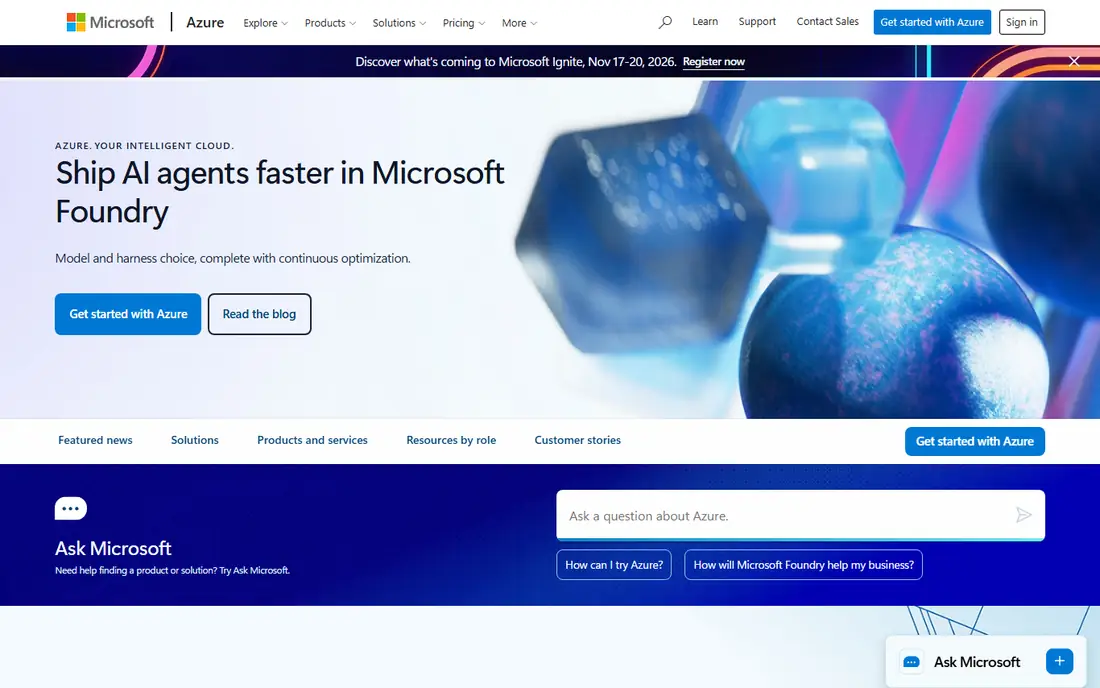
Azure AI Foundry is the natural pick for companies already running on Microsoft 365, Entra ID, and Azure data services. It brings model access, agent building, retrieval, and content safety into one managed layer, with Azure OpenAI models alongside other vendors. Identity controls, private networking, and compliance coverage fit enterprises that already pass Microsoft-based security reviews.
The complexity is real. Foundry splits deployments by payment type and by data zone, and the choice affects where prompts are processed, so a team must decide residency posture at deployment time rather than later. Token pricing varies by model, and provisioned throughput can cut costs for steady workloads while adding commitment. For Microsoft shops, those trade-offs are worth learning. For companies on another cloud, the same features become integration work.
What we like- Broad model catalog including OpenAI models
- Strong identity, security, and compliance controls
- Provisioned throughput for steady workloads
Watch out for- Pricing is complex across deployment types
- Global deployment can raise data residency questions

#2Amazon Bedrock
Best for: AWS-based model choice4.4/5 on
G2 (78 reviews, checked Oct 2026)
Visit aws.amazon.com
Starting priceSee website
Free planNo
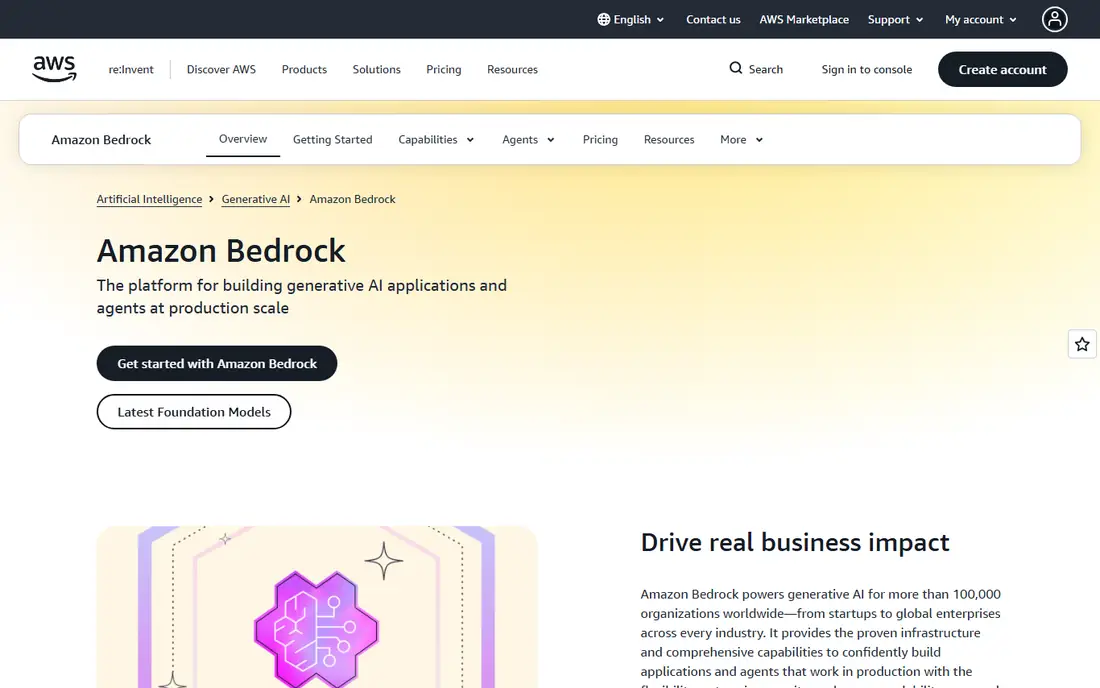
Amazon Bedrock gives AWS customers a managed way to use models from Amazon, Anthropic, Meta, Mistral, and others without running the models themselves. You call one API, add guardrails for content and sensitive data, connect knowledge bases for retrieval, and build agents with a managed runtime. Serverless billing suits bursty workloads, since you pay for tokens used rather than idle servers.
The bill needs modeling beyond tokens. Knowledge base queries, guardrail checks, storage, logging, and agent runtime hours add costs on top of inference, and a retrieval-heavy app can cost far more than its raw token count suggests. Region availability also matters, since not every model runs in every AWS region. For AWS teams that want vendor choice without managing infrastructure, Bedrock is a strong default.
What we like- Wide model choice across vendors in one API
- Serverless pay-per-token billing
- Guardrails, knowledge bases, and agent runtime
Watch out for- No free tier
- Ancillary costs for storage, monitoring, and retrieval add up
- Model availability varies by region

#3Google Cloud Vertex AI
Best for: Google Cloud and Gemini workloads4.3/5 on
G2 (660 reviews, checked Oct 2026)
Visit cloud.google.com
Starting priceSee website
Free planYes
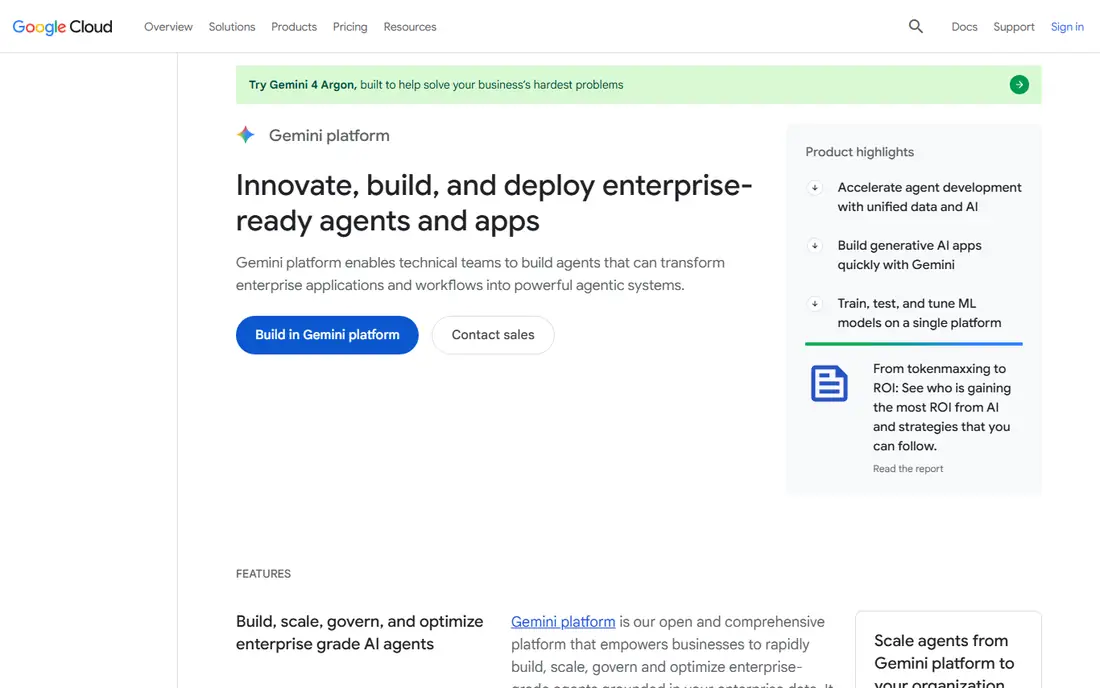
Vertex AI is Google Cloud's managed platform for building and running AI, centered on Gemini models with long context windows and multimodal input. It connects well to BigQuery, Cloud Storage, and Dataflow, so teams that already analyze data in Google Cloud can build retrieval and agent workflows without moving data elsewhere. A free tier helps development and low-volume work, and context caching can cut costs for repeated prompts.
Pricing is the part to model carefully, since it mixes per-token model costs, compute for training and deployment, and per-query costs for search and grounding tools. Teams that only need Gemini will find Vertex straightforward. Teams that want the newest third-party models on day one should check availability in the Model Garden, since some non-Google models arrive later than on their home platforms.
What we like- Strong Gemini models with long context
- Close links to BigQuery and Google data tools
- Free tier for development
Watch out for- Pricing mixes tokens, compute, and agent tools
- Non-Google models can lag behind their native releases

#4IBM watsonx.ai
Best for: Governed, multi-cloud AI4.4/5 on
G2 (153 reviews, checked Oct 2026)
Visit ibm.com
Starting price$1,110 per month (Standard)
Free planYes
IBM watsonx.ai suits companies that need governance and deployment flexibility more than a single cloud catalog. The free toolbox offers a monthly token allowance, limited compute hours, and text extraction for testing. The Standard plan starts at 1110 dollars a month for enterprise production use, with model inference, retrieval, agent tools, and tuning features, while Essentials offers pay-as-you-go use for smaller production work.
The honest catch is that the Standard price is a starting point. Model inference, compute hours, and advanced support add usage costs, and a full enterprise deployment with private hosting or dedicated controls will be quoted. For regulated industries that need audit trails, model governance, and on-premises or multi-cloud options, watsonx is a serious contender. For a small team that only needs API access to one model, a cloud platform will be simpler and cheaper.
What we like- Published pricing with a free toolbox
- Governance and model tuning tools
- Deployment beyond a single cloud
Watch out for- Standard plan is a floor, not a full enterprise cost
- Usage fees for models and compute sit on top

#5Dataiku
Best for: Data teams building governed AI4.4/5 on
G2 (266 reviews, checked Oct 2026)
Visit dataiku.com
Starting priceSee website
Free planFree trial
Dataiku brings analytics, models, and AI agents into one governed system. Analysts build visual pipelines, data scientists write code in the same project, and teams share data preparation, modeling, and deployment in a single flow. Its LLM Mesh centralizes how teams connect to language models, which helps governance teams control which models are used, what data they see, and how outputs are reviewed.
Pricing is the main friction. Dataiku does not publish paid prices, so buyers need a sales quote, and the platform can feel large for a company that only wants a chatbot or a single model. A free edition and a trial let teams test the core workflow first. For a data team that already cleans, models, and monitors data in one place, Dataiku reduces handoffs. For a team without that data work, a cloud AI platform is a lighter start.
What we like- Visual pipelines plus code in Python, R, and SQL
- Governed LLM access through LLM Mesh
- Strong collaboration for analysts and data scientists
Watch out for- Paid pricing is quoted, not published
- Platform can feel large for a team that only needs one model

#6DataRobot
Best for: Automated modeling and governance4.4/5 on
G2 (54 reviews, checked Oct 2026)
Visit datarobot.com
Starting priceSee website
Free planFree trial
DataRobot focuses on getting models into production with governance, not just building them in a notebook. Its automated modeling tests many approaches for tabular, time-series, and text data, ranks them, and explains drivers in terms a business team can follow. Model monitoring watches for drift and performance drops, and governance tools track approvals, versions, and documentation for regulated use.
The platform does not remove data work. Clean, well-labeled data and a clear business question still decide whether a model is useful, and automated results still need human review before they affect customers. Pricing is quoted rather than published, so budget talks happen with sales. DataRobot fits companies with strong data teams that want speed and governance for many models, rather than a one-off experiment.
What we like- Automated machine learning for tabular and time-series data
- Model monitoring and governance
- Agent and app building
Watch out for- Pricing is quoted
- Automated modeling still needs data quality work and human review

#7Databricks
Best for: Data and AI on one platform4.6/5 on
G2 (1,383 reviews, checked Oct 2026)
Visit databricks.com
Starting priceSee website
Free planYes
Databricks grew from data engineering, and that foundation shapes its AI platform. Teams store and process data in a lakehouse, build models and agents in shared notebooks, and serve them with governance controls, all without moving data to a separate AI silo. That matters for companies whose AI value comes from their own data, such as customer records, transactions, and operational logs, rather than from a generic model alone.
Billing is the challenge. Databricks charges by compute units, and the underlying cloud infrastructure adds cost on top, so a forecast needs both parts and a clear view of workload size. A free edition lets individuals test the workspace, while enterprise pricing is negotiated. For data-heavy companies already on Databricks, adding AI there is natural. For companies without a lakehouse, the platform is a larger commitment than a model API alone.
What we like- Unified data, analytics, and AI workspace
- Strong Spark and lakehouse foundation
- Governed model serving and agents
Watch out for- Consumption-based billing is hard to forecast
- Cloud infrastructure costs sit on top of platform charges
Starting priceSee website
Free planNo
Palantir builds platforms that help organizations make decisions across complex operations, from supply chains and manufacturing to defense and healthcare workflows. Its ontology links data sources to real objects such as assets, orders, and patients, and agents and workflows act on that linked picture with human oversight. That design suits problems where a decision needs many data sources and a clear audit trail, not just a text answer.
The cost and effort are enterprise-scale. Pricing is quoted, deployments often involve substantial implementation work, and a company that only needs a customer chatbot will find Palantir far heavier than needed. For organizations with complex, high-stakes operations and the budget to implement a decision platform properly, Palantir is in a class of its own. For most other buyers, a cloud or data platform will deliver value faster.
What we like- Strong ontology for linking operational data to decisions
- Agent and workflow tools for complex operations
- Deep deployment support
Watch out for- Pricing is quoted and enterprise-scale
- Implementation effort is high
- Overkill for a simple chatbot or single model
Starting priceSee website
Free planFree trial
Salesforce Einstein, including Agentforce, brings AI into the CRM where customer work already happens. Agents can draft replies, summarize cases, qualify leads, and complete guided tasks inside Sales and Service Cloud, using customer data under Salesforce trust controls. For a company already running on Salesforce, that embedding is the main advantage: staff do not need a separate AI tool, and AI actions stay inside existing workflows and permissions.
The limit is scope. Einstein delivers most value to companies already committed to Salesforce, and pricing mixes CRM editions, AI credits, and add-ons in a way that needs a careful quote. Custom agents and integrations need Salesforce skills, either in-house or from a partner. If your customer data and service workflows live in Salesforce, Einstein is a natural shortlist entry. If they live elsewhere, a cloud or data platform will fit better.
What we like- AI embedded in Sales, Service, and Marketing Cloud
- Agentforce agents for customer workflows
- Trust layer for data and prompts
Watch out for- Value depends on Salesforce adoption
- Pricing mixes editions, credits, and add-ons
- Customization needs Salesforce skills
How we chose
We compared pricing pages, product documentation, and public reviews on G2, Capterra, and Reddit, and we checked each platform for model choice, data controls, governance features, deployment options, integrations, and fit for different company sizes. We kept a mix of cloud platforms, data and modeling platforms, and operational platforms, because enterprise AI buyers start from different stacks. We did not claim hands-on testing, and we treated vendor pricing pages as the source for prices and plan terms, with review sites used only to spot common complaints such as billing complexity or implementation effort.
Running a pilot that proves value
Pick one workflow with a clear owner, a clear data source, and a measurable outcome, such as faster case handling, fewer manual reviews, or shorter report preparation. A pilot that tries to cover every department at once usually produces a demo, not a decision. Give the pilot a fixed time frame, a small set of users, and a baseline from current work, so you can compare the AI result against how the job is done today.
Governance should start in the pilot, not after it. Decide who can access which data, which models are approved, how outputs are reviewed, and where logs are kept. Test the failure cases early: wrong answers, missing data, and requests outside the approved scope. A platform that makes those controls easy will save far more time in a security review than a platform with a slightly better model but weak audit trails.
Budgeting beyond the model price
Model tokens are only one part of the bill. Add compute for retrieval and agents, storage for logs and embeddings, monitoring tools, integration work, and staff time for review and support. Usage-based platforms suit bursty or experimental work, while provisioned capacity suits steady production traffic. Ask each vendor for a cost model based on your expected volume, and run the pilot at a realistic volume, not a tiny demo volume, before you sign a larger commitment.
Questions for every vendor
Ask how your data is used, whether it trains shared models, where it is processed and stored, and how you can delete it. Ask what happens when a model version changes, how you roll back a deployment, and how you monitor accuracy and drift over time. Ask for reference customers in your industry and of a similar size, and for a clear path from pilot to production, including support hours and escalation. The answers will separate platforms that are ready for enterprise use from those that are only ready for a demo.
Frequently asked questions
What is the best enterprise AI platform for a company already on AWS, Azure, or Google Cloud?
The matching cloud platform is usually best: Azure AI Foundry for Microsoft shops, Amazon Bedrock for AWS shops, and Google Cloud Vertex AI for Google Cloud shops. The match reduces integration work, keeps data controls inside a familiar security model, and simplifies billing. A data or operational platform can still sit on top, but the cloud platform is the safer foundation.
How much does an enterprise AI platform cost?
Costs vary widely, from pay-per-token API use that can start small, to quoted enterprise contracts that run into six figures a year. IBM watsonx.ai publishes a Standard starting price of 1110 dollars a month, while most other platforms quote based on usage, seats, or compute. Model your pilot at realistic volume, including retrieval, storage, and monitoring, before you compare headline prices.
Do we need a data platform, or is a model API enough?
A model API is enough for a single chatbot or summarization task with simple data. A data platform such as Databricks, Dataiku, or DataRobot becomes necessary when AI value depends on company data, many models, governance, and monitoring over time. If your use case is one workflow with public or simple data, start with the API and add platform controls only when the workload grows.
How do enterprises control AI risk and governance?
Leading platforms offer access controls, audit logs, content filters, data residency options, and model governance tools that track versions and approvals. Governance also needs process: approved models, human review for high-stakes outputs, regular accuracy checks, and clear rules on data use. Pick a platform whose controls match your strictest regulator or customer, and test them in the pilot.
Can a mid-size company use these platforms, or are they only for large enterprises?
Mid-size companies can use cloud platforms and data platforms, often starting with pay-per-use pricing and a single workflow. Palantir and full enterprise deployments of other platforms suit larger budgets and more complex operations. Start small, prove value on one workflow, and expand only when governance and cost controls are in place.
Sources we checked (9)
- https://azure.microsoft.com
- https://aws.amazon.com/bedrock/
- https://cloud.google.com/vertex-ai
- https://www.ibm.com/watsonx
- https://www.dataiku.com
- https://www.datarobot.com
- https://www.databricks.com
- https://www.palantir.com
- https://www.salesforce.com
Is your product missing or out of date?
We review this list regularly. Vendors can request a listing, send updated pricing or ask about featured placement.

Shihab Mia · Founder, Rankite
Shihab has 5+ years in B2B and SaaS SEO. He writes Rankite's software buying guides from pricing pages, documentation and public user reviews. More about Shihab.
 Microsoft Azure AI Foundry
 Palantir
 Salesforce Einstein