How we make this list: we compare pricing pages, product documentation and public user reviews. Ratings come from G2, Capterra or Trustpilot, with the date we checked them.
What is the best engineering analytics software
The best engineering analytics software for most mid-size teams is LinearB, because it publishes a clear starting price, covers DORA metrics and AI impact in one platform, and offers a 45 day free trial. Swarmia is the strongest choice for small teams, because it is free for companies with fewer than 10 developers and publishes every plan price. Jellyfish and DX suit larger organisations that need finance grade reporting and developer experience surveys, but both sell by quote, so budget approval takes longer.
Key takeaways: LinearB starts at $29 per contributor per month, with a 50 contributor minimum. Swarmia starts at $45 per developer per month and is free below 10 developers. Pluralsight Flow starts at $38 per contributor per month. Jellyfish, DX and Code Climate Velocity do not publish a starting price, so treat them as quote only. Faros AI now uses consumption based pricing.
What are DORA metrics and why do they matter
DORA metrics answer one question: how fast and how reliably does your team ship software. Deployment frequency measures how often code reaches production. Lead time for changes measures the time from a commit to production. Change failure rate measures the share of deployments that cause a failure. Time to restore service measures how fast the team recovers from an incident. Together they give a leader numbers to track week by week.
What is the difference between engineering analytics and observability
Engineering analytics measures how people and process produce software, while observability measures how software behaves once it runs. An observability platform tracks logs, traces and infrastructure health, and it answers questions about errors and latency in production. An engineering analytics platform tracks pull requests, review time, cycle time and deployment frequency, and it answers questions about bottlenecks in the delivery process. The two categories overlap on incident data, but they serve different buyers. This guide covers analytics tools only.
What is SPACE and how does it fit with DORA
SPACE is a framework for developer productivity that looks beyond delivery speed. It stands for Satisfaction and well-being, Performance, Activity, Communication and collaboration, and Efficiency and flow. DORA metrics cover the performance and efficiency parts well, but they say nothing about how developers feel about their work. That gap matters, because a team can ship fast while burning out, and the numbers will look healthy until people leave. Tools such as DX, Swarmia and Jellyfish add developer experience surveys to their Git based metrics.
How much does engineering analytics software cost
Engineering analytics software costs from $20 to $59 per developer per month where prices are published, and considerably more where pricing is quote only. The table below uses the starting price of each tool, checked 21 Nov 2026. Prices are per contributor or per developer per month on annual billing unless stated otherwise.
| Tool |
Starting price |
Free plan |
Best for |
| LinearB |
$29 per contributor per month, billed annually |
No free plan, 45 day trial |
Mid-size teams that want DORA metrics plus AI impact |
| Jellyfish |
Quote only |
No |
Large organisations that need finance reporting |
| Pluralsight Flow |
$38 per contributor per month, billed annually |
No |
Teams already using Pluralsight for learning |
| Code Climate Velocity |
Quote only |
No |
Enterprises that want metrics plus advisory |
| Swarmia |
$45 per developer per month, billed annually |
Yes, under 10 developers |
Small teams and developer first workflows |
| DX |
Quote only |
No |
Organisations that run developer experience surveys |
| Sleuth |
$20 per developer per month |
Yes, Lite plan |
Teams focused on deployment tracking |
| Faros AI |
Quote only, consumption based |
Faros Desktop free |
Organisations measuring AI coding spend and ROI |
The cheapest published entry point is Sleuth at $20 per developer per month, followed by LinearB at $29 and Pluralsight Flow at $38. LinearB requires at least 50 contributors on its entry plan, so a 20 person team cannot buy it at the listed price. Swarmia is free below 10 developers, which makes it the cheapest option for a small team even though its paid price is higher. Jellyfish and DX cost more: the only public figures are Jellyfish at $30,800 a year for 15 seats, and DX at a $15,000 a year platform fee plus $672 per additional active contributor.
Quick comparison
| Tool | Best for | Starting price | Free plan |
|---|
 LinearB | Mid-size engineering teams that want DORA metrics, AI impact reporting and pull request automation in one platform | $29 per contributor per month, billed annually, Essentials plan, 50 contributor minimum | No free plan. A 45 day free trial is available with no payment method required. |
 Jellyfish | Large engineering organisations that report delivery, allocation and R and D spend to finance and the board | Quote only. The vendor pricing page lists no prices. The only public figure is an AWS Marketplace bundle at $30,800 a year for the full platform with 15 seats. | No free plan and no free trial is listed on the vendor pricing page. |
 Pluralsight Flow | Engineering teams in companies that already use Pluralsight Skills for developer learning | $38 per contributor per month, billed annually, Core plan | No free plan and no free trial is listed. |
 Code Climate Velocity | Enterprises that want engineering metrics combined with hands on advisory from practitioners | Quote only. Code Climate sells Velocity as an engagement that pairs the platform with advisory support, and it does not publish a platform only price. | No free plan. The free Velocity for Teams service ended in December 2023 and those accounts were deactivated in March 2024. |
 Swarmia | Small and mid-size teams that want published pricing, a free tier and developer experience surveys in one tool | $45 per developer per month, billed annually, Standard plan. Single modules start at $5 per developer per month. | Yes. Free for companies with fewer than 10 developers. |
 DX | Organisations that run developer experience surveys as the centre of their productivity programme | Quote only. DX does not publish prices on its own site. Its AWS Marketplace listing starts at $15,000 for a 12 month contract, plus $672 per additional active contributor. | No free plan, free trial or pricing page is listed. Buyers start with a demo. |
 Sleuth | Teams that want focused DORA metrics and deployment tracking without a broad platform purchase | $20 per developer per month, Team plan, as reported by multiple sources. The vendor does not publish a price on its main site, so confirm this figure with Sleuth before buying. | Yes. A free Lite plan with limited history is available. |
 Faros AI | Organisations that need to measure AI coding spend, model ROI and governance across many AI tools | Quote only. Faros uses consumption based pricing, and buyers contact the vendor for a quote. | Faros Desktop is free for individual builders. Faros Playground is free and uses illustrative data. |
Is your product missing or out of date?
We review this list regularly. Vendors can request a listing, send updated pricing or ask about featured placement.
The eight tools below cover delivery metrics and developer experience.
#1
LinearB
Best for: Mid-size engineering teams that want DORA metrics, AI impact reporting and pull request automation in one platform
Visit linearb.io
Starting price$29 per contributor per month, billed annually, Essentials plan, 50 contributor minimum
Free planNo free plan. A 45 day free trial is available with no payment method required.
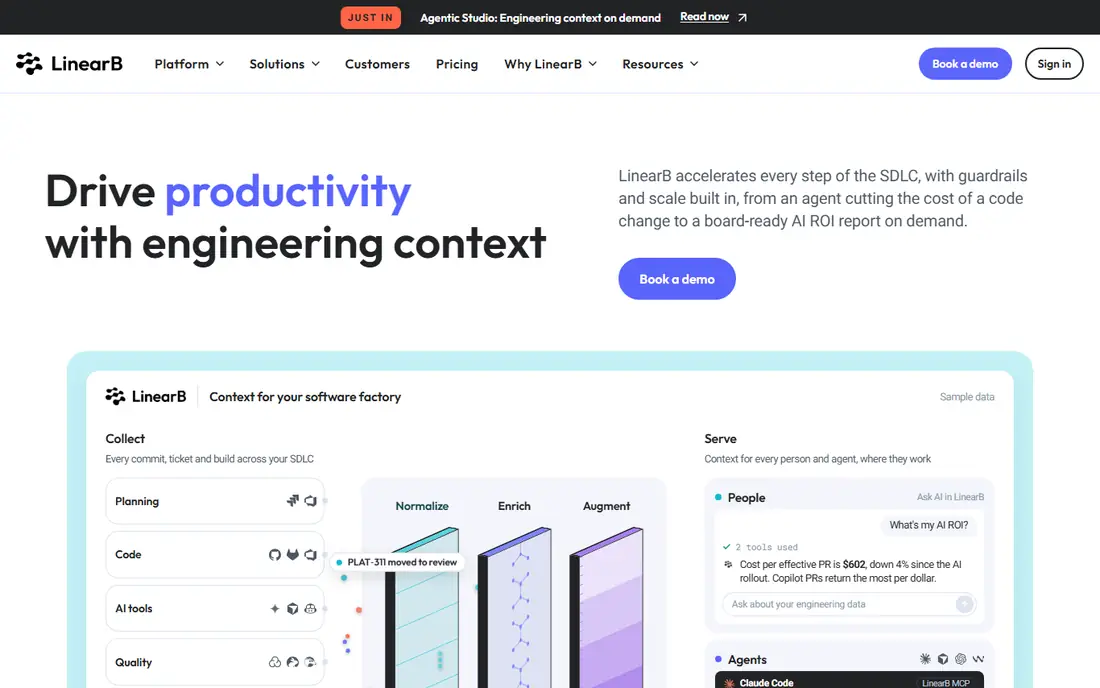
LinearB connects Git, project management, CI and incident tools, then rebuilds the delivery pipeline from that data. Its dashboards track AI adoption and cost alongside delivery metrics. Pricing was checked 21 Nov 2026. Essentials costs $29 per contributor per month and Enterprise costs $59, both billed annually. Older listings still show $10 or $15 per developer per month, but those figures do not match the current vendor pricing page.
What we like- Publishes its prices, covers DORA metrics and AI adoption in one place, includes pull request workflow automation, offers a 45 day full platform trial
Watch out for- The 50 contributor minimum on Essentials excludes small teams, and Jira, Slack, forecasting and cost capitalisation are limited to the $59 Enterprise plan
#2
Jellyfish
Best for: Large engineering organisations that report delivery, allocation and R and D spend to finance and the board
Visit jellyfish.co
Starting priceQuote only. The vendor pricing page lists no prices. The only public figure is an AWS Marketplace bundle at $30,800 a year for the full platform with 15 seats.
Free planNo free plan and no free trial is listed on the vendor pricing page.
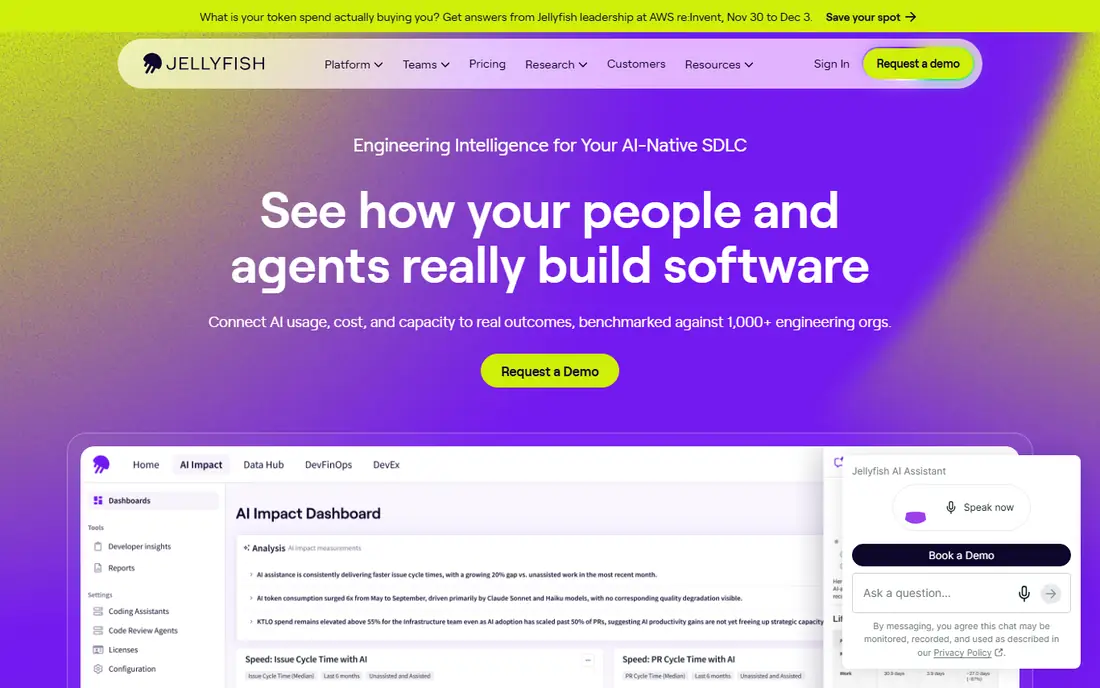
Jellyfish is the most complete platform in this guide for leaders who answer to a CFO. It combines delivery metrics, investment allocation, AI impact analysis and DevFinOps. The DevFinOps module produces audit ready reports for R and D tax credits and software capitalisation. Pricing was checked 21 Nov 2026 and the vendor does not publish prices. Some directories list a $10 per month starting price, but that figure has no basis on the vendor pricing page and should be ignored.
What we like- Strongest finance reporting in this guide, with DevFinOps covering R and D tax credits and software capitalisation, plus industry benchmarking and developer experience surveys
Watch out for- No published price means a buyer cannot size a pilot or build a budget case before a sales call, and the platform is priced by seats and modules, which makes quotes hard to compare
#3
Pluralsight Flow
Best for: Engineering teams in companies that already use Pluralsight Skills for developer learning
Visit pluralsight.com
Starting price$38 per contributor per month, billed annually, Core plan
Free planNo free plan and no free trial is listed.
Pluralsight Flow, formerly known as GitPrime, turns Git and issue tracker data into views of cycle time, work in progress, review time and team health. Pricing was checked 21 Nov 2026. Core costs $38 per contributor per month and Plus costs $50, both billed annually. Some directories list $499 per user per year, but the current figure is $38 per contributor per month.
What we like- Publishes both plan prices, gives clear visibility into workflow patterns and bottlenecks, and sits inside a vendor many engineering teams already buy from
Watch out for- The entry plan is limited compared with rivals at a similar price, and there is no free tier for a small team to test the product on real data
#4
Code Climate Velocity
Best for: Enterprises that want engineering metrics combined with hands on advisory from practitioners
Visit codeclimate.com
Starting priceQuote only. Code Climate sells Velocity as an engagement that pairs the platform with advisory support, and it does not publish a platform only price.
Free planNo free plan. The free Velocity for Teams service ended in December 2023 and those accounts were deactivated in March 2024.
Code Climate Velocity measures engineering delivery and team health from Git and project data, with reports on cycle time, throughput, review bottlenecks and work in progress. Every engagement pairs the platform with practitioners, and the lightest tier includes quarterly advisory support. Pricing was checked 21 Nov 2026 and no price is published on the vendor site. A third party dataset reports $40 to $70 per committer per month, but that is not a vendor figure, so treat Velocity as quote only.
What we like- Combines metrics with quarterly advisory check-ins on the smallest engagement, covers delivery and health reporting in depth, and suits organisations that want expert guidance rather than a dashboard alone
Watch out for- There is no platform only purchase, the smallest engagement includes advisory that smaller teams may not need, and the stated sweet spot starts at around 50 developers
#5
Swarmia
Best for: Small and mid-size teams that want published pricing, a free tier and developer experience surveys in one tool
Visit swarmia.com
Starting price$45 per developer per month, billed annually, Standard plan. Single modules start at $5 per developer per month.
Free planYes. Free for companies with fewer than 10 developers.
Swarmia covers business outcomes, developer productivity, developer experience and AI impact in one platform. It tracks DORA and SPACE metrics, runs developer surveys and produces software capitalisation reports. Pricing was checked 21 Nov 2026. Standard costs $45 per developer per month and Enterprise costs $55, both billed annually. Some sources quote Swarmia in euros at 42 and 52 per developer per month, against $45 and $55 on the vendor pricing page. Use the dollar figures.
What we like- Publishes every plan price, free below 10 developers, includes developer surveys and software capitalisation, and bills only developers added to Swarmia teams, so product managers use it without a seat charge
Watch out for- Annual billing only, with no monthly option, and on-premise integrations and HR system integrations are limited to the $55 Enterprise plan
#6
DX
Best for: Organisations that run developer experience surveys as the centre of their productivity programme
Visit getdx.com
Starting priceQuote only. DX does not publish prices on its own site. Its AWS Marketplace listing starts at $15,000 for a 12 month contract, plus $672 per additional active contributor.
Free planNo free plan, free trial or pricing page is listed. Buyers start with a demo.
DX combines survey data with system data from Git, Jira, CI, incident tools, calendars and AI coding tools. Its surveys follow the SPACE and DevEx frameworks, and it links survey results to delivery data. Pricing was checked 21 Nov 2026 and the vendor publishes no prices. The only public figure is the AWS Marketplace listing at $15,000 for a 12 month contract plus $672 per additional active contributor.
What we like- Pairs developer surveys with system data from more than 80 sources, covers AI coding tool usage and cost, and is now part of Atlassian, which suits teams already in the Atlassian ecosystem
Watch out for- No published price and no self serve trial, so evaluation starts with a sales demo, and the marketplace platform fee makes it costly for small teams
#7
Sleuth
Best for: Teams that want focused DORA metrics and deployment tracking without a broad platform purchase
Visit sleuth.io
Starting price$20 per developer per month, Team plan, as reported by multiple sources. The vendor does not publish a price on its main site, so confirm this figure with Sleuth before buying.
Free planYes. A free Lite plan with limited history is available.
Sleuth is the most focused tool in this guide. It tracks deployments automatically, calculates the four DORA metrics, benchmarks teams against Elite, High, Medium and Low performance bands, and correlates deployments with incidents so leaders can see which changes caused a failure. Pricing was checked 21 Nov 2026 and the vendor does not publish a price on its main site. Multiple sources report the Team plan at $20 per developer per month, but other directories list $24 or $30 per month, so confirm the figure with Sleuth before budgeting.
What we like- Purpose built for DORA metrics, automatically detects deployments and correlates them with incidents, and offers a free Lite plan for small teams
Watch out for- Narrow scope compared with rivals, with no financial analytics and no IDE tracking, and pricing is not published on the vendor site, so the $20 figure needs confirmation
#8
Faros AI
Best for: Organisations that need to measure AI coding spend, model ROI and governance across many AI tools
Visit faros.ai
Starting priceQuote only. Faros uses consumption based pricing, and buyers contact the vendor for a quote.
Free planFaros Desktop is free for individual builders. Faros Playground is free and uses illustrative data.
Faros AI started as an engineering intelligence platform and now describes itself as a token engineering platform. It observes AI coding sessions, traces token spend to the work that shipped, compares ROI across models and projects, and enforces approved model and budget policy. It connects to GitHub, GitLab, Bitbucket, Azure DevOps, Jira, SonarQube and PagerDuty. The vendor FAQ states that Faros uses consumption based pricing. Directories still list $15 per user per month, but that figure belongs to the older product and does not match the current vendor site.
What we like- Connects token spend to shipped outcomes, covers more than 100 data sources, and includes model routing and governance alongside measurement
Watch out for- No published price for the platform, and the product has shifted toward token engineering, so buyers who want classic engineering analytics should check that the older metrics are still covered
Team size decides the shortlist before features do. For a team under 10 developers, Swarmia is the clear first choice, because it is free at that size, and Sleuth Lite is the free alternative for teams that only need DORA metrics. For a team of 10 to 50 developers, LinearB is not available at its entry price because of the 50 contributor minimum, so compare Swarmia at $45, Pluralsight Flow at $38 and Sleuth at $20. For a team of 50 to 200 developers, LinearB at $29 becomes the value pick. Above 200 developers, Jellyfish and DX suit buyers that need finance reporting and survey depth. Before signing, check the seat minimum and the billing unit.
Frequently asked questions
What is the best engineering analytics software for a small team
Swarmia is the best choice for a small team, because it is free for companies with fewer than 10 developers and its paid plans are published. Sleuth is the best free alternative if you only need DORA metrics and deployment tracking, because its Lite plan costs nothing and its Team plan is reported at $20 per developer per month. LinearB is not an option below 50 contributors.
Do I need developer surveys as well as Git metrics
You need surveys if you want to measure developer experience, not just delivery speed. Git metrics show what happened, and surveys show how developers felt about it. A team can ship fast while burning out, and only surveys reveal that. DX, Swarmia and Jellyfish all combine surveys with system data. If your only goal is faster delivery, DORA metrics from Sleuth or LinearB are enough.
What is the difference between DORA and SPACE metrics
DORA metrics measure delivery performance through deployment frequency, lead time for changes, change failure rate and time to restore service. SPACE is a wider framework that adds satisfaction, activity, communication and efficiency to the picture. DORA answers whether you ship fast and reliably, while SPACE answers whether the team is productive in a sustainable way. Most tools in this guide report DORA metrics, and a smaller set covers SPACE through surveys.
How much should a 50 person engineering team budget for analytics software
A 50 person team should budget between $12,000 and $35,000 a year at published prices. Sleuth at $20 per developer per month comes to $12,000 a year, LinearB at $29 comes to $17,400 a year, Pluralsight Flow at $38 comes to $22,800 a year, and Swarmia at $45 comes to $27,000 a year. Confirm seat minimums before budgeting.
Can engineering analytics tools replace Jira or GitHub
No, engineering analytics tools do not replace Jira or GitHub. They read data from those systems and turn it into metrics and reports, but they do not store the work itself. If you disconnect Jira or GitHub, the analytics tool has nothing to measure. Treat these tools as a reporting layer on top of your existing stack, and keep your issue tracker and source control as the systems of record.
Sources we checked (16)
- https://linearb.io
- https://jellyfish.co/blog/linearb-alternatives-competitors/
- https://engineeringintelligenceplatforms.com/jellyfish-pricing/
- https://jellyfish.co
- https://softwarefinder.com/project-management-software/pluralsight-flow
- https://www.pluralsight.com
- https://velocity.codeclimate.com/how-it-works
- https://codeclimate.com
- https://www.tempo.io/blog/swarmia-vs-jellyfish
- https://www.swarmia.com
- https://meetzest.com/for/dx-alternative/
- https://engineeringintelligenceplatforms.com/dx-vs-jellyfish/
- https://getdx.com
- https://tools.aileapers.com/articles/78-best-developer-analytics-tools-2026.html
- https://www.sleuth.io
- https://www.faros.ai
Is your product missing or out of date?
We review this list regularly. Vendors can request a listing, send updated pricing or ask about featured placement.

Shihab Mia · Founder, Rankite
Shihab has 5+ years in B2B and SaaS SEO. He writes Rankite's software buying guides from pricing pages, documentation and public user reviews. More about Shihab.