How we make this list: we compare pricing pages, product documentation and public user reviews. Ratings come from G2, Capterra or Trustpilot, with the date we checked them.
Key takeaways
- Lattice is the default shortlist pick for mid sized and larger companies that want reviews, goals, engagement and compensation in one system; 15Five is the pick when the real goal is better managers, not tidier forms.
- Half of this category hides its pricing behind demos, and published figures for the rest conflict between sources, so several entries below read see website. Budget per employee, per year, including module add ons.
- A review is an employment record. Whatever you write in these tools can surface in a dispute, so calibration, consistent criteria and bias checks matter more than any feature list.
- PerformYard and Small Improvements serve smaller teams that want a clean review cycle without buying a full people platform.
Quick comparison
| Tool | Best for | Starting price | Free plan |
|---|
 Lattice | Reviews tied to goals and compensation | See website | No |
 15Five | Manager coaching and check ins | $11 per user per month | No |
 Culture Amp | Engagement led performance programmes | See website | No |
 Leapsome | Performance plus learning in one platform | See website | No |
 PerformYard | Custom review workflows | $5 per person per month | No |
 Betterworks | Goal driven enterprise performance | $8 per user per month | No |
 BambooHR | Reviews inside an all in one HR system | See website | No |
 Effy AI | Fast, light review cycles for small teams | $3 per seat per month | Yes |
Is your product missing or out of date?
We review this list regularly. Vendors can request a listing, send updated pricing or ask about featured placement.
#1Lattice
Best for: Reviews tied to goals and compensation4.6/5 on
G2 (4,117 reviews, checked Oct 2026)
Visit lattice.com
Starting priceSee website
Free planNo
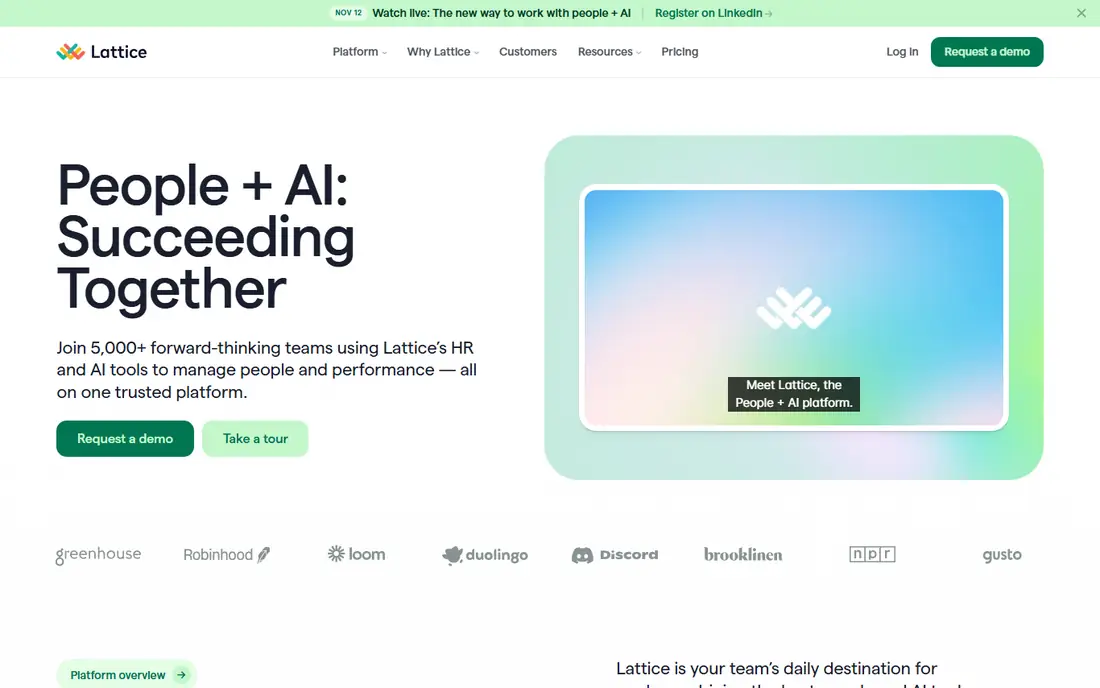
What we like- Lattice is the platform most HR teams benchmark against. Reviews are fully configurable across self, manager, peer and upward formats, goals and OKRs sit in the same system so the review opens with progress already attached, and add on modules cover engagement surveys, career growth and compensation cycles, which lets a company tie a rating to a pay decision without exporting spreadsheets. It has also added an HRIS layer for people data. Published entry prices conflicted across current sources, ranging from 8 to 13 dollars per user per month depending on module and date, so treat any roundup figure as stale and get the current modular quote.
Watch out for- The modular pricing that makes it flexible also makes the total hard to predict, and reported annual minimums put it out of reach for very small teams. There is no free plan and no self serve trial worth the name
- You buy through a sales process. Companies that only want a simple annual review will pay for depth they never use.
#215Five
Best for: Manager coaching and check ins4.6/5 on
G2 (1,930 reviews, checked Oct 2026)
Visit 15five.com
Starting price$11 per user per month
Free planNo
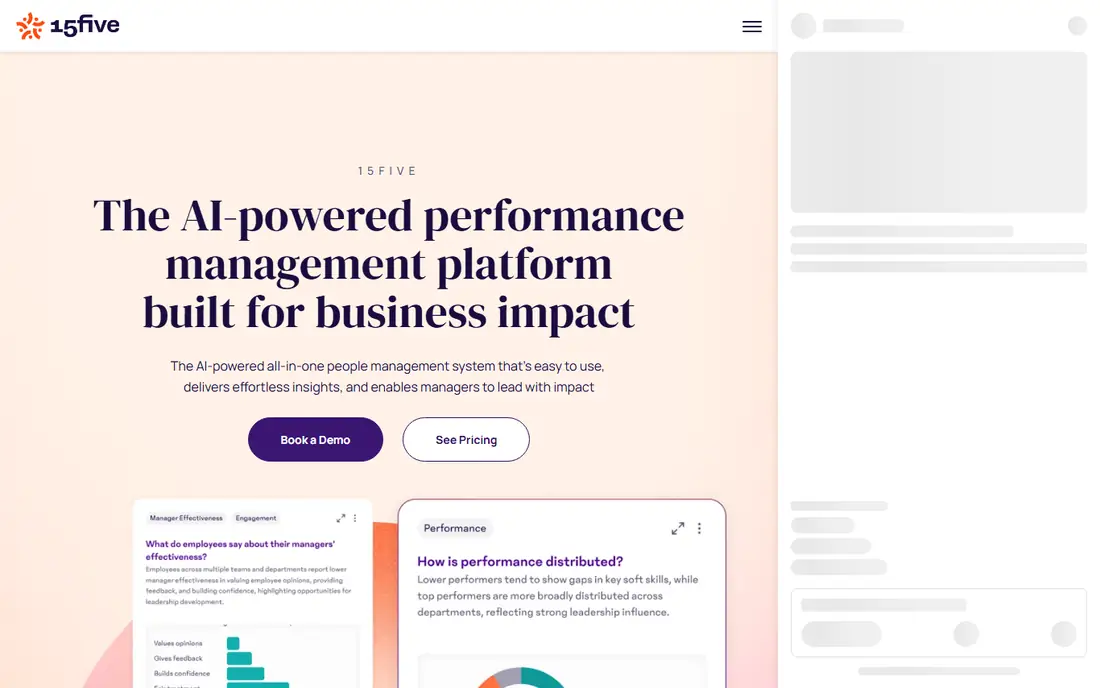
What we like- 15Five treats the review as the output of a year of management, not a yearly event. Weekly check ins, one to one agendas, feedback requests and manager training content feed into its Perform tier, listed at 11 dollars per user per month billed annually, so the formal review assembles evidence that already exists instead of relying on memory. Companies whose real problem is inconsistent managers, rather than a bad form, get the most from it. A lighter Engage tier covers surveys at a lower per user price.
Watch out for- The approach asks managers to actually do weekly check ins, and where that habit fails the review cycle inherits the gap. Pricing is annual only, and the full performance features sit in the higher tier, so the cheap headline tier is not the product most buyers mean. It is a coaching platform first
- Companies wanting heavy custom form logic may find PerformYard a closer fit.
Starting priceSee website
Free planNo
What we like- Culture Amp comes at performance from the listening side. Its research base in engagement surveys and people analytics is the deepest in this list, and its performance module connects review outcomes to engagement drivers, so HR can see whether low ratings cluster in particular teams or follow a manager pattern. Calibration tools and AI assisted comment summaries support large cycles, and its benchmark data helps a company judge whether its rating distribution is unusual. Pricing is quote based and annual.
Watch out for- There is no published price and no free tier, so small companies cannot self qualify. The analytics depth is wasted on a company that only runs one simple cycle a year, and implementation is a project, not an afternoon. If your engagement data lives happily elsewhere, you are paying for the strongest part of the platform twice.
#4Leapsome
Best for: Performance plus learning in one platform4.8/5 on
G2 (2,571 reviews, checked Oct 2026)
Visit leapsome.com
Starting priceSee website
Free planNo
What we like- Leapsome combines reviews, goals, engagement surveys, learning paths and compensation in one modular people platform, with a strong following among European and international companies that need multi language support and GDPR minded data handling. Review cycles support calibration and competency frameworks, and the learning module turns a development point from a review into assigned training, which closes a loop most tools leave open. A free trial is offered even though headline pricing is quoted per customer.
Watch out for- Published per user figures conflicted sharply between current sources, from single digits to the mid teens, so the only reliable price is a quote for your headcount and modules. The breadth means setup decisions multiply: competencies, review forms, learning libraries and survey cadence all need an owner. US only companies may not need its international strengths and can find simpler value elsewhere.
Starting price$5 per person per month
Free planNo
What we like- PerformYard does one job and lets you shape it almost without limits: review forms, rating scales, question types, cycle timing and approval routes are all configurable, which suits companies whose process does not match the standard template other tools assume. Pricing is published in a 5 to 10 dollar per person per month range depending on modules, and it covers 360 feedback and goal tracking without forcing an engagement suite on top. HR teams migrating from paper or spreadsheet reviews usually land here when their process is the point.
Watch out for- There is no free plan, and the flexibility cuts both ways: a badly designed form stays badly designed, just faster. It lacks the engagement analytics of Culture Amp and the compensation depth of Lattice. Companies expecting the software to tell them what a good review process looks like will get a blank canvas instead of guidance.
#6Betterworks
Best for: Goal driven enterprise performance4.4/5 on
G2 (265 reviews, checked Oct 2026)
Visit betterworks.com
Starting price$8 per user per month
Free planNo
What we like- Betterworks is built for larger companies that run performance through goals: OKRs cascade from company to team to individual, check ins and feedback attach to those goals, and calibration tools handle the scale of enterprise cycles. It is commonly listed at 8 dollars per user per month for the standard product. Integrations with the big HRIS and collaboration platforms are a strength, and its reporting is aimed at executives who want goal completion and rating patterns across thousands of staff.
Watch out for- It is more platform than a mid sized company needs, and implementation with goal migration is a real project. There is no free plan, and smaller teams usually find the goal machinery heavy for a simple review cycle. Current pricing should be confirmed on a quote, since enterprise packaging varies by contract.
#7BambooHR
Best for: Reviews inside an all in one HR system4.4/5 on
G2 (7,718 reviews, checked Oct 2026)
Visit bamboohr.com
Starting priceSee website
Free planNo
What we like- BambooHR is the pick when performance reviews are one module in a wider HR system: employee records, time off, onboarding, payroll add ons and performance in a single login that small HR teams find easy to run. Its review tool covers self and manager assessments, goal tracking and standard reports without the ceremony of a dedicated platform, which is exactly what many companies under a few hundred staff need. Published prices for the tier that includes performance conflicted across sources, so confirm the current per employee figure.
Watch out for- The performance module is competent rather than deep: calibration, competency libraries and analytics are lighter than in Lattice or Culture Amp. Reviews sit in the higher pricing tier, so the cheap headline price does not include them. Fast growing companies sometimes outgrow the review tool before they outgrow the rest of the system.
#8Effy AI
Best for: Fast, light review cycles for small teams4.8/5 on
G2 (37 reviews, checked Oct 2026)
Visit effy.ai
Starting price$3 per seat per month
Free planYes
What we like- Effy AI is the quick start in this list: templates for reviews and 360 feedback, AI assistance drafting summaries from collected feedback, and a free plan for up to five users so a small team can run a real cycle before paying. Paid plans start at 3 dollars per seat per month with no annual minimums, which makes it the lowest risk way to replace a spreadsheet process. Setup is measured in days, and the interface assumes no HR department exists to administer it.
Watch out for- Depth is the trade. Competency frameworks, calibration sessions and analytics are basic next to the enterprise tools, and the AI drafting help still needs a manager to read every word before it becomes part of someone's record. Companies past a few hundred staff will likely outgrow it. Keep the human review step non negotiable, because AI written comments in a personnel file are still the manager's words in any dispute.
How we chose
We shortlisted performance review platforms in active sale in October 2026 with published product pages and, where available, public pricing. The list favours tools that handle the full cycle, from goals and feedback through calibration to the written record, over form builders that only collect ratings. Where current sources disagreed on price, which was often, we wrote see website rather than print a number we could not verify. We deliberately left out our own previously published lists as sources. No tool was hands on tested; judgements rest on vendor documentation and current reporting.
Decide what problem you are solving. If ratings arrive as a surprise every year, the fix is continuous feedback and check ins, which points to 15Five or Lattice. If your process itself is unusual, PerformYard's configurability matters more. If reviews already work but pay decisions feel disconnected, look at platforms with compensation modules.
Then run the employment checks. Ask who can see and edit a completed review, whether edits are logged, how long records are kept, and whether the tool prompts reviewers to support ratings with examples. Pilot with two departments, including your most sceptical managers, and watch completion rates and comment quality, not just logins.
Finally, cost the whole thing honestly: per employee pricing multiplied by headcount, plus the modules you will add in year two, plus the HR time to run calibration. A cheap tool that managers abandon costs more than a pricey one they use.
Frequently asked questions
How much does performance review software cost?
Published prices in this category run from about 3 dollars per person per month for light tools such as Effy AI and Small Improvements, through 5 to 11 dollars for mid range platforms, up to quote only enterprise pricing. Many vendors add annual minimums and charge separately for engagement or compensation modules, so ask for the full platform price at your headcount before comparing.
Are performance reviews legally sensitive documents?
Yes. Review ratings and comments are employment records and are commonly requested in termination and discrimination disputes. That is why consistent criteria, evidence based comments and calibration matter, and why managers should write every comment as if the employee and a third party will read it, because both may.
Should AI write performance review comments?
AI can draft and summarise from feedback a manager has already gathered, which saves real time. It should not invent assessments, and a manager who signs AI text without reading it owns words they did not write about a person they manage. Use AI for structure and summaries; keep judgements human, specific and evidenced.
How do we reduce bias in review cycles?
Use the same criteria for everyone in a role, require examples behind ratings, calibrate across managers so one team's harsh is not another team's normal, and review rating patterns by department before results are finalised. Software helps by enforcing the steps and keeping the record; it cannot remove bias from a manager who has already decided.
What is calibration and why does it matter?
Calibration is a meeting where managers review and defend draft ratings together before they are shared, adjusting for the fact that some managers grade harder than others. It is the single step that most improves fairness in a cycle, and platforms such as Lattice, Culture Amp and Betterworks build it into the workflow rather than leaving it to spreadsheets.
Sources we checked (0)
Is your product missing or out of date?
We review this list regularly. Vendors can request a listing, send updated pricing or ask about featured placement.

Shihab Mia · Founder, Rankite
Shihab has 5+ years in B2B and SaaS SEO. He writes Rankite's software buying guides from pricing pages, documentation and public user reviews. More about Shihab.