How we make this list: we compare pricing pages, product documentation and public user reviews. Ratings come from G2, Capterra or Trustpilot, with the date we checked them.
Key takeaways
- Shopify is the safest all-round pick for a startup store, with checkout, payments and apps that scale from first sale to high volume.
- WooCommerce suits a startup that already runs WordPress and wants full control without a monthly platform fee, at the cost of more setup work.
- BigCommerce suits startups that need strong built-in features without many apps, while Wix and Squarespace suit small catalogs with design-led sites.
- Square Online and Ecwid suit startups that want to start free or cheap, especially sellers who already use Square or an existing website.
- Transaction fees, app costs and payment processing rates matter as much as the monthly plan price, so model total cost at your expected sales volume.
Quick comparison
| Tool | Best for | Starting price | Free plan |
|---|
 Shopify | All-round startup store | $39 per month | Free trial |
 WooCommerce | WordPress stores | Free | Yes |
 BigCommerce | Built-in features | $39 per month | Free trial |
 Wix | Small catalog design | $17 per month | Yes |
 Squarespace | Design-led stores | $16 per month | Free trial |
 Square Online | Free start | Free | Yes |
 Webflow | Design-led commerce | $14 per month | Yes |
 Ecwid | Add a store anywhere | Free | Yes |
Is your product missing or out of date?
We review this list regularly. Vendors can request a listing, send updated pricing or ask about featured placement.
#1Shopify
Best for: All-round startup store4.4/5 on
G2 (5,144 reviews, checked Oct 2026)
Visit shopify.com
Starting price$39 per month
Free planFree trial

Shopify is the default choice for a startup store for good reason. Checkout is fast and trusted, payments work out of the box, and the app store adds almost any feature a growing store needs, from email marketing to inventory and subscriptions. Themes are polished, and the platform handles traffic spikes during launches without server work. A founder can go from idea to first sale in days, then keep the same platform as sales grow into thousands of orders.
Costs need modeling. The monthly plan is only part of the bill, since apps, themes and payment processing add up, and transaction fees apply unless you use Shopify Payments. A startup with thin margins should test total cost at realistic sales volume before committing. For most startups, Shopify offers the best balance of speed, reliability and growth room.
What we like- Best checkout and payments for startups
- Huge app store
- Scales from one product to high volume
Watch out for- Monthly cost plus transaction fees unless using Shopify Payments
- Theme and app costs add up
Starting priceFree
Free planYes
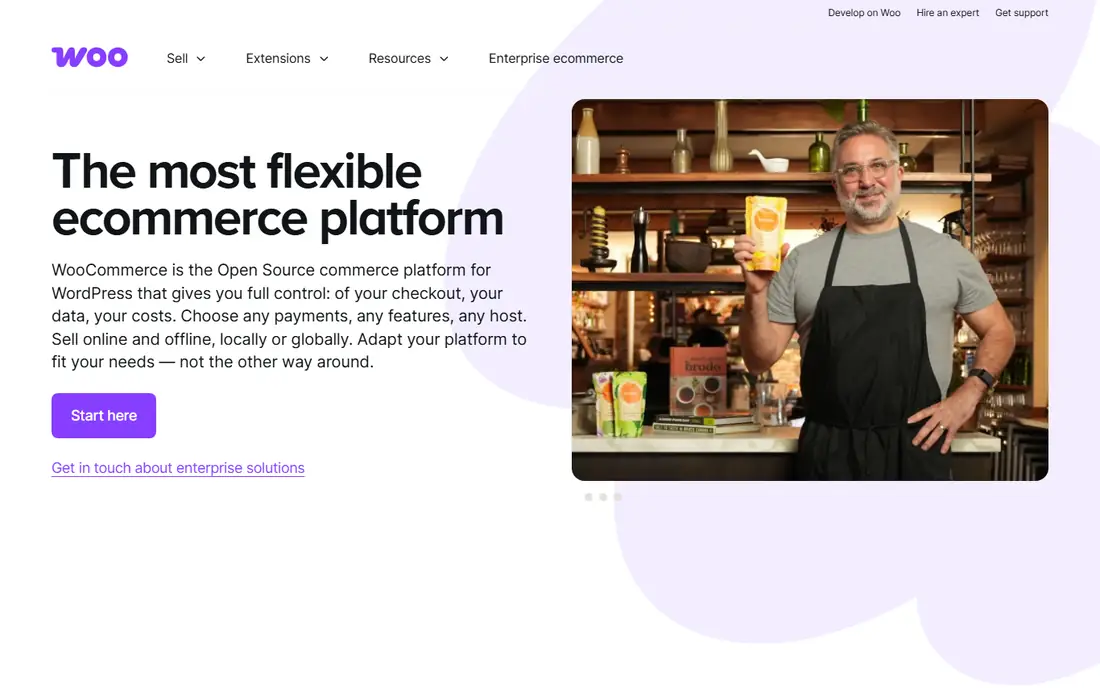
WooCommerce suits a startup that already runs WordPress or wants full control of its store. The plugin itself is free, and it turns a WordPress site into a full store with products, checkout, shipping and tax tools. Extensions cover subscriptions, bookings, memberships and almost any niche need, and there is no monthly platform fee. Data stays with the store owner, which matters for a brand that wants to own its customer list and site fully.
Control comes with work. Hosting, security, backups and updates are the store owner job, and a badly chosen plugin can slow the site or break checkout. Setup takes longer than Shopify, especially for a founder without WordPress experience. For a technical founder or a WordPress site owner, WooCommerce offers unmatched control at low software cost.
What we like- Free plugin with full store control
- No monthly platform fee
- Huge extension market
Watch out for- Hosting, security and updates are your job
- Setup takes longer than Shopify
Starting price$39 per month
Free planFree trial

BigCommerce suits a startup that wants strong features without buying many apps. Product options, discounts, customer groups and SEO tools come built in, which keeps the monthly app bill lower than on Shopify for a similar feature set. There are no additional transaction fees on most plans, which helps margins as sales grow. For a catalog with many variants or business customers, BigCommerce handles complexity well.
Design flexibility trails Shopify, and the theme market is smaller, so a design-led brand may need more custom work. The admin interface also takes longer to learn than Wix or Squarespace. For a startup that values built-in power over app shopping, BigCommerce is a strong alternative to Shopify.
What we like- Many features built in without apps
- No transaction fees on most plans
- Strong SEO and product tools
Watch out for- Theme and design flexibility trail Shopify
- Learning curve is steeper than Wix
#4Wix
Best for: Small catalog design4.2/5 on
G2 (1,888 reviews, checked Oct 2026)
Visit wix.com
Starting price$17 per month
Free planYes
Wix suits a startup with a small catalog that also needs a strong brand site. The drag-and-drop builder makes it easy to design pages, and commerce plans add products, checkout and payments without leaving Wix. Hosting, security and updates are included, so a founder can focus on products and marketing rather than technical upkeep. For a maker, artist or service business selling a few dozen products, Wix is fast and friendly.
Commerce depth is the limit. Large catalogs, complex variants and advanced shipping rules are harder than on Shopify or BigCommerce, and the app market is smaller. A startup that expects rapid catalog growth should start on a commerce-first platform instead. For a small, design-led store, Wix offers the easiest start.
What we like- Easy drag-and-drop builder
- Hosting included
- Good for small catalogs and service plus product sites
Watch out for- Commerce features are thinner than Shopify
- Large catalogs become hard to manage
Starting price$16 per month
Free planFree trial
Squarespace suits a startup whose brand look matters as much as its products. Templates are polished, with strong photography and typography for fashion, food, art and lifestyle brands. Blogging sits alongside commerce, which helps content marketing, and hosting is included. A founder can build a beautiful store and a blog in one place without plugins or extra tools.
Commerce plans cost more than basic website plans, and features for large catalogs, complex shipping and wholesale trail Shopify. A startup that grows past a few hundred products may outgrow Squarespace. For a design-led startup with a focused catalog, Squarespace delivers a professional store with little effort.
What we like- Beautiful templates
- Blogging and commerce in one place
- Reliable hosting
Watch out for- Commerce plans cost more than basic plans
- Features trail Shopify for large stores
Starting priceFree
Free planYes
Square Online suits a startup that wants to start selling for free, especially a seller who already uses Square for in-person payments. The free plan covers a basic online store with checkout, and inventory syncs with Square point of sale, so a shop that sells in person and online keeps one stock count. Setup is fast, and a founder can test demand before paying for a platform.
Design flexibility is limited compared with Shopify or Squarespace, and transaction fees apply on sales. Advanced features such as abandoned cart recovery and custom domains need paid plans. For a startup testing an idea on a tight budget, Square Online offers the lowest-risk start in this list.
What we like- Free plan to start selling
- Integrates with Square payments and point of sale
- Easy setup
Watch out for- Design flexibility is limited
- Transaction fees apply
- Advanced features need paid plans
#7Webflow
Best for: Design-led commerce4.4/5 on
G2 (995 reviews, checked Oct 2026)
Visit webflow.com
Starting price$14 per month
Free planYes
Webflow suits a design-led startup that wants a store to look exactly like its brand. The visual builder gives precise control over layout and interactions, and pages load fast on hosted infrastructure. CMS content and commerce sit in one platform, so a startup can run a blog, landing pages and a store without separate tools. For a brand where design is a competitive edge, Webflow offers control that template builders cannot match.
Ecommerce plans cost more than basic site plans, and the learning curve is steeper than Wix or Squarespace. A founder without design experience may need tutorials or a designer. For a design-led startup willing to learn the tool, Webflow produces some of the best-looking stores in this list.
What we like- Precise visual design control
- Clean code and fast pages
- CMS plus commerce in one platform
Watch out for- Ecommerce plans cost more than site plans
- Learning curve is steeper than Wix
#8Ecwid
Best for: Add a store anywhere4.7/5 on
G2 (405 reviews, checked Oct 2026)
Visit ecwid.com
Starting priceFree
Free planYes
Ecwid suits a startup that already has a website, blog or social following and wants to add selling without rebuilding. The store widget embeds into an existing site, and the same catalog can sell on social pages and marketplaces. The free plan covers a small catalog, which lets a founder test demand before paying. For a creator or blogger with an audience, Ecwid turns existing traffic into sales with minimal work.
Design control inside the widget is limited compared with a full store platform, and advanced features need paid plans. A startup building a brand-new store from scratch may prefer Shopify or Wix. For adding commerce to an existing site, Ecwid is the simplest and cheapest route.
What we like- Free plan to start
- Adds a store to an existing website, blog or social page
- Multi-channel selling
Watch out for- Design control is limited inside the widget
- Advanced features need paid plans
How we chose
We compared vendor pricing pages, feature lists and public reviews for ecommerce platforms serving startups. We looked for setup speed, checkout quality, transaction fees, app and extension ecosystems, design control and growth room. We did not claim hands-on testing, and we treated prices as snapshots, since platform pricing and free trials change often.
Start with your catalog and your skills. A small catalog with a design focus fits Wix, Squarespace or Webflow, while a larger catalog or a growth-focused store fits Shopify or BigCommerce. A WordPress site owner should use WooCommerce, and a seller testing an idea should start free with Square Online or Ecwid. Do not pick a platform for features you may need in two years at the cost of a painful first month.
Next, model total cost at realistic sales. Add the monthly plan, payment processing, transaction fees, apps and theme costs, then compare platforms at your expected monthly sales. Finally, test checkout on a phone before launch, since most startup traffic arrives on mobile. A slow or confusing mobile checkout loses more sales than any feature gap.
Frequently asked questions
Which ecommerce platform is best for a startup?
Shopify is the safest all-round pick for most startups, thanks to checkout quality and growth room. WooCommerce suits WordPress owners, BigCommerce suits feature-heavy catalogs, and Square Online or Ecwid suit startups testing an idea for free.
Can I start an online store for free?
Yes. Square Online and Ecwid offer free plans, WooCommerce software is free apart from hosting, and Wix offers a free website tier. Payment processing and transaction fees still apply on sales, so free does not mean zero cost.
How much does Shopify cost per month?
Shopify entry plans start around $39 per month, with higher tiers for growing stores. Apps, themes and payment processing add to the total, so model full cost at your sales volume before committing.
Should I use WooCommerce or Shopify?
Use WooCommerce if you run WordPress, want full control and can handle hosting and updates. Use Shopify if you want the fastest setup, managed hosting and a checkout that works without technical work.
Can I switch platforms later?
Yes, but migration takes work. Products, customers and orders usually export, while design, apps and custom features rarely move cleanly. Pick a platform you can grow with for at least two years to avoid a painful early switch.
Sources we checked (8)
- https://www.shopify.com
- https://woocommerce.com
- https://www.bigcommerce.com
- https://www.wix.com
- https://www.squarespace.com
- https://squareup.com
- https://www.webflow.com
- https://www.ecwid.com
Is your product missing or out of date?
We review this list regularly. Vendors can request a listing, send updated pricing or ask about featured placement.

Shihab Mia · Founder, Rankite
Shihab has 5+ years in B2B and SaaS SEO. He writes Rankite's software buying guides from pricing pages, documentation and public user reviews. More about Shihab.