How we make this list: we compare pricing pages, product documentation and public user reviews. Ratings come from G2, Capterra or Trustpilot, with the date we checked them.
Key takeaways
- The best data engineering tools in 2026 split by layer: Fivetran and Airbyte load data, dbt transforms it, Snowflake and Databricks store and process it, and Monte Carlo watches it for quality problems.
- A full modern data stack costs real money: tooling alone runs 5,000 to 25,000 dollars a month for many teams, with ETL at 500 to 2,000 dollars, warehouse at 2,000 to 10,000 dollars, and dbt Cloud at 100 to 500 dollars.
- Fivetran and dbt Labs merged, with the merger closing in June 2026, so transformations now run as metered model runs on the same bill, and buyers should watch pricing and roadmap direction.
- No single tool covers the whole stack: even Databricks users still assemble notebooks, dbt, and a separate BI tool, so pick one tool per layer rather than one vendor for everything.
Quick comparison
Is your product missing or out of date?
We review this list regularly. Vendors can request a listing, send updated pricing or ask about featured placement.
Starting priceFree
Free planYes
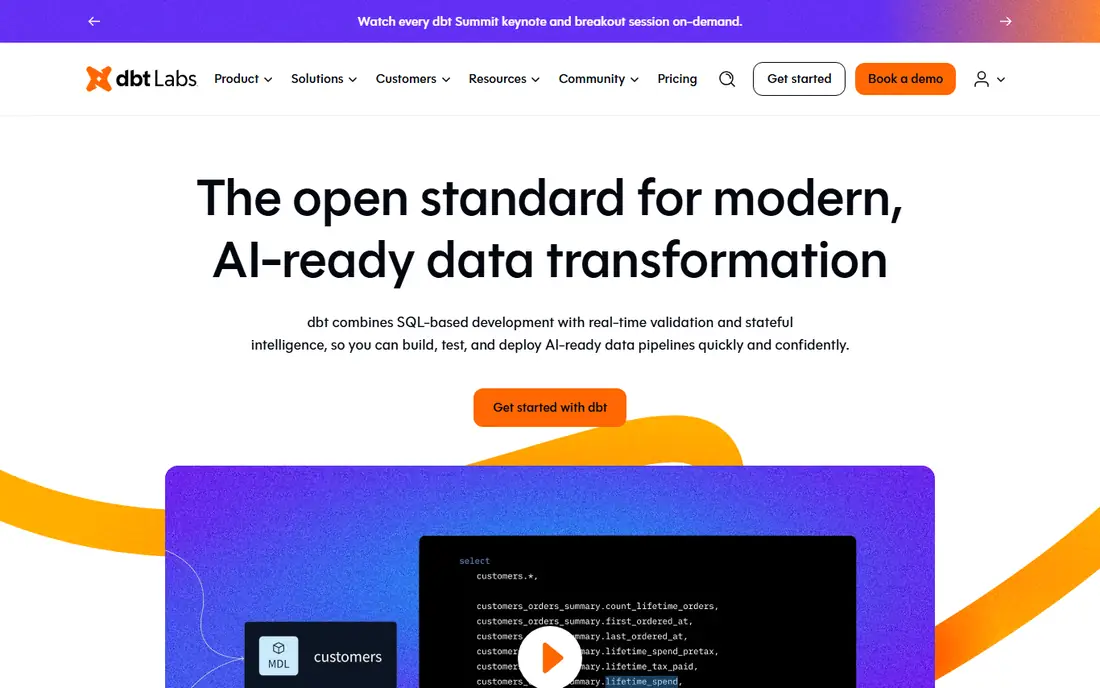
dbt by dbt Labs owns the "T" in ELT. It does not extract or load data, it transforms data already in the warehouse, with modular, testable, version-controlled pipelines that analytics engineers trust.
dbt Core is free and open source under Apache 2.0, dbt Cloud Developer is free for 1 seat, and Starter costs 100 dollars per developer seat a month with 5 seats included. For SQL transformations, dbt leads.
What we like- Industry-standard SQL-first transformations inside the warehouse
- Built-in testing, docs, and lineage graphs
- Git-based version control and CI/CD
Watch out for- Handles only the "T" in ELT, so you still need ingestion tools
- Weak visual data modeling
- Total cost is hard to predict with warehouse compute
Starting priceSee website
Free planNo
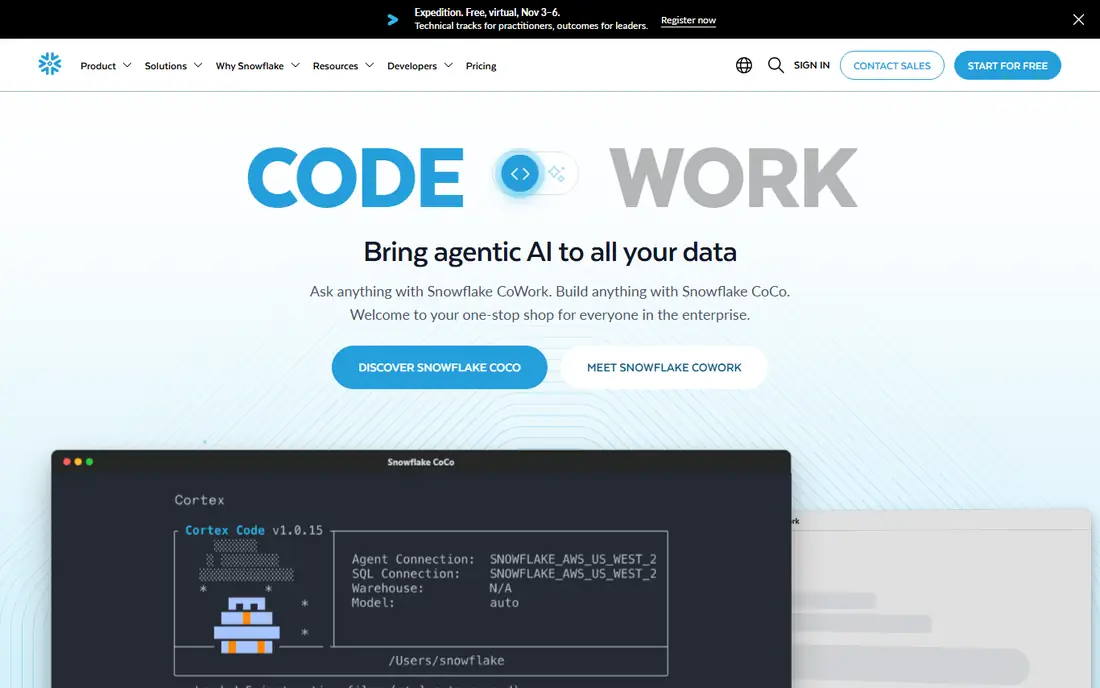
Snowflake suits teams that want a governed cloud warehouse. Its consumption-based platform handles storage, compute, and sharing, with Snowpipe for files already in object storage and Openflow for BYOC deployments.
Pricing is usage-based, so check the vendor pricing page and model your compute before committing. For a cloud warehouse, Snowflake is the best pick.
What we like- Governed cloud warehouse with secure sharing
- Consumption-based pricing
- Snowpipe and Openflow for files in object storage
Watch out for- Typical warehouse costs run 2,000 to 10,000 dollars a month
- Compute and storage bills grow with usage
- Needs a data team to run well
Starting priceSee website
Free planNo
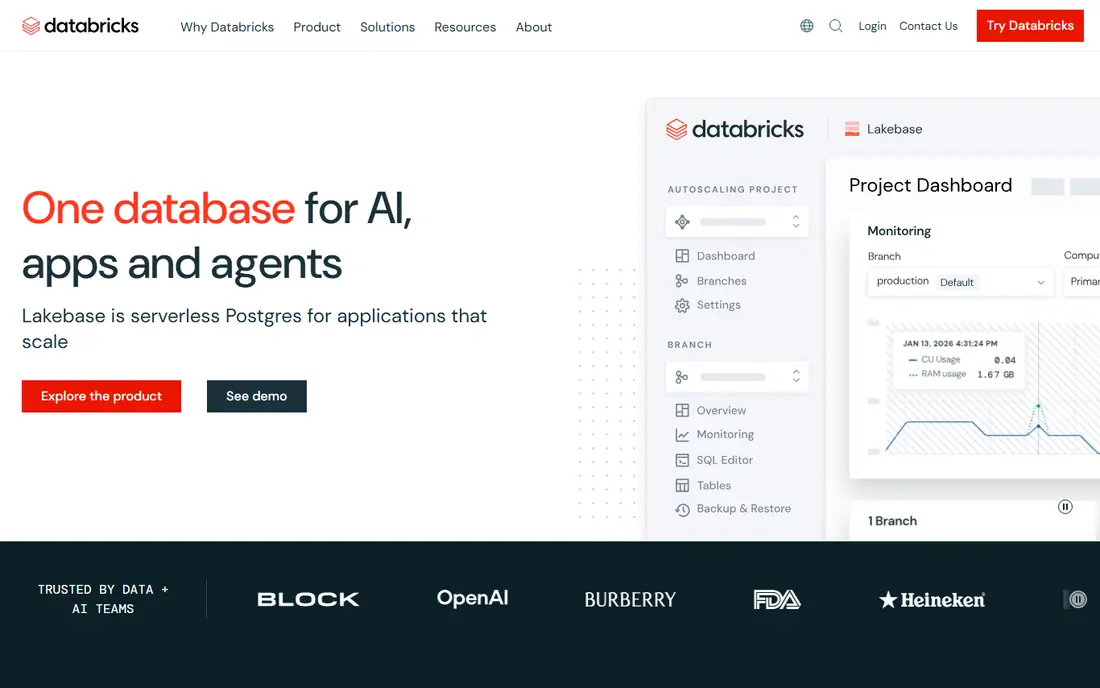
Databricks suits teams running large-scale processing, machine learning pipelines, and streaming workloads. Its lakehouse combines analytics and AI workloads, with Spark in-memory processing far faster than older disk-based models.
Pricing starts from 0.07 dollars per DBU, with compute billed on top. For a lakehouse and Spark, Databricks leads.
What we like- Unified analytics and AI workloads on a lakehouse
- Spark through Databricks rather than self-managed clusters
- Integrated ML and governance
Watch out for- Needs engineers who understand Spark
- Still assembling a stack with notebooks, dbt, and a separate BI tool
- Pricing from 0.07 dollars per DBU adds up

#4Fivetran
Best for: Managed ELT loading4.3/5 on
G2 (841 reviews, checked Oct 2026)
Visit fivetran.com
Starting priceFree
Free planYes
Fivetran is the best-known managed ELT service. Its 700 plus connectors land raw data in the warehouse with automatic schema drift handling, and since the dbt Labs merger closed in June 2026, transformations run as metered model runs on the same bill.
Each connection is billed on its own monthly active rows cost curve with a 5 dollar base charge. For managed ELT loading, Fivetran is the best pick.
What we like- Fully managed with 700 plus connectors
- Automatic schema drift handling
- Free up to 500,000 monthly active rows
Watch out for- Costs rise with every source and event-heavy tables
- No transformation before load
- 1-minute syncs need the Enterprise plan
Starting price$20 per month
Free planYes
Airbyte suits technical teams that want open source flexibility and cost control. Its Core is free to self-host, while Cloud Standard starts at 20 dollars a month, with a large connector catalog beside the self-host option.
For open ingestion, Airbyte leads.
What we like- Open source Core self-hosted free
- Cloud Standard from 20 dollars a month
- Large catalog plus self-host option for cost control
Watch out for- AI Connector Builder helper is a draft tool
- Managed Cloud costs grow with data volume
- Self-hosting needs engineering time
Starting price$100 per month
Free planNo
Stitch suits SMBs needing fast setup without infrastructure management. Its managed ELT service covers 130 plus connectors, with row-metered pricing from 100 dollars a month.
For fast SMB loading, Stitch is the best pick.
What we like- Managed loading with 130 plus connectors
- Fast setup without infrastructure management
- Row-metered pricing is easy to understand
Watch out for- Fewer connectors than Fivetran
- Row-metered costs grow with volume
- Less suited to enterprise scale than Fivetran
Starting priceSee website
Free planNo
Matillion suits SQL-fluent data teams standardized on Snowflake. Its Data Productivity Cloud combines ingestion and in-warehouse transformation in one tool, with a low-code canvas and Git built in.
Pricing is credit-based and quote-only, with a free trial. For warehouse-native ELT, Matillion leads.
What we like- Low-code canvas that generates push-down SQL and Python
- Git built in
- Agentic layer Maia for building pipelines
Watch out for- Credit-based pricing is quote-only
- Transformations run on Snowflake compute, adding to your Snowflake bill
- Streaming CDC and hybrid deployment on Scale edition

#8Monte Carlo
Best for: Data observability4.3/5 on
G2 (547 reviews, checked Oct 2026)
Visit montecarlo.ai
Starting priceSee website
Free planNo
Monte Carlo suits teams whose pipelines keep failing without warning. Its data observability platform monitors freshness, volume, and schema changes, so someone notices when data is wrong before stakeholders do.
Pricing is not published and credit-based, so request a quote and model your usage. For data observability, Monte Carlo rounds out the list.
What we like- Catches pipelines failing without warning
- Credit-based observability across the stack
- Suits teams whose data quality problems reach stakeholders
Watch out for- Pricing not published
- Credit-based costs need modeling
- Newer category with less review data than warehouse tools
How we chose
We ranked tools by connector coverage, transformation discipline, processing scale, and value at entry level pricing. We favored one tool per layer, since three overlapping tools make it hard to tell which one helped, and we gave extra weight to testing and monitoring, because faster code does not help if nobody notices when it is wrong.
We also weighed total cost honestly. A full stack runs 5,000 to 25,000 dollars a month for many teams, with ETL, warehouse, transformation, and BI each adding a bill, plus warehouse compute underneath. Enterprise pricing is usually custom, so check the vendor pricing page before buying.
Buying guide
Start with the layer that hurts most. Teams whose pipelines keep failing without warning should put Monte Carlo or a similar observability tool first, while teams with no warehouse yet should start with free tiers such as dbt Developer, Airbyte Core, and open source orchestration, then add a managed loader once maintaining connectors eats real time. Audit your sources before buying anything: count how many connectors you actually need, how much data each one moves, and how fresh it must be, since those three numbers drive most of the bill.
Next, pick one tool per problem and keep AI work on non-critical pipelines for the first few weeks. Compare time saved against mistakes caught, keep tests and monitoring on everything an AI wrote, and check the bill every week for the first month, especially on metered products such as Snowflake compute and Fivetran monthly active rows.
Finally, plan for the team, not just the tools. Both Snowflake and Databricks paths need a data team to set up and maintain, with weeks or months to set up properly, so budget for people beside software. Planning ahead is smart, while paying ahead for problems you do not have yet is just expensive, and negotiate annual contracts only after a month of real usage data, so discounts reflect actual volume and real needs, not vendor forecasts.
Frequently asked questions
What is the best data engineering tool overall?
dbt leads for SQL transformations, Snowflake for a cloud warehouse, Databricks for a lakehouse, Fivetran for managed loading, and Monte Carlo for observability. The best pick depends on which layer needs fixing first, and most teams end up with several of these tools together rather than one tool for everything.
How much does a modern data stack cost?
Tooling alone runs 5,000 to 25,000 dollars a month for many teams, with ETL at 500 to 2,000 dollars, warehouse at 2,000 to 10,000 dollars, dbt Cloud at 100 to 500 dollars, and BI at 1,000 to 5,000 dollars. Model your compute and volume before committing, since warehouse compute underneath transformations and event-heavy tables can push the bill well past the headline tool price.
Is dbt free?
dbt Core is free and open source under Apache 2.0, and dbt Cloud Developer is free for 1 seat. Starter costs 100 dollars per developer seat a month with 5 seats included, while Enterprise plans are custom-quoted, with market data putting the median annual contract around 26,460 dollars a year. Small teams should start with Core or Developer and upgrade only when scheduling, CI/CD, and the Semantic Layer matter.
Should I pick Fivetran or Airbyte?
Pick Fivetran for fully managed loading with 700 plus connectors and zero maintenance, and Airbyte for open source flexibility, self-hosting, and cost control. Note that Fivetran and dbt Labs merged in June 2026, so watch pricing and roadmap direction. Teams with many SaaS sources and little engineering time should pay for Fivetran, while teams with strong engineers and tight budgets should self-host Airbyte and spend the savings elsewhere.
What is data observability and do I need it?
Data observability monitors freshness, volume, schema, and lineage so you catch bad data before stakeholders do. Teams whose pipelines fail without warning should add Monte Carlo or a similar tool first, since faster code does not help if nobody notices when it is wrong.
Can a startup skip Snowflake and Databricks?
Yes, at first. A startup with no warehouse yet can start with free tiers such as dbt Developer, Airbyte Core, and open source orchestration, then add a warehouse and a managed loader once volume and connector maintenance justify the cost. Paying for enterprise tools before you have the data volume to use them wastes money that a small team needs elsewhere.
Sources we checked (0)
Is your product missing or out of date?
We review this list regularly. Vendors can request a listing, send updated pricing or ask about featured placement.

Shihab Mia · Founder, Rankite
Shihab has 5+ years in B2B and SaaS SEO. He writes Rankite's software buying guides from pricing pages, documentation and public user reviews. More about Shihab.
 dbt Cloud
 Snowflake
 Databricks
 Airbyte
 Stitch
 Matillion