How we make this list: we compare pricing pages, product documentation and public user reviews. Ratings come from G2, Capterra or Trustpilot, with the date we checked them.
Key takeaways
- Data democratization means giving non-technical teams safe access to trusted data, not giving everyone raw database access.
- Governance is what makes democratization work: a semantic layer with defined metrics prevents ten teams from reporting ten different revenue numbers.
- Natural language questions and AI agents are now standard, but their answers are only as good as the governed definitions behind them.
- Spreadsheet-like interfaces lower the learning curve for business users, while code-friendly layers keep analysts productive.
- Start with one governed metric set and one pilot team, then expand: democratization fails when it launches company-wide without definitions.
Quick comparison
| Tool | Best for | Starting price | Free plan |
|---|
 Tableau | Visual analytics with trusted AI | See website | Yes |
 Power BI | Self-service BI in the Microsoft ecosystem | See website | No |
 Looker | Governed semantic layer on Google Cloud | See website | No |
 Domo | AI and data products for all teams | See website | No |
 ThoughtSpot | Natural language analytics at scale | See website | No |
 Sigma Computing | Spreadsheet-style analytics on live warehouse data | See website | No |
 Alteryx | Governed data prep and AI workflows | See website | No |
 Qlik | Associative analytics with data integration | See website | No |
Is your product missing or out of date?
We review this list regularly. Vendors can request a listing, send updated pricing or ask about featured placement.
#1Tableau
Best for: Visual analytics with trusted AI4.4/5 on
G2 (3,787 reviews, checked Oct 2026)
Visit tableau.com
Starting priceSee website
Free planYes
Tableau is the best-known visual analytics platform, and its current pitch is agentic analytics: trusted, governed insights delivered where people work, including Slack, Teams, and AI assistants, without sacrificing accuracy. Its knowledge engine and semantic layer deliver consistent metrics to every agent and person, natural language questions return proactive insights without requiring a dashboard, and Tableau Desktop is now free to download. Deployment options cover fully hosted Tableau Cloud, self-hosted Tableau Server for regulated industries, and Tableau Next inside Salesforce CRM and Slack.
The full platform remains enterprise-priced, and teams deeply embedded in Salesforce will feel that pull grow. For organizations that want visual self-service backed by governed definitions and a huge user community, Tableau remains the benchmark.
What we like- Tableau Desktop now free
- Strong visual exploration and community
- Agentic analytics with a governed semantic layer
Watch out for- Full platform pricing is enterprise-grade
- Salesforce ecosystem ties deepen over time
Starting priceSee website
Free planNo
Power BI is Microsoft's unified, scalable platform for self-service and enterprise business intelligence, connecting to and visualizing any data and embedding visuals into everyday apps. Its licensing lets organizations mix Premium or Fabric capacity for hosting popular reports with Pro licenses for creators, and Power BI Embedded offers pay-as-you-go analytics from $1 per hour for app developers. Free self-paced training through Microsoft Learn and downloadable sample reports lower the learning curve.
Licensing complexity is the main drawback: Pro, Premium, and Fabric capacity interact in ways that require planning. For organizations already running Microsoft 365, Teams, and Azure, Power BI's integration and price make it the obvious democratization choice.
What we like- Unified self-service and enterprise BI
- Deep Microsoft 365 and Fabric integration
- Free self-paced training through Microsoft Learn
Watch out for- Licensing mixes Pro, Premium, and Fabric capacity in confusing ways
- Best value inside Microsoft shops
#3Looker
Best for: Governed semantic layer on Google Cloud4.4/5 on
G2 (1,654 reviews, checked Oct 2026)
Visit cloud.google.com
Starting priceSee website
Free planNo
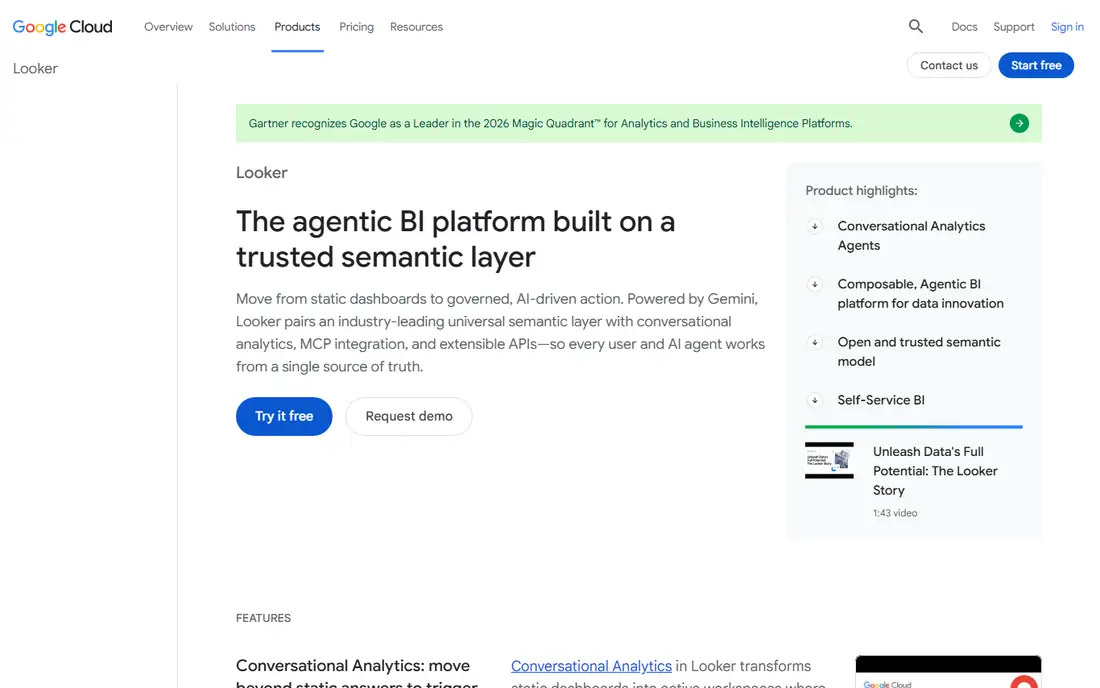
Looker, now part of Google Cloud, is the agentic BI platform built on a trusted semantic layer: business logic is defined once in LookML, then conversational analytics, dashboard agents, and MCP-connected tools all work from the same governed definitions. Gemini-powered features let business users ask natural-language questions, build visualizations, and launch deep dives, while Looker Embedded extends governed analytics into customer-facing apps. Pricing has platform and user components, with Standard, Enterprise, and Embed editions on annual commitment.
LookML requires modeling skill, so Looker suits organizations with a data team to define metrics, not teams expecting zero setup. For Google Cloud and BigQuery shops that need one governed definition of every metric, Looker is the strongest semantic-layer choice.
What we like- Universal semantic layer in LookML as a single source of truth
- Gemini-powered conversational analytics
- Strong BigQuery integration
Watch out for- LookML modeling needs analyst skills
- Pricing is quote-based with platform plus user components
#4Domo
Best for: AI and data products for all teams4.3/5 on
G2 (1,086 reviews, checked Oct 2026)
Visit domo.com
Starting priceSee website
Free planNo
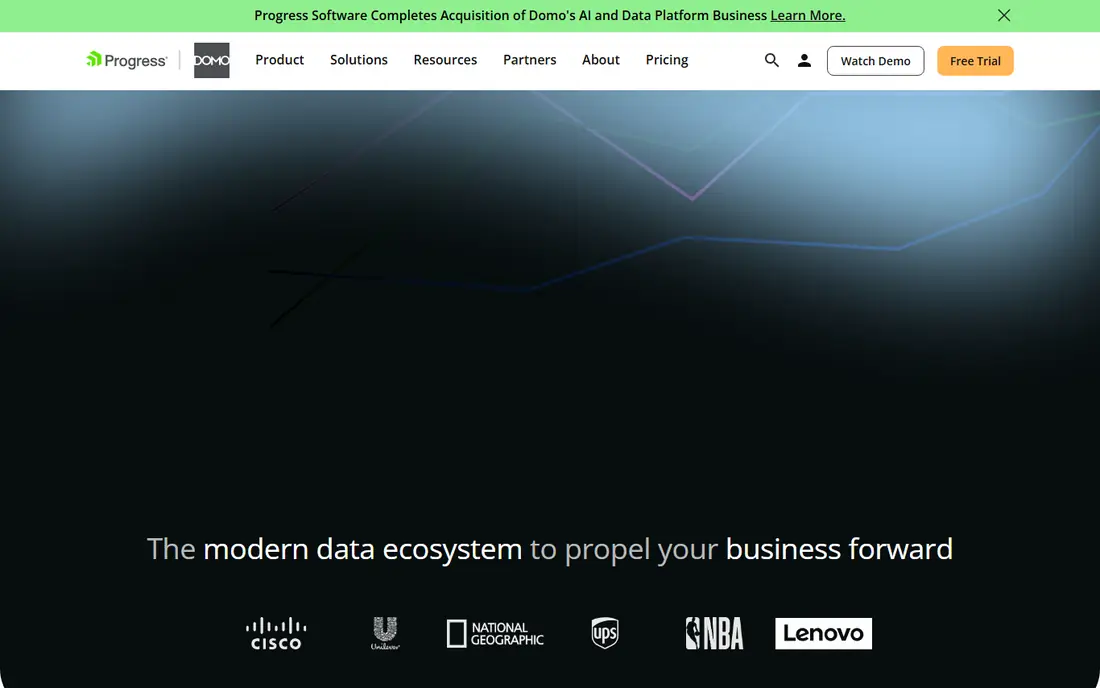
Domo calls itself the AI and data products platform, with tools to connect and prepare data from any source, expand access for exploration, and build data products that accelerate business-critical insights, with AI assistance at every step. Its AI agents cover practical cases such as HR benefits questions, competitive research, retail associate support, and insurance claims analysis, and its hybrid architecture works with existing cloud data warehouse investments. Analyst recognition includes Leader status in embedded business intelligence.
Domo is enterprise-priced and its breadth suits organizations ready to build data products, not just dashboards. For companies that want business teams to build AI-assisted data products on governed data, Domo is a strong platform.
What we like- Connects and prepares data from any source
- AI agents for common business use cases
- Hybrid architecture with cloud data warehouses
Watch out for- Enterprise pricing
- Breadth can overwhelm small teams
#5ThoughtSpot
Best for: Natural language analytics at scale4.4/5 on
G2 (340 reviews, checked Oct 2026)
Visit thoughtspot.com
Starting priceSee website
Free planNo
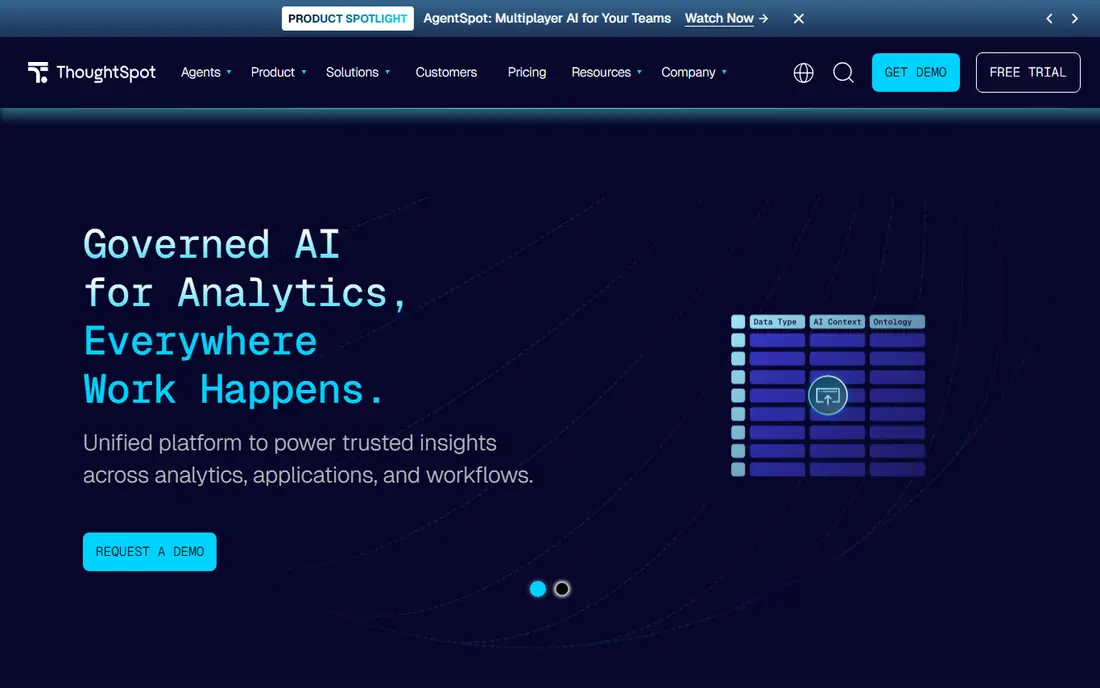
ThoughtSpot's agentic analytics platform is built around one idea: every team should get trusted answers from governed data, wherever decisions happen. Business logic, joins, calendars, calculations, and security are governed before teams ask the first question, so natural-language answers rest on verified definitions rather than guesses. Liveboards support drill-downs and follow-up questions, anomaly and driver detection surfaces what needs attention, and embedding brings governed analytics into business apps and customer products. It holds 2026 Gartner Leader recognition.
ThoughtSpot needs a solid data model to shine; messy, undefined data produces messy answers on any platform. For enterprises whose bottleneck is business users waiting on analysts for answers, ThoughtSpot's search-driven experience is the most direct democratization play.
What we like- Natural language questions with governed answers
- Liveboards for interactive exploration
- Strong embedding for apps and workflows
Watch out for- Works best with a well-modeled data foundation
- Enterprise pricing
Starting priceSee website
Free planNo
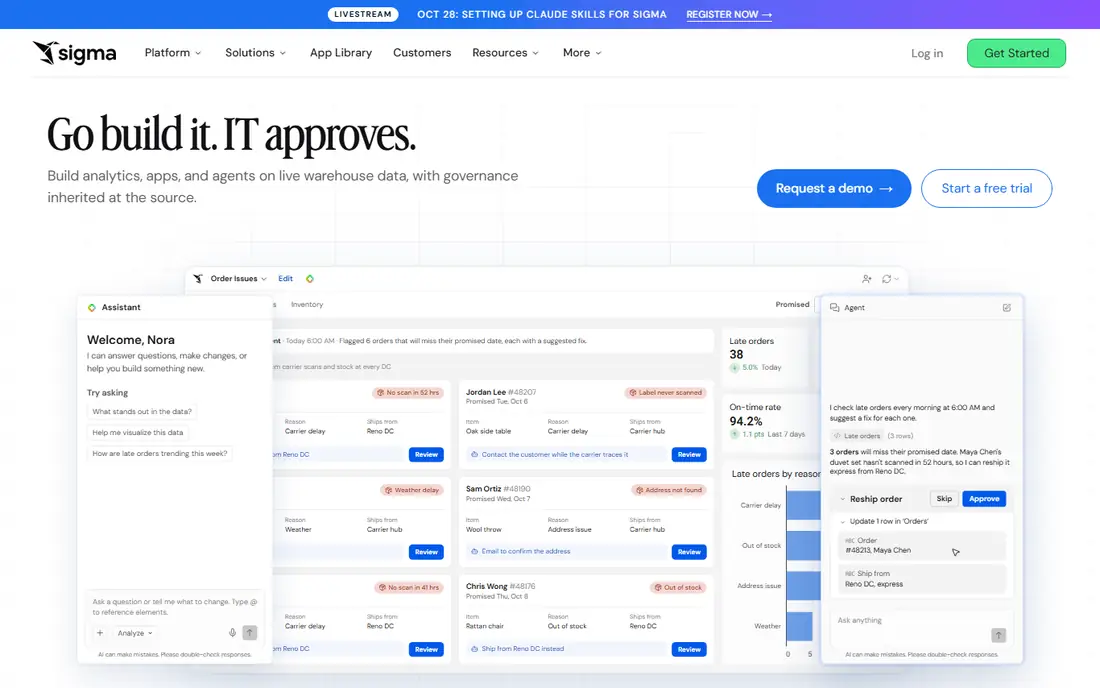
Sigma is the AI runtime for business: teams build analytics, apps, and agents on live warehouse data from Snowflake, Databricks, BigQuery, and Redshift, with governance inherited at the source. Its spreadsheet interface lets business users explore live data without SQL or extracts, every query runs with the viewer's own warehouse permissions down to the row, and agents can answer questions, watch metrics on a schedule, and write back to the warehouse with approval. More than 2,000 enterprises use it, with strong ratings on G2 and Gartner.
Sigma assumes a cloud data warehouse, so teams without one get less value. For warehouse-centered organizations that want business users to work in a familiar spreadsheet on live, governed data, Sigma is a distinctive and powerful choice.
What we like- Familiar spreadsheet interface on live warehouse data
- Governance inherited from warehouse permissions
- AI agents that act on data
Watch out for- Warehouse-native design requires a cloud data warehouse
- Newer AI agent features are still maturing
#7Alteryx
Best for: Governed data prep and AI workflows4.6/5 on
G2 (951 reviews, checked Oct 2026)
Visit alteryx.com
Starting priceSee website
Free planNo
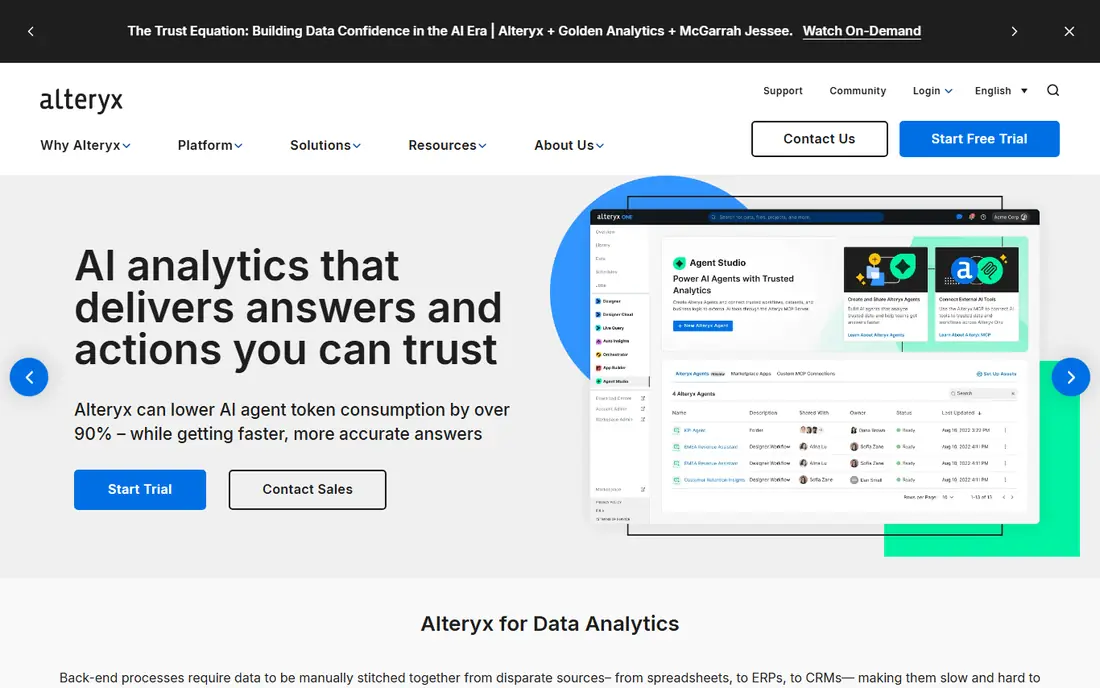
Alteryx One helps teams automate workflows, connect business systems, and deliver AI-powered insights, acting as a business logic layer that brings governed, auditable logic into visual workflows. Business analysts use no-code interfaces to embed rules, calculations, and validations, publish workflows for reuse, and deliver AI-ready datasets to LLMs, agents, BI tools, and business applications. Its approach can cut AI token costs by more than 90 percent by cleaning and routing data before model calls, and its workflows are visible, understandable, repeatable, and auditable.
Alteryx is stronger at preparing and governing data than at presenting dashboards, so most teams pair it with a BI tool. For organizations whose democratization bottleneck is trusted, governed data preparation rather than visualization, Alteryx is the leading workflow choice.
What we like- No-code visual workflows for data prep and analytics
- Governed business logic layer for AI
- 100-plus connectors and in-database processing
Watch out for- More of a prep and workflow tool than a dashboard tool
- Enterprise pricing
#8
Qlik
Best for: Associative analytics with data integration
Visit qlik.com
Starting priceSee website
Free planNo
Qlik combines data integration, data quality, and analytics in one platform, with an associative engine that lets users explore data freely and see relationships across datasets without being limited to predefined query paths. Its AI and agentic analytics features build on trusted, integrated data, and the company reports that 75 percent of the Fortune 500 use Qlik. Data integration pipelines with full traceability appeal to organizations modernizing messy data estates.
Qlik's breadth means a longer learning curve than a pure visualization tool, and pricing requires a sales conversation. For organizations that need integration, quality, and analytics together, especially those with complex data environments, Qlik is a comprehensive choice.
What we like- Associative engine for free exploration
- Modern data integration and quality tools
- Used by 75 percent of the Fortune 500
Watch out for- Platform breadth takes time to master
- Pricing is quote-based
How we chose
We compared tools on the factors that make democratization succeed: self-service ease for non-technical users, governance through semantic layers and permissions, natural language and AI capabilities, and integration with common warehouses and business apps. We included visualization leaders, semantic-layer specialists, and data-prep platforms because democratization fails at any weak link. Where pricing could not be confirmed on the vendor's own site, we wrote "See website." We did not deploy these tools ourselves, so treat vendor claims as starting points for trials.
What to check before you hire
Start with governance, not dashboards. Ask how metrics are defined, who can change a definition, and whether every tool surface uses the same definition. Next, run a pilot with one real business question and one non-technical team: can they get a trusted answer without analyst help, and does the answer match finance's number?
Check security and permissions: row-level and column-level controls should follow each user from the warehouse through every dashboard and AI answer. Confirm total cost, including creator versus viewer licenses and warehouse compute, since self-service tools can grow expensive as adoption spreads. Finally, plan training and support: democratization needs ongoing education, not just software licenses.
Frequently asked questions
What is data democratization?
Data democratization gives employees across an organization safe, governed access to data and analytics so they can answer their own questions without waiting for a data team. It depends on governed definitions, permissions, and easy tools, not on giving everyone raw database access.
What is a semantic layer and why does it matter?
A semantic layer defines business metrics once, in business terms, so every dashboard, report, and AI answer uses the same definition. Without it, different teams calculate revenue, churn, or conversion differently, and democratization creates confusion instead of clarity.
Do business users need SQL to use these tools?
No. Modern democratization tools offer drag-and-drop builders, spreadsheet interfaces, and natural language questions. SQL and modeling skills still help data teams define metrics, but business users should be able to explore governed data without code.
How do you keep democratized data secure?
Use row-level and column-level permissions inherited from your warehouse or defined in the platform, audit logs of who accessed what, and certified datasets for sensitive metrics. Governance should be built into the platform, not added as an afterthought.
Which tool is best for a small company?
Small companies often start with Power BI if they use Microsoft tools, Tableau Public or Desktop for visual work, or Sigma if they already have a cloud warehouse. Start with one governed dataset and one team, prove value, then expand licenses.
Sources we checked (8)
- https://www.tableau.com
- https://powerbi.microsoft.com
- https://cloud.google.com/looker
- https://www.domo.com
- https://www.thoughtspot.com
- https://www.sigmacomputing.com
- https://www.alteryx.com
- https://www.qlik.com
Is your product missing or out of date?
We review this list regularly. Vendors can request a listing, send updated pricing or ask about featured placement.

Shihab Mia · Founder, Rankite
Shihab has 5+ years in B2B and SaaS SEO. He writes Rankite's software buying guides from pricing pages, documentation and public user reviews. More about Shihab.