How we make this list: we compare pricing pages, product documentation and public user reviews. Rankite is independent; if a vendor ever pays for a featured spot, that listing is clearly labeled Partner.
Key takeaways
- Small budgets start with Vibe.co (from $50/day, no minimum), Roku Ads Manager (from $500/campaign) or Disney Campaign Manager (from $500/campaign).
- MNTN ($5,000/month minimum) and Tatari ($350/week retargeting, $5,000/week prospecting) are the performance-TV specialists built around measurable outcomes.
- Simpli.fi, StackAdapt and The Trade Desk are programmatic DSPs: bigger reach across streaming inventory, but custom pricing and steeper learning curves.
- The minimum spend is not the real budget: creative production, CPMs of $25 to $65 and test-then-scale cycles mean a real first test runs $3,000 to $10,000.
- Every platform promises attribution; insist on incrementality testing (holdouts) before you believe a ROAS number.
Quick comparison
| Tool | Best for | Starting price | Free plan |
|---|
 Vibe.co Vibe.co | Small budgets running their first CTV test | From $50/day (no minimum spend, no contract) | No |
 MNTN MNTN | DTC brands running performance-driven TV | $5,000/month (minimum monthly budget) | No |
 Roku Ads Manager Roku Ads Manager | Shopify merchants and DTC brands wanting Roku inventory | From $500/campaign | No |
 Disney Campaign Manager Disney Campaign Manager | Brands wanting direct access to Hulu's premium inventory | From $500/campaign (third-party reported; confirm with the vendor) | No |
 Paramount Ads Manager Paramount Ads Manager | Budget-conscious brands targeting sports, news and entertainment | From $500/campaign (third-party reported; confirm with the vendor) | No |
 Tatari Tatari | Brands that want TV measured like a performance channel | $350/week (self-serve retargeting; prospecting $5,000/week) | No |
 Simpli.fi Simpli.fi | Agencies and local advertisers needing hyperlocal CTV | See website (custom quote; reviewers report no campaign budget minimums) | No |
 StackAdapt StackAdapt | Agencies running CTV inside a multi-channel strategy | See website (custom quote) | No |
 The Trade Desk The Trade Desk | Enterprise teams with serious programmatic budgets | See website (custom quote; high minimums widely reported) | No |
Is your product missing or out of date?
We review this list regularly. Vendors can request a listing, send updated pricing or ask about featured placement.
Television advertising used to start at a number with five zeroes and a media buyer. Connected TV changed the arithmetic: your ad can now run full-screen and non-skippable inside Hulu, Tubi or Peacock with a credit card and a $50 daily budget. The platforms below split into two families. Self-serve CTV platforms (Vibe, MNTN, Roku, Disney, Paramount, Tatari) give you a campaign builder, direct premium inventory and same-day launches. Programmatic DSPs (Simpli.fi, StackAdapt, The Trade Desk) buy across exchanges and apps through auctions, with broader reach and more complexity. Pick the family first, then the platform.
#1
Vibe.co
Best for: Small budgets running their first CTV test
Visit vibe.co
Starting priceFrom $50/day (no minimum spend, no contract)
Free planNo
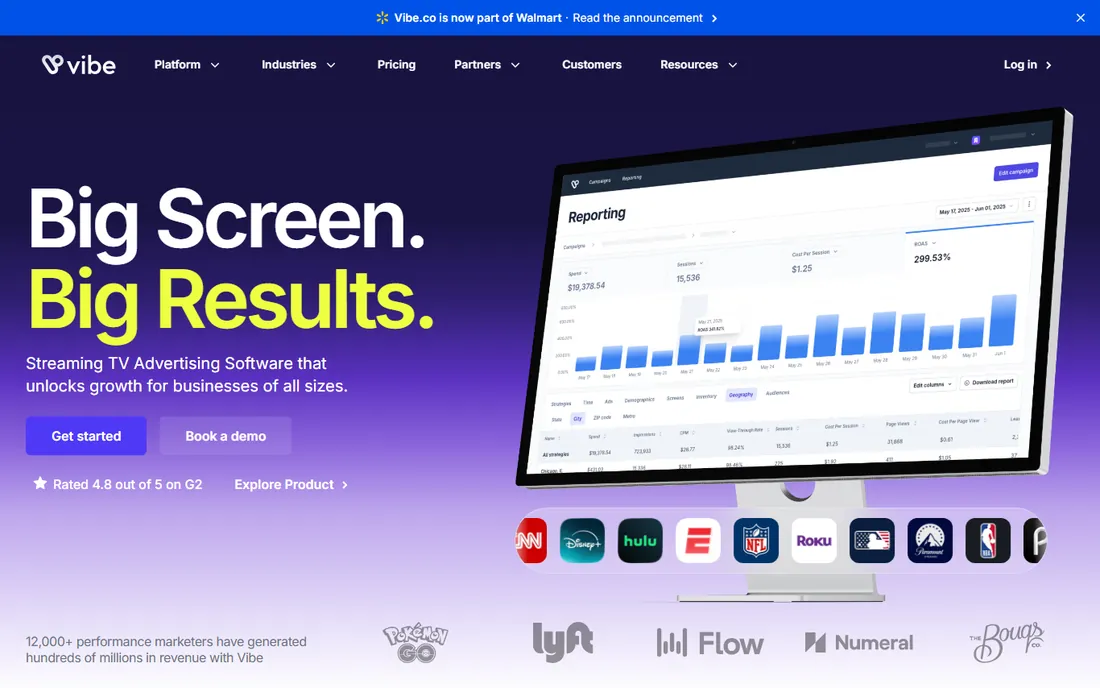
Vibe is the on-ramp. You sign up, define an audience (CRM upload, behavioral targeting or ZIP/metro geo), upload a 15- or 30-second video, set a daily budget starting at $50, and your ad runs the same day inside premium streaming apps on smart TVs, Roku, Fire TV and Apple TV. There is no minimum commitment, no annual contract and no agency required. A four-week test at $50 a day costs roughly $1,400 to $1,500, less than a single prime-time spot on local broadcast.
The economics hold up because the inventory is direct: no reseller markup on top of the media cost, unlike open-exchange programmatic where buy-side fees add 18 to 30 percent. Premium streaming inventory runs $15 to $35 CPM on the platform, with targeted inventory at $40 to $60. Vibe publishes genuinely useful budgeting guidance (start with retargeting if you have a warm audience of 50,000 households, move to prospecting at 30 to 40 percent of budget once ROAS is proven), which is more honest than most vendor content. For a first CTV test, this is where to start.
What we like- Lowest entry point in the category with direct premium inventory
- 500-plus streaming channels including Hulu, Tubi and Peacock
- Built-in creative tools and incrementality measurement
Watch out for- Smaller scale than the DSPs
- Premium targeted inventory (live sports, narrow B2B lists) runs $40-$60 CPM
Starting price$5,000/month (minimum monthly budget)
Free planNo
MNTN invented the "performance TV" category: television advertising bought and measured like digital. The platform's pitch is that over 90 percent of its clients had never run a TV commercial before, and the product is built for them: pick from 150-plus premium networks, upload creative (or generate it with the built-in AI tools), target with the MNTN Matched audience system, and measure with Verified Visits attribution. Monthly budgets start at $5,000, and the platform recommends at least $500 a day.
The minimum is the filter. At $5,000 a month, MNTN is a serious commitment for a small business, and competitors note that the platform fee is bundled into media rather than broken out transparently. Attribution is view-through only unless you set up more rigorous measurement, which is the standard CTV caveat. For DTC brands with proven unit economics that want TV as a performance channel rather than a branding exercise, MNTN remains the reference platform. For everyone else, it is the thing you graduate to after Vibe proves the channel.
What we like- Purpose-built for performance with Verified Visits attribution
- 150-plus premium networks
- AI creative generation and audience matching
Watch out for- $5,000 monthly minimum prices out small testers
- Platform fee bundled into media (less transparent)
- View-through-only attribution by default
Starting priceFrom $500/campaign
Free planNo
Roku's self-serve Ads Manager is the company's play for performance marketers who buy search and social and want to translate that buying style to TV. Campaigns start at $500, and the platform covers Roku's own inventory plus third-party streaming inventory from services such as Netflix, Peacock and Max. The Shopify integration is the standout feature: Action Ads let viewers shop directly from the ad with their remote, which turns the TV into a storefront for DTC brands.
The trade-off is concentration. You are buying inside Roku's world, which is enormous (the largest streaming device footprint in the US) but still one ecosystem. If your audience lives on Fire TV or Apple TV, a DSP buys there too. For Shopify merchants and DTC brands already comfortable with performance marketing interfaces, Roku Ads Manager is the most natural first step into television, and the $500 entry point makes the test cheap.
What we like- Direct access to Roku's inventory plus 100 ad-supported streamers
- Shopify integration for shoppable Action Ads
- No minimum at launch, now from $500
Watch out for- Roku-centric inventory
- Less cross-platform reach than a DSP
- Newer platform with less third-party measurement history
Starting priceFrom $500/campaign (third-party reported; confirm with the vendor)
Free planNo
Disney Campaign Manager is the self-serve door into Disney's streaming inventory, led by Hulu. Hulu's ad-supported audience is one of the most valuable in streaming: affluent, engaged, and famously tolerant of the ad experience. Campaigns are reported to start at $500, with guided setup that walks first-time TV buyers through targeting, creative specs and flighting.
The limitation is the walls. You are buying Disney inventory, full stop. That is fine if Hulu is where your audience is, and for many consumer brands it is. But you cannot extend the same campaign to Tubi or Peacock from here, which means multi-platform reach needs a second tool. Buy Disney Campaign Manager when the plan is specifically "Hulu, done well." Buy a DSP or Vibe when the plan is "streaming TV, broadly."
What we like- Direct access to Hulu, with select Disney+ and ESPN+ inventory
- Guided campaign setup for new buyers
- Premium brand-safe content
Watch out for- Limited to Disney-owned inventory
- $500 floor is higher than Vibe's daily entry
- Less self-serve flexibility than independent platforms
#5
Paramount Ads Manager
Best for: Budget-conscious brands targeting sports, news and entertainment
Visit paramount.com
Starting priceFrom $500/campaign (third-party reported; confirm with the vendor)
Free planNo

Paramount's self-serve platform opens Paramount+, Pluto TV and CBS inventory to smaller buyers at a reported $500 campaign minimum. The content mix is the differentiator: live sports, news and entertainment programming that skews older and more mainstream than the typical streaming audience. Pluto TV's free ad-supported audience is enormous and cheap to reach, which makes this platform interesting for broad-reach, budget-conscious campaigns.
The caveats mirror Disney's: you are buying inside one company's inventory, and live sports (the best inventory here) prices at a premium. The platform is also the newest of the network-owned self-serve tools, so expect a thinner feature set than Roku's or Vibe's. For brands whose customers watch CBS and Paramount+, it is a direct line. For everyone else, it is a secondary buy.
What we like- Access to Paramount+, Pluto TV and CBS content including live sports
- Tiered buying bundles
- Strong in news and live programming
Watch out for- Smaller streaming footprint than Roku or Disney
- Live sports inventory commands premium CPMs
- Newer self-serve product
#6
Tatari
Best for: Brands that want TV measured like a performance channel
Visit tatari.tv
Starting price$350/week (self-serve retargeting; prospecting $5,000/week)
Free planNo
Tatari's argument is that everyone else is selling you "TV lite" while it sells you all of television: linear plus streaming, bought convergently, measured with modeled ROAS, view-through and incrementality methodologies. Self-serve retargeting starts at $350 a week, which is accessible. Prospecting, the thing most brands actually want, requires $5,000 a week, which puts it firmly in mid-market and enterprise territory.
The measurement story is the reason to take Tatari seriously. Most CTV platforms report view-through attribution and call it a day; Tatari pushes incrementality testing, which is the only way to know whether the ad caused the sale. Treat the vendor's comparison pages (including its MNTN takedown) with the skepticism any vendor-authored content deserves, but the underlying point stands: if you are spending real money on TV, demand incrementality, and Tatari is built around that demand.
What we like- Converged buying across linear and streaming TV
- Transparent pricing with direct inventory
- Strongest measurement story (modeled ROAS, view-through and incrementality)
Watch out for- $5,000/week prospecting minimum is enterprise money
- The platform's own comparison pages are, unsurprisingly, favorable to Tatari
#7
Simpli.fi
Best for: Agencies and local advertisers needing hyperlocal CTV
Visit simpli.fi
Starting priceSee website (custom quote; reviewers report no campaign budget minimums)
Free planNo
Simpli.fi is the DSP for local. Its signature is granularity: target by ZIP, by radius, by household, even by physical address, and extend the campaign across display, mobile and CTV from one platform. G2 reviewers consistently highlight the absence of campaign budget minimums as the reason they chose it over The Trade Desk, and the platform is built for agencies running programmatic for multiple local clients, with managed-service and self-service tiers.
The pricing opacity is the honest complaint: no published plans, custom quotes, and reviewers who mention extra fees they did not expect. This is a platform for buyers who already speak programmatic. If you are an agency or a multi-location brand (franchises, dealerships, regional retail) that needs household-level targeting at local scale, Simpli.fi is purpose-built for you. If you are a single brand running your first CTV test, start self-serve and come back when the complexity is justified.
What we like- No campaign budget minimums, unusual for a DSP
- Hyperlocal and household-level targeting including addressable geo-fencing
- Strong agency and local-media fit
Watch out for- No published pricing (custom quotes only)
- Reviewers mention extra fees and limited pricing transparency
- Complexity needs programmatic experience
Starting priceSee website (custom quote)
Free planNo
StackAdapt is the multi-channel DSP that happens to do CTV well. The pitch is consolidation: run CTV alongside display, native, video, audio, digital out-of-home and in-game from one platform, with one reporting layer and shared audiences. The creative studio and AI targeting are genuinely good, and it carries some of the highest user ratings among DSPs.
The trade-off is focus. StackAdapt is not a CTV specialist: it will not hold your hand through your first television buy the way Vibe or MNTN will, and pricing is custom-quote only, which tells you the target buyer is an agency or a brand with a real media budget. Buy StackAdapt when CTV is one line in a multi-channel plan and you want one platform running all of it. Buy a CTV specialist when television is the whole plan.
What we like- CTV plus six other ad formats in one DSP
- Strong creative studio
- Highly rated usability for a programmatic platform
Watch out for- Custom pricing with no public entry point
- CTV is one channel among many, not a specialty
- Learning curve for new programmatic buyers
Starting priceSee website (custom quote; high minimums widely reported)
Free planNo
The Trade Desk is the 800-pound gorilla of independent programmatic. For CTV, it offers the broadest access to premium streaming inventory through private marketplace deals, the most sophisticated bidding (including its AI bidding product), and the deepest data and measurement integrations. Enterprise media teams run serious CTV budgets through it, and nothing else matches the control.
Everything else about it says "enterprise." Minimum spends are high, advanced features carry extra fees, and the platform assumes you have traders who do this full-time. G2 reviewers name cost as the main trade-off. A mid-market brand can absolutely buy CTV here through an agency, but buying it direct as your first CTV platform is like learning to drive in a Formula 1 car. Start self-serve, prove the channel, then graduate to The Trade Desk when the budget and the team justify it.
What we like- The largest independent DSP with the broadest premium CTV inventory access
- Most sophisticated bidding and data controls
- Strong measurement partnerships
Watch out for- High minimum spends and extra fees for advanced features
- Complex enough to need dedicated traders
- Overkill for anything under six figures
How we chose
We treated this as a media-buying decision, not a software review. We read each platform's own documentation and pricing pages, third-party pricing analyses, G2 and TrustRadius reviews from media buyers, and practitioner guides on CTV costs through 2026. We favored platforms with a live self-serve product and verifiable entry pricing, and we included the three major DSPs because that is where enterprise CTV budgets actually go. Minimum spends change: several figures above come from third-party reporting rather than vendor pricing pages (we say so where that is the case), so confirm the current minimum with the vendor before planning a budget around it.
Minimums are not the real cost: budgeting your first CTV test honestly
The minimum spend gets you in the door; it does not buy you a result. A real first test has four costs. One, creative: you need a 15- or 30-second video spot, and production for a regional-quality spot typically runs $15,000 to $50,000 unless you use a platform's AI creative tools (Vibe and MNTN both offer them) or cut from existing footage. Two, media: at $25 to $65 CPM for premium streaming inventory, a $500 test buys 8,000 to 20,000 impressions, which is not enough to read. Practitioners suggest $3,000 to $10,000 for a first flight that generates enough conversion events to measure. Three, measurement setup: pixels, attribution windows and holdout design, which costs time if not money. Four, iteration: the first creative rarely wins, so budget for two or three variants. Add it up and the honest first-test budget is $5,000 to $15,000 all-in, even on a platform with a $50 daily minimum. The platforms with low minimums are still the right place to start, because they let you spend that budget learning instead of spending it on access.
The measurement problem nobody warns you about
Every CTV platform shows you a dashboard with impressive numbers, and most of those numbers are view-through attribution: someone saw your ad, then visited your site within some window, and the platform claims the credit. The problem is that view-through takes credit for conversions that would have happened anyway, especially for retargeting audiences who were already going to buy. The industry's honest answer is incrementality testing: hold out a control group that does not see the ad, and measure the difference. Vibe builds incrementality into its product, Tatari leads with it, and MNTN's Verified Visits is a step in the right direction. Before you scale any CTV spend, ask the platform one question: "Can you run a holdout test, and what did the last one show?" If the answer is vague, the ROAS number is decorative. This matters more than the CPM, the minimum, or the inventory list, because an unmeasured channel always looks like it works until finance asks for proof.
Frequently asked questions
How much does it cost to advertise on connected TV?
Entry points range from $50 a day with no minimum (Vibe.co) to $500 per campaign (Roku, Disney, Paramount) to $5,000 a month (MNTN) and $5,000 a week for prospecting (Tatari). Premium streaming CPMs run $25 to $65. A realistic first test that produces readable data costs $3,000 to $10,000 in media, plus creative production.
What is the cheapest CTV advertising platform?
Vibe.co has the lowest entry point: $50 a day with no minimum spend and no contract. Roku Ads Manager, Disney Campaign Manager and Paramount Ads Manager start around $500 per campaign. Tatari's self-serve retargeting starts at $350 a week. "Cheapest to start" is not "cheapest per result," so measure cost per outcome, not CPM.
What is the difference between a CTV platform and a DSP?
Self-serve CTV platforms (Vibe, MNTN, Roku, Disney, Paramount, Tatari) sell you their own or directly-sourced premium streaming inventory through a campaign builder, with same-day launches and simpler pricing. DSPs (The Trade Desk, StackAdapt, Simpli.fi) buy across many publishers and exchanges through real-time auctions, offering broader reach but more complexity and usually custom pricing.
Do I need a video ad to run CTV campaigns?
Yes. CTV runs 15- or 30-second non-skippable video spots. If you do not have one, Vibe and MNTN offer AI creative tools that build a spot from existing assets, and several platforms accept repurposed social or YouTube creative. Budget $15,000 to $50,000 for professional production, or start with AI-generated creative and upgrade what works.
How is CTV advertising measured?
Most platforms report view-through attribution (site visits after ad exposure) by default, which overstates impact. The credible methods are incrementality testing with holdout control groups, marketing mix modeling, and foot-traffic or sales-lift studies. Ask any platform whether it supports holdout testing before you trust its ROAS figures.
Can small businesses advertise on TV now?
Yes. Self-serve CTV platforms removed the old barriers: Vibe starts at $50 a day, and Roku, Disney and Paramount start around $500 per campaign, with no agency required and campaigns live the same day. A local business can run its ad inside Hulu or Tubi scoped to its ZIP codes. The remaining barrier is creative, not media access.
Sources we checked (15)
- https://www.vibe.co/blog/how-to/tv-advertising-cost
- https://www.vibe.co/blog/how-to/how-to-budget-ctv-advertising
- https://www.Vibe.co/blog/how-to/how-to-advertise-on-smart-tv
- https://www.vibe.co/blog/how-to/ctv-advertising
- https://getadlib.com/blog/best-self-serve-ctv-advertising-platforms/
- https://mountain.com/?mkt_tok=MjE0LVVWWC0zNzcAAAGG9mxBkaSZFtS8n6JSmjd9lvdkbz0fuhx3xwAnC--gW9BCMoAcNuDDQxjOPgmEwxhYLXoEzbZObxyG
- https://www.tatari.tv/insights/tatari-vs-mntn-which-tv-advertising-platform-comparison
- https://www.vibe.co/blog/how-to/mntn-competitors
- http://digitaldealer.com/news/webinar-recap-mntn-trumpets-ctv-for-auto-advertising/162813/
- https://www.nexttv.com/news/rokus-self-serve-ads-manager-lets-search-social-advertisers-buy-ctv
- https://adtechradar.com/2024/09/20/roku-launches-self-serve-ads-manager-targets-growth-marketers/
- https://vidico.com/news/how-much-does-a-30-second-commercial-cost/
- https://www.g2.com/compare/simpli-fi-vs-the-trade-desk
- https://www.g2.com/products/simpli-fi/pricing
- https://www.vibe.co/blog/how-to/programmatic-advertising-platforms
Is your product missing or out of date?
We review this list regularly. Vendors can request a listing, send updated pricing or ask about featured placement.

Shihab Mia · Founder, Rankite
Shihab has spent more than a decade helping SaaS and e-commerce brands grow through search. He writes Rankite's software buying guides from pricing pages, documentation and public user reviews. More about Shihab.