How we make this list: we compare pricing pages, product documentation and public user reviews. Ratings come from G2, Capterra or Trustpilot, with the date we checked them.
Key takeaways
- Procore is the best all-round choice for general contractors managing subcontracts, change orders and payments in one place.
- Autodesk Build, now Forma Build, is the strongest pick for design-build firms already using Revit and Autodesk tools.
- Oracle Aconex and e-Builder suit owners and large capital programmes more than small contractors.
- CMiC, Jonas Construction and Viewpoint Vista are construction ERPs, tying contracts to accounting.
- Kahua is the most flexible option for owners and public agencies needing custom approval workflows.
What is construction contract management software and what should it cover?
Construction contract management software is the system a contractor, owner or programme manager uses to create, approve, track and close out construction contracts. It covers prime contracts with clients and subcontracts with trade partners, and it keeps every version, signature, change and payment in one place. A good tool starts with templates and approval routing, so a draft moves from the project manager to commercial review and then to signature.
It should store the signed contract, the scope, the schedule of values and the insurance documents alongside it. It should handle change orders from first request to approved change, with an audit trail that shows who asked and what it costs.
How much does construction contract management software cost in 2026?
Most tools in this guide do not publish a price. Procore, Oracle Aconex, CMiC, Jonas Construction, e-Builder, Kahua and Viewpoint Vista all price by quote, so the vendor asks about annual construction volume, user count, modules and project count before giving a figure. Autodesk is the exception, because it publishes per-user annual pricing for Build, now Forma Build. Third-party directories report starting figures for the quote-only tools, but those figures are not vendor-published and often disagree, so treat them as rough guides only.
The pricing model changes the total cost a lot. Procore charges on annual construction volume with unlimited users, while a small firm may still face a five-figure annual bill. Autodesk charges per user, so cost follows headcount. CMiC, Jonas and Viewpoint charge for an ERP licence plus implementation.
A mid-size general contractor, with roughly 20 to 50 staff and 10 active projects, needs a tool that handles subcontracts and change orders without a long ERP implementation. Procore fits that profile best, because it covers the full contract cycle, from subcontract creation to payment application, and its volume-based pricing includes unlimited users. Autodesk Build is the next best fit if the firm already uses Revit or AutoCAD, because drawings and contract documents sit in one common data environment.
CMiC and Viewpoint Vista fit a mid-size contractor only when the firm also wants to replace its accounting system, because both are full ERPs with job costing, payroll and financials built in. Jonas Construction fits specialty contractors that need strong accounting and service work in the same system. Aconex and e-Builder are built for owners and very large programmes.
What should you check before you sign a contract for contract software?
Check the licence, the implementation and the renewal terms, because those are three separate costs. Ask for the price basis in writing, whether it is per user, per project, by construction volume or by module, and ask what happens when you add users or projects mid-term. Ask whether the quoted price includes data migration, training and ongoing support, and get the renewal uplift in writing.
Check the product fit in a demo that uses your own contract documents, not the vendor sample set. Load a real subcontract, a real change order and a real payment application, and watch how the tool handles each step. Ask which integrations are included in the quoted price and which need a paid connector.
Subcontracts, change orders and payments are the three workflows that separate a real construction contract tool from a generic document store. A subcontract workflow should start from a standard template, pull in the scope, the schedule of values and the insurance requirements, route the draft for approval and collect a digital signature. The best tools link the subcontract to the budget, so committed cost updates as soon as a subcontract is signed, and they track insurance expiry before a payment is released.
A change order workflow should record the request, the reason, the cost effect and the time effect, then route it for approval and update the contract sum once approved. A payment workflow should let the subcontractor submit an application against the schedule of values, let the project manager certify the work completed and apply retention.
Quick comparison
| Tool | Best for | Starting price | Free plan |
|---|
 Procore | General contractors needing contracts, change orders and payments in one platform | Quote only, checked 12 Nov 2026 | No free plan, no free trial listed |
 Autodesk Construction Cloud (Build) | Design-build firms and contractors already using Revit, AutoCAD and other Autodesk tools | 1,400 dollars per user per year, 800 dollars for Essentials, third-party reported, checked 12 Nov 2026 | No free plan, 30-day trial reported by third-party sources |
 Aconex (Oracle) | Owners, consultants and contractors on large infrastructure and capital projects | Quote only, checked 12 Nov 2026 | No free plan and no free trial |
 CMiC | Large contractors that want contracts, accounting, payroll and job costing in one ERP | Quote only, checked 12 Nov 2026 | No free plan and no free trial |
 Jonas Construction | Specialty, mechanical, electrical and service contractors that need contracts tied to accounting | Quote only, checked 12 Nov 2026 | No free plan and no free trial |
 e-Builder (Trimble) | Owners and public agencies managing capital programmes and large project portfolios | Quote only, checked 12 Nov 2026 | No free plan and no free trial |
 Kahua | Owners, programme managers and public agencies that need custom approval workflows | Quote only, checked 12 Nov 2026 | No free plan and no free trial listed |
 Viewpoint (Trimble) | Large contractors that need Vista ERP job costing, payroll and contract control in one system | Quote only, checked 12 Nov 2026 | No free plan and no free trial |
Is your product missing or out of date?
We review this list regularly. Vendors can request a listing, send updated pricing or ask about featured placement.
#1Procore
Best for: General contractors needing contracts, change orders and payments in one platform4.6/5 on
G2 (4,357 reviews, checked Oct 2026)
Visit procore.com
Starting priceQuote only, checked 12 Nov 2026
Free planNo free plan, no free trial listed

Procore is the leading construction management platform for general contractors. You can create prime contracts and subcontracts from templates, route them for approval, collect signatures and link each contract to its budget, schedule of values and change orders. Payment applications flow from the subcontract, through certification of work completed, to accounting, with retention applied at each step. Procore prices on annual construction volume rather than per user, and third-party sources report entry costs around 15,000 to 30,000 dollars a year for small firms, but that figure is not vendor-published.
What we like- Unlimited users on volume-based pricing, strong subcontract and payment workflows, large integration library
Watch out for- No published price makes budgeting hard before a sales conversation
#2
Autodesk Construction Cloud (Build)
Best for: Design-build firms and contractors already using Revit, AutoCAD and other Autodesk tools
Visit construction.autodesk.com
Starting price1,400 dollars per user per year, 800 dollars for Essentials, third-party reported, checked 12 Nov 2026
Free planNo free plan, 30-day trial reported by third-party sources
Autodesk Construction Cloud Build, renamed Forma Build in March 2026, connects design, preconstruction and field work in one cloud platform. Contract documents, drawings, RFIs and change orders sit in the same common data environment, so a contract change can be traced back to the drawing revision that caused it. The cost module tracks budgets, contracts, change orders and payment applications. Pricing is published per user. Note a price conflict: one source reports 1,400 dollars per user per year, while another reports 1,625 dollars.
What we like- Published per-user pricing, strong BIM and drawing links, drawings and contract documents in one common data environment
Watch out for- Cost climbs quickly as user numbers grow, and the cost module is less deep than a full ERP
#3
Aconex (Oracle)
Best for: Owners, consultants and contractors on large infrastructure and capital projects
Visit oracle.com
Starting priceQuote only, checked 12 Nov 2026
Free planNo free plan and no free trial
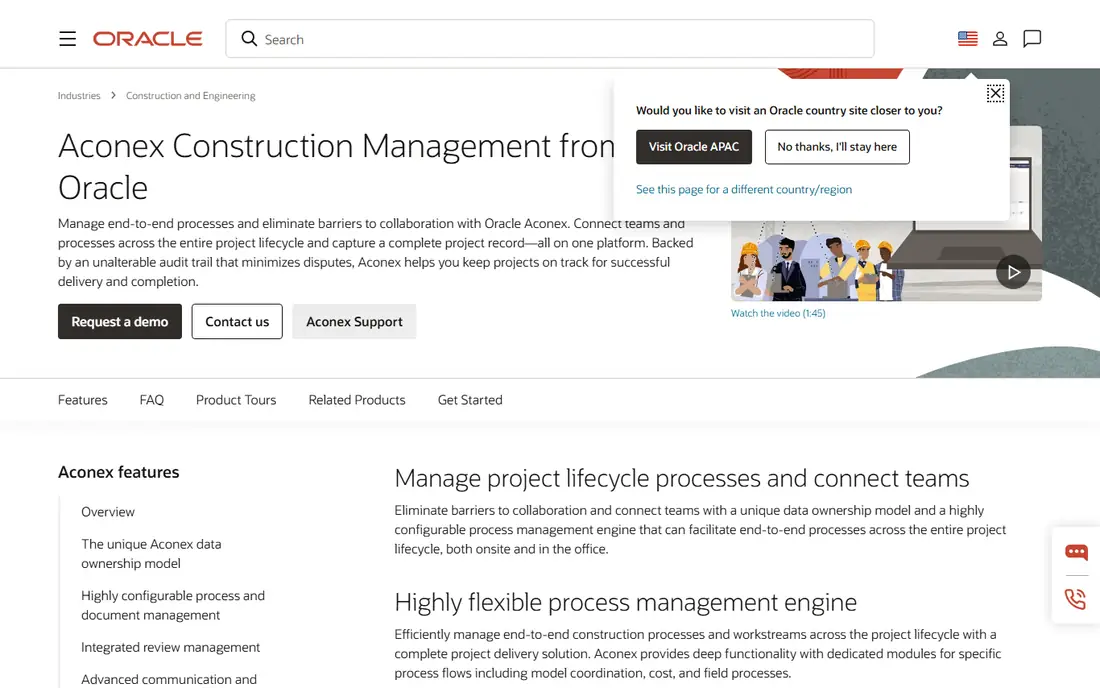
Oracle Aconex is a cloud common data environment for construction, widely used on large infrastructure, energy and public sector programmes. Its contract strength is control: every document, transmittal, RFI, change and approval is logged with a full audit trail, so the project record can stand up in a dispute. Contracts, variations and payment claims run through configurable workflows that span the owner, the consultant and the contractor. That rigour suits programmes with hundreds of users, but the setup is heavy for a small contractor. Third-party sources report around 49 dollars per user per month, while a UK government document lists 53 pounds per hosted named user.
What we like- Very strong audit trail and document control, built for multi-organisation capital programmes
Watch out for- Heavy setup and administration for a small contractor
#4CMiC
Best for: Large contractors that want contracts, accounting, payroll and job costing in one ERP4.1/5 on
G2 (122 reviews, checked Oct 2026)
Visit cmicglobal.com
Starting priceQuote only, checked 12 Nov 2026
Free planNo free plan and no free trial
CMiC is a construction ERP built on a single database, so contracts, budgets, change orders, payroll and accounting all draw on the same figures. A subcontract entered in CMiC updates committed cost, job cost and the forecast at once, and payment applications flow into accounts payable without rekeying. CMiC is aimed at large contractors, and implementation typically runs six to eighteen months and costs 100,000 to 500,000 dollars in services, according to third-party research. Third-party sources report entry rates around 100 dollars per user per month and typical totals of 50,000 to 150,000 dollars a year, but another directory lists 300 dollars per month.
What we like- Single database for contracts, accounting and project controls, strong job costing and financial reporting
Watch out for- Long implementation, often six to eighteen months, and high services costs
#5Jonas Construction
Best for: Specialty, mechanical, electrical and service contractors that need contracts tied to accounting3.4/5 on
G2 (26 reviews, checked Oct 2026)
Visit jonasconstruction.com
Starting priceQuote only, checked 12 Nov 2026
Free planNo free plan and no free trial
Jonas Construction is an integrated construction and service management system aimed at mechanical, electrical, plumbing and other specialty contractors. Its contract tools cover project contracts, subcontracts, change orders and billing, and they connect directly to job costing, payroll, equipment and service work. That link matters, because a change order on a service job can flow through to billing and to the technician schedule. The vendor does not publish pricing, and every deal is quoted. Third-party sources disagree: one directory reports 249 dollars per user per month, while another reports a Premier plan at 199 dollars, so get a written quote.
What we like- Deep construction accounting and service management, strong fit for specialty trade contractors
Watch out for- Per-user pricing adds up fast for larger teams, and the interface feels dated next to newer cloud platforms
#6
e-Builder (Trimble)
Best for: Owners and public agencies managing capital programmes and large project portfolios
Visit trimble.com
Starting priceQuote only, checked 12 Nov 2026
Free planNo free plan and no free trial
e-Builder is a cloud programme management platform for owners of capital programmes, and Trimble now carries it forward as Trimble Unity Construct, with the same login and the same core capabilities. It covers the full capital project lifecycle, from planning and design through procurement, construction and handover, with cost management, document control, process automation, scheduling and bid management. Contract administration sits inside that programme view, so an owner can track contracts, changes and payments across a portfolio of projects. That portfolio view is its main strength, and also its main limit for a contractor. Trimble publishes no price, and cost is by quote only.
What we like- Strong capital planning, cost control and programme reporting for owners, now carried into Trimble Unity Construct
Watch out for- Built for owners rather than contractors, so a contractor using it on its own projects will find some workflows aimed at the client side
#7Kahua
Best for: Owners, programme managers and public agencies that need custom approval workflows4.4/5 on
G2 (24 reviews, checked Oct 2026)
Visit kahua.com
Starting priceQuote only, checked 12 Nov 2026
Free planNo free plan and no free trial listed
Kahua is a low-code construction programme and project management platform used by owners, programme managers, general contractors and subcontractors on complex capital projects. Its contract strength is flexibility: teams can build or adapt apps for contracts, change orders, payment applications, cost tracking and document control, and they can set approval routes that match their own governance rules. Partners collaborate across organisations through the Kahua Network. The vendor does not publish pricing. Third-party sources report around 690 dollars per user per year, with a per-project entry point of 5,000 dollars or more.
What we like- Low-code platform for custom contract and approval apps, strong cross-company collaboration through the Kahua Network
Watch out for- No published price, and custom configuration can add time and cost before the first project goes live
#8
Viewpoint (Trimble)
Best for: Large contractors that need Vista ERP job costing, payroll and contract control in one system
Visit viewpoint.com
Starting priceQuote only, checked 12 Nov 2026
Free planNo free plan and no free trial
Viewpoint Vista, part of Trimble Construction One, is an enterprise construction ERP for job costing, financial management, payroll, HR, equipment and service management. Its contract tools link subcontracts and change orders to job cost, so committed cost, forecast cost and actual cost are visible in one place, and payment applications flow into the accounting system. Vista handles union payroll, multi-company and multi-currency accounting, which suits large contractors with complex labour and entity structures. The vendor does not publish Vista pricing, and cost is quoted per deal. Third-party figures conflict: one directory reports a starting price of 10,000 dollars a year, while another reports core modules at 800 to 1,500 dollars per user a year.
What we like- Deep job costing, union payroll and multi-entity accounting, long track record with large contractors
Watch out for- Quote-only pricing with large implementation costs, and trained staff needed for custom reports
Comparison table
| Tool |
Best for |
Starting price, 12 Nov 2026 |
Free plan |
Contract strength |
| Procore |
General contractors |
Quote only |
No |
Subcontracts, changes, payments |
| Autodesk Build |
Design-build firms |
1,400 dollars per user per year |
No |
Drawings, RFIs, cost |
| Aconex (Oracle) |
Owners, capital programmes |
Quote only |
No |
Audit trail, document control |
| CMiC |
Large contractors, ERP |
Quote only |
No |
Contracts tied to job costing |
| Jonas Construction |
Specialty contractors |
Quote only |
No |
Contracts tied to billing |
| e-Builder (Trimble) |
Owners, capital programmes |
Quote only |
No |
Programme cost and contracts |
| Kahua |
Owners, agencies |
Quote only |
No |
Configurable approvals, cost |
| Viewpoint (Trimble) |
Large contractors, Vista ERP |
Quote only |
No |
Job costing, payroll, contracts |
Worked cost example: a mid-size contractor with 10 active projects
Take a mid-size general contractor with 25 users who need a paid seat and 10 active projects. On Autodesk Build at the reported 1,400 dollars per user per year, the annual licence cost is 35,000 dollars, because 25 multiplied by 1,400 equals 35,000. On the Essentials tier at 800 dollars per user per year, the same team would pay 20,000 dollars a year.
For the quote-only tools, use the third-party reported figures only as a planning range. On Kahua at the reported 690 dollars per user per year, 25 users would cost 17,250 dollars a year in licence fees, before configuration and training. On Jonas at the reported 249 dollars per user per month, 25 users would cost 74,700 dollars a year, while the lower reported figure of 199 dollars would give 59,700 dollars a year.
Frequently asked questions
What is the best construction contract management software for a general contractor?
Procore is the best choice for most general contractors, because it covers subcontracts, change orders, payment applications and compliance in one platform, with unlimited users on its volume-based pricing. Autodesk Build is the best alternative for firms that already work in Revit, because drawings and contract records sit together.
How much does construction contract management software cost?
Most tools in this guide are priced by quote, so there is no single published price to compare. Autodesk Build is the exception, with a reported 1,400 dollars per user per year. Third-party sources report roughly 15,000 to 30,000 dollars a year for Procore, 50,000 to 150,000 dollars a year for CMiC, and 100,000 to 400,000 dollars in the first year for Viewpoint.
Is Procore or Autodesk Build better for contract management?
Procore is better for a contractor that wants the full contract cycle, from subcontract creation to payment, in one system with unlimited users. Autodesk Build is better for a design-build firm that already uses Revit, because the model, the drawings and the contract documents stay connected in one common data environment.
Can small contractors use these construction contract tools?
Small contractors can use Procore and Autodesk Build, but both can be costly for a firm with only a few projects. Procore prices on construction volume, so a small firm still faces a five-figure annual bill in many cases. Autodesk Build charges per user, so a small team can start with a few seats. Aconex, e-Builder, CMiC and Viewpoint are built for larger firms.
What is the difference between construction contract software and legal contract software?
Construction contract software manages prime contracts, subcontracts, change orders, payment applications, retention and job costing for building projects. Legal contract software, such as Ironclad or DocuSign CLM, manages general business contracts, approvals and signatures across many industries. A construction firm needs the project, cost and field links that legal tools do not provide.
Sources we checked (19)
- https://www.procore.com
- https://www.workhoist.app/compare/procore
- https://helonic.com/blog/construction-software-pricing
- https://www.jibble.io/construction-software-reviews/autodesk-build-review
- https://softcircles.com/blog/construction-management-software-pricing-guide-2026
- https://assets.applytosupply.digitalmarketplace.service.gov.uk/g-cloud-15/documents/724443/581788040066311-pricing-document-2026-01-26-1648.pdf
- https://www.erpresearch.com/pricing/cmic
- https://www.selecthub.com/construction-management-software/buildertrend-vs-jonas-construction/
- https://www.itqlick.com/e-builder-enterprise
- https://tracxn.com/d/companies/kahua/__9tKXeVWDqRW6QkPfTbaICSRhzhWbZmPVATswhd0bNYg
- https://www.erpresearch.com/en-us/trimble-viewpoint-vista
- https://www.vendr.com/marketplace/trimble
- https://construction.autodesk.com/products/autodesk-build
- https://www.oracle.com/construction-and-engineering/aconex/
- https://www.cmicglobal.com
- https://www.jonasconstruction.com
- https://www.trimble.com
- https://www.kahua.com
- https://www.viewpoint.com
How we picked
We picked tools built for construction contract work, with subcontract, change order and payment workflows, and a real working vendor website. We checked pricing information on 12 November 2026, and we labelled every price as vendor-published or third-party reported. We did not include legal contract tools, because they serve a different buyer.
Last verified: 12 November 2026
Is your product missing or out of date?
We review this list regularly. Vendors can request a listing, send updated pricing or ask about featured placement.

Shihab Mia · Founder, Rankite
Shihab has 5+ years in B2B and SaaS SEO. He writes Rankite's software buying guides from pricing pages, documentation and public user reviews. More about Shihab.