How we make this list: we compare pricing pages, product documentation and public user reviews. Ratings come from G2, Capterra or Trustpilot, with the date we checked them.
What is the best chronic care management software for a Medicare CCM program
The best chronic care management software for most practices is ThoroughCare. It is a software first platform that covers CCM, RPM, Behavioral Health Integration, Transitional Care Management, and Annual Wellness Visits in one system, with automated CPT coding and integration with more than 400 RPM devices. It is NCQA Prevalidated for Population Health Management, which helps with health plan accreditation work.
A strong alternative is Prevounce. It is an all in one remote care management platform covering RPM, CCM, Advanced Primary Care Management, Annual Wellness Visits, and preventive services, with guided workflows for care plan creation, time tracking, patient engagement, and billing, plus AI powered software and cellular connected devices.
The right pick depends on how your practice wants to run CCM. A practice that wants its own staff to run the program needs software first tools such as ThoroughCare, Prevounce, or HealthArc. A practice that wants the work done for it needs a full service model such as CareHarmony or ChartSpan. This guide compares eight tools with prices checked on 22 Nov 2026.
Key takeaways
- ThoroughCare is the top pick for most practices, with software first CCM, automated CPT coding, and integration with more than 400 RPM devices.
- Prevounce is the best all in one alternative, covering RPM, CCM, Advanced Primary Care Management, and Annual Wellness Visits on one platform.
- CareHarmony and ChartSpan are full service models where vendor staff handle patient contact, which suits practices without care coordination staff but reduces direct control over outreach.
- Every vendor in this guide sells by quote. No CCM vendor here publishes a starting price, so ask each one for a written quote before you compare costs.
- Time tracking decides whether CCM pays. Medicare requires at least 20 minutes of care coordination per patient per month, so the software must log time automatically and tie it to the right CPT code.
Which features matter most in chronic care management software
Time tracking is the first feature to check. Medicare CCM billing starts at 20 minutes of care coordination per patient per month under CPT 99490, with higher codes for more time and for complex patients. The software must log time automatically as staff work, tie it to the patient and the code, and flag patients who are close to the threshold. A tool that makes staff type time by hand will lose billable minutes and create audit risk.
Care plans are the second feature. Every enrolled patient needs a comprehensive care plan that the whole team can see and update. Look for templates by condition, SMART goals, and a plan that prints or shares cleanly with the patient. A tool with weak care plans forces staff to keep plans in a separate document, which defeats the purpose of the platform.
EHR integration is the third feature. CCM work happens between visits, so the software must read the patient list and diagnoses from the EHR and write time, notes, and vitals back into the chart. ThoroughCare integrates with more than 400 RPM devices, HealthArc connects with more than 55 EHRs, and ChronicCareIQ integrates with 8 EHRs and more than 50 phone systems. Ask each vendor to name your EHR and show the integration working, not just listed.
Enrollment and outreach are the fourth feature. A CCM program only pays when patients enroll and stay engaged, so the software should identify eligible patients, track consent, and support monthly outreach by phone, text, or portal. Full service vendors such as CareHarmony and ChartSpan handle enrollment and outreach with their own staff. Software first vendors give your staff the tools to do it themselves.
How much does chronic care management software cost
No vendor in this guide publishes a starting price. ThoroughCare, CareHarmony, ChartSpan, Prevounce, HealthArc, ChronicCareIQ, TimeDoc Health, and Vivo Care all sell by quote, so every price comes from a sales conversation. Third party sites report figures such as $150 per month for Prevounce, $12 per user per month for HealthArc, and $5 per patient per month falling to $2 at volume for ChronicCareIQ, but those figures are third party, not vendor published, and they conflict with other sources, so treat them as unverified.
The pricing model matters more than the number. Software only models charge per patient per month or per user per month, and the practice keeps the Medicare reimbursement. Full service models such as CareHarmony and ChartSpan staff the program with vendor coordinators, and ChartSpan describes its model as revenue share, which means the practice gives up part of its Medicare reimbursement in exchange for the staffing. A third party comparison site gives a range of 40 to 60 percent for full service vendors in general, so margin loss is the key trade off to confirm in a quote.
Free plans do not exist in this category. No vendor here offers a free plan. Prevounce is reported by third party listings to offer a free trial, but that is not confirmed on the vendor site, so confirm trial terms with the vendor before you count on them. Every vendor offers a demo or a consultation. Use it to test time tracking, care plan templates, and the EHR integration with your real patient list.
Should a practice choose software only or full service CCM
A practice with care coordination staff should choose software only. ThoroughCare, Prevounce, HealthArc, ChronicCareIQ, and TimeDoc Health all give your staff the tools to run CCM, and the practice keeps the full Medicare reimbursement. That model suits practices that already employ nurses or care coordinators and want them to own patient relationships.
A practice without spare staff should choose full service. CareHarmony and ChartSpan staff the program with vendor coordinators who handle enrollment, monthly outreach, care plans, and documentation. ChartSpan says it serves more than 150 practices and health systems and guarantees at least 20 minutes of engagement per patient per month, with a 24/7 nurse care line. CareHarmony says more than 100,000 people rely on its program. The trade off is control. Vendor coordinators handle much of the patient contact, which reduces direct practice control over outreach, tone, and scheduling, and the revenue share model gives up part of the reimbursement.
A hybrid model sits between the two. TimeDoc Health offers software only, hybrid, and full service plans, and Vivo Care offers CCM as software only or as a fully managed service with US licensed care navigators working as an extension of the practice team. A hybrid model suits a practice that wants its own staff to run the program but needs help during busy months.
Comparison table
| Tool |
Best for |
Starting price |
Free plan |
| ThoroughCare |
Most practices that want software first CCM with automated CPT coding |
quote |
No free plan; demo on request |
| Prevounce |
Practices that want RPM, CCM, and Annual Wellness Visits on one platform |
quote |
No free plan; trial reported by third parties, unconfirmed |
| HealthArc |
Practices running several CMS programs on one login |
quote |
No free plan; trial reported by third parties, unconfirmed |
| ChronicCareIQ |
High volume Medicare practices that want risk signals between visits |
quote |
No free plan; demo on request |
| TimeDoc Health |
Practices that want software only, hybrid, or full service options |
quote |
No free plan; demo on request |
| Vivo Care |
Practices that want software only or fully managed CCM |
quote |
No free plan; demo on request |
| CareHarmony |
Practices that want a turnkey full service CCM program |
quote |
No free plan; sales consultation |
| ChartSpan |
Practices that want the largest full service CCM organization |
quote |
No free plan; consultation on request |
Quick comparison
| Tool | Best for | Starting price | Free plan |
|---|
 ThoroughCare | Most practices that want software first CCM with automated CPT coding | quote | No free plan; demo on request |
 Prevounce | Practices that want RPM, CCM, and Annual Wellness Visits on one platform | quote | No free plan; trial reported by third party listings, unconfirmed on the vendor site; demo on request |
 HealthArc | Practices running several CMS programs on one login | quote | No free plan confirmed on the vendor site; trial reported by third party listings, unconfirmed |
 ChronicCareIQ | High volume Medicare practices that want risk signals between visits | quote | No free plan; demo on request |
 TimeDoc Health | Practices that want software only, hybrid, or full service options | quote | No free plan; demo on request |
 Vivo Care | Practices that want software only or fully managed CCM | quote | No free plan; demo on request |
 CareHarmony | Practices that want a turnkey full service CCM program | quote | No free plan; sales consultation |
 ChartSpan | Practices that want the largest full service CCM organization | quote | No free plan; consultation on request |
Is your product missing or out of date?
We review this list regularly. Vendors can request a listing, send updated pricing or ask about featured placement.
#1
ThoroughCare
Best for: Most practices that want software first CCM with automated CPT coding
Visit thoroughcare.net
Starting pricequote
Free planNo free plan; demo on request

ThoroughCare is a care coordination platform founded in 2013, and the vendor says providers use it to help more than 3 million patients manage chronic conditions. It covers CCM, Principal Care Management, RPM, Behavioral Health Integration, Transitional Care Management, and Annual Wellness Visits, with care plans, SMART goals, and automated CPT coding. That breadth matters because a practice running several CMS programs does not want a separate tool for each one. It integrates with more than 400 RPM devices, so vitals from home devices flow into the care record without manual entry. The vendor says it is NCQA Prevalidated for Population Health Management in Health Plan Accreditation, which helps practices that work with health plans. The main drawback is add on pricing. SMS, calls, and the patient mobile app can cost extra, so ask for a written quote that lists every add on before you compare the total cost.
What we like- Covers CCM, RPM, Behavioral Health Integration, Transitional Care Management, and Annual Wellness Visits in one system
- Automated CPT coding
- Integrates with more than 400 RPM devices
- NCQA Prevalidated for Population Health Management
Watch out for- Basic add ons such as SMS, calls, and the patient mobile app can cost extra, which can raise the total cost above the base subscription
#2
Prevounce
Best for: Practices that want RPM, CCM, and Annual Wellness Visits on one platform
Visit prevounce.com
Starting pricequote
Free planNo free plan; trial reported by third party listings, unconfirmed on the vendor site; demo on request
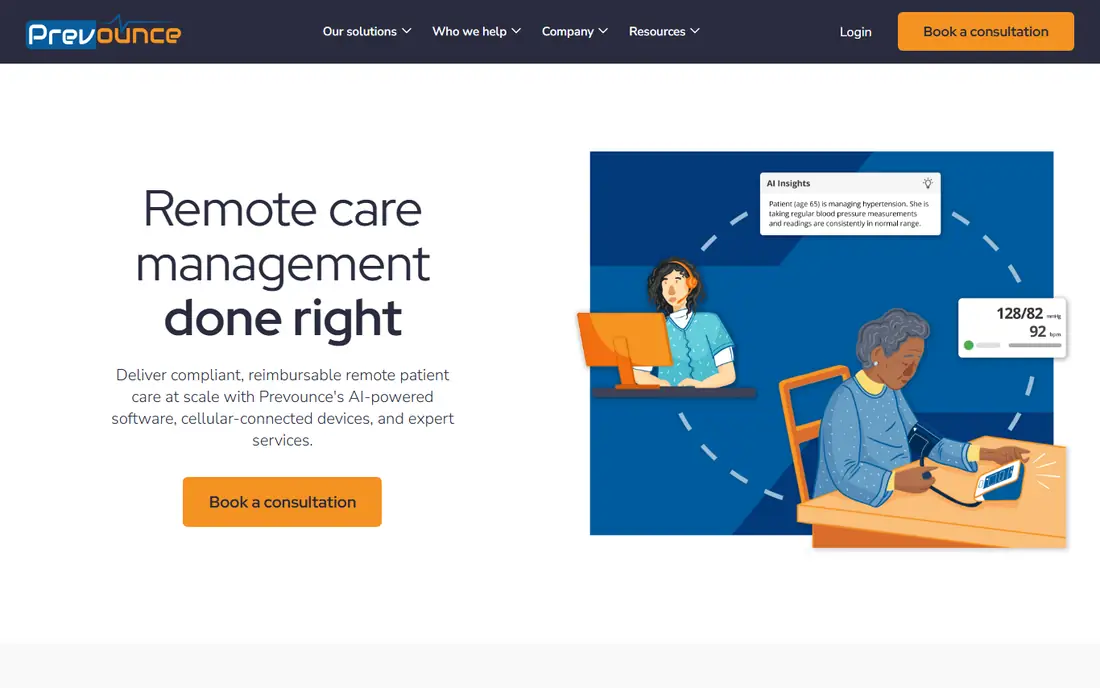
Prevounce is an all in one remote care management platform covering RPM, CCM, Advanced Primary Care Management, Annual Wellness Visits, and preventive services. It offers guided workflows for care plan creation, time tracking, patient engagement, and billing, plus AI powered software and cellular connected devices. The cellular devices matter for older patients, because they need no app, pairing, or WiFi setup. The platform is designed as a single cloud system for managing RPM, CCM, APCM, and AWV programs together, so a practice does not need separate vendors for each program. The main drawback is integration cost. User reviews summarised by SelectHub report that EMR integration can be costly, and skipping integration leaves staff with manual data entry. Confirm the integration price for your EHR in writing before you sign.
What we like- All in one remote care management platform with guided workflows
- AI powered software
- Cellular connected devices
- Covers RPM, CCM, Advanced Primary Care Management, and Annual Wellness Visits
Watch out for- User reviews summarised by SelectHub report that EMR integration can be costly, and skipping integration leaves staff with manual data entry between Prevounce and the EMR
#3
HealthArc
Best for: Practices running several CMS programs on one login
Visit healtharc.io
Starting pricequote
Free planNo free plan confirmed on the vendor site; trial reported by third party listings, unconfirmed
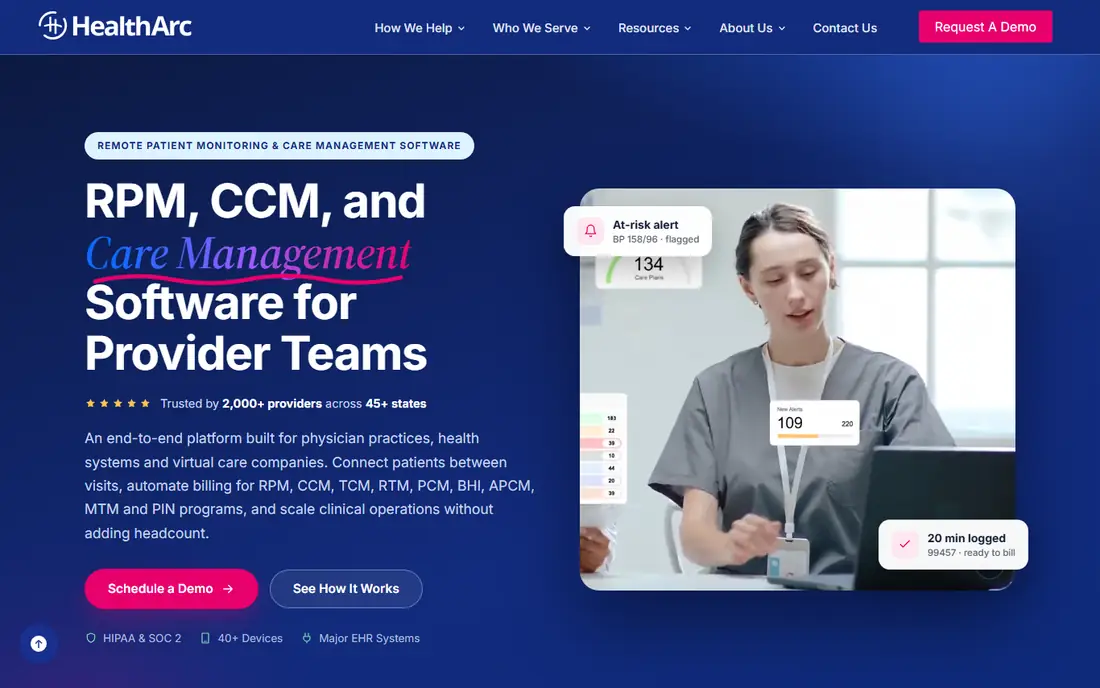
HealthArc runs nine CMS programs on one login, including RPM, CCM, RTM, TCM, PCM, BHI, APCM, MTM, and PIN, with one patient record and one billing engine. That single login matters for staff who would otherwise switch between tools all day. It automates CPT documentation for CCM codes 99490, 99439, 99491, 99437, 99487, and 99489, and connects with more than 55 EHRs and more than 40 devices. It offers cellular devices with no app, pairing, or WiFi setup, and it is HIPAA and SOC 2 Type II compliant. The vendor says pricing is per enrolled patient per month, with no long term contract and no upfront hardware purchase, but it publishes no dollar figure. The main drawback is tiering. Third party listings report that advanced analytics and reporting sit behind higher tiers, so confirm which reports are included in your tier before you buy.
What we like- Runs nine CMS programs on one login with one patient record and one billing engine
- Automates CPT documentation for CCM codes 99490, 99439, 99491, 99437, 99487, and 99489
- Connects with more than 55 EHRs and more than 40 devices
Watch out for- Third party listings report that advanced analytics and reporting sit behind higher tiers, and onboarding complexity rises when connecting multiple device ecosystems
#4
ChronicCareIQ
Best for: High volume Medicare practices that want risk signals between visits
Visit chroniccareiq.com
Starting pricequote
Free planNo free plan; demo on request
ChronicCareIQ helps high volume Medicare practices simplify CCM workflows, identify rising risk patients between visits, and capture reimbursable non face to face care activity. Its tools include RiskIQ for patient risk signals, PatientIQ for a connected patient view, and CallerIQ for capturing phone based care activity. That phone capture matters because much of CCM work happens on the phone, and time spent on calls is billable when it is logged properly. The vendor says it integrates with 8 EHRs and more than 50 phone systems, and it supports CCM, RPM, RTM, PCM, BHI and Collaborative Care, TCM, and APCM in one platform. The vendor also offers a reimbursement analysis tool based on the practice NPI, which helps a practice estimate revenue before it enrolls patients. The main drawback is fit. It is built for high volume practices, so a small practice may find the platform oversized, and integration can be a challenge in some cases.
What we like- RiskIQ for patient risk signals, PatientIQ for a connected patient view, and CallerIQ for capturing phone based care activity
- Supports CCM, RPM, RTM, PCM, BHI, TCM, and APCM in one platform
Watch out for- Integrating with existing systems is not one of its strongest suits according to third party reviews, and it is positioned for high volume, large practices, so a small practice may find the platform oversized
#5
TimeDoc Health
Best for: Practices that want software only, hybrid, or full service options
Visit timedochealth.com
Starting pricequote
Free planNo free plan; demo on request
TimeDoc Health was founded in 2015 and provides an EHR integrated CCM, RPM, and behavioral health platform used by more than 140 healthcare organizations. Its CCM platform covers medication reviews, appointment scheduling, durable medical equipment assistance, care plan automation, and billing code support, with patient vitals pushed into the EHR chart. That EHR push matters because vitals that live only in the CCM tool do not help the clinician at the next visit. Practices can use the software alone or add TimeDoc clinical services under its hybrid model, or hand the whole program to TimeDoc under full service. That flexibility suits a practice that wants to start with software and add help later. The main drawback is pricing opacity. Three custom tiers with no published prices mean a practice cannot budget without a sales conversation, and the hybrid and full service models reduce direct practice control over patient contact.
What we like- Software only, hybrid, and full service plans from one vendor
- EHR integrated platform used by more than 140 healthcare organizations
- Covers medication reviews, appointment scheduling, and care plan automation
Watch out for- No published pricing and three custom tiers mean a practice cannot budget without a sales conversation, and outside coordinators handle part of the care work in the hybrid and full service models
Starting pricequote
Free planNo free plan; demo on request
Vivo Care is the direct successor to Optimize Health, which rebranded to Vivo Care in 2025. The old Optimize Health domain now redirects to Vivo Care, so buyers searching for the old name will land on the new one. Vivo Care offers CCM as software only or as a fully managed service, with US licensed care navigators working as an extension of the practice team. Its CCM page covers consent, electronic care plans, automatic time tracking, monthly touchpoints of at least 20 minutes, and revenue and billing support. The vendor says it has supported more than 120,000 patients and serves more than 350 healthcare organizations across RPM, CCM, PCM, and APCM, with point of care enrollment live on athenahealth and eClinicalWorks. The vendor also combined with Onpoint Healthcare Partners in November 2026, which adds to the brand change. The main drawback is price transparency. The vendor publishes no price, and its CCM guide states clearly that the rates shown there are CMS reimbursement rates, not Vivo Care pricing, so do not mistake them for the cost of the software.
What we like- CCM as software only or fully managed service
- US licensed care navigators working as an extension of the practice team
- Point of care enrollment live on athenahealth and eClinicalWorks
Watch out for- No published price, so practices cannot compare cost without a sales quote, and the 2025 rebrand from Optimize Health to Vivo Care creates brand confusion for buyers who search for the old name
Starting pricequote
Free planNo free plan; sales consultation
CareHarmony provides turnkey CCM, RPM, Annual Wellness Visits, and Transitional Care Management, built on its Symphony platform and CareBlocks technology for tailored care plans. The company was founded in 2015 in Brentwood, Tennessee, and says more than 100,000 people rely on CareHarmony. It raised a $15 million Series A round in 2022, led by Maverick Ventures. The model is simple for the practice. CareHarmony coordinators enroll patients, run monthly outreach, and keep the care plans current, while the practice reviews the work and bills Medicare. That suits a practice with no spare care coordination staff and no appetite for hiring. The trade off is control. Vendor coordinators handle much of the patient contact, so the practice has less direct control over outreach, tone, and scheduling than it would with software its own staff runs. Confirm the service level agreement, the coordinator to patient ratio, and the revenue share or fee structure in writing before you sign.
What we like- Turnkey full service model with CareHarmony coordinators handling patient contact
- Symphony platform with CareBlocks technology for tailored care plans
- Covers CCM, RPM, Annual Wellness Visits, and Transitional Care Management
Watch out for- It is a turnkey full service model, so CareHarmony coordinators handle much of the patient contact, which reduces direct practice control over outreach, tone, and scheduling compared with software a practice runs with its own staff
#8
ChartSpan
Best for: Practices that want the largest full service CCM organization
Visit chartspan.com
Starting pricequote
Free planNo free plan; consultation on request
ChartSpan describes itself as the largest full service CCM organization in the United States, serving more than 150 practices and health systems. Its team handles patient identification, enrollment, care plans, monthly outreach, and documentation, with a 24/7 nurse care line and a guarantee of at least 20 minutes of engagement per patient per month. That 20 minute guarantee matters because it matches the Medicare threshold for the base CCM code, so the practice can count on billable time. Its RapidBill technology supports review and billing under general supervision, and its software integrates with the practice EHR. The model is revenue share, which means the practice gives up part of its Medicare reimbursement in exchange for ChartSpan staffing the program. A third party comparison site gives a range of 40 to 60 percent for full service vendors in general, so the margin question is the first thing to settle in the quote. The vendor publishes no CCM price, and its RapidAWV tool at $349 per NPI per month is a different product, so do not use that figure as the CCM price.
What we like- Describes itself as the largest full service CCM organization in the United States, serving more than 150 practices and health systems
- 24/7 nurse care line
- Guarantee of at least 20 minutes of engagement per patient per month
Watch out for- The full service revenue share model means the practice gives up part of its Medicare reimbursement in exchange for ChartSpan staffing the program, so margin loss is the key trade off to confirm in a quote
Frequently asked questions
What is the best chronic care management software for a small practice
ThoroughCare is the best pick for most small practices that want to run CCM with their own staff. It is software first, with automated CPT coding and integration with more than 400 RPM devices, and it covers CCM, RPM, Behavioral Health Integration, Transitional Care Management, and Annual Wellness Visits in one system. Prevounce is the best alternative for a practice that wants an all in one platform with AI powered workflows and cellular devices. A practice with no spare staff should look at the full service models, CareHarmony or ChartSpan, instead.
How much does chronic care management software cost
No vendor in this guide publishes a starting price, so every price comes from a sales quote. Third party figures such as $150 per month for Prevounce and $12 per user per month for HealthArc are unverified and conflict across sources. The pricing model matters more than the number. Software only models charge per patient or per user per month and the practice keeps the Medicare reimbursement. Full service models such as ChartSpan use revenue share, so the practice gives up part of its reimbursement in exchange for vendor staffing.
What is the difference between software only and full service CCM
Software only tools give your staff the platform to run CCM, including time tracking, care plans, outreach, and billing, and your practice keeps the full Medicare reimbursement. Full service vendors such as CareHarmony and ChartSpan staff the program with their own coordinators who handle enrollment, monthly outreach, and documentation. Full service suits a practice with no spare staff, but it reduces direct control over patient contact and, in revenue share models, gives up part of the reimbursement. Hybrid models from TimeDoc Health and Vivo Care sit between the two.
Which CCM codes does the software need to support
The software must support CPT 99490 for 20 minutes of CCM per month, 99439 and 99491 for additional time and for physician led CCM, and 99487 and 99489 for complex CCM. HealthArc automates documentation for 99490, 99439, 99491, 99437, 99487, and 99489. ThoroughCare offers automated CPT coding across its programs. Ask each vendor to show how time is logged against each code and how the audit trail looks, because Medicare audits test time records first.
Can chronic care management software work with my EHR
Most tools in this guide integrate with common EHRs, but the depth varies. HealthArc connects with more than 55 EHRs, ChronicCareIQ integrates with 8 EHRs and more than 50 phone systems, and TimeDoc Health pushes vitals into the EHR chart. Prevounce reviews note that EMR integration can be costly, so confirm the integration price for your EHR in writing. Ask the vendor to name your EHR, show the integration working, and confirm whether vitals, time, and notes write back into the chart or stay in the CCM tool.
Sources we checked (8)
- https://www.thoroughcare.net/
- https://www.prevounce.com/
- https://www.healtharc.io/
- https://www.chroniccareiq.com/
- https://timedochealth.com/
- https://vivocaresolutions.com/
- https://care-harmony.com/
- https://www.chartspan.com/
Is your product missing or out of date?
We review this list regularly. Vendors can request a listing, send updated pricing or ask about featured placement.

Shihab Mia · Founder, Rankite
Shihab has 5+ years in B2B and SaaS SEO. He writes Rankite's software buying guides from pricing pages, documentation and public user reviews. More about Shihab.