How we make this list: we compare pricing pages, product documentation and public user reviews. Ratings come from G2, Capterra or Trustpilot, with the date we checked them.

Key takeaways
- ProjectionLab and Boldin are the purpose built FIRE planners, modelling retirement dates, withdrawal strategies and what if scenarios in real depth.
- Monarch, Copilot Money and Tiller handle the tracking side, accounts, spending and net worth, which is the raw material every plan runs on.
- OnTrajectory models life events and big changes well, and Rocket Money earns its place by finding money leaks before any plan matters.
- A disclaimer that matters: these tools calculate and organise; they create no returns, and a beautiful projection built on guessed returns is still a guess.
Quick comparison
| Tool | Best for | Starting price | Free plan |
|---|
 ProjectionLab | Detailed FIRE plans and scenarios | $9 per month | Yes |
 Boldin | Retirement planning with withdrawal strategy | See website | Yes |
 Monarch | Tracking accounts and net worth as a household | $14.99 per month | No |
 Copilot Money | A polished tracker for Apple users | See website | No |
 Tiller | Spreadsheet based tracking and planning | $79 per year | No |
 OnTrajectory | Modelling life changes and cash flow futures | See website | Yes |
 Rocket Money | Finding subscriptions and leaks first | See website | Yes |
Is your product missing or out of date?
We review this list regularly. Vendors can request a listing, send updated pricing or ask about featured placement.
The best apps for financial independence
Starting price$9 per month
Free planYes

What we like- ProjectionLab was built by and for the financial independence community: model your accounts, income, savings and expenses, then run the plan forward with Monte Carlo simulations, historical sequences, tax aware withdrawal ordering, Roth conversions and backdoor scenarios, and see the distribution of outcomes rather than one fragile line. What if tools answer the questions FIRE actually asks, what if I retire at 50, go part time at 45, spend more in my sixties, quickly and beautifully. A free tier covers basic planning
- Paid plans from 9 dollars a month on annual billing add the depth. Data can be kept without linking accounts, a privacy option this audience values.
Watch out for- Depth brings homework: the plan is only as honest as the expense and account detail you enter, and a first serious model takes an evening, not ten minutes. It is a planner, not a tracker, so balances go stale unless you update them or pair it with a tracking tool. As a small independent product it lacks the institutional heft some users want holding their financial picture, though its local data options answer much of that concern. Tax modelling is US centred.
#2
Boldin
Best for: Retirement planning with withdrawal strategy
Visit boldin.com
Starting priceSee website
Free planYes
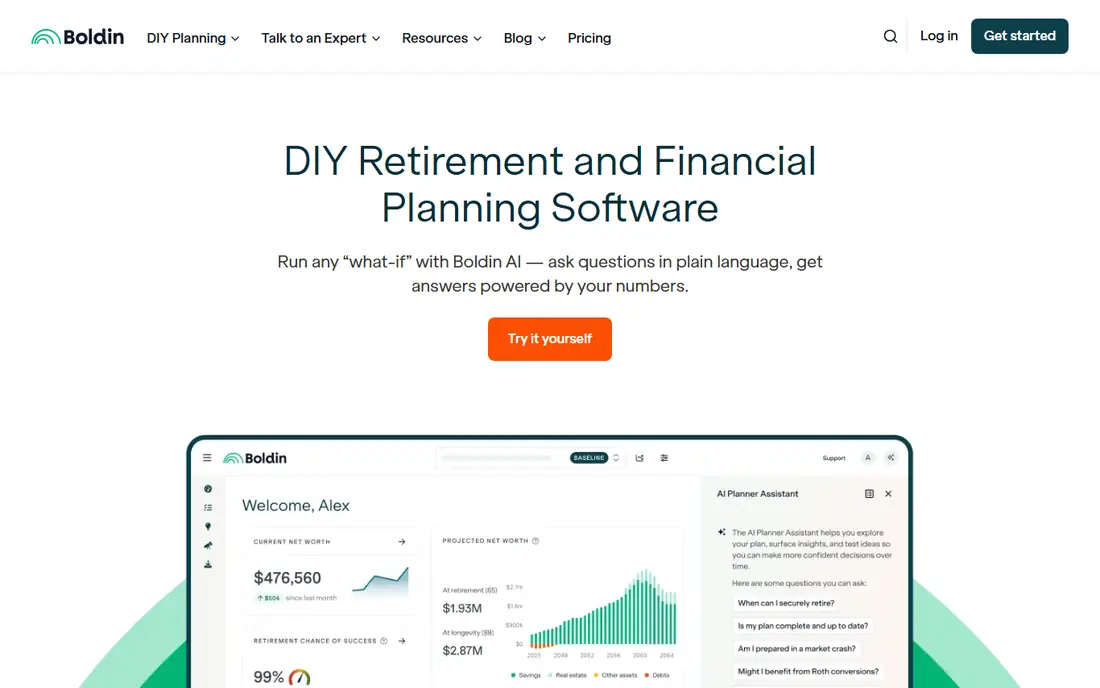
What we like- Boldin, formerly NewRetirement, is the planner most often recommended beside ProjectionLab, aimed slightly more at conventional retirement with a strong FIRE following of its own: detailed modelling of income streams, Social Security timing, pension and annuity income, Medicare costs, tax brackets year by year and withdrawal sequencing, presented in an interface non specialists can drive. A free plan covers the basics
- The paid PlannerPlus tier adds the scenario depth and is priced on its site. Its scenario comparisons, retire at 60 versus 62 with this pension choice, are exactly the decisions its users face.
Watch out for- The breadth tilts toward US retirement systems, so early retirees decades from Social Security use only part of the machine. Serious use still demands an evening of data entry and regular updates, since it plans from figures you provide rather than live account feeds in its core model. Pricing and plan structure have changed with the rebrand, hence see website. Like every tool here, its projections are assumption driven
- Its polish makes that easier to forget, not less true.
#3Monarch
Best for: Tracking accounts and net worth as a household4.7/5 on
G2 (3 reviews, checked Oct 2026)
Visit monarch.com
Starting price$14.99 per month
Free planNo

What we like- Monarch is the tracker most households land on now: connect bank, card, loan and investment accounts, and budgets, cash flow, goals and net worth stay current in a clean interface built for two people to share one financial picture. For FIRE households the savings rate and net worth trend are the vital signs, and Monarch reports both without spreadsheet labour. Investment holdings are tracked at a level adequate for allocation checks, and custom categories bend to a FIRE budget's shape. At 14 dollars and 99 cents a month it replaced the old incumbents for many couples after other dashboards closed or stagnated.
Watch out for- Monarch tracks
- It does not plan. There is no Monte Carlo, no withdrawal strategy, no retirement date engine, so it feeds a planner rather than replacing one. Account connection reliability varies by institution, the standing complaint of every aggregator. There is no free plan beyond a trial. Households outside the US and Canada get little from it. Used alone it can create a false sense of progress: a rising net worth chart feels like a plan, and it is not one.
Starting priceSee website
Free planNo
What we like- Copilot Money is the tracker Apple users praise for design: fast, native apps for iPhone and Mac, account aggregation, budgets that adapt, investment tracking with holdings detail, and a net worth view that makes the FIRE dashboard genuinely pleasant to check. Its categorisation learns well, review queues keep data honest, and couples and shared access features have grown steadily. For the tracking half of a financial independence system, it is arguably the nicest front end available, and its subscription is priced on its site and in the App Store.
Watch out for- Apple only is a real wall: no Android and a limited web experience, so mixed platform households cannot standardise on it. Planning features stop at goals and projections of the simple kind
- The FIRE modelling still belongs to ProjectionLab or Boldin. Aggregation hiccups occur as with all rivals. Pricing has moved since launch, hence see website, and the per month figure adds up across the decades a FIRE plan spans, which is worth one raised eyebrow and a yearly review.
#5Tiller
Best for: Spreadsheet based tracking and planning4.0/5 on
G2 (2 reviews, checked Oct 2026)
Visit tiller.com
Starting price$79 per year
Free planNo
What we like- Tiller takes the opposite approach to every app here: it pours your bank, card and investment transactions into a Google Sheet or Excel workbook that you own, with templates for budgets, net worth and FIRE style calculations, and total freedom to build the model your brain actually wants. For the spreadsheet fluent, and the FIRE community is full of them, this beats any fixed dashboard: your savings rate formula, your withdrawal test, your chart, in a file that cannot be shut down by a company's strategy change. At 79 dollars a year with a trial, it is also the cheapest full tracker here.
Watch out for- A spreadsheet is only as good as its keeper: break a formula and the dashboard lies politely. There is no dedicated app experience, mobile use is the Sheets app, and setup takes an afternoon of template work. Planning templates are community and starter grade beside ProjectionLab's engine. People who hate spreadsheets will hate this, and should not let its price argue them into a tool they will abandon by March, since a tracker abandoned is worse than a tracker costing more.
Starting priceSee website
Free planYes
What we like- OnTrajectory models a financial life as a sequence of events: incomes that start and stop, a sabbatical, a house purchase, college years, retirement, each placed on a timeline and projected forward with taxes and account types handled along the way. That event based view suits the way FIRE decisions actually arrive, as changes to a life rather than tweaks to a spreadsheet, and its outputs show the trajectory bending at each event. A free tier covers simpler plans, and paid tiers add complexity, priced on its site. Long time users praise how quickly a new scenario can be sketched.
Watch out for- The interface and visual style feel a generation behind ProjectionLab, and the learning curve is real, with concepts to absorb before the first model makes sense. It is planning only: no account feeds, so the model needs manual upkeep to stay truthful. The user community is smaller, so examples and help are thinner. For a household whose question is a single retirement date, simpler tools answer faster
- OnTrajectory earns its keep when the future has chapters.
Starting priceSee website
Free planYes
What we like- Rocket Money, the former Truebill, does the least glamorous and most immediately profitable job in personal finance: it finds your subscriptions and recurring charges, shows the total creeping out monthly, cancels the unwanted ones through its service, and tracks spending and bills alongside. For a household beginning a financial independence push, the first hundred dollars of monthly savings usually comes from exactly this audit, before any investment decision matters. Its bill negotiation service has a real record of lowering cable and phone bills for a share of the savings. The free tier covers tracking
- Premium adds the concierge features, priced on a pay what is fair scale on its site.
Watch out for- Rocket Money is not a FIRE planner at all: no projections, no withdrawal modelling, and including it in a plan means pairing it with a real planner. Cancellation and negotiation services take a percentage or have mixed success rates worth reading before handing over a bill. Premium pricing on a sliding scale confuses comparison shoppers. Account aggregation quality is fine rather than leading. Treat it as the cleanup crew that visits once or twice a year, not the architect.
How we chose
We compared apps a US household pursuing financial independence would genuinely use in October 2026, split by the two halves of the work: planning engines that model the future, ProjectionLab, Boldin and OnTrajectory; trackers that keep the present accurate, Monarch, Copilot and Tiller; and one leak finder, Rocket Money, because outflow control precedes planning in most real households. Prices are subscription figures from vendor pages, marked see website where pricing models vary or have recently changed. No tool here is an investment product and none promises returns; we excluded robo advisers and brokerages deliberately, since growing the money and planning the independence are different jobs.
Build the system in order. First, stop the leaks and get tracking running for ninety days, because a plan built on guessed expenses is fiction with charts; Monarch, Copilot or Tiller will tell you the true savings rate, the single number that drives every FIRE outcome. Second, model with a planner: enter real figures, run the conservative case, returns a point below your hope, inflation a point above, and see whether the plan survives its own bad luck. A plan that only works at optimistic assumptions is not a plan; it is a wish with a date on it.
Third, revisit the assumptions on a schedule, yearly is enough, and treat the output as a range of possible dates rather than a promise to your future self. Keep an eye on the things models handle badly: health costs before Medicare, tax law changes, supporting family, and the chance that future you wants a different life than present you is planning for. The point of financial independence was never the chart. It is options: to change work, to take the break, to say no. Tools that keep those options visible and honestly priced are doing their whole job.
Frequently asked questions
Can an app really tell me when I can retire?
It can tell you when you could retire under the assumptions you feed it, which is a different and still useful thing. Good planners show ranges and probabilities: a Monte Carlo result of 85 percent success means the plan survived 85 percent of simulated market histories, not that your future is 85 percent safe. Use the output to compare decisions, retiring at 55 versus 57, spending less versus saving more, where the relative answers are trustworthy, rather than to circle a date and stop thinking. The decision itself deserves an adviser and a stress test.
What is the difference between a tracker and a planner?
A tracker reports the present: accounts, spending, net worth today and its trend. A planner projects the future: given savings, returns, taxes and spending, what happens over decades and when does work become optional. Monarch, Copilot and Tiller are trackers; ProjectionLab, Boldin and OnTrajectory are planners. Most serious households end up with one of each, because the planner is only as good as the tracker's facts. Buying only a tracker and calling the rising net worth line a retirement plan is the commonest self deception in this category.
Do I still need a financial adviser if I use these tools?
For many people, at most decision points, a good planner plus honest tracking covers the work. An adviser earns their fee at the irreversible moments: claiming Social Security, structuring withdrawals across account types, estate and insurance gaps, a business sale, divorce or inheritance, and as a check on the optimism built into self made assumptions. Look for a fiduciary, ideally fee only and paid by you alone, and consider a one time plan review rather than an ongoing percentage of assets, which compounds into a very large fee across a retirement.
How accurate are the tax calculations in planning apps?
Good enough for comparing scenarios, not good enough for filing. ProjectionLab and Boldin model federal and often state brackets, account types and conversion windows with real sophistication, and those models genuinely change decisions, such as when Roth conversions pay. But tax law changes, and personal situations, business income, rental property, equity compensation, break general models. Treat in app tax output as a strong estimate that shapes strategy, then confirm the first year of any major move with a tax professional before executing it.
Is it safe to link all my accounts to one app?
Aggregation is a real trade: the major trackers use established connection providers, read only access in most cases, encryption and two factor sign in, and the convenience is the product. The risk is concentration: one more company holds a map of your entire financial life. Reduce it with a unique password, app based two factor, and alerts on the underlying accounts. Privacy focused users can choose ProjectionLab's manual entry route or Tiller's spreadsheet in their own cloud drive. There is no zero risk option, including the spreadsheet on a laptop; there is only choosing which risks you understand.
Sources we checked (0)
Is your product missing or out of date?
We review this list regularly. Vendors can request a listing, send updated pricing or ask about featured placement.

Shihab Mia · Founder, Rankite
Shihab has 5+ years in B2B and SaaS SEO. He writes Rankite's software buying guides from pricing pages, documentation and public user reviews. More about Shihab.