How we make this list: we compare pricing pages, product documentation and public user reviews. Ratings come from G2, Capterra or Trustpilot, with the date we checked them.
Key takeaways
- AI in data integration now drafts pipelines from prompts, recommends mappings, heals broken schema changes, and builds connectors from API docs.
- Fivetran and Airbyte cover automated ELT into warehouses, while Talend, Matillion, and Informatica add visual transformation and governance.
- Pricing models differ sharply: Fivetran bills on monthly active rows, Airbyte Cloud starts at 20 dollars per month, and Integrate.io charges a flat 1,999 dollars per month.
- Open source options such as Airbyte Core and Apache NiFi cost nothing in license but need engineering time to run.
- Always verify AI output before production, since a wrong mapping or a bad join can corrupt downstream reports silently.
Quick comparison
| Tool | Best for | Starting price | Free plan |
|---|
 Fivetran | Automated SaaS ingestion | Free | Yes |
 Airbyte | Open source ELT with control | Free | Yes |
 Informatica IDMC | Enterprise data management | See website | No |
 Qlik Talend Cloud | Enterprise hybrid integration | See website | No |
 Matillion | Warehouse native ELT | See website | No |
 Integrate.io | Flat fee low code pipelines | $1,999 per month | No |
 SnapLogic | Visual integration with agents | See website | No |
 AWS Glue | AWS native serverless ETL | $0.44 per DPU hour | No |
Is your product missing or out of date?
We review this list regularly. Vendors can request a listing, send updated pricing or ask about featured placement.
#1Fivetran
Best for: Automated SaaS ingestion4.3/5 on
G2 (841 reviews, checked Oct 2026)
Visit fivetran.com
Starting priceFree
Free planYes
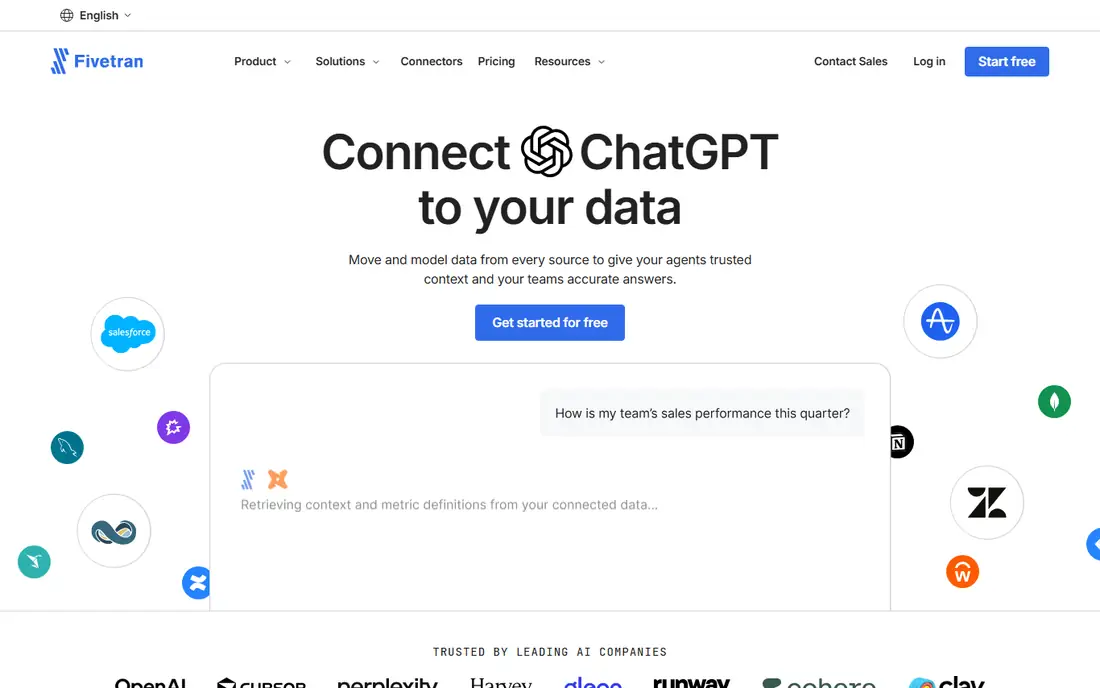
What we like- Fivetran offers more than 700 connectors and automated schema evolution, so pipelines keep running when a source changes a field. It is free up to 500,000 monthly active rows, and log based change data capture keeps warehouses fresh with low latency. Since the June 2026 merger with dbt, ingestion and transformation come from one vendor, which simplifies the stack.
Watch out for- Pricing above the free tier is usage based on monthly active rows, and since January 2026 deletes and history mode changes count toward paid rows, with a 5 dollar monthly minimum per standard connection and a 12,000 dollar annual minimum on contracts. Custom connectors require a request queue with a 2 to 8 week initial review, or a Python SDK you maintain yourself. It covers ELT only, not application integration.
#2Airbyte
Best for: Open source ELT with control4.4/5 on
G2 (78 reviews, checked Oct 2026)
Visit airbyte.com
Starting priceFree
Free planYes
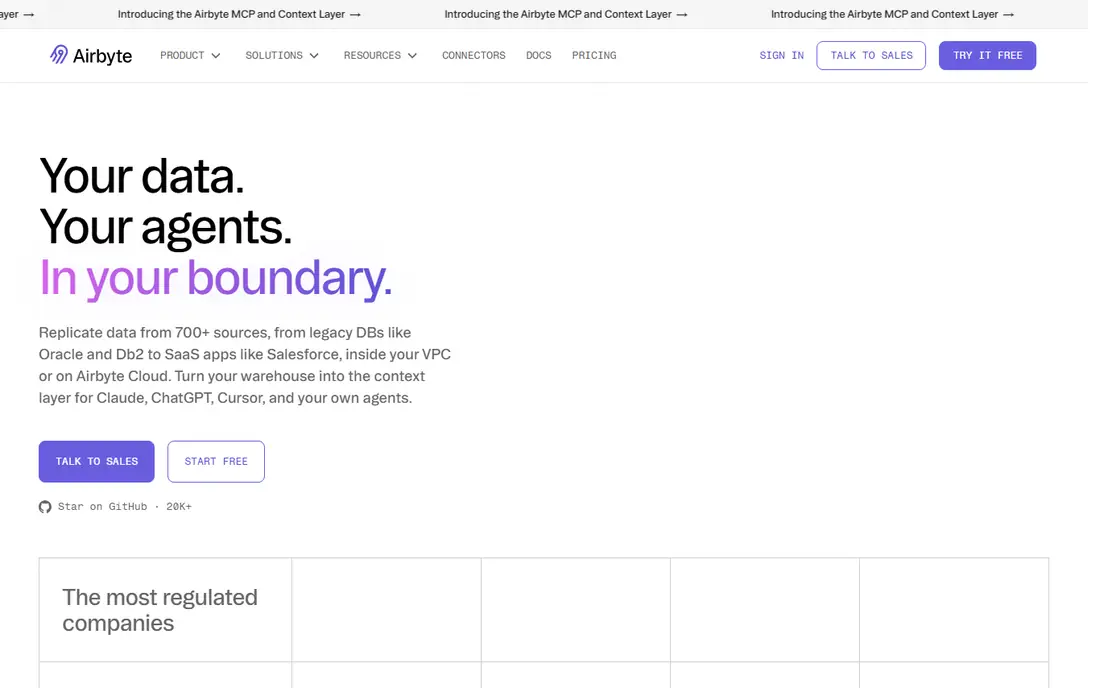
What we like- Airbyte offers more than 700 connectors plus a Connector Development Kit, and its AI Assistant builds connectors from API docs with chat guided setup. The self hosted Core edition is free, Cloud Standard starts at 20 dollars per month, and Plus starts at 189 dollars per month. Pro and Enterprise Flex price on Data Workers, dedicated compute capacity, so row counts and job volume do not drive the bill. Agent Connectors and MCP support suit teams building AI agents on warehouse data.
Watch out for- Self hosted Airbyte needs engineering time to run and maintain, roughly half a full time role in some estimates. Cloud Standard syncs hourly at best, with 15 minute syncs on Plus, so true real time needs higher tiers. Reverse ETL capabilities lag some rivals, and transformation is left to dbt or code rather than built in.
Starting priceSee website
Free planNo
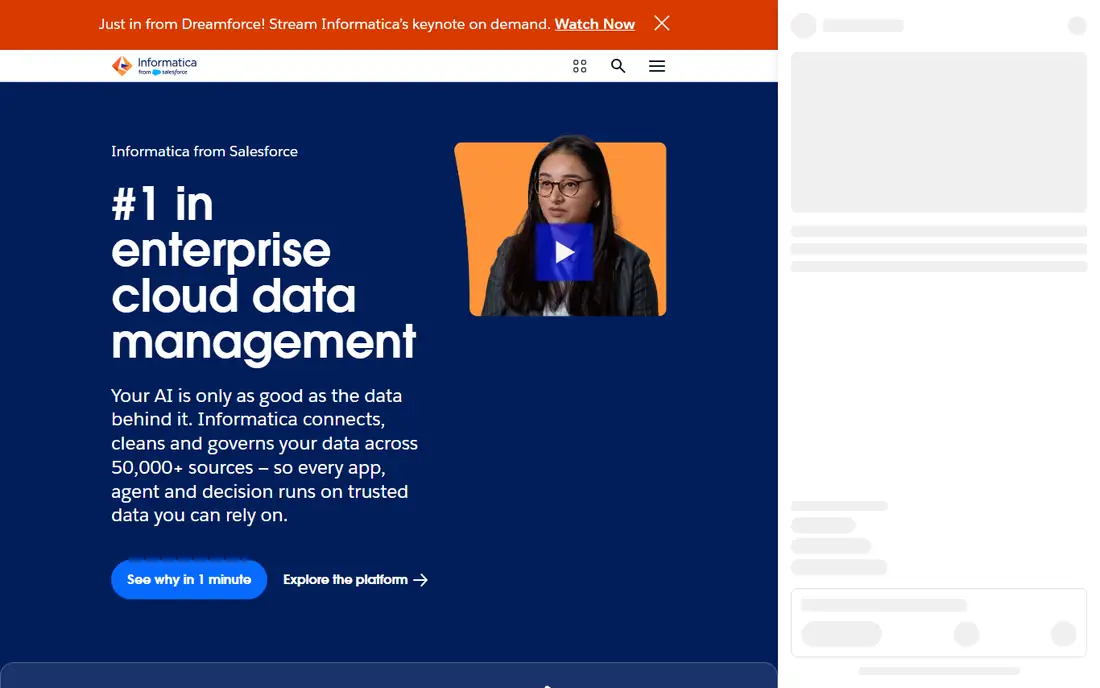
What we like- Informatica Intelligent Data Management Cloud pairs the CLAIRE engine, which recommends mappings, with CLAIRE GPT and Copilot for conversational pipeline design. It covers ingestion, transformation, data quality, and governance in one platform, with change data capture for low latency sync. Regulated industries value its governance and lineage features, and Salesforce completed its acquisition of Informatica in November 2025.
Watch out for- Pricing is quote only and consumption based on Informatica Processing Units, with enterprise licensing that can reach six figures annually. Implementation often needs professional services, and custom connectors can cost 50,000 to 150,000 dollars. The platform is heavy for small teams, and PowerCenter 10.5 standard support ended in March 2026, so legacy users face migration.
#4Qlik Talend Cloud
Best for: Enterprise hybrid integration3.7/5 on
Capterra (3 reviews, checked Oct 2026)
Visit qlik.com
Starting priceSee website
Free planNo
What we like- Qlik Talend Cloud combines Talend Studio visual jobs with cloud pipelines, AI generated SQL in no code pipelines, and machine learning assisted data quality. It supports cloud and on premises deployment, change data capture through Replicate, and more than 1,000 connectors with plugins. Enterprises that need hybrid deployment and strong data quality will find it a complete platform.
Watch out for- Pricing is quote only across four editions, metered on data moved, job executions, and job duration, with third party reports putting Starter at 12,000 to 30,000 dollars a year and larger estates well into six figures. Each pipeline is a Java job in Talend Studio rather than a configured connector, which slows simple ingestion next to Fivetran or Airbyte. Stitch, the former Talend ELT product, is now part of Qlik Talend Cloud, so buyers should confirm the current product name.
Starting priceSee website
Free planNo
What we like- Matillion runs warehouse native ELT on Snowflake, BigQuery, Redshift, and Databricks, with a low code canvas plus SQL and Python, and pushdown processing that keeps compute in the warehouse. Its Maia agents build pipelines from natural language across ingestion, transformation, and quality, and streaming change data capture is available on the Scale edition. Teams that live in one warehouse will find it fast and familiar.
Watch out for- Pricing is quote only and credit based, with a free trial but no published starting price. It is warehouse native, so teams without a cloud warehouse get less value. Agent features are newest on the four supported warehouses, and multi warehouse estates need care in planning.
#6Integrate.io
Best for: Flat fee low code pipelines4.3/5 on
G2 (213 reviews, checked Oct 2026)
Visit integrate.io
Starting price$1,999 per month
Free planNo
What we like- Integrate.io charges a flat 1,999 dollars per month with unlimited volume, which removes the usage surprises that row based billing creates. Its Helm copilot drafts and explains pipelines from a prompt, an MCP Server lets any language model inspect, build, and run pipelines, and self healing schema mapping handles source changes. Low code steps number more than 220, with SQL and Python alongside, and change data capture runs every 60 seconds.
Watch out for- The flat fee is high for small teams, since 1,999 dollars per month exceeds Airbyte Cloud or Fivetran free tiers by a wide margin. The 14 day trial is short for evaluating a pipeline platform. Teams with tiny volumes will find usage based pricing cheaper, and the connector library is smaller than Fivetran or Airbyte.
#7SnapLogic
Best for: Visual integration with agents4.4/5 on
G2 (404 reviews, checked Oct 2026)
Visit snaplogic.com
Starting priceSee website
Free planNo
What we like- SnapLogic offers visual Snaps for building integrations, SnapGPT copilot for conversational design, an AgentCreator add-on for building agents, and an MCP Server released in May 2026. Event driven Ultra pipelines run sub second for message based flows, and the platform covers both application integration and data pipelines. Teams that need APIs and data in one platform will find it a strong fit.
Watch out for- Pricing is quote only across Essential, Professional, and Enterprise One tiers, with consumption based credits that make total cost hard to predict. The platform suits integration specialists more than analysts, and small teams may find the learning curve steep. Published pricing is absent, so budgeting requires a sales conversation.
Starting price$0.44 per DPU hour
Free planNo
What we like- AWS Glue is serverless Spark based ETL native to Amazon Web Services, priced at 0.44 dollars per DPU hour billed per second, with Glue Streaming for real time flows. Amazon Q data integration writes and troubleshoots jobs from natural language, and Glue Data Quality adds machine learning anomaly detection. Teams already on AWS get native integration with S3, Redshift, and Lake Formation without a second vendor.
Watch out for- It is AWS only, so multi cloud teams need another tool. Glue jobs require Spark, Python, or Scala skills, which rules out no code teams. Costs scale with data processing units and job duration, so poorly tuned jobs can surprise, and the console experience is rougher than dedicated integration platforms.
How we chose
We ranked tools on AI feature depth, connector count, transformation options, real time support, pricing transparency, and fit for small versus enterprise teams. Tools earned credit for published pricing, open source editions, and AI features that work in production rather than demos. We excluded tools with no verifiable AI features and tools that only resell another vendor's connectors. Figures come from published pricing and 2026 comparison reporting, and readers should confirm current terms directly, since pricing units and AI features change often.
Start with your warehouse and your sources. If you run Snowflake or BigQuery and need SaaS ingestion fast, Fivetran or Airbyte will get you running in days. If you need transformation, governance, and data quality in one platform, Informatica or Qlik Talend Cloud suit regulated enterprises better. Next, model pricing on your real volumes, not the headline tier: Fivetran monthly active rows, Airbyte Data Workers, Matillion credits, and Glue DPU hours produce very different bills at the same row count, so run a one month trial with production data. Then test AI output on a real pipeline, since a copilot that drafts a plausible but wrong mapping can corrupt reports silently, and keep human review on production pipelines. Finally, check deployment fit: self hosted tools need engineering time, cloud tools need budget for usage, and hybrid tools suit estates split between cloud and on premises systems.
Frequently asked questions
What is the difference between ETL and ELT?
ETL transforms data before loading it into a warehouse, while ELT loads raw data first and transforms it inside the warehouse. Modern tools such as Fivetran and Airbyte favor ELT, since warehouse compute is cheap and raw data stays available for new transformations.
How does AI help with data integration?
AI drafts pipelines from prompts, recommends mappings between source and target fields, heals broken schema changes, builds connectors from API documentation, and explains existing pipelines. It speeds setup, but human review remains essential before production.
Is open source data integration free?
The license is free, but running it is not. Self hosted tools need infrastructure and engineering time for maintenance, upgrades, and connector fixes, which can cost more than a managed cloud plan for small teams.
How is Fivetran priced?
Fivetran bills on monthly active rows per connection, with a free tier up to 500,000 rows, a 5 dollar monthly minimum per standard connection, and a 12,000 dollar annual minimum on contracts. Deletes and history mode changes count toward paid rows since January 2026.
Can AI agents use data integration tools?
Yes. Several tools now expose MCP servers that let language models inspect, build, and run pipelines, and Airbyte and SnapLogic both shipped MCP support in 2026. Agent access needs governance, since an agent with write access can change production pipelines.
Which tool is best for real time data?
Change data capture tools such as Fivetran, Qlik Talend Replicate, and Matillion Scale offer low latency sync, while AWS Glue Streaming and SnapLogic Ultra suit event driven flows. True real time needs the right tier, since entry cloud plans often sync hourly.
Sources we checked (0)
Is your product missing or out of date?
We review this list regularly. Vendors can request a listing, send updated pricing or ask about featured placement.

Shihab Mia · Founder, Rankite
Shihab has 5+ years in B2B and SaaS SEO. He writes Rankite's software buying guides from pricing pages, documentation and public user reviews. More about Shihab.