How we make this list: we compare pricing pages, product documentation and public user reviews. Ratings come from G2, Capterra or Trustpilot, with the date we checked them.
Key takeaways
- Fivetran and Airbyte lead on managed connectors and pipeline automation, with different pricing models that suit different workloads.
- AI features differ: some tools draft pipelines from prompts, others suggest mappings, and others use AI mainly for schema evolution and error recovery.
- Pricing units vary widely, including monthly active rows, credits, compute capacity, and consumption units, so model your own tables before you buy.
- Open source and self hosted options, such as Airbyte Core, suit teams that need control, while managed cloud suits teams that want less maintenance.
- Transformation, governance, and data quality tools matter as much as connectors, because raw loaded data rarely answers a business question alone.
Quick comparison
| Tool | Best for | Starting price | Free plan |
|---|
 Fivetran | Automated, fully managed warehouse loading | See website | Yes |
 Airbyte | Open, flexible ELT with managed cloud options | $20 per month | Yes |
 Informatica IDMC | Enterprise AI, governance, and data quality | See website | No |
 Qlik Talend | Hybrid integration with built in data quality | See website | No |
 SnapLogic | Low code enterprise integration and automation | See website | No |
 Matillion | Cloud warehouse transformation and ELT | See website | No |
 Hevo Data | No code pipeline setup for small to mid size teams | See website | Yes |
 Workato | App integration and workflow automation alongside data | See website | No |
Is your product missing or out of date?
We review this list regularly. Vendors can request a listing, send updated pricing or ask about featured placement.
#1Fivetran
Best for: Automated, fully managed warehouse loading4.3/5 on
G2 (841 reviews, checked Oct 2026)
Visit fivetran.com
Starting priceSee website
Free planYes
Fivetran is the managed ELT standard for teams that want connectors to just work. You connect a source, choose a destination warehouse, and Fivetran handles schema changes, incremental syncs, retries, and error logging, so a source adding a column does not break your reports. The platform covers hundreds of sources, including databases, SaaS apps, and APIs, and its dbt integration, strengthened after the dbt merger, handles post load transformations in SQL.
Pricing is the main decision point. Fivetran charges by monthly active rows per connection, with a free plan up to 500,000 monthly active rows, and paid plans usage based above that, with a per connection minimum and an annual contract minimum reported on paid plans. That model suits stable tables, but a table with many changed rows can cost more than expected. For a data team that values reliability and low maintenance over fine grained control, Fivetran is a leading choice.
What we like- Large managed connector library
- Automated schema evolution and error recovery
- Dbt transformations bundled after its dbt merger
Watch out for- Usage based pricing by monthly active rows can grow fast
- Less control over transformations than a code first tool
- Annual contract minimums on paid plans
#2Airbyte
Best for: Open, flexible ELT with managed cloud options4.4/5 on
G2 (78 reviews, checked Oct 2026)
Visit airbyte.com
Starting price$20 per month
Free planYes
Airbyte gives data teams a choice that few rivals match: run the open source Core version yourself, or use managed Cloud with Standard from $20 a month, Plus from $189 a month, and capacity based Pro and Enterprise Flex plans. Its AI Assistant builds connectors from API documentation, and its Connector Builder lets teams create custom connectors without deep coding, which helps when a niche SaaS app has no prebuilt connector. The connector library, commonly cited above 700, covers databases, SaaS APIs, files, and unstructured sources.
The trade off is pricing complexity. Cloud Standard charges by credits, and a row synced in many incremental runs can be billed multiple times, unlike Fivetran monthly active rows, so hourly syncs of busy tables need modeling. Transformation also relies on dbt or tools such as Airflow, rather than a built in visual designer. For a team that wants open code, self hosting, and AI assisted connector building, Airbyte is a strong, flexible option.
What we like- Open source core and self hosted option
- AI Assistant builds connectors from API docs
- Large connector library
- Dbt integration
Watch out for- Cloud pricing by credits can rise with sync frequency
- Managed features vary by plan tier
- Transformation relies on dbt or external tools
Starting priceSee website
Free planNo
Informatica Intelligent Data Management Cloud, or IDMC, is the enterprise platform in this list, and its AI engine, CLAIRE, is the most developed. CLAIRE recommends mappings, suggests data quality rules, and, through CLAIRE GPT and Copilot features, lets users design pipelines conversationally and explain existing ones. Governance, catalog, lineage, and data quality are built in, which matters for regulated companies that must prove where data came from and how it was transformed.
That depth comes with enterprise cost and complexity. Pricing is quote based and consumption based, using Informatica processing units, and implementation often involves a partner or a dedicated data team. Small teams will find IDMC heavy for a simple warehouse load. For a large organization that needs AI assisted design plus governance, quality, and compliance in one platform, Informatica IDMC is the benchmark.
What we like- CLAIRE AI engine suggests mappings and data quality rules
- Conversational copilot for pipeline design
- Strong governance and catalog
Watch out for- Quote based, consumption priced, and enterprise heavy
- Learning curve and implementation effort are high for small teams
#4
Qlik Talend
Best for: Hybrid integration with built in data quality
Visit qlik.com
Starting priceSee website
Free planNo
Qlik Talend Cloud combines data integration, transformation, and data quality in one platform, with AI features that generate SQL in no code pipelines and assist with data quality checks. That combination suits teams that need to clean, validate, and transform data during loading, not just move it, because quality rules can be applied before bad data reaches a warehouse. Hybrid deployment also helps companies with sources behind a firewall or in a private cloud.
Pricing is quote based and tied to data volume and job execution on higher tiers, so a direct quote is essential. The Talend to Qlik transition has also changed product names and packaging, so confirm exactly which product and tier a proposal covers. For a team that values data quality and hybrid deployment alongside AI assisted pipeline building, Qlik Talend is a serious enterprise option.
What we like- AI generated SQL in no code pipelines
- ML assisted data quality
- Hybrid cloud and on premises deployment
- Log based change data capture
Watch out for- Quote based pricing by data volume
- Product naming and migration after the Qlik acquisition can confuse buyers
#5SnapLogic
Best for: Low code enterprise integration and automation4.4/5 on
G2 (404 reviews, checked Oct 2026)
Visit snaplogic.com
Starting priceSee website
Free planNo
SnapLogic is a low code integration platform that suits enterprise teams connecting SaaS apps, databases, and cloud services, not just loading a warehouse. Its visual builder uses prebuilt Snaps for common systems, and SnapGPT, a copilot, drafts and explains pipelines from natural language, while AgentCreator and MCP support help teams build AI agent workflows that use enterprise data. That breadth makes SnapLogic useful for both data pipelines and application integration.
Pricing is quote based across Essential, Professional, and Enterprise tiers, so small teams cannot estimate cost from the website, and the platform is priced for enterprise use. Teams that only need simple warehouse replication may find Fivetran or Airbyte cheaper and simpler. For an enterprise that needs low code integration, AI assisted design, and agent ready data access, SnapLogic is a strong choice.
What we like- Visual pipeline builder with Snaps
- SnapGPT copilot for pipeline creation
- AgentCreator and MCP support for AI agents
Watch out for- Quote based pricing across tiers
- Enterprise focus means small teams may pay for breadth they do not use
#6Matillion
Best for: Cloud warehouse transformation and ELT4.4/5 on
G2 (83 reviews, checked Oct 2026)
Visit matillion.com
Starting priceSee website
Free planNo
Matillion focuses on transformation inside the cloud warehouse, using pushdown processing so heavy work runs in Snowflake, BigQuery, Databricks, or a similar warehouse rather than on a separate server. Its Maia agents build pipelines from natural language across ingestion, transformation, and quality, which can speed up routine pipeline work for data engineers. The low code canvas, with SQL and Python options, gives engineers control when a visual flow is not enough.
Pricing is quote based and credit based, with a free trial but no ongoing free plan, so teams need a sales quote and a usage model. Matillion is also warehouse centric, so a team that needs broad application integration or reverse ETL may need another tool alongside it. For a warehouse first team that wants AI assisted ELT and strong transformation, Matillion is a leading option.
What we like- Maia AI agents build pipelines from natural language
- Pushdown transformation in the warehouse
- Low code canvas with SQL and Python
Watch out for- Quote based, credit priced
- Warehouse centric, so non warehouse use cases are less natural
- Free trial only, no free plan
#7Hevo Data
Best for: No code pipeline setup for small to mid size teams4.4/5 on
G2 (295 reviews, checked Oct 2026)
Visit hevodata.com
Starting priceSee website
Free planYes
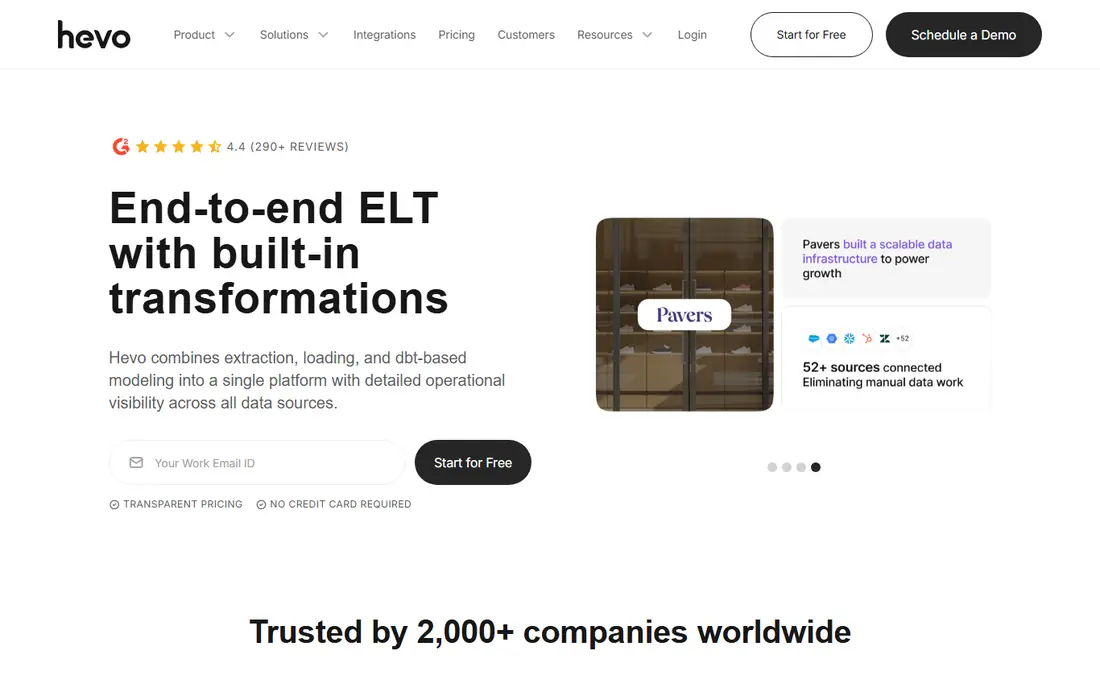
Hevo Data suits small to mid size teams that want pipelines running without writing code. Setup is form based: choose a source, choose a destination, map fields, and schedule syncs, with real time replication available on many pipelines and built in transformations plus Python for custom logic. A free tier for small datasets lets a team test a real pipeline before paying, which is useful for a startup or a first warehouse project.
Pricing is event based, so volume matters, and higher tiers include features such as advanced transformations, higher frequency, and support levels. Connector depth is also less than Fivetran or Airbyte for very niche sources, so check your specific SaaS apps before you commit. For a team that wants no code pipelines, fast setup, and a low entry cost, Hevo Data is a practical choice.
What we like- No code setup for common sources
- Real time replication on many pipelines
- Free tier for small datasets
- Built in transformations and Python options
Watch out for- Event based pricing can grow with volume
- Advanced features sit on higher tiers
- Connector depth is less than Fivetran for niche sources
#8Workato
Best for: App integration and workflow automation alongside data4.7/5 on
G2 (843 reviews, checked Oct 2026)
Visit workato.com
Starting priceSee website
Free planNo
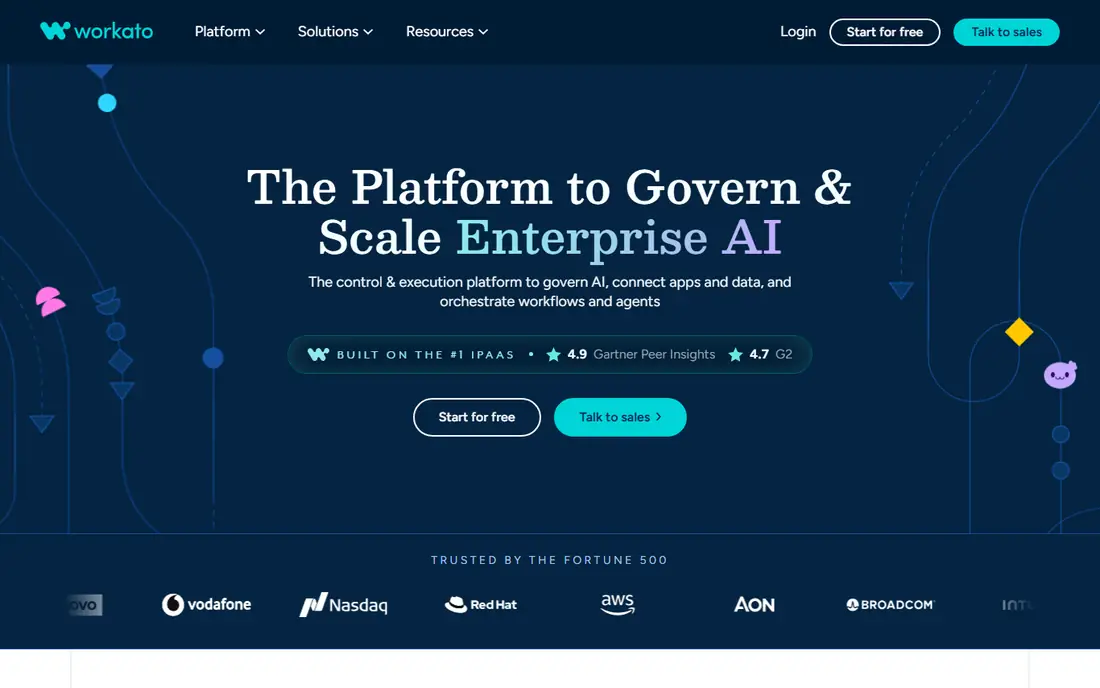
Workato is included because many data integration needs are actually workflow needs: when a deal closes in a CRM, update an ERP, notify a team, and sync a record to a warehouse. Workato excels at that event driven, app to app integration, with a large connector library, AI assisted recipe building, and enterprise governance for automations. For operations teams, that workflow view is more useful than a pure ELT pipeline.
The limit is data depth. Workato is not a replacement for Fivetran or Airbyte for large scale warehouse replication, change data capture, and transformation at volume, and its pricing is enterprise oriented. Use Workato alongside a warehouse loader: Workato for business workflows and operational syncs, and an ELT tool for analytics pipelines. For a company that needs both, Workato completes the stack.
What we like- Large app connector library for business workflows
- Event driven automation
- AI assisted recipe building
- Enterprise governance
Watch out for- Enterprise pricing
- Data pipeline depth is less than pure ELT tools
- Best as a complement to a warehouse loader, not a replacement
How we chose
We compared vendor product pages, AI feature documentation, connector libraries, deployment options, pricing models, and public reviews, alongside independent AI ETL comparisons. We favored tools with a documented AI feature, not just a marketing claim, a clear pricing unit, and a realistic fit for a stated team size, and we marked pricing as See website where vendors publish no stable list price.
Start with your workload, not the AI demo. List your sources, destinations, tables, row volumes, change rates, and sync frequencies, then model cost in each pricing unit: monthly active rows, credits, compute, or consumption units. A tool that is cheap for a nightly batch of stable tables can be expensive for hourly syncs of busy tables, and vice versa, so run your own numbers with vendor calculators or a trial.
Next, test the AI help on a real pipeline, not a sample. Ask the copilot to build a connector for a niche source, suggest mappings for a messy table, and explain a failed run, then review the output for errors, governance gaps, and data quality issues. Finally, check transformation, testing, lineage, and rollback: an AI drafted pipeline that cannot be tested, versioned, or rolled back is a risk, not a shortcut. Choose the tool whose AI output you can trust and govern.
Questions to ask every vendor
- What exactly does the AI do: draft, suggest, explain, or auto fix, and what stays human reviewed.
- How is pricing calculated for my tables, sync frequency, and change rate.
- How are pipelines tested, versioned, and rolled back.
- What lineage, governance, and data quality checks are included.
- How does the tool handle schema changes, failed runs, and API rate limits.
Frequently asked questions
What is AI powered data integration?
AI powered data integration uses machine learning and language models to help build, maintain, and fix data pipelines. Examples include drafting pipelines from prompts, suggesting field mappings, building connectors from API documentation, detecting schema changes, and explaining pipeline failures, while humans still review and govern the result.
Is Fivetran or Airbyte better for a small team?
Airbyte often suits a small team that wants open source control and a low $20 a month Cloud starting point, while Fivetran suits a team that wants fully managed reliability and is willing to pay usage based pricing for it. Model your row volumes and sync frequency in both pricing units before you decide, because the cheaper option depends on your workload.
Do AI tools replace data engineers?
No. AI tools speed up routine pipeline drafting, mapping, and troubleshooting, but data engineers still design architecture, model data, set quality rules, govern access, and review AI output. A team that treats AI output as final without review will ship errors faster, not better pipelines.
What is ELT versus ETL?
ELT loads raw data into a warehouse first, then transforms it there, which suits cloud warehouses and modern analytics. ETL transforms data before loading, which suits older systems and strict quality gates. Most tools here are ELT focused, with transformation in dbt, SQL, or a visual designer after loading.
How do I estimate data integration costs?
Count your sources, tables, monthly active or synced rows, sync frequency, and transformation compute, then apply the vendor pricing unit. Run a trial with real tables for at least two weeks, because a small sample can hide the cost of busy, frequently changed tables.
Should I use a separate tool for reverse ETL?
Often yes. ELT tools load data into a warehouse, while reverse ETL tools, such as Hightouch, sync warehouse data back into SaaS apps for marketing, sales, and support. If you need both directions, plan for two tools or a platform that covers both, rather than forcing one tool to do both jobs poorly.
Sources we checked (10)
- https://fivetran.com
- https://airbyte.com
- https://www.informatica.com
- https://www.qlik.com/us/products/talend
- https://www.snaplogic.com
- https://www.matillion.com
- https://hevodata.com
- https://www.workato.com
- https://www.integrate.io/blog/ai-etl-tools/
- https://airbyte.com/compare/fivetran-vs-airbyte
Is your product missing or out of date?
We review this list regularly. Vendors can request a listing, send updated pricing or ask about featured placement.

Shihab Mia · Founder, Rankite
Shihab has 5+ years in B2B and SaaS SEO. He writes Rankite's software buying guides from pricing pages, documentation and public user reviews. More about Shihab.