How we make this list: we compare pricing pages, product documentation and public user reviews. Ratings come from G2, Capterra or Trustpilot, with the date we checked them.

Key takeaways
- Surfer SEO and Frase are the strongest all round picks for optimizing articles you already write, with live scoring against the pages that rank now.
- Clearscope suits editorial teams that share one workspace, while NeuronWriter gives similar term coverage for a fraction of the price.
- Profound and MarketMuse work at a different level: AI search visibility and site wide topic planning rather than single page scoring.
- No score in any of these tools guarantees a ranking or an AI citation, and every AI draft still needs fact checking by a human editor.
Quick comparison
| Tool | Best for | Starting price | Free plan |
|---|
 Surfer SEO | Live scoring while you write | $49 per month | No |
 Frase | Research to publishing in one tool | $39 per month | No |
 Clearscope | Editorial teams sharing a workspace | $129 per month | No |
 NeuronWriter | Term coverage on a small budget | $23 per month | No |
 MarketMuse | Site wide topic planning | See website | Yes |
 Profound | Tracking AI search visibility | See website | No |
 PageOptimizer Pro | Pure on page scoring | $40 per month | No |
 Dashword | Simple briefs and scoring | $39 per month | No |
 Scalenut | Planning and drafting in one app | See website | No |
Is your product missing or out of date?
We review this list regularly. Vendors can request a listing, send updated pricing or ask about featured placement.
The best AI SEO tools for content optimization
#1Surfer SEO
Best for: Live scoring while you write4.8/5 on
G2 (546 reviews, checked Oct 2026)
Visit surferseo.com
Starting price$49 per month
Free planNo

What we like- Surfer's content editor scores your draft in real time against top ranking pages and suggests terms, headings, and paragraph counts as you write, which makes it the fastest tool here for improving an existing article. The Discovery plan starts at 49 dollars a month billed yearly with 120 documents a year, and Standard at 99 dollars adds keyword clustering, a SERP analyzer, and content audits. It connects to WordPress and Google Docs, and newer plans add tracking for how your pages appear in AI search results.
Watch out for- The useful research features sit on Standard and above, so the entry plan is mostly an editor. Document credits are annual and prepaid, which punishes teams whose output is uneven across the year. There is no free plan, and the score can push writers toward stuffing in terms a page does not need.
#2Frase
Best for: Research to publishing in one tool4.8/5 on
G2 (311 reviews, checked Oct 2026)
Visit frase.io
Starting price$39 per month
Free planNo
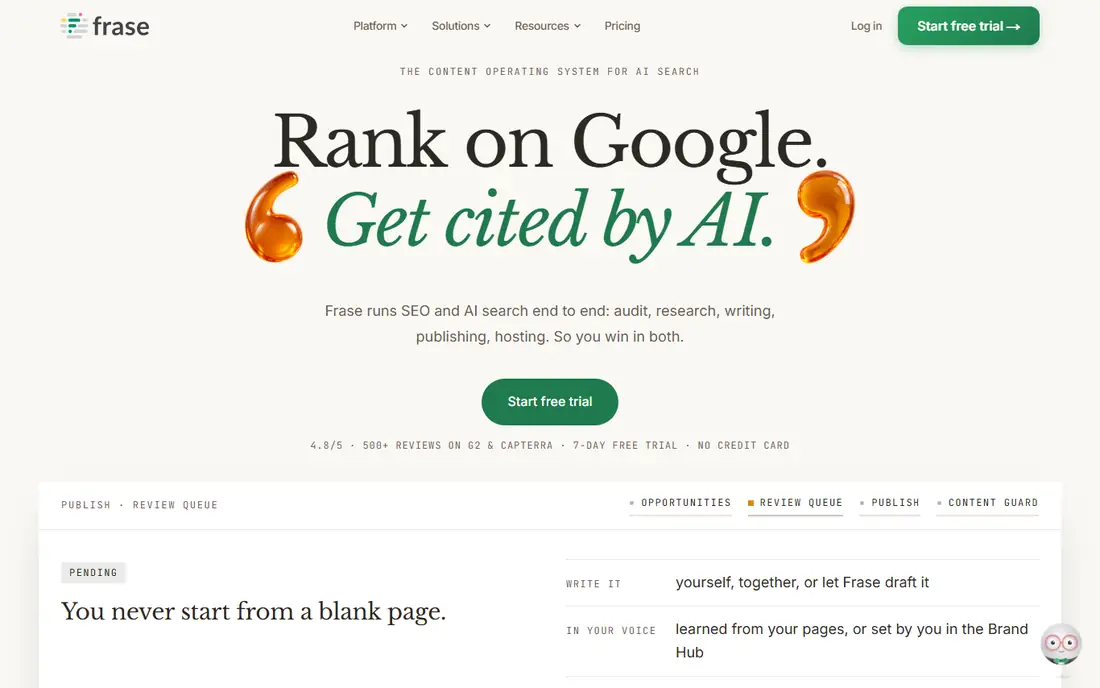
What we like- Frase covers the whole loop in one place: it pulls the top results for a keyword, builds a brief from their headings and questions, drafts with AI, and scores the result for both classic search and AI visibility. Starter costs 39 dollars a month billed yearly, or 49 dollars month to month, with 10 articles and 50 audit pages a month, and Professional at 103 dollars raises that to 40 articles across five sites. A seven day trial needs no credit card, which makes it the lowest risk way to test this category.
Watch out for- There is no standing free plan, and the trial is capped at five articles. AI drafts still need heavy editing and fact checking, and Frase's brief data is thinner than a full SEO suite for competitive keywords. White label reporting is reserved for the Enterprise tier.
#3Clearscope
Best for: Editorial teams sharing a workspace4.9/5 on
G2 (92 reviews, checked Oct 2026)
Visit clearscope.io
Starting price$129 per month
Free planNo
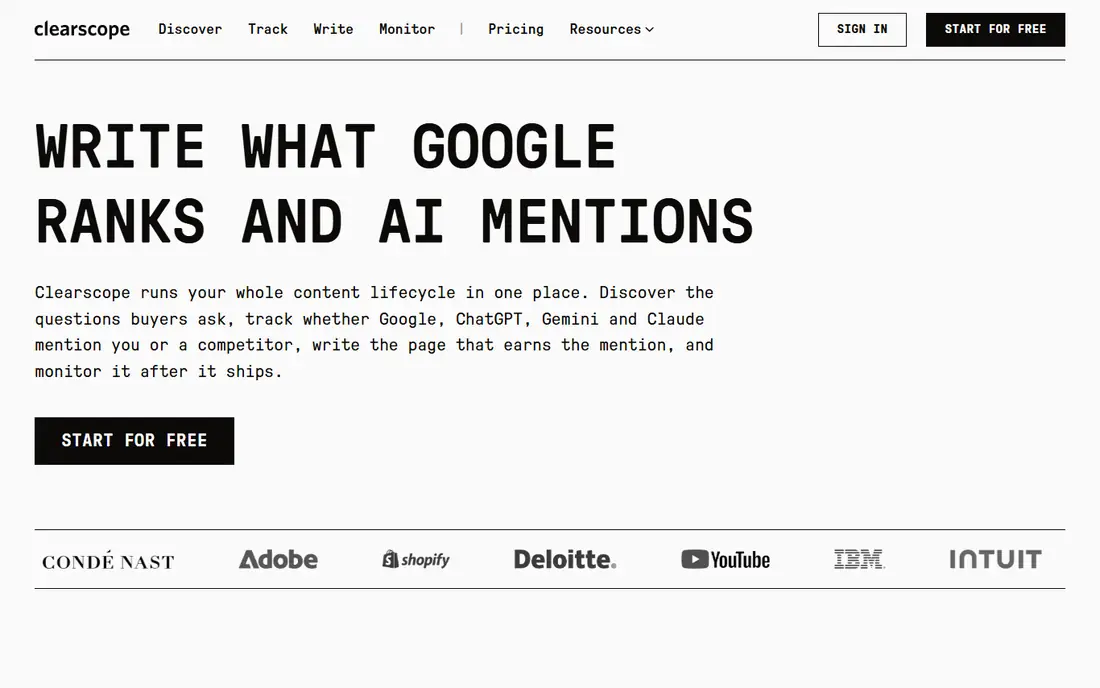
What we like- Clearscope grades drafts on topic coverage using a clear A to F scale that editors and freelance writers understand at a glance, which is why content teams with outside contributors like it. Essentials costs 129 dollars a month with 20 reports and unlimited users and projects, and Business at 399 dollars raises the tracked query and page limits. Because seats are unlimited, the cost per writer falls fast as a team grows, and the Google Docs and WordPress add ons fit into existing workflows without training.
Watch out for- At 129 dollars a month it is the priciest single purpose optimizer on this list, and solo writers rarely get their money's worth. Draft and page allowances are capped even though users are not, so heavy publishers pay add on fees. It does no keyword research or rank tracking, so most teams still pay for a second SEO platform.
#4NeuronWriter
Best for: Term coverage on a small budget4.4/5 on
G2 (31 reviews, checked Oct 2026)
Visit neuronwriter.com
Starting price$23 per month
Free planNo
What we like- NeuronWriter gives you the core of what Surfer does, semantic term suggestions, a content score, and competitor heading analysis, at a much lower price. Bronze costs 23 dollars a month, or about 19 dollars on annual billing, and higher tiers reach 117 dollars with more analyses and AI credits. It handles non English content well, which matters for teams publishing in several languages, and it connects to WordPress and Google Search Console so you can plan from your own ranking data.
Watch out for- The interface is denser and less polished than Surfer or Clearscope, and new users face a learning curve. There is no free plan, only a short trial on the Gold tier terms. AI writing credits are limited per plan, so high volume drafting eats through them quickly.
#5MarketMuse
Best for: Site wide topic planning4.6/5 on
G2 (216 reviews, checked Oct 2026)
Visit marketmuse.com
Starting priceSee website
Free planYes
What we like- MarketMuse works above the single page level. It inventories your whole site, scores your authority topic by topic, and tells you which pages to write, update, or link together to build coverage competitors cannot copy quickly. Its free plan is real: one user and 10 queries a month, enough to test the approach on a small site. For content strategists deciding a quarter's publishing calendar, its difficulty and priority scores are more useful than another page level score.
Watch out for- Paid plan list prices were withdrawn in 2026 and are now quoted through sales, which is why this guide lists see website. The platform is built for strategists, so a writer who just wants to fix one article will find it heavy. Per page optimization exists but is less direct than Surfer or Clearscope.
#6Profound
Best for: Tracking AI search visibility4.6/5 on
G2 (640 reviews, checked Oct 2026)
Visit tryprofound.com
Starting priceSee website
Free planNo
What we like- Profound answers a question the other tools here mostly skip: how often do ChatGPT, Google AI Overviews, Perplexity, and similar engines mention and cite your brand, and which pages earn those citations. It tracks prompts by category, shows the sources AI engines pull from, and reports share of voice against competitors, which gives content teams a work list for AI search rather than guesswork. Large brands and agencies use it to decide which comparison and guide pages to build next.
Watch out for- Profound is a monitoring and insight tool, not a writing editor, so it does not optimize a draft the way Surfer does. Pricing is not published in a way we could confirm from current sources, so this guide lists see website. It fits teams with an AI search strategy and a budget to match, not a solo blogger.
Starting price$40 per month
Free planNo
What we like- PageOptimizer Pro strips the category back to on page analysis: it studies the top ranking pages and gives you a precise checklist of terms, headings, and page elements to match, with no AI drafting layer in the way. Basic costs 40 dollars a month, Unlimited is 72 dollars, and Teams is 143 dollars, so it undercuts Clearscope for the same core job. Consultants who write in their own tools and only need the analysis tend to like its directness.
Watch out for- There is no free plan and no real writing environment, so you still draft elsewhere. The recommendations can read as mechanical, and following them to the letter can produce pages that sound assembled rather than written. It has no AI visibility tracking, which matters more every quarter.
Starting price$39 per month
Free planNo
What we like- Dashword keeps the workflow plain: enter a keyword, get a brief built from the ranking pages, hand it to a writer, and check the finished draft against a content score. It starts at 39 dollars a month, tracks keyword rankings alongside the optimization work, and reports page changes over time so editors can see whether an update helped. Small teams that found the bigger suites confusing often settle here because there is little to configure.
Watch out for- Its data depth is thinner than Surfer or a full SEO suite, so competitive niches outgrow it. There is no free plan. AI features are lighter than Frase or Scalenut, which matters if you want drafting help inside the same tool.
#9Scalenut
Best for: Planning and drafting in one app4.7/5 on
G2 (316 reviews, checked Oct 2026)
Visit scalenut.com
Starting priceSee website
Free planNo
What we like- Scalenut combines topic clustering, brief building, AI drafting in its Cruise Mode, and optimization scoring in one subscription aimed at small teams. It also added monitoring for AI search visibility, so one tool covers both the classic and the AI side of a content program. For a two or three person team publishing weekly, that bundle removes the cost of stacking two or three separate subscriptions.
Watch out for- Published prices conflict between Scalenut's own promotions and current directories, ranging widely for the entry tier, so this guide lists see website until you confirm on the pricing page. Jack of all trades depth is the trade off: its keyword data and scoring are lighter than the specialists. AI drafts vary in quality and need the same editing as every tool here.
How we chose
We compared these tools on what they actually optimize: live page scoring, brief building, site wide planning, and AI search visibility. We favoured tools that publish prices on their own pages, and where current sources disagreed on a price we wrote see website instead of picking one figure. We excluded general SEO suites whose optimization feature is a minor add on, and we excluded the vendor Scrunch because its public site does not present a real product a buyer can evaluate. Every tool here is a paid product in active sale as of October 2026, and none of them can promise a ranking.
Start with the job that is actually slow. If writers stare at a blank page, you need research and brief building, which points to Frase or Scalenut. If drafts come back thin on topic coverage, you need a scoring editor, which points to Surfer, Clearscope, NeuronWriter, or PageOptimizer Pro depending on budget and team size. If your problem is deciding what to publish next quarter, MarketMuse works at that level. If your traffic is shifting to AI answers and you cannot see where you stand, Profound measures that directly.
Then check the unit economics behind the headline price. Document credits, report counts, and AI word allowances differ more between these tools than features do, and an annual credit pool punishes uneven publishing. Count your real monthly output before you pick a tier. Finally, set one rule for your team before the tool arrives: the score informs the edit, it does not make it. Keep a human checking facts, quotes, prices, and any claim a reader might spend money on, because AI assisted content that repeats an error ranks the same as hand written content that repeats one, and both damage trust.
Frequently asked questions
Do AI SEO tools guarantee better rankings?
No. A content score measures how closely your page matches the topics and terms on pages that rank today. It cannot account for links, brand searches, page experience, or a competitor publishing something better next week. Tools that imply a score equals a ranking are selling, not informing, and you should treat any such claim as a reason to look elsewhere.
What is the difference between content optimization and AI visibility tracking?
Content optimization improves a single page against classic search results: term coverage, headings, and depth. AI visibility tracking measures how AI engines such as ChatGPT and Google AI Overviews mention and cite your brand across many prompts. Surfer and Clearscope do the first job, Profound does the second, and a growing number of teams now budget for both.
Can I use these tools on content written by AI?
Yes, and that is how many teams use them. You draft with an AI writer, then score and fix the draft in an optimizer before publishing. The step that cannot be skipped is human review: check every fact, price, name, and statistic in the draft, because AI writers state wrong figures with complete confidence, and the optimizer's score will not catch them.
Which AI SEO tool is cheapest for a solo blogger?
NeuronWriter at 23 dollars a month is the cheapest full optimizer here, and MarketMuse's free plan covers light topic planning at no cost. Frase at 39 dollars a month billed yearly adds drafting and audits at a still modest price. Below that level, the free tiers of general SEO suites cover basic checks but not real optimization.
How many tools from this list does one team need?
Usually one optimizer plus, at most, one planning or visibility tool. Stacking two scoring editors such as Surfer and Clearscope adds cost without adding information, since they read the same ranking pages. A common pairing is a scoring editor for writers and MarketMuse or Profound for the strategist deciding what gets written.
Sources we checked (0)
Is your product missing or out of date?
We review this list regularly. Vendors can request a listing, send updated pricing or ask about featured placement.

Shihab Mia · Founder, Rankite
Shihab has 5+ years in B2B and SaaS SEO. He writes Rankite's software buying guides from pricing pages, documentation and public user reviews. More about Shihab.