How we make this list: we compare pricing pages, product documentation and public user reviews. Ratings come from G2, Capterra or Trustpilot, with the date we checked them.
Key takeaways
- Couch to 5K is the best known beginner plan, with a 9 week walk to run structure, though only 27.3 percent of participants completed a standard 9 week version in a 2023 study.
- Nike Run Club is the best fully free running app, with guided runs, coaching, and training plans from 5K to marathon at no cost and no premium tier.
- Strava is the best pick for social motivation, with segment leaderboards and community challenges, though advanced stats sit behind a subscription.
- Runna suits intermediate runners ready to progress from 5K to 10K with a properly structured, coached plan.
- None to Run suits anyone starting from zero or returning after a break, with time based intervals, walk breaks, and strength and mobility work included.
- Health note: consult a clinician before starting a new running program, especially if you have a heart condition, joint problems, or another health concern, and stop if you feel pain. This article is general information only, not medical advice.
Quick comparison
Is your product missing or out of date?
We review this list regularly. Vendors can request a listing, send updated pricing or ask about featured placement.
The best 5K training apps
Starting priceFree
Free planYes
Couch to 5K, often written C25K, is the beginner plan that has become synonymous with starting running, built on a 9 week walk to run structure that starts with 1 minute runs and 90 second walks and builds to a 20 minute continuous run by week 5. It is free to start, with premium reported at $49.99 per year, and it offers offline mode for runs without signal. The NHS Couch to 5K app is the most popular free beginner plan in the world, and its structure works for many first time runners.
The trade off is popularity against progression steepness. A peer reviewed study found only 27.3 percent of people completed the standard 9 week plan, often because the weekly jumps were too steep, and the plan includes no strength or mobility work despite that fast progression. Couch to 5K fits absolute beginners who want a simple, proven plan and are willing to slow it down or repeat weeks when needed.
What we like- 9 week walk to run program
- Most popular beginner plan in the world
- Simple audio cues
- Offline mode
- Free tier for starting out
Watch out for- Weekly jumps are steep for many beginners
- No strength or mobility work
- Only useful for the first 8 to 9 weeks
- Premium price reported at $49.99 per year
Starting priceFree
Free planYes
Nike Run Club is the best fully free running app in 2026, with everything free forever, including GPS tracking, guided runs from real coaches, audio cues, and structured training plans from 5K to marathon, with no premium tier and no feature gates. It suits runners who want actual coaching and structured plans without paying anything, and its social challenges and achievements keep motivation up.
The trade off is free coaching against beginner fit. Nike Run Club is free and polished, but it is not built for zero to running: its Get Started plan asks for a 20 minute continuous run on week 1, day 1, which is too much for a true beginner. Nike Run Club fits runners who can already run for 20 minutes and want free coaching to reach 5K and beyond.
What we like- Fully free, no premium tier
- Audio guided runs from real coaches
- Structured training plans from 5K to marathon
- Social challenges and achievements
Watch out for- Not built for zero to running, week 1 asks for 20 minute continuous runs
- Running focused only, no strength plans
- Needs a Nike account
- Limited social features
Starting priceFree
Free planYes
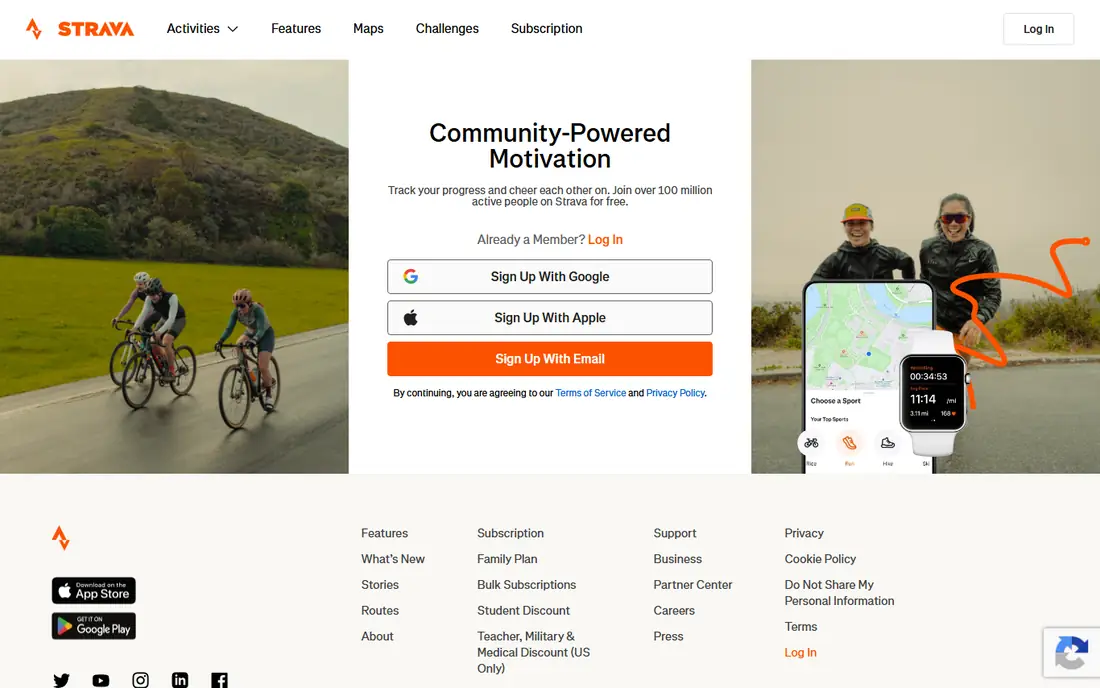
Strava is the social running app, built around a community feed, segment leaderboards, and competitions that keep runners accountable through friends and clubs. It is free for GPS tracking, activity feed, kudos, basic stats, and top 10 segment rankings, with a subscription at $11.99 per month or $79.99 per year for full leaderboards, training log, suggested routes, and advanced analysis. It suits runners who stay motivated through community and competition.
The trade off is community against paywalled analysis. Strava has the largest running community, but most of the analysis people want sits behind the subscription, and social pressure can push beginners to run too fast. Strava fits runners who want community accountability and already have a base fitness level.
What we like- Largest running community
- Segment leaderboards and competitions
- Social feed with kudos
- Route discovery
- Free GPS tracking
Watch out for- Advanced stats behind a subscription at $11.99 per month or $79.99 per year
- Structured plans limited on free tier
- No offline mode in some reports
- Social pressure can push pacing too hard
Starting priceFree
Free planYes
Runkeeper sits in the middle, with reliable free GPS tracking, structured race training plans, and a full history on the free tier, plus offline mode for runs without signal. Runkeeper Go costs $9.99 per month or $39.99 per year for personalized plans and advanced features, and it suits runners who want goal setting and flexibility without a social feed dominating the experience.
The trade off is reliability against social depth. Runkeeper tracks well and plans well, but its social features are weaker than Strava and some users report aggressive upselling. Runkeeper fits runners who want simple tracking with plans available when they want them.
What we like- Reliable free GPS tracking
- Structured race training plans
- Full history on free tier
- Offline mode
- Simple interface
Watch out for- Aggressive upselling in some reports
- Paid tier at $9.99 per month or $39.99 per year
- Social features weaker than Strava
- Interface less polished than Nike Run Club
Starting priceFree
Free planYes
MapMyRun is the route discovery pick, with a large library of mapped routes and navigation that helps runners explore new areas safely, plus free GPS tracking and multi sport logging. It suits runners who move to a new area or want fresh routes, since its route library and mapping are stronger than most rivals.
The trade off is routes against polish. MapMyRun finds routes well, but its interface is reported as outdated and its structured 5K plans are thinner than Runna. MapMyRun fits runners who value route discovery and navigation over coaching.
What we like- Strong route discovery and navigation
- Free GPS tracking
- Multi sport logging
- Large route library
- Good for exploring new areas
Watch out for- Interface reported as outdated
- Premium features behind in app purchase
- Social features weaker than Strava
- Fewer structured 5K plans than Runna
Starting priceSee website
Free planNo
Runna is the structured progression pick for intermediate runners ready to move from 5K to 10K, or anyone who wants a properly structured, coached training plan rather than a fixed schedule. Its plans adapt when life changes, reshaping your week instead of leaving you behind, and paid plans tend to include strength and mobility work that free apps skip. Pricing reports conflict, with about 8 to 10 pounds per month in UK sources and $15 or more per month in US sources, so check the current pricing page before committing, and note that its free tier offers sample workouts only, not full plans.
The trade off is structure against cost. Runna gives you the best structured progression here, but it is subscription only and its price varies by region. Runna fits intermediate runners who want a coached plan that adapts to real life.
What we like- Properly structured, coached training plans
- Best for 5K to 10K progression
- Adaptive plans that reshape your week
- Integrated strength and mobility in some plans
Watch out for- Subscription only, free tier offers sample workouts only
- Price reports conflict at about 8 to 10 pounds per month and $15 or more per month
- No offline mode in some reports
Starting priceFree
Free planYes
Zombies, Run is the gamification pick, wrapping runs in an immersive zombie survival story that boosts adherence for runners who find plain training boring. It is free to start, with in app purchases for full story content, and it suits runners who need a reason to lace up that is not a pace target. For gamification lovers, it is unmatched among free options.
The trade off is fun against focus. Zombies, Run makes running fun, but gameplay distractions may interfere with pacing awareness, and its training structure is thinner than Runna. Zombies, Run fits runners who struggle with motivation and want story driven runs.
What we like- Immersive storytelling that boosts adherence
- Gamification unmatched among free options
- Fun for runners who find training boring
- Free tier for starting out
Watch out for- Gameplay distractions may interfere with pacing awareness
- Story focus suits some runners only
- In app purchases for full content
- Less structured training than Runna
Starting price$6.99 per month
Free planNo
None to Run is the best pick for anyone starting from zero or coming back after a long break or injury, built on time based intervals that remove pace anxiety, tiny weekly progressions that help your body adapt safely, and walk breaks that are encouraged rather than treated as failure. It includes strength and mobility work that Couch to 5K skips, and it is the only app in this comparison currently being independently studied by university researchers at Edge Hill University in the UK. It costs $6.99 per month or $39.99 per year, with no free tier.
The trade off is gentle progression against cost and community. None to Run is the safest beginner progression here, but it is subscription only and its community is smaller than Couch to 5K. None to Run fits true beginners and returners who want a slow, safe start with strength work included.
What we like- Time based intervals remove pace anxiety
- Tiny weekly progressions help your body adapt safely
- Walk breaks encouraged
- Strength and mobility included
- Independently studied by university researchers
Watch out for- Subscription only at $6.99 per month or $39.99 per year
- Smaller community than Couch to 5K
- Less social motivation than Strava
- Fewer advanced plans than Runna
How we chose
We compared published feature lists and pricing from 2026, favoring tools with distinct strengths: the most popular beginner plan, the best fully free coaching, the largest community, the most reliable tracking with plans, the best route discovery, the best structured progression, the best gamification, and the safest zero to running start. We recorded prices as reported and wrote See website where Runna pricing conflicted by region. We favored apps with a current release and an active runner user base, and we noted the Couch to 5K completion study, since a plan only helps if runners finish it.
How to choose a 5K training app
Start with your current fitness: true beginners point to None to Run or Couch to 5K, runners who can already run 20 minutes point to Nike Run Club, and intermediate runners point to Runna. Next, check what keeps you consistent: community points to Strava, story points to Zombies, Run, and coaching points to Nike Run Club or Runna. Then check price honesty: Nike Run Club is fully free, Strava and Runkeeper are free with paid upgrades, and Runna and None to Run are subscription only. Finally, stick with one app for at least two weeks before judging it, since downloading five apps to compare usually means none of them gets a fair chance.
Frequently asked questions
What is the best 5K training app for beginners?
None to Run is the safest beginner pick with tiny progressions and strength work included, while Couch to 5K is the most popular beginner plan, though its weekly jumps are steep for many runners.
Is Nike Run Club really free?
Yes. Nike Run Club has no subscription and no premium tier, with tracking, guided runs, audio coaching, achievements, and training plans all included at no cost, though you need a Nike account.
Do I need to pay for a running app to finish a 5K?
No. Free apps like Nike Run Club and Couch to 5K cover what most casual runners need, though paid apps like Runna pull ahead on adaptive plans and integrated strength and mobility work.
How long does it take to train for a 5K?
Most beginner plans run 8 to 9 weeks, with Couch to 5K at 9 weeks and None to Run at a similar length, though you should repeat weeks or slow down if the progression feels too steep.
Is running safe for beginners?
Running is safe for most healthy adults when started gradually, but consult a clinician before starting a new program if you have a heart condition, joint problems, or another health concern, and stop if you feel pain.
What is the difference between Couch to 5K and None to Run?
Couch to 5K is the most popular 9 week walk to run plan but progresses fast with no strength work, while None to Run uses smaller progressions with strength and mobility included, at $6.99 per month.
Sources we checked (0)
Is your product missing or out of date?
We review this list regularly. Vendors can request a listing, send updated pricing or ask about featured placement.

Shihab Mia · Founder, Rankite
Shihab has 5+ years in B2B and SaaS SEO. He writes Rankite's software buying guides from pricing pages, documentation and public user reviews. More about Shihab.
 Couch to 5K
 Nike Run Club
 Strava
 Runkeeper
 MapMyRun
 Runna
 Zombies, Run
 None to Run