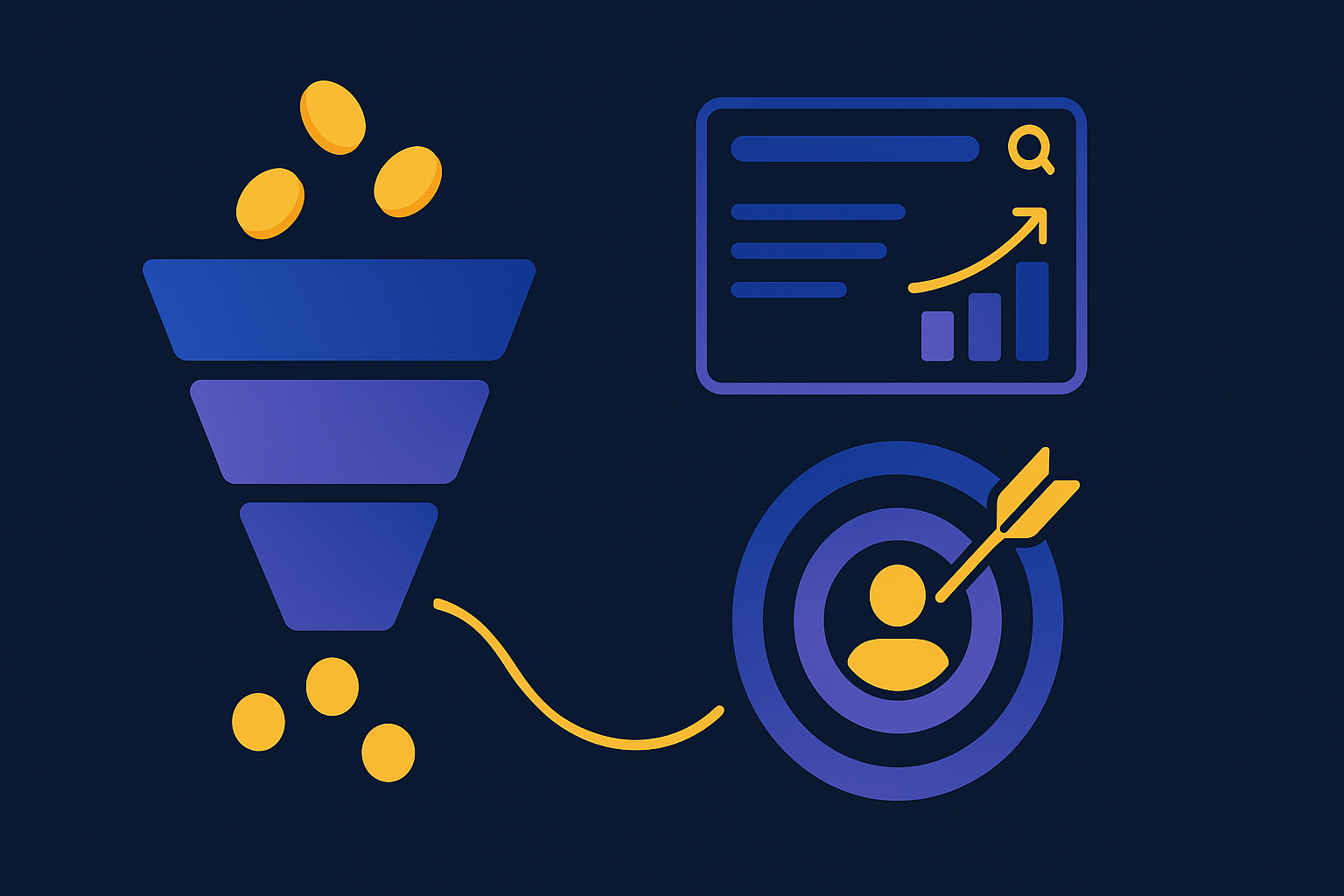
A B2B SEO strategy is a plan for ranking on the low-volume, high-intent keywords your buyers' decision-makers search while evaluating a purchase, then moving them through a long sales cycle toward a demo or contact request. It differs from B2C SEO in three ways: you chase fewer, more valuable keywords instead of high-volume consumer terms; you write for a buying committee of several people, not one shopper; and you measure success in pipeline and revenue, not raw traffic. This guide walks the framework end to end, with the funnel map, the committee content, and the pipeline math that make it work.
If you sell software specifically and want the vertical playbook rather than the general strategy, our B2B SaaS SEO service page covers that. This article is the how-to for building the strategy itself, whatever you sell.
There is no separate B2B ranking algorithm. Google weighs the same signals for both. What changes is the market you are optimizing for. Search rarely works alone here either, and our guide to B2B social media marketing covers the channel that most often runs alongside it. B2B audiences are smaller, the keywords carry far more purchase intent per search, the buyer is really a committee, and the payoff is a high-value contract instead of a single checkout. That combination flips almost every practical decision you make.
The clearest difference is keyword volume. Backlinko points out that B2B companies often chase keywords in the 10 to 50 searches a month range, because those low-volume phrases are exactly what decision-makers type when they are actively evaluating a solution. A B2C site would ignore a 40-volume keyword. In B2B, if those 40 searchers are heads of procurement, that term can be worth more than a consumer keyword with 20,000 searches and no buying intent.
The second difference is the buyer. A B2C purchase is usually one person deciding in minutes. A B2B purchase runs through a committee. Gartner's research on B2B buying puts the typical committee at 6 to 10 stakeholders, and it found buyers spend only about 17% of the entire journey meeting with all potential suppliers combined. Most of the work happens off to the side, in independent research, long before a sales rep is involved. Your content is that independent research. Getting it right is how you make the shortlist.
Build a B2B SEO strategy in six steps: define your ideal customer and the personas on the buying committee, map keywords to funnel stages, win the bottom of the funnel first, build the supporting top-funnel content for authority, cover technical SEO and links, then measure the whole thing on pipeline. The order matters. Skipping straight to blog posts without the persona and bottom-funnel work is the most common way B2B teams waste a year.
Each step feeds the next, and the persona work at the top quietly controls everything below it. If you want a broader planning document to slot this into, our SEO strategy template gives you the site-level plan, and this framework is the B2B-specific engine inside it.
B2B keyword research starts from intent and funnel stage, not volume. For each keyword, ask what the searcher is trying to do and how close they are to buying, then build the page type that matches. A buyer typing "best [category] software for enterprise" is near a decision and needs a comparison page. Someone searching "what is [category]" is learning and needs a guide. Same topic, very different pages.
The practical move is to build a keyword map: a simple sheet where every target term is tagged with its funnel stage, the intent behind it, and the page type it deserves. This is the map most B2B teams never make, and it is what stops you from writing a blog post for a keyword that clearly wanted a product page.
| Funnel stage | Keyword intent | Example keyword pattern | Page type to build |
|---|---|---|---|
| Bottom of funnel | Ready to choose a vendor | "[competitor] alternative", "[category] pricing", "best [category] software" | Comparison, alternatives, pricing page |
| Middle of funnel | Evaluating how to solve it | "how to [solve problem]", "[category] for [use case]" | Solution guide, use-case page |
| Top of funnel | Learning about the problem | "what is [concept]", "[problem] explained" | Educational blog post, pillar guide |
Prioritize the bottom rows first. They have the fewest searches and the most revenue behind each one. Then group your top-funnel terms into a few pillar topics so the blog builds authority in a focused area instead of scattering across unrelated posts. Covering a topic fully, with the related entities and questions a complete answer needs, is what signals depth to both Google and AI engines, which is the core idea behind semantic SEO.
Write for the committee by mapping the roles Gartner says sit on it, then making sure your key pages answer each one's real question. On a 6 to 10 person committee, the end user wants proof it actually works, finance wants ROI and clear pricing, IT wants security and integrations, and the executive sponsor wants the business case. A page that only speaks to one of them stalls the deal at the others.
You do not need a separate page per role. A strong bottom-funnel page can serve several at once with clear sections: a feature or workflow section for the user, a pricing and ROI section for finance, a security and integrations section for IT, and outcomes or case studies for the executive. The point is to anticipate the objection each role brings and answer it on the page, so nobody has to leave to find it.
Depth is what makes committee content work. First Page Sage frames good B2B pages around matching search intent so precisely that the visitor gets the full answer without bouncing, and it benchmarks a healthy optimized page at a visitor-to-lead conversion rate of at least 2.5%. Thin content cannot carry a committee decision. This is the same content depth work our SEO content optimization service runs for clients, and it applies whether the page is a blog post or a product comparison.
Start at the bottom of the funnel. Bottom-funnel pages target buyers who are already choosing a vendor, so they convert far better and produce pipeline you can point to in the first few months. Tightening how those pages turn visitors into leads is the job of B2B conversion rate optimization. UnfoldMart recommends that mature B2B programs put 60 to 70% of content production into bottom-funnel formats: comparisons, alternatives, integrations, pricing transparency, and case studies. Top-funnel educational content matters, but it is a slower, indirect payoff.
The logic is cash flow and proof. Bottom-funnel wins give you early pipeline that justifies continued investment to leadership, which buys you the runway to build the slower top-funnel library. Reverse the order, spend six months on awareness blog posts, and you will have traffic but nothing to show sales, which is where B2B SEO budgets get cut. Once the bottom is covered, top-funnel content compounds: it earns the links and topical authority that lift the whole domain, including those money pages.
B2B needs the same technical foundations as any site, plus authority signals strong enough to make Google trust you on high-stakes purchase queries. Technically, that means a crawlable, fast, mobile-friendly site with clean information architecture, logical internal linking from pillar content to your money pages, and structured data on key pages. None of it is B2B-specific, but neglecting it caps everything else you do.
Where B2B differs is the bar for authority. You are asking a company to trust you with a serious contract, so earned links and demonstrated expertise carry real weight. Backlinko notes that the average result on page one of Google runs around 1,447 words, a reminder that thin pages rarely compete for these terms, and it recommends earning links through genuinely useful assets: free tools and calculators, original data, and digital PR rather than low-quality link buying. A single free calculator, in Backlinko's example, earned over 200 backlinks on its own. Aim for a handful of link-worthy assets over a pile of forgettable guest posts.
Measure B2B SEO on pipeline, not traffic. Track the full chain from organic click to revenue: organic sessions, then leads or MQLs, then SQLs, then opportunities, then closed-won deals, along with the SEO-attributed pipeline value behind them. Traffic and rankings are leading indicators that tell you a change landed. Pipeline contribution is the number that keeps the budget alive.
Set the benchmark honestly. UnfoldMart reports that mature B2B SaaS programs with 18 or more months of investment attribute 25 to 45% of new pipeline to organic search on a multi-touch basis. You will not hit that in quarter one. First Page Sage is blunt that the best SEO results tend to appear in the second and third years, because both the rankings and the long sales cycle take time to mature. Report leading indicators early, rankings and organic leads, then shift the conversation to pipeline and revenue as deals close.
We have watched this pattern hold across client work. Optimizing existing pages around clearer intent and buyer-stage structure grew Zluri's organic traffic by 45%, and sharper bottom-funnel content helped drive a 400% revenue increase for Swordfish AI. In both cases the wins came from aiming SEO at the pages and queries closest to a purchase, which is exactly what a B2B SEO strategy is built to do.
B2B SEO fails in a few predictable ways. Watch for these:
What is a B2B SEO strategy? A B2B SEO strategy is a plan for winning search visibility on the low-volume, high-intent terms a company's decision-makers use while evaluating a purchase, then guiding those buyers through a long sales cycle toward a demo or contact request. It differs from B2C SEO because it chases fewer, more valuable keywords, serves a buying committee of several people rather than one shopper, and is measured on pipeline and revenue instead of raw traffic.
How is B2B SEO different from B2C SEO? The ranking algorithm is the same, but the strategy is not. B2B targets low-volume keywords that decision-makers search at work, often 10 to 200 searches a month, while B2C chases high-volume consumer terms. B2B serves a buying committee that Gartner puts at 6 to 10 stakeholders across a sales cycle of months, so content has to answer several roles. And success is judged on leads, pipeline, and revenue, not sessions.
Should B2B SEO target high-volume or low-volume keywords? Low-volume, high-intent keywords come first in B2B. A term with 40 searches a month that a buyer types when comparing vendors is worth more than a 20,000-volume term with no purchase intent. Backlinko notes that B2B often pursues keywords in the 10 to 50 searches a month range because those are the phrases decision-makers actually use when evaluating solutions. High-volume top-funnel terms still matter for authority, but they are not the priority.
What is bottom-of-funnel content in B2B SEO? Bottom-of-funnel content targets buyers who are actively choosing a vendor: comparison pages, alternatives pages, integration pages, pricing pages, and case studies. It carries the highest purchase intent, so it converts far better than blog posts. UnfoldMart recommends that mature B2B programs put 60 to 70 percent of content production into bottom-funnel formats rather than top-funnel educational content.
How do you write content for a B2B buying committee? Map the roles that Gartner says sit on a typical 6 to 10 person committee, such as the end user, the economic buyer, IT, finance, legal, and an executive sponsor, then make sure your key pages answer each one's question. The end user wants to know it works, finance wants ROI and pricing clarity, IT wants security and integrations, and the executive wants the business case. A single page can serve several roles with clear sections and links to proof.
How long does B2B SEO take to work? Expect early bottom-funnel wins in a few months and the strongest results in years two and three, according to First Page Sage. B2B sales cycles are long, so even after a page ranks, it can take weeks or months for the click to turn into a closed deal. Set expectations on leading indicators first, rankings and organic leads, then on pipeline and revenue as the cycle completes.
How do you measure a B2B SEO strategy with pipeline instead of traffic? Track the chain from organic click to revenue: organic sessions, then leads or MQLs, then SQLs, then opportunities, then closed-won, plus the SEO-attributed pipeline value behind them. UnfoldMart reports that mature B2B SaaS programs with 18 or more months of investment attribute 25 to 45 percent of new pipeline to organic search on a multi-touch basis. Traffic is only a leading indicator; pipeline contribution is the number leadership cares about.
Does B2B SEO still matter with AI search and rep-free buying? Yes, and arguably more. Gartner found that 61 percent of B2B buyers prefer a rep-free buying experience and spend only about 17 percent of the journey meeting with all potential suppliers, so most evaluation happens through independent search and AI answers. Being the page that ranks and gets cited is how you enter the shortlist before a sales conversation ever starts.
Start with one keyword map and one bottom-funnel page. List the 10 highest-intent queries your buyers use when they are ready to choose, tag each with a funnel stage and page type, and build or rewrite the single page closest to a purchase to answer every role on the committee. Measure it to lead, then to pipeline, and let the result guide the next page. If you want a faster read on where your highest-intent B2B keywords and pipeline gaps are, request a free SEO audit from Rankite and we will show you which pages to build first.
Get a free, no-obligation SEO audit and a 30-minute strategy session. We'll show you exactly where the growth is hiding.
Fill out the form and we'll get back to you within one business day. Prefer email? Write to us directly at contact@rankite.com.