Semantic SEO is the practice of optimizing for the meaning behind a search, not just the words in it. Instead of stuffing one keyword onto one page, you build content that fully covers a topic, defines the entities (people, places, products, concepts) involved, and connects related ideas so search engines and AI engines understand what your site is about. Done well, semantic SEO helps you rank for hundreds of related queries from a single well-structured cluster of pages.
This matters more in 2026 than ever. Google confirmed its AI Overviews reached over 1.5 billion users by 2025, which means a growing share of searches now resolve inside an AI-generated answer that pulls from sources it understands at the level of meaning. If your content reads as a thin keyword match rather than a genuine topic authority, it gets skipped.
This guide keeps things accessible. We cover what semantic SEO is, why it works, and a step-by-step workflow you can run this week. Python and NLP get a mention as one optional power-tool, but you do not need to write code to do this well.
Traditional SEO asked: does this page contain the keyword? Semantic SEO asks a better question: does this page satisfy the intent and cover the topic the way a real expert would?
The shift happened because search engines stopped reading pages as bags of words. Google's systems now interpret queries through natural language understanding, mapping words to concepts and concepts to entities in its Knowledge Graph. So a page about "running shoes for flat feet" needs to demonstrate understanding of overpronation, arch support, and stability features, not just repeat the phrase.
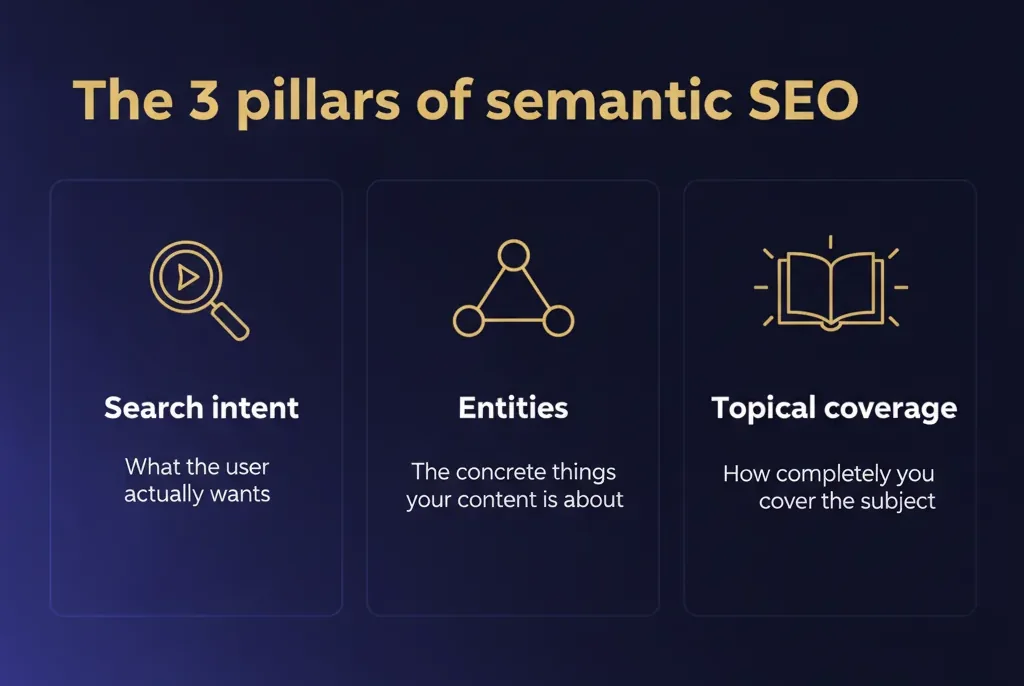
Semantic SEO has three pillars: search intent (what the user actually wants, informational, navigational, commercial, or transactional), entities (the concrete things your content is about), and topical coverage (how completely you address the subject and its subtopics). When all three align, you stop competing for single keywords and start owning a subject area.
This is also a defensive necessity. Ahrefs found that roughly 96% of all pages get zero organic traffic from Google (around 1 billion pages studied). The pages in that 96% are usually thin, off-intent, or semantically shallow. Depth is what separates the 4% that win.
To optimize for meaning, it helps to know how a modern search engine extracts it. Three ideas do most of the work, and none of them are guesswork, Google has named these systems publicly.
Search engines convert words, sentences, and whole pages into embeddings: lists of numbers, or vectors, that place similar meanings near each other in mathematical space. "Cardiologist" and "heart doctor" land close together even though they share no letters. Relevance is then measured as the distance between those vectors, which is exactly why exact-match keywords no longer gate ranking, the engine is comparing meaning, not string overlap.
Pure lexical search matches the literal words; pure semantic search matches meaning through embeddings. Google runs a hybrid of both, which is why your page still needs the right terms and genuine topical depth. Optimize for only one side and you leave ranking signal on the table.
Semantic search is not a single switch but a decade of named, confirmed systems, each adding a layer of language understanding:
The practical lesson runs through this whole guide: write so that any single section answers its heading completely, name your concepts precisely, and the same signals that satisfy these systems also make your content quotable in AI answers.
Google understands the web as a network of entities and relationships, not a list of strings. When you clearly name and describe entities, and link them to authoritative references, you help Google place your content correctly in that network. An entity-rich page is easier to trust, easier to classify, and easier to cite.
Generative answers now sit between your content and the user. BrightEdge data still puts organic search at roughly 53% of trackable website traffic, so classic rankings remain the largest single channel. But the way that traffic is won has shifted. Brandlight reported that the overlap between Google's top organic results and the sources AI engines actually cite fell about 70% to under 20% in about a year. In plain terms: ranking #1 no longer guarantees you get quoted in the AI answer. Semantic clarity, entity coverage, and structured data are how you stay visible in both lanes.
AI search also adds a wrinkle called query fan-out: tools like AI Overviews and AI Mode silently expand one question into many related sub-queries, gather sources for each, and synthesize a single answer. A page that covers a topic comprehensively can be pulled in for several of those hidden sub-queries at once, while a thin keyword page matches none of them. Breadth of genuine coverage is now a retrieval advantage, not just a reader courtesy.
We saw this play out directly. When Swordfish AI worked with Rankite, their revenue grew 400% from organic search after we rebuilt their content around topic clusters and entity coverage instead of one-off keyword pages. The lesson was simple: depth compounds.
For a deeper look at how meaning-first content is built, see our guide on what content optimization is.
A topic cluster is a hub-and-spoke model. One pillar page covers a broad topic at a high level, and several cluster pages each cover a specific subtopic in depth. Every cluster page links up to the pillar, and the pillar links down to each cluster. This structure tells search engines you cover the subject comprehensively.
Here is a sample cluster map for the topic "email marketing," showing how a hub organizes its spokes:
| Page type | Page topic | Target intent | Primary entities | Links to |
|---|---|---|---|---|
| Pillar (hub) | Email marketing guide | Informational, broad | Email marketing, ESP, deliverability | All cluster pages |
| Cluster | Email list building | How-to | Lead magnet, opt-in, double opt-in | Pillar + segmentation |
| Cluster | Email segmentation | How-to | Segment, behavior, lifecycle | Pillar + automation |
| Cluster | Email automation | How-to | Workflow, trigger, drip campaign | Pillar + deliverability |
| Cluster | Email deliverability | Troubleshooting | SPF, DKIM, sender reputation | Pillar + automation |
| Cluster | Email metrics | Informational | Open rate, CTR, conversion | Pillar + segmentation |
To build your own cluster, follow this workflow:
Solid keyword grouping is the foundation here. Our keyword research tutorial walks through finding and clustering the terms that map to each page.
Entities are the nouns that matter: a brand, a product, a city, a medical condition, a software category. Your job is to name them plainly, define them, and connect them to the wider web.
A simple way to plan that coverage is the entity–attribute–value (EAV) model: take your primary entity, list its attributes, and give each a value. For a running shoe that is "cushioning: maximal," "support: stability," "use case: marathon training." Answering those attribute questions on the page is what proves to Google you understand the entity, not just its name, and it doubles as a ready-made outline for your subheadings.
Practical ways to strengthen entity coverage:
Structured data then makes those entities machine-readable. By adding schema markup, you spell out for crawlers exactly what each element means. Mark up articles, FAQs, products, organizations, and authors using the vocabulary at schema.org, and follow the implementation rules in Google Search Central's structured data documentation. Structured data does not directly boost rankings, but it boosts eligibility for rich results and gives AI engines cleaner signals to cite.
Internal links are how you pass topical context, not just authority. A link from your "email automation" page to your "deliverability" page using descriptive anchor text tells Google these concepts are related and that your site treats them as a connected body of knowledge.
Guidelines that work:
Strong internal linking is one of the most underused ranking levers. Our guide on how to rank on Google covers how link structure supports the wider ranking picture.
The old game was hitting a keyword density target. The new game is topical completeness: covering every reasonable question a searcher might have on the topic, in one place or one cluster.
To gauge coverage, compare your page against the top results and the People Also Ask questions. Are there subtopics, objections, comparisons, or definitions you skipped? Fill those gaps. The goal is for a reader to finish your content without needing another tab.
This is also why thin content fails so reliably. With around 96% of pages earning no Google traffic (Ahrefs), the differentiator is rarely a clever keyword. It is whether the page genuinely resolves the intent better than the alternatives. Comprehensive, well-structured coverage is the most durable advantage you can build, and it is exactly what our SEO content optimization service is designed to deliver at scale.
The most durable edge within coverage is information gain: giving the reader something the other results simply do not have. Google holds a patent describing how a system could score documents by the new information they add beyond what a searcher has already seen. Whether or not that exact mechanism runs live, the principle is sound and it is what earns links and citations: an original statistic, a first-hand test, a clearer framework, or a synthesized comparison beats one more rephrasing of the same ten articles.
Many semantic SEO guides, including ones ranking above this page, tell you to sprinkle in "LSI keywords." It is worth knowing that Latent Semantic Indexing is a 1980s document-retrieval technique that Google does not use, and Google's own search representatives have stated plainly that there is no such thing as "LSI keywords." What actually helps is covering the naturally co-occurring terms and entities a complete answer contains, genuine topical coverage, not a synonym checklist. The same goes for keyword density targets: modern relevance scoring in the BM25 family saturates term frequency, so repeating a phrase past the point of natural use adds nothing and can read as spam. Write for a knowledgeable human and the math takes care of itself.
You can run a full semantic strategy with accessible tools, then layer on advanced methods as you grow:
The order matters. Start with intent, clusters, and entities using free tools. Reach for Python only when manual analysis stops scaling.
Avoid these traps:
What is semantic SEO in simple terms? It is optimizing your content around the meaning and intent of a topic, rather than a single keyword, so search engines understand your page as a complete, authoritative answer.
Is semantic SEO the same as topic clusters? Topic clusters are a core tactic within semantic SEO, but the discipline is broader. It also includes entity optimization, structured data, internal linking, and comprehensive coverage.
Do I need Python to do semantic SEO? No. Python and NLP can automate keyword clustering and entity analysis at scale, but the full strategy works with free tools and manual analysis. Treat code as an optional accelerator, not a requirement.
How does semantic SEO help with AI search? AI engines pull from sources they understand at the level of meaning. Clear entities, structured data, and complete topical coverage make your content easier to interpret and cite, which matters now that AI-cited sources overlap less with traditional rankings (Brandlight).
How long does semantic SEO take to work? Most sites see movement within two to four months as clusters get indexed and interlinked, though competitive topics take longer. Depth compounds, so results tend to accelerate over time.
What is an entity in SEO? An entity is a distinct, identifiable thing: a person, place, product, brand, or concept. Google stores entities and their relationships in its Knowledge Graph, and naming them clearly helps your content connect to that network.
What is the difference between semantic SEO and traditional SEO? Traditional SEO optimizes a page for one target keyword and its close variants. Semantic SEO optimizes for an entire topic and the meaning behind it, covering subtopics, defining entities, and structuring content so engines understand it as a complete answer. The payoff is one cluster ranking for hundreds of related queries instead of one page chasing one phrase.
Is semantic SEO the same as entity SEO? Entity SEO is a major part of semantic SEO, focused specifically on identifying, defining, and connecting the entities in your content to Google's Knowledge Graph. Semantic SEO is the broader discipline that also covers search intent, topical completeness, internal linking, and structured data.
Does semantic SEO help with Google AI Overviews? Yes. AI Overviews and assistants like ChatGPT and Perplexity pull from sources they can interpret at the level of meaning. Clear entities, passage-level answers, structured data, and complete topical coverage make your content easier to understand and quote, and because AI-cited sources now overlap under 20% with top organic results (Brandlight), semantic depth is how you stay visible when a number-one ranking alone no longer guarantees a citation.
Start small and concrete. Pick one pillar topic, map five to ten subtopics from People Also Ask, list the entities each page must define, and sketch a cluster table like the one above. Then write the pillar, build the clusters, interlink them deliberately, and add structured data. Within a quarter you will have a topical hub that competes on meaning, not just keywords.
If you would rather have experts build and execute the cluster strategy for you, book a free local SEO audit with Rankite and we will show you exactly where your semantic gaps are.
Get a free, no-obligation SEO audit and a 30-minute strategy session. We'll show you exactly where the growth is hiding.
Fill out the form and we'll get back to you within one business day. Prefer email? Write to us directly at contact@rankite.com.