How we make this list: we compare pricing pages, product documentation and public user reviews. Ratings come from G2, Capterra or Trustpilot, with the date we checked them.

Key takeaways
- A straight stairlift is the fastest, cheapest fix when one person needs to ride the stairs, with installed prices commonly starting around 3,000 dollars.
- Wheelchair users who must stay in their chair need a platform lift, inclined or vertical, or a ramp where the rise is small and space allows.
- A home elevator is the complete answer and the biggest project, typically 30,000 dollars and upward installed with building work.
- Every option here needs a professional assessment and installation: weight limits, stair width, power backup and local permits decide what is safe in a real house.
Quick comparison
Is your product missing or out of date?
We review this list regularly. Vendors can request a listing, send updated pricing or ask about featured placement.
The best accessible alternatives to staircases
Starting priceFrom $3,000 installed
Free planNo
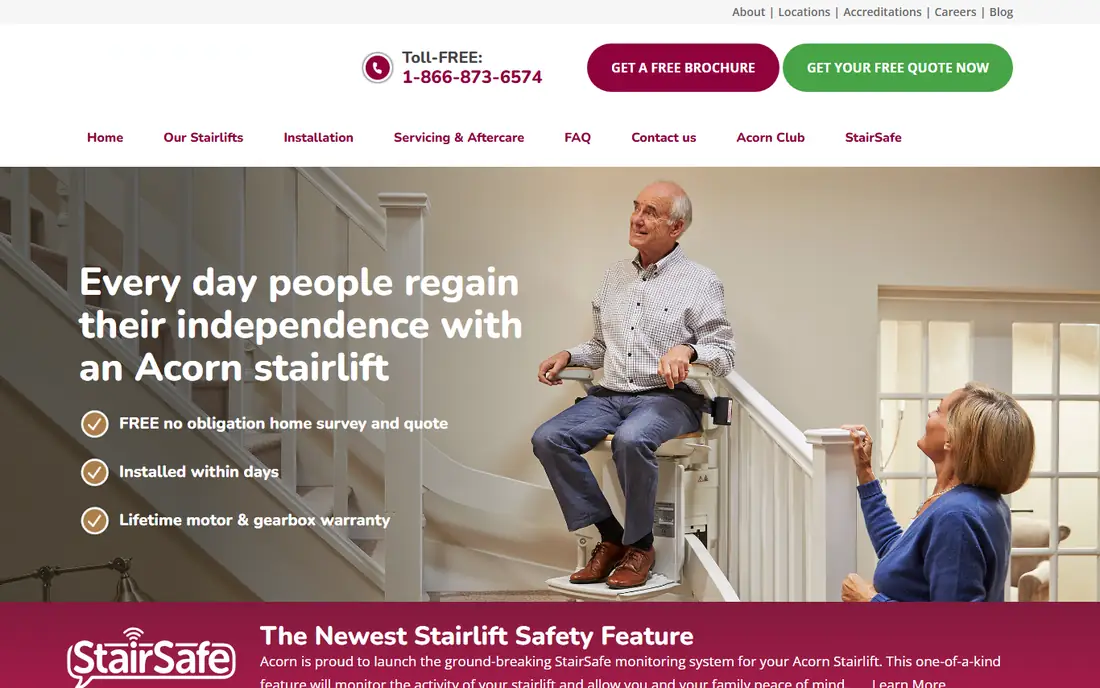
What we like- A stairlift is a rail fixed to the stair treads with a powered seat that carries one person up and down, and for a straight staircase it is the simplest intervention in this guide: no building work, installation often inside a day, and a seat that folds away so others can use the stairs. Acorn is one of the largest makers, factory direct in the US, with battery power that keeps the lift working through an outage and safety sensors that stop the chair on meeting an obstruction. Installed prices for straight lifts commonly start around 3,000 dollars, the lowest entry cost of any powered option here.
Watch out for- The rider must transfer on and off the seat at both ends, which rules it out for many wheelchair users and for anyone whose transfer ability is declining. It carries one person and nothing else, no wheelchair, no laundry basket beyond a lap. Straight means straight: a single bend or fan steps at the top ends this option. Resale value is low, and the rail, while removable, is a visible change to the home that some families resist until a fall makes the decision for them.

#2
Curved stairlift (Stannah)
Best for: Stairs with bends or landings
Visit stannah.com
Starting priceFrom $10,000 installed
Free planNo
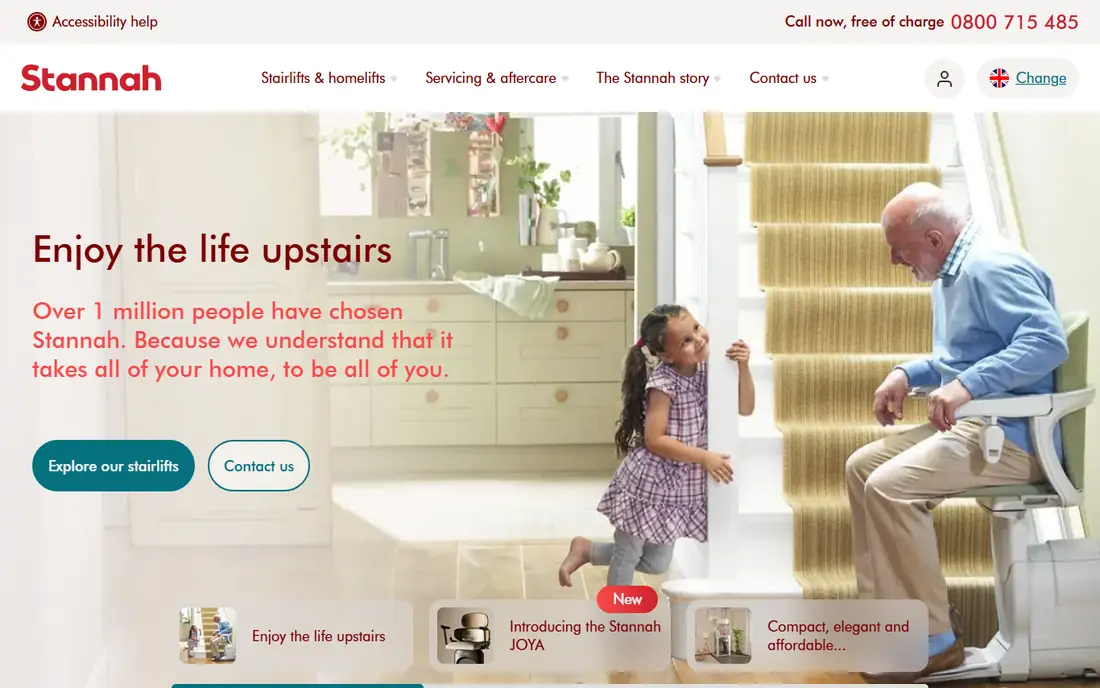
What we like- Where the staircase turns, the rail must turn with it, and curved stairlifts run on a rail fabricated to the exact shape of your stairs. Stannah, a family firm making stairlifts since the 1970s, is the name most associated with the category, with seats designed for comfort on longer rides, swivel seats for safe dismounting at the top and rails that can start or finish clear of doorways. For a split level or L shaped staircase in a home someone intends to stay in for decades, this is often the least disruptive full solution, installed without structural work once the rail is made.
Watch out for- A fabricated rail costs fabricated rail money: installed prices commonly begin around 10,000 dollars and rise with complexity, and manufacturing lead times run to weeks. The rail fits one staircase in the world, so the value leaves when you do. Transfer on and off is still required, exactly as with a straight lift. Stair width narrows for everyone else, and on a tight staircase the parked chair and rail can make the stairs awkward for the rest of the household.

#3
Vertical platform lift (Bruno)
Best for: Wheelchair access up to a porch or floor
Visit bruno.com
Starting priceFrom $5,000 installed
Free planNo
What we like- A vertical platform lift is a small open elevator: the wheelchair rolls onto a platform, a gate closes, and the platform rises straight up to porch, deck or the next floor, indoors or out. Bruno, an American maker long established in this category, builds residential models for rises from a few feet to a full storey, with battery backup and weather rated outdoor versions. The user stays in the chair, no transfer, which makes this the standard answer for porch access and for split levels where a ramp would eat the garden. Installed pricing commonly starts around 5,000 dollars for short rises.
Watch out for- It needs a concrete pad, power supply and, in many areas, a permit, so installation is a small construction project rather than a day's fitting. Higher rises cost much more, and full storey models with enclosures approach small elevator money. Travel is slow, as all platform lifts are, and the platform must be kept clear of snow and leaves outdoors. Local code decides details such as gates and enclosures, which a proper installer handles and a bargain seller may skip.

#4
Inclined platform lift (Garaventa)
Best for: A wheelchair platform that travels the stairs
Visit garaventalift.com
Starting priceSee website
Free planNo
What we like- An inclined platform lift mounts a folding platform on a rail along the staircase: the wheelchair rolls on, barriers drop, and the platform travels the slope of the stairs, folding flat against the wall when parked so the stair remains usable. Garaventa Lift, part of the Savaria group, is a leading maker with models for straight and curved stairs, widely used in schools and public buildings as well as homes. It solves the case the vertical lift cannot: a full flight inside a house with no shaft space and no room for a ramp, while keeping the user in their chair throughout.
Watch out for- The staircase must be wide enough to give up a strip to the rail and still pass building rules for the remaining width, which excludes many narrow homes. Prices are quoted per staircase after survey, hence see website, and sit well above stairlift money. The ride is slow and feels exposed compared with an enclosed lift. Two users cannot pass each other on the stair while it runs, a real consideration in a busy household.

#5
Home elevator (Savaria)
Best for: Full access between floors for everyone
Visit savaria.com
Starting priceSee website
Free planNo
What we like- A residential elevator removes the problem rather than managing it: everyone rides, standing, seated or in a wheelchair, with luggage, laundry and grandchildren, between every floor the shaft serves. Savaria is one of the largest accessibility lift companies in North America, with elevator models from compact through floor designs that need no separate machine room to traditional shaft elevators in many finishes. It is the only option here that adds to a home's value in most markets, and for a forever home it converts an accessibility purchase into a permanent feature of the house.
Watch out for- This is construction: shaft or hoistway work, permits, inspections and timelines measured in months, with installed totals commonly starting around 30,000 dollars and climbing well past it. Through floor models cost less but still cut a hole between floors. Maintenance contracts and phone line or battery backup requirements for the emergency phone are ongoing obligations. For a short expected stay in the home, the money rarely makes sense beside a stairlift or platform lift.

#6
Modular ramp system (EZ-ACCESS)
Best for: Step free entry over a small rise
Visit ezaccess.com
Starting priceSee website
Free planNo
What we like- For a few steps at the door, a modular aluminium ramp is often the right answer: no power, no moving parts, usable by wheelchairs, walkers, prams and delivery trolleys alike, and removable when no longer needed. EZ-ACCESS is the established American maker of modular ramp systems, with configurable sections, platforms and handrails that installers assemble to the site, plus portable and threshold ramps for smaller rises. Rented or bought, it is the fastest way to make an entrance step free, and because nothing is powered there is nothing to fail during a storm or an outage.
Watch out for- Geometry is the hard limit: a safe slope needs about twelve inches of ramp for every inch of rise, so a three foot rise wants around thirty six feet of ramp with landings, which many plots cannot fit and budgets notice. Aluminium gets slippery when icy and noisy under wheels. Long ramp runs tire manual wheelchair users, which is why slope and rest landings are safety requirements, not niceties. Any full storey rise rules ramps out entirely
- That is lift territory.

#7
Outdoor and portable lifts (Harmar)
Best for: Porch lifts and flexible access needs
Visit harmar.com
Starting priceSee website
Free planNo
What we like- Harmar, an American accessibility maker, covers the awkward cases the headline categories miss: vertical platform lifts built for outdoor service, high capacity models, and a wider mobility catalogue that includes vehicle lifts when the access problem continues at the car. Its residential platform lifts are sold through local dealers who survey, install and service them, which matters because in this category the dealer is half the product. For a raised porch, a deck or a garage entry, a weather built platform lift from a maker like Harmar is the standard solution, priced after survey.
Watch out for- As with all platform lifts, expect a pad, power and usually a permit, and budget for annual servicing to keep safety systems honest. Dealer quality varies by territory, so references from local disability organisations are worth more than a brochure. Prices are survey dependent, hence see website. Portable ramps and threshold products from any maker are for small rises only
- Using a steep portable ramp on a big step is how injuries happen, and no convenience justifies it.
How we chose
We chose the solution types that certified accessibility installers actually specify for homes, ordered roughly from least to most construction: stairlifts, platform lifts in both directions, a residential elevator and ramps. Each entry names an established maker with a US dealer or direct network in October 2026, because service access matters as much as the product. Prices are installed ranges from current market reporting where a range is meaningful, and see website where a survey decides; the free plan field is no throughout because none of this is software, and any seller offering a lift without a survey should be treated as a warning sign, not a bargain.
How to choose the right alternative to your stairs
Work through four questions in order. Can the user transfer safely onto a seat, now and realistically in three years? If yes, a stairlift fits: straight rail for straight stairs, curved for bends. If no, the user stays in the chair, and the choice becomes platform or ramp. How high is the rise and how much space is available? Small rise with room means a ramp; a flight of stairs means inclined platform or vertical lift; several floors or a whole household's benefit means pricing an elevator. What do local rules require? Permits, inspections and, for any shared or public building, accessibility codes apply; in a private home the rules vary by state and city, and a licensed installer will know them.
Then choose the installer as carefully as the equipment. Ask for references from customers two years on, not two weeks, confirm servicing arrangements and emergency call out, and get the weight capacity, battery backup behaviour and warranty in writing. Funding is worth checking before paying privately: veterans' grants, state Medicaid waiver programmes, area agencies on aging and some insurers contribute toward home access equipment in the US, and an occupational therapist's assessment often supports both the right specification and the paperwork. This guide is information, not medical or building advice; the assessment is the step that makes it personal and safe.
Frequently asked questions
What is the cheapest accessible alternative to stairs?
A modular ramp for a small rise, or a straight stairlift for a full flight. Ramps over a step or two can cost hundreds rather than thousands, and straight stairlifts are commonly installed from around 3,000 dollars, the lowest powered price in this guide. The expensive answers, curved rails, platform lifts for tall rises and elevators, climb from five figures upward. Beware any quote far below market: in safety equipment, a suspicious price usually means the survey, permit or servicing has been skipped.
Does Medicare pay for stairlifts or home elevators?
Generally no: Medicare treats stairlifts and elevators as home modifications rather than medical equipment, and does not cover them in most cases. Some Medicare Advantage plans offer limited home safety benefits, and Medicaid waiver programmes, the VA and state or local grants help specific groups. A vertical platform lift prescribed in particular circumstances occasionally fares better, but plan on private payment, ask about financing and used equipment programmes, and check funding sources before signing, because rules differ by state and change.
Do I need a permit to install a lift in my home?
Often yes for platform lifts and elevators, which are usually covered by local building or elevator codes requiring permits and inspection; stairlifts and ramps vary by jurisdiction, ramps frequently needing no permit if they meet slope and railing rules and sit within your property. A licensed installer handles permitting as part of the job in most markets. Skipping it risks insurance problems after any incident and complications when selling the house, so treat a seller who waves permits away as disqualified.
How wide do stairs need to be for a stairlift?
Most stairlifts fit stairs from about 28 to 30 inches wide, with narrow models for tighter cases, but the parked chair and rail reduce the clear width for everyone else, so the true test is whether other people can still pass safely. Very narrow or steep stairs may rule a stairlift out and point to a platform lift elsewhere in the house or a through floor lift. The free home survey exists precisely to answer this with a tape measure rather than a guess.
Which option works during a power outage?
Battery operation is standard on modern stairlifts and available on platform lifts: the lift completes a number of trips on battery while power is out. Home elevators should have battery lowering and an emergency phone or alarm. Ramps, having no power, work in any outage, one more reason they suit small rises. Whatever you choose, ask the installer in writing what the equipment does when the power fails at the worst moment, with the user mid journey, and how they get down safely.
Sources we checked (0)
Is your product missing or out of date?
We review this list regularly. Vendors can request a listing, send updated pricing or ask about featured placement.

Shihab Mia · Founder, Rankite
Shihab has 5+ years in B2B and SaaS SEO. He writes Rankite's software buying guides from pricing pages, documentation and public user reviews. More about Shihab.
 Straight stairlift (Acorn)