How we make this list: we compare pricing pages, product documentation and public user reviews. Ratings come from G2, Capterra or Trustpilot, with the date we checked them.
Key takeaways
- Microsoft is the broadest company on this list, covering productivity software, cloud, Windows, and gaming.
- Oracle and ServiceNow lead for large enterprises that need databases, cloud infrastructure, or workflow automation.
- Salesforce remains the reference point for customer relationship management, now built around AI agents.
- Adobe owns the creative and document software categories, from Photoshop to Acrobat.
- Palo Alto Networks is the pure cybersecurity pick, while Intuit and Workday lead in finance and people software.
Quick comparison
| Tool | Best for | Starting price | Free plan |
|---|
 Microsoft | Productivity software, cloud services, and Windows for businesses of any size | See website | Varies by product |
 Oracle | Databases, enterprise cloud infrastructure, and industry specific application suites | See website | Varies by product |
 Adobe | Creative design, video, and document software for individuals and teams | See website | Varies by product |
 Salesforce | Customer relationship management, sales, service, and AI agents for customer teams | See website | Varies by product |
 Intuit | Tax preparation, small business accounting, and personal finance | See website | Varies by product |
 ServiceNow | IT service management, employee workflows, and customer service workflows | See website | Varies by product |
 Palo Alto Networks | Network security, cloud security, and security operations for mid-size to large organizations | See website | Varies by product |
 Workday | Human resources, payroll, and finance for mid-size to large employers | See website | Varies by product |
Is your product missing or out of date?
We review this list regularly. Vendors can request a listing, send updated pricing or ask about featured placement.
The best software companies in the USA
#1Microsoft
Best for: Productivity software, cloud services, and Windows for businesses of any size4.6/5 on
G2 (11 reviews, checked Oct 2026)
Visit microsoft.com
Starting priceSee website
Free planVaries by product
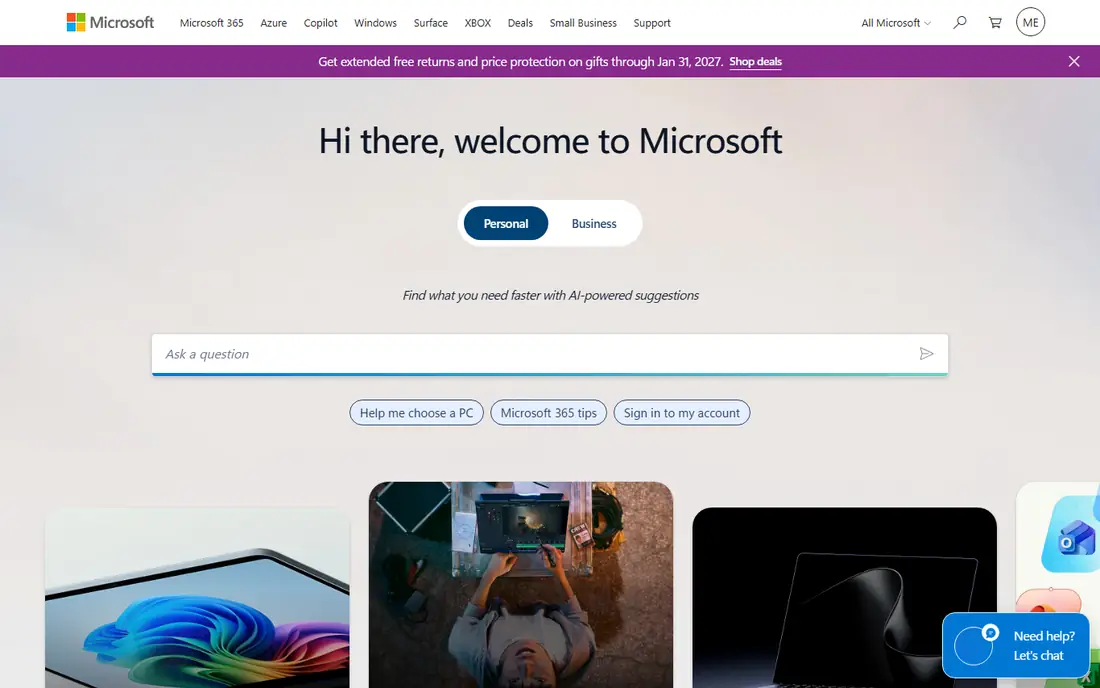
Microsoft is the largest software company in the United States by breadth. Its homepage leads with AI, cloud, productivity, computing, gaming, and apps, and that spread is the point. Windows runs on most business PCs. Microsoft 365 bundles Word, Excel, PowerPoint, Outlook, and Teams with Copilot AI features and cloud storage. Azure provides cloud infrastructure and AI services. Xbox and Game Pass cover gaming, and Surface covers hardware.
For a business buyer, Microsoft is usually the default starting point rather than a single purchase. A small company may only need Microsoft 365. A large company may run Azure, Dynamics 365, Teams, and Windows together. The trade-off is pricing complexity: with so many products and bundles, two companies can pay very different amounts for what looks like the same setup. Ask for a quote tied to your exact user count and needs, and check which products include free tiers, since several do and several do not.
What we like- Widest product range on this list
- Azure is a top three cloud platform
- Microsoft 365 bundles the office apps most teams already use
Watch out for- Enterprise pricing is complex and quote based
- Some products overlap, which can confuse buyers
#2
Oracle
Best for: Databases, enterprise cloud infrastructure, and industry specific application suites
Visit oracle.com
Starting priceSee website
Free planVaries by product
Oracle built its name on databases, and databases remain at the center of the company. Its AI Database runs on high performance Exadata hardware and is available in Amazon, Google, Microsoft, and Oracle Cloud data centers, so customers can pick the cloud they want. Oracle Cloud Infrastructure, or OCI, is pitched as high performing cloud services at a low cost, and the company names AMD, ByteDance, Meta, NVIDIA, OpenAI, TikTok, Uber, and xAI among its cloud customers.
Oracle also owns NetSuite, the cloud business software suite for finance, accounting, CRM, planning, ecommerce, HR, and supply chain. NetSuite reports more than 44,000 customers in over 200 countries and dependent territories. On top of that, Oracle sells industry suites for banking, construction and engineering, retail, healthcare, hospitality, manufacturing, and many more sectors. Choose Oracle when data and enterprise scale matter most. Small businesses will usually find NetSuite or a rival simpler to buy.
What we like- Database technology runs in Amazon, Google, Microsoft, and Oracle clouds
- NetSuite serves more than 44,000 customers
- Strong industry suites for over two dozen sectors
Watch out for- Enterprise focused, so small companies get less value
- Pricing is quote based and hard to compare
#3
Adobe
Best for: Creative design, video, and document software for individuals and teams
Visit adobe.com
Starting priceSee website
Free planVaries by product
Adobe is the creative software company. Photoshop for images, Illustrator for vector graphics, Premiere for video, and Acrobat for PDFs are the tools most professionals learn first, and that shared knowledge is part of the value. Firefly, Adobe's AI model family, now sits inside the creative tools for generating and editing images and video. GenStudio covers content creation for marketing teams, and Adobe's business products cover customer experience and document workflows.
The homepage also highlights a 71 percent saving for students and teachers, which matters for schools and new designers. The main drawback is the subscription model. There is no perpetual license for the flagship apps, so costs continue every year. Buyers should check single app plans against the full Creative Cloud bundle, since the bundle only pays off if you use several apps.
What we like- Photoshop, Illustrator, Premiere, and Acrobat are category standards
- Firefly adds AI image and video generation
- Student and teacher discounts reach 71 percent
Watch out for- Subscription only for most products
- The full Creative Cloud bundle is costly for casual users
#4Salesforce
Best for: Customer relationship management, sales, service, and AI agents for customer teams4.4/5 on
G2 (27,566 reviews, checked Oct 2026)
Visit salesforce.com
Starting priceSee website
Free planVaries by product
Salesforce calls itself the number one AI CRM, and its current pitch is the agentic enterprise: AI agents that handle research, validation, and repetitive work inside guardrails a company controls, so staff can focus on decisions only people can make. The platform covers sales, service, marketing, commerce, and data. Agentforce is the agent layer, Data 360 unifies customer data across sources, and Slack brings the work into team chat.
The homepage shows the range in customer stories, from Pandora using Agentforce for online shopping guidance to Williams-Sonoma using Data 360, AI, Marketing Cloud, and Slack across nine brands. Salesforce also runs AgentExchange, a marketplace for agents, apps, and capabilities. The strength is the ecosystem: thousands of apps and consultants work on Salesforce. The weakness is cost and complexity at scale, so small teams should start with one cloud and expand only when the first one pays off.
What we like- The most widely used CRM platform
- Agentforce adds AI agents that work inside customer workflows
- Slack and Marketing Cloud extend the platform
Watch out for- Costs grow as you add clouds and users
- Smaller teams may find the setup heavy
#5
Intuit
Best for: Tax preparation, small business accounting, and personal finance
Visit intuit.com
Starting priceSee website
Free planVaries by product
Intuit describes itself as a financial platform built to help people prosper, powered by Intuit Intelligence. Its pitch pairs AI agents that analyze data, deliver real time insights, and automate work with human experts who review work and guide next steps. The homepage names TurboTax expert services directly, and the platform covers taxes, personal money, and business finance.
The company's best known products are TurboTax for tax filing and QuickBooks for small business accounting, invoicing, and payroll. Credit Karma covers credit and personal finance, and Mailchimp covers email marketing for small businesses. For a US buyer, Intuit is the small business finance pick on this list. Larger companies with complex finance needs will usually look at Oracle, Workday, or SAP instead.
What we like- TurboTax is the best known tax product in the US
- QuickBooks serves millions of small businesses
- AI agents plus human experts on one financial platform
Watch out for- Homepage detail is thin, so product specifics need a visit to each product site
- Pricing varies widely by product and tier
#6
ServiceNow
Best for: IT service management, employee workflows, and customer service workflows
Visit servicenow.com
Starting priceSee website
Free planVaries by product
ServiceNow sells a single AI platform for running work across a company. Its homepage frames the idea plainly: AI without workflows is just expensive advice. The platform adds data, workflows, and security around AI models, so AI actions are grounded in company data and governed as they happen. Products cover IT service management, customer relationship management, employee experience, risk and security, and low-code app development.
The company reports that 85 percent of the Fortune 500 use ServiceNow, with a 98 percent renewal rate and 95 billion workflows on the platform. It also reports 5 million ServiceNow workflows per month and 2.5 million AI powered interactions in less than a year. ServiceNow Otto is its AI assistant for work, handling requests end to end across systems and departments. Choose ServiceNow when work crosses departments and needs one system of record. Small teams with simple ticketing needs will find cheaper tools.
What we like- Used by 85 percent of the Fortune 500
- 98 percent renewal rate reported on its site
- One platform for IT, CRM, employee experience, and app development
Watch out for- Enterprise pricing and implementation effort
- Overkill for very small teams
#7
Palo Alto Networks
Best for: Network security, cloud security, and security operations for mid-size to large organizations
Visit paloaltonetworks.com
Starting priceSee website
Free planVaries by product
Palo Alto Networks is the cybersecurity specialist on this list. Its platforms, powered by Precision AI, cover network security, security operations, cloud security, identity security, and observability. Strata is the network security platform, built for Zero Trust and designed to monitor, analyze, and prevent threats in real time. Cortex covers security operations, and the cloud platform merges leading cloud security tools with detection and response.
The company reports 75,000 customers, 95 percent of the Fortune 100, and up to 30.9 billion inline attacks blocked per day, with 480 billion endpoints scanned daily. Unit 42, its threat research and incident response team, handles more than 1,000 matters a year with over 200 threat researchers. For a company that needs serious security depth, Palo Alto Networks is the reference vendor. Smaller companies may start with one platform, such as network security, rather than the full suite.
What we like- 95 percent of the Fortune 100 are customers
- Up to 30.9 billion inline attacks blocked per day
- Platforms cover network, cloud, SecOps, identity, and observability
Watch out for- Enterprise grade pricing
- The platform breadth can be more than a small company needs
#8Workday
Best for: Human resources, payroll, and finance for mid-size to large employers4.2/5 on
G2 (2,449 reviews, checked Oct 2026)
Visit workday.com
Starting priceSee website
Free planVaries by product
Workday is the enterprise AI platform for HR, finance, and IT. Its argument is that HR and finance belong together: when one system holds people, policies, skills, and financials, AI actions have the full picture and can be trusted for critical work. Agents cover HR tasks such as hiring and people decisions, finance tasks such as spend and cost control, and IT tasks such as employee support, all inside company rules with audit trails.
Sana is Workday's single agentic experience, orchestrating agents behind the scenes to anticipate, advise, and act within a company's rules. Customer stories on the homepage include 7-Eleven, reporting more than 2 million hours saved annually, and Jabil, reporting $4.5 million saved annually from decommissioning systems. Workday GO offers simplified packages of HR, payroll, finance, and AI products for mid-size businesses with lean teams. Choose Workday when headcount and finance planning need one source of truth.
What we like- One system for HR and finance, so people, policies, skills, and financials sit together
- Sana is a single agentic experience across the platform
- Workday GO packages suit lean mid-size teams
Watch out for- Built for mid-size and large employers, not tiny teams
- Implementation is a major project
How we chose
We ranked companies by scale, category leadership, and relevance to US buyers. Each company had to have a working official homepage that we opened and confirmed. We favored companies that lead a major software category, serve a large US customer base, and publish clear product information. We excluded companies whose sites were dead, parked, or belonged to a different business, and we did not guess any domain from a company name.
Because these are companies rather than single products, pricing fields read "See website" and free plan fields read "Varies by product." A company like Microsoft sells both free products and expensive enterprise platforms, so a single price or free plan label would mislead. Check the product you actually need, not the company average.
How to pick a software vendor
Start from the job, not the brand. A company that needs customer management should compare Salesforce against its rivals. A company that needs creative tools should compare Adobe plans. A company that needs HR and finance in one system should look at Workday. The biggest company is not always the best fit, and the cheapest product is not always the lowest total cost once training and implementation are counted.
Ask four questions before signing. First, does the product fit your current team size, or will you pay for enterprise features you never use. Second, what does implementation cost in time and money, beyond the subscription. Third, how does pricing change as you add users, since per user pricing grows fast. Fourth, can you export your data if you leave. A vendor that locks data in deserves extra scrutiny.
Finally, use trials and demos. Most companies on this list offer free trials, demos, or a free tier on at least one product. Test with your real data and your real team, not a sales demo, before committing to a multi-year contract.
Frequently asked questions
Which is the largest software company in the USA?
By revenue and market value, Microsoft is the largest US software company, with Windows, Microsoft 365, Azure, and Xbox. Oracle, Adobe, and Salesforce follow in different categories, so the answer depends on whether you rank by size, revenue, or category leadership.
What is the best software company for small businesses?
Intuit is the strongest small business pick on this list, with TurboTax and QuickBooks built for individuals and small firms. Adobe suits creative freelancers and studios. Microsoft 365 suits almost any small team that needs office apps, email, and cloud storage in one bundle.
Which US software company is best for cybersecurity?
Palo Alto Networks is the pure cybersecurity pick, with platforms for network security, cloud security, security operations, identity, and observability. ServiceNow also covers security workflows, but Palo Alto Networks is the specialist.
Do these companies offer free plans?
It varies by product. Microsoft, Adobe, Salesforce, and Intuit each offer free tiers or free trials on some products, while enterprise platforms such as ServiceNow, Workday, and Oracle are usually quote based. Check the product page for the exact product you need.
How were these companies ranked?
We ranked by category leadership, scale, and relevance to US buyers, not by a single revenue table. Microsoft leads on breadth, Oracle on databases, Adobe on creative software, Salesforce on CRM, Intuit on small business finance, ServiceNow on workflows, Palo Alto Networks on security, and Workday on HR and finance.
Sources we checked (0)
Is your product missing or out of date?
We review this list regularly. Vendors can request a listing, send updated pricing or ask about featured placement.

Shihab Mia · Founder, Rankite
Shihab has 5+ years in B2B and SaaS SEO. He writes Rankite's software buying guides from pricing pages, documentation and public user reviews. More about Shihab.