How we make this list: we compare pricing pages, product documentation and public user reviews. Ratings come from G2, Capterra or Trustpilot, with the date we checked them.
Key takeaways
- erwin Data Modeler and ER/Studio are the enterprise choices, built for governance, large teams and complex database estates.
- Hackolade is the flexible pick for mixed environments, covering relational, NoSQL, APIs and event streams in one model.
- dbdiagram.io and MySQL Workbench cost nothing and handle most small-team diagramming needs.
- Redgate Data Modeler, formerly Vertabelo, brings cloud collaboration at $189 per user per year with no installation.
- Moon Modeler is the only perpetual license on the list at $99 one time, with no subscription to renew.
Quick comparison
| Tool | Best for | Starting price | Free plan |
|---|
 erwin Data Modeler erwin Data Modeler | enterprise governance and modeling | See website | No |
 ER/Studio ER/Studio | enterprise data architecture | See website | Free trial |
 Hackolade Hackolade | polyglot relational and NoSQL modeling | See website | Yes |
 dbdiagram.io dbdiagram.io | fast ER diagrams for developers | $8 per user/month (billed annually) | Yes |
 SqlDBM SqlDBM | cloud modeling for data teams | See website | Free trial |
 Redgate Data Modeler Redgate Data Modeler | browser-based team modeling | $189 per user/year | Free trial (14 days) |
 Moon Modeler Moon Modeler | affordable perpetual-license modeling | $99 one-time | Free trial (14 days) |
 Navicat Data Modeler Navicat Data Modeler | multi-database visual design | $22.99 per user/month | Free trial |
 MySQL Workbench MySQL Workbench | free MySQL modeling and admin | Free | Yes |
 DBeaver DBeaver | database client with ER diagrams | See website | Yes (Community) |
Is your product missing or out of date?
We review this list regularly. Vendors can request a listing, send updated pricing or ask about featured placement.
The most flexible data modeling software
#1
erwin Data Modeler
Best for: enterprise governance and modeling
Visit erwin.com
Starting priceSee website
Free planNo
erwin Data Modeler is the enterprise standard, with more than thirty years of weight behind the name. Now part of the Quest erwin Data Management Platform, it ties modeling into data intelligence, governance and metadata management. Conceptual, logical and physical models live in one environment, with forward and reverse engineering across many relational and NoSQL targets.
Version 15.2 arrived in January 2026, so the product is under active development. Complete Compare synchronizes models with live databases and generates the ALTER scripts to close the gap. The honest catch is fit. Pricing is quote based and the sales process is enterprise grade, which makes erwin overkill for a five-person startup. For a large organization that needs governed, auditable data design, it remains the benchmark.
What we like- Deepest feature set in the category, strong governance integration, huge install base
Watch out for- Enterprise pricing and sales process
- Heavy for small teams
Starting priceSee website
Free planFree trial
ER/Studio is erwin's oldest rival, and the rivalry is still close. Owned by Idera, it covers conceptual, logical and physical modeling with AI-assisted design, forward and reverse engineering, and integrations with governance platforms like Collibra and Microsoft Purview. The current release line, ER/Studio 21.2, leans into Microsoft Fabric and AI-ready data architectures.
Three editions let you scale from a single Data Architect license up to the Enterprise package with the central Repository and Team Server for collaboration. That ladder is useful because you can start small and grow into the platform. Pricing is not published, so expect a sales conversation. The other thing to know is platform history. ER/Studio grew up on Windows, and while it has broadened, teams that are all Mac or Linux should confirm the current story before committing.
What we like- Mature modeling with AI-assisted features, strong Microsoft Fabric support, three editions
Watch out for- Quote-based pricing
- Windows-centric history
Starting priceSee website
Free planYes
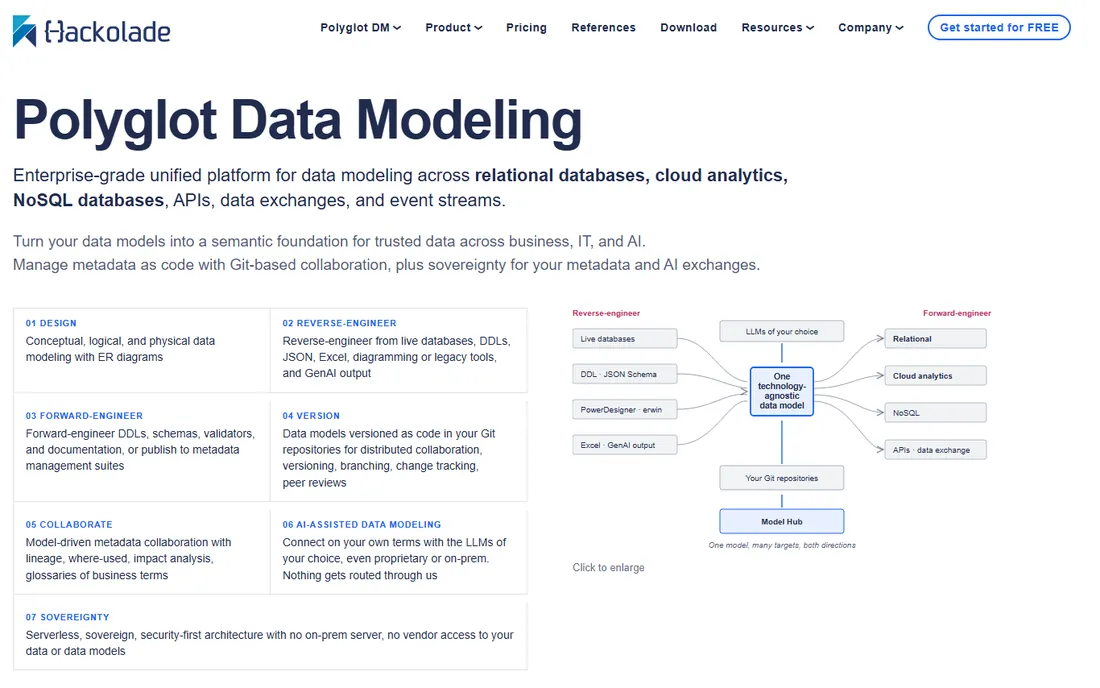
Hackolade started as the NoSQL modeling tool, and it has grown into something broader. Today it handles relational databases, cloud analytics platforms like Snowflake and Databricks, NoSQL stores, APIs and event streams from one technology-agnostic model. You define meaning once, then derive physical schemas per target. That polyglot approach is the closest thing to flexible in this category.
The architecture is deliberately serverless and sovereign. You run Hackolade Studio in the browser or on the desktop, models live as JSON in your own Git repositories, and the vendor never sees your data. Reverse engineering pulls models from live databases, DDL, JSON Schema and even GenAI output. The free tier lets you start without registration. The gap is pricing transparency. Plans are not listed on the public site, so you will need to talk to sales for team pricing.
What we like- Models 45+ targets in one tool, metadata as code in Git, no server to install
Watch out for- Pricing is not transparent on the site
- Less known than the enterprise incumbents
Starting price$8 per user/month (billed annually)
Free planYes
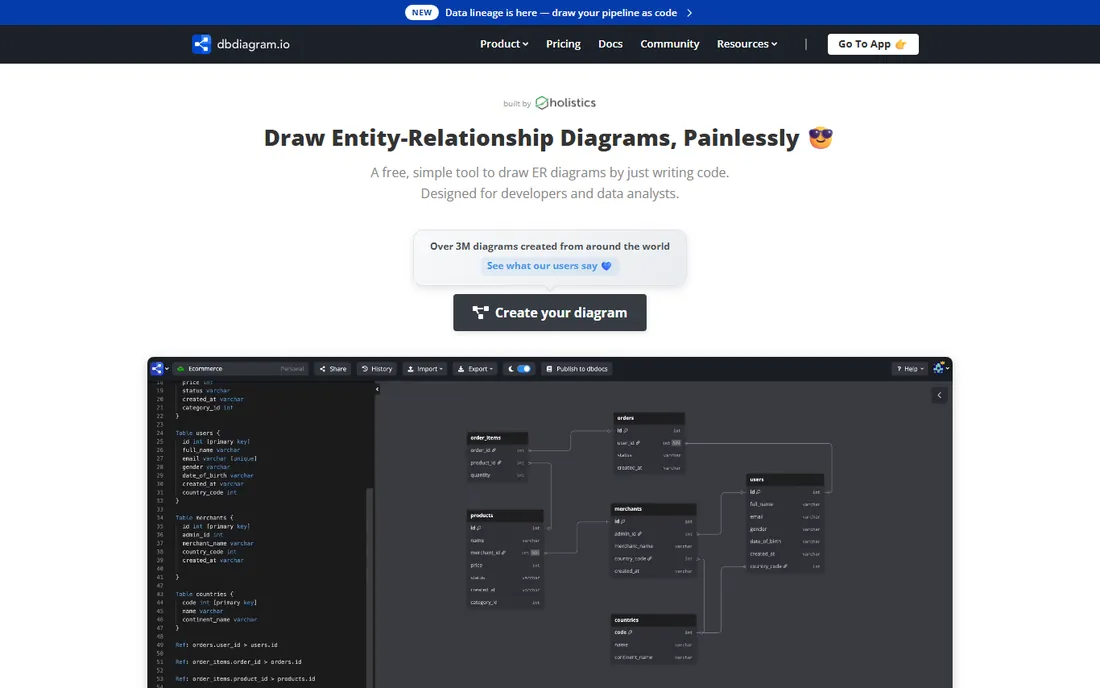
dbdiagram.io takes the opposite approach from the enterprise suites. Instead of dragging boxes, you write in DBML, a simple database markup language, and the ER diagram appears as you type. Over three million diagrams have been created with it.
The free tier needs no signup and is genuinely useful for quick diagrams. Personal Pro costs $14 per month or $8 per month billed annually, and adds unlimited diagrams, real-time collaboration, version history and AI-assisted design. For developers who want to document a schema fast and share it with a link, this is the quickest path. The tradeoff is depth. It is a diagramming tool with modeling features, not a governance platform, so it will not replace erwin for regulated industries.
What we like- Diagrams from typed DBML code, no signup for the free tier, real-time collaboration
Watch out for- Focused on diagrams, not full governance
- Free tier limits public diagrams
Starting priceSee website
Free planFree trial
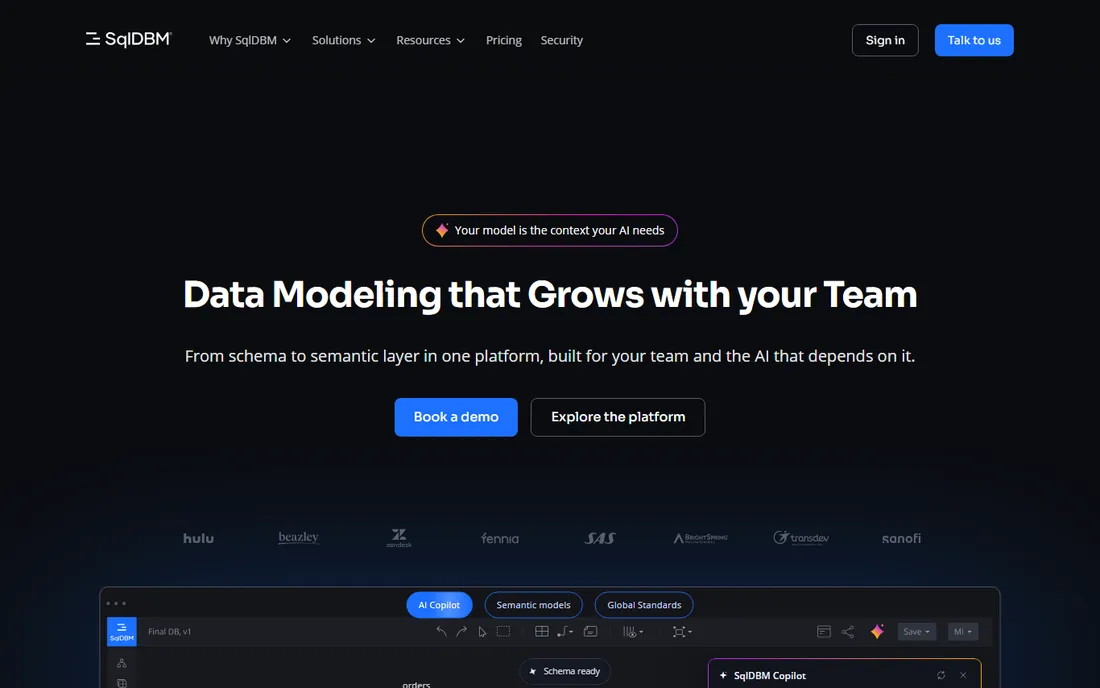
SqlDBM is the browser-based modeler built for teams that live in cloud data warehouses. It was the first online modeling tool to support Snowflake natively, and it now covers Databricks, BigQuery and the rest of the modern stack alongside traditional databases. Conceptual, logical and physical modeling, reverse and forward engineering, and version control are all in the browser.
The 2026 product adds an AI Copilot, semantic modeling for a governed metric layer, and MCP access so AI agents can read the same metadata your people use. That AI-ready positioning is SqlDBM's current pitch. Pricing is not published on the site, so plan on a sales call. The other consideration is deployment. Everything runs in SqlDBM's cloud, which is convenient for distributed teams but a non-starter for organizations that keep schemas off third-party infrastructure.
What we like- Fully browser based, strong Snowflake and cloud warehouse support, AI copilot
Watch out for- Cloud only, which rules out air-gapped shops
- Pricing not published
Starting price$189 per user/year
Free planFree trial (14 days)
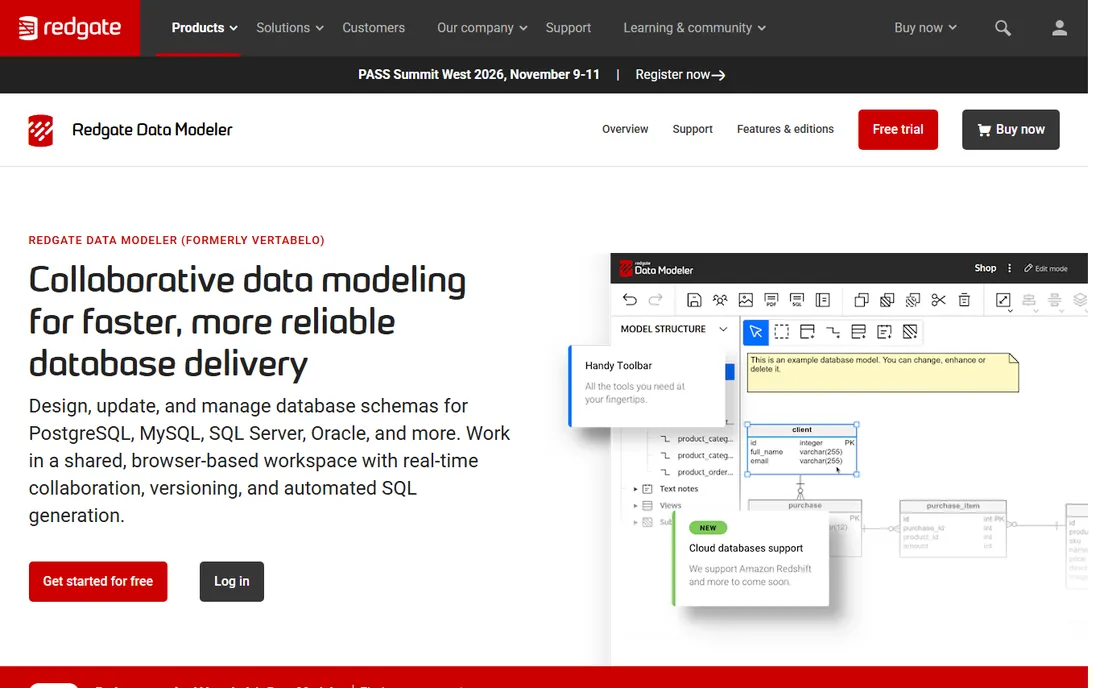
Redgate Data Modeler is the new name on a familiar product. Redgate acquired Vertabelo Data Modeler in October 2025 and relaunched it under its own brand. If you used Vertabelo, this is the same cloud-based modeler: a shared browser workspace with real-time collaboration, built-in versioning, reverse engineering and automated SQL generation for PostgreSQL, MySQL, SQL Server, Oracle and more.
The pricing is refreshingly clear for this category. The Standard edition is $189 per user per year with limits of 20 models and 100 tables per model, and Pro is $303 per user per year with unlimited models and tables plus API access and logical design. A 14-day free trial needs no installation. The risk is simply newness. The product is proven technology, but the Redgate branding and roadmap are less than a year old, so check that the features you need survived the transition.
What we like- Real-time collaboration with versioning, no installation, clear per-user pricing
Watch out for- Newer product under the Redgate name
- Cloud only
Starting price$99 one-time
Free planFree trial (14 days)
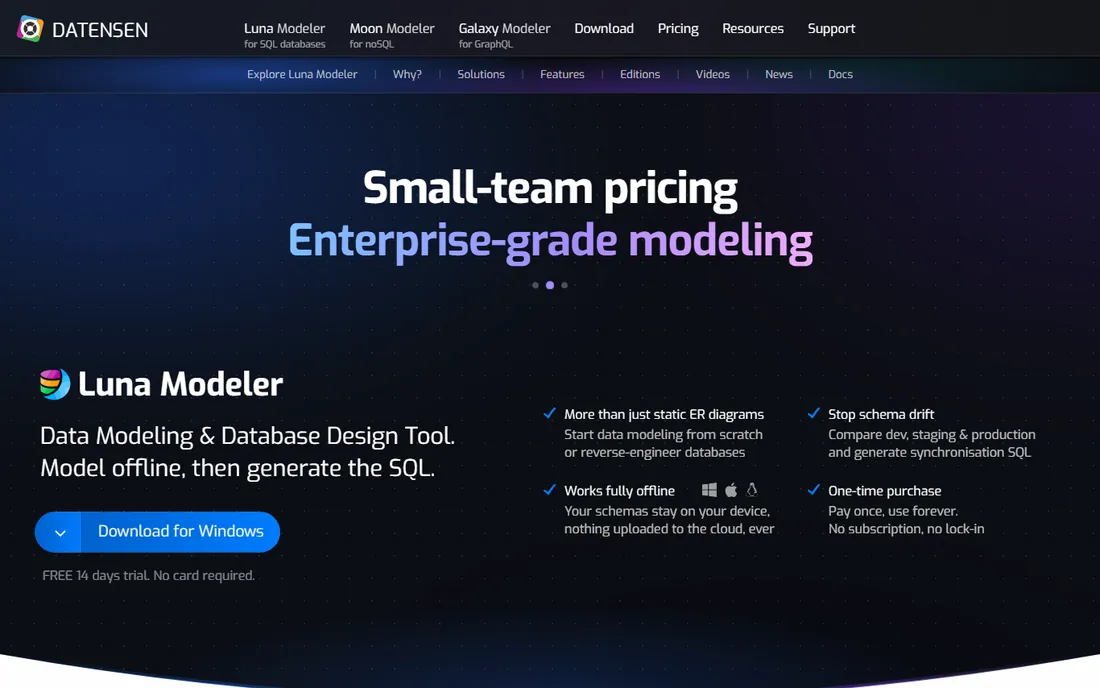
Moon Modeler is the quiet value pick. Datensen sells it for a one-time $99, and you keep using that version forever with no subscription to renew. It is the MongoDB and NoSQL member of the Datensen family, with visual schema design, reverse engineering of existing databases and script generation for validation and creation.
Everything runs offline on your own machine, which suits regulated work and client projects under NDA. The desktop apps run natively on Windows, macOS and Linux, a real advantage in a category where several established tools are still Windows only. A free 14-day trial needs no credit card. The limitation is scope. Moon Modeler targets MongoDB and document databases. If your stack is relational, Datensen's sibling product Luna Modeler is the one to evaluate, at the same one-time pricing.
What we like- One-time purchase, no subscription
- Fully offline
- Works on Windows, macOS and Linux
Watch out for- Small vendor
- NoSQL focused, so relational teams should look at Luna Modeler instead
Starting price$22.99 per user/month
Free planFree trial
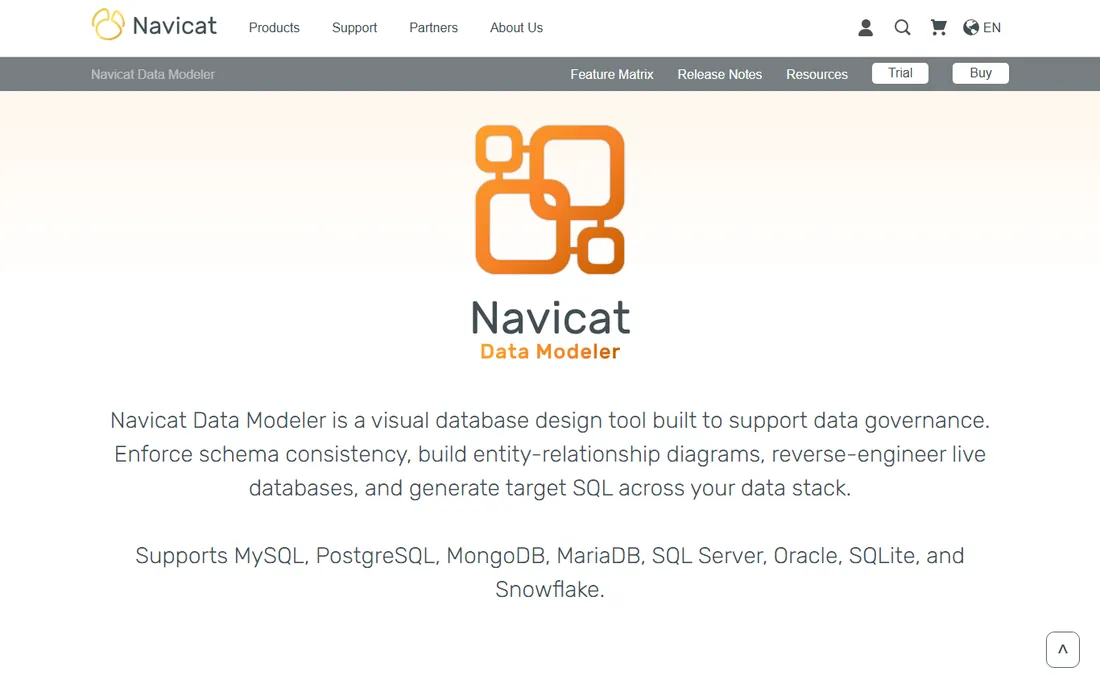
Navicat Data Modeler comes from the same company as the popular Navicat database clients, and it shows. The interface will feel familiar to anyone who has used Navicat Premium, and it supports an unusually wide spread: MySQL, PostgreSQL, SQL Server, Oracle, SQLite, MariaDB, MongoDB and Snowflake. Conceptual, logical and physical models share one workspace, with reverse engineering, model comparison and DDL generation.
Pricing is $22.99 per user per month on subscription, $229.99 per year, or $1,299 for a perpetual license. Native applications exist for Windows, macOS and Linux. The honest weakness is depth. It covers the core modeling workflow well but does not match erwin or ER/Studio on governance, metadata bridges or enterprise process.
What we like- Supports MySQL, Postgres, MongoDB, Snowflake and more
- Native apps for three platforms
Watch out for- Subscription pricing adds up
- Modeling depth trails the enterprise specialists
Starting priceFree
Free planYes
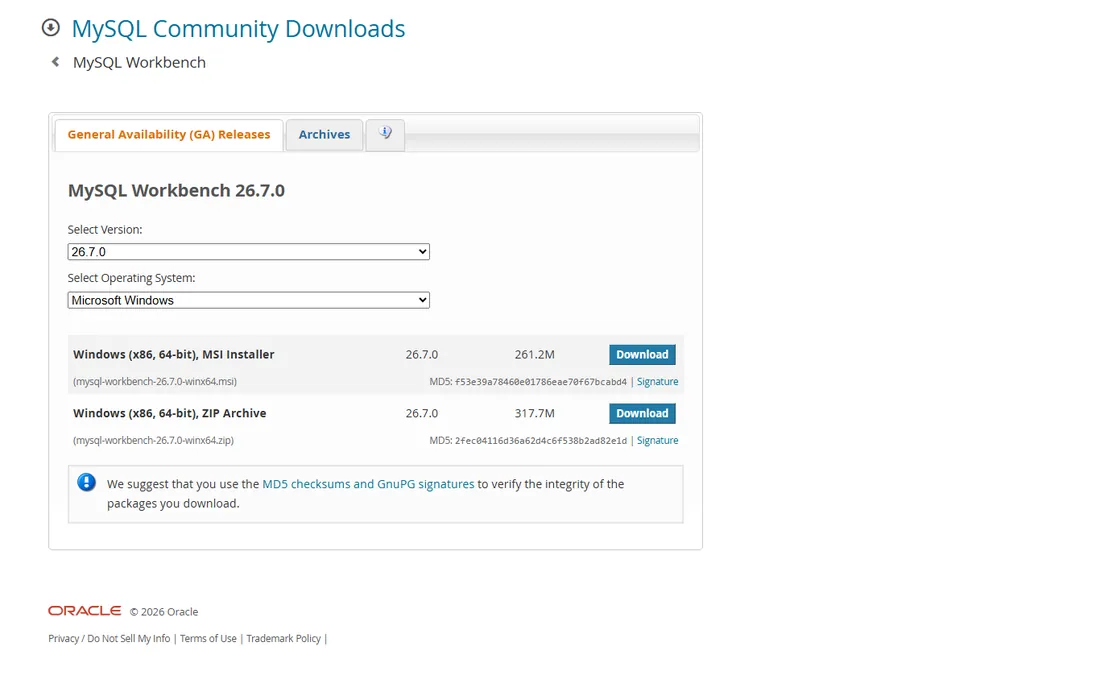
MySQL Workbench is free, Oracle-maintained and already on many developers' machines. Its data modeling module draws ER diagrams, forward-engineers them into DDL, and reverse-engineers existing databases into diagrams. For a MySQL shop, that covers the core modeling loop at zero cost.
The current release is 26.7.0, and the Community edition is GPL licensed. Beyond modeling, Workbench bundles SQL development, server administration and migration tools, which makes it a decent all-rounder for MySQL operations. The limits are obvious. It is MySQL only, so polyglot environments need something else. And the interface, while functional, feels dated compared with browser-based tools. But free is free, and for MySQL-only teams it is hard to argue with.
What we like- Completely free and open source, visual ER modeling with forward engineering, from Oracle
Watch out for- MySQL only
- Interface feels dated next to modern tools
Starting priceSee website
Free planYes (Community)
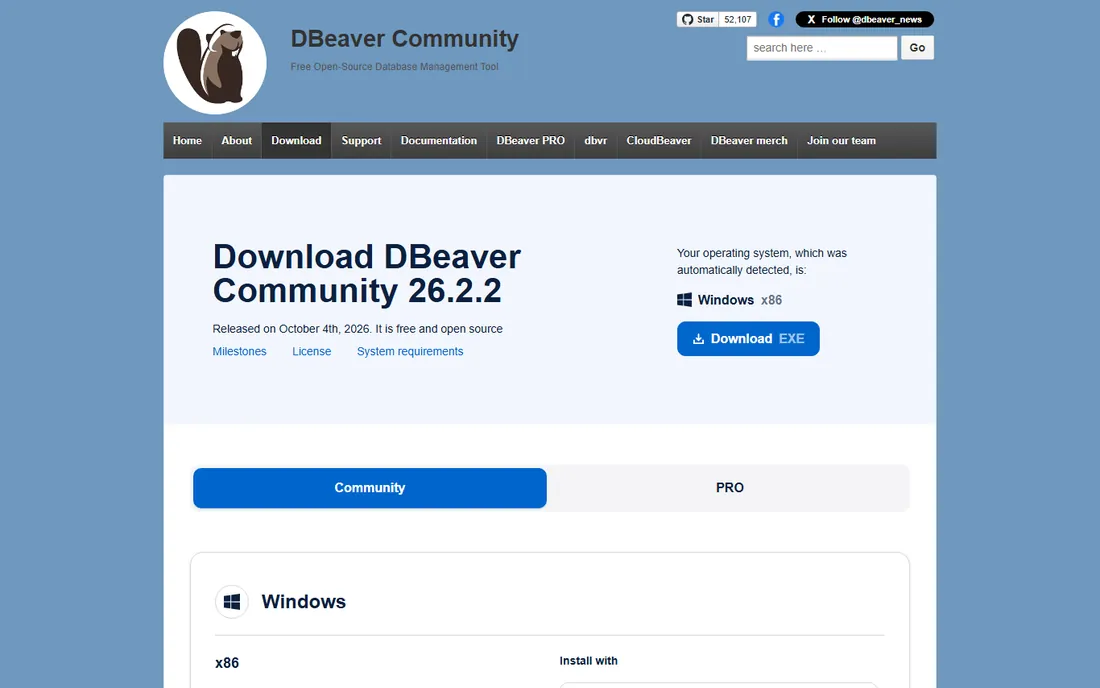
DBeaver is the database client people install for everything, and its ER diagrams are better than expected. The free Community edition connects to virtually any relational or NoSQL database and renders ER diagrams from live schemas with an edit mode for tweaks. For developers who already use DBeaver daily, that is often enough modeling.
The PRO edition, sold separately through dbeaver.com, adds an AI SQL assistant, mock data generation, schema comparison and a task scheduler. Pricing for PRO is not on the download page, so check the PRO site. The honest framing matters here. DBeaver is a database client with diagramming, not a data modeling tool with governance. If you need conceptual modeling, naming standards and model-driven documentation, look at the dedicated modelers above.
What we like- Free Community edition, connects to almost any database, ER diagrams included
Watch out for- Diagrams are a side feature, not a modeling methodology
- PRO pricing is separate
How we chose
We opened every vendor homepage and read the current product pages, documentation and licensing terms. Prices come from the vendors' own pricing pages, and where a vendor does not publish a price we say so instead of inventing one. We checked release activity and ownership changes, including Redgate's acquisition of Vertabelo and Datensen's current product lineup, against public announcements. We compared claims with public reviews on G2 and Capterra and with practitioner discussion on Reddit. No vendor paid for placement, and we did not claim hands-on testing.
How data modeling pricing really works
This category has three pricing philosophies, and knowing which one you are buying saves surprises. The enterprise tools, erwin and ER/Studio, use quote-based annual subscriptions. You will talk to sales, and the price will reflect your team size and modules. Budget for a real procurement cycle.
The mid-market tools publish per-user annual prices. Redgate Data Modeler charges $189 to $303 per user per year, and dbdiagram.io charges $8 per user per month billed annually. These are predictable and easy to approve. Then there are the outliers. Moon Modeler is a $99 one-time purchase with optional paid upgrades, and MySQL Workbench and DBeaver Community are free. The tradeoff with free tools is support. When something breaks, you are reading forums, not calling an account manager.
Watch for the limits on cheaper plans. Redgate's Standard edition caps you at 20 models and 100 tables per model. SqlDBM and Hackolade keep pricing behind sales, which usually means the number depends on your seat count. Always confirm what happens to your models if you stop paying, especially with cloud-only tools.
Start with your database inventory, not with a feature list. A MySQL-only team gets 90 percent of what it needs from MySQL Workbench for free. A team split across Postgres, Snowflake and MongoDB needs a polyglot tool like Hackolade or Navicat Data Modeler. An enterprise with governance requirements needs erwin or ER/Studio, full stop.
Match the deployment to your security rules
Cloud-only tools like SqlDBM and Redgate Data Modeler are convenient but keep your schemas on someone else's infrastructure. If your schemas describe regulated data or client systems under NDA, prefer tools that run locally, like Moon Modeler, or confirm the vendor's security certifications before you upload anything.
Decide how much methodology you need
Some teams just need diagrams that stay current. dbdiagram.io and DBeaver cover that. Other teams need conceptual, logical and physical models with naming standards, version control and approval workflows. That is the enterprise tier, and the price difference reflects real additional capability, not marketing.
Check the NoSQL story
Most classic modelers grew up with relational databases. If your stack includes MongoDB, Cassandra or event streams, verify native support rather than assuming it. Hackolade and Moon Modeler are built for this. SqlDBM handles it through its cloud platform. The rest vary, so check the supported targets list on the vendor's site.
Pilot with a real schema
Every tool on this list offers a free tier or trial. Take one messy production schema, reverse-engineer it, generate the DDL, and show the result to the people who will actually use it. A one-hour pilot tells you more than a week of feature-matrix comparison.
Frequently asked questions
What is data modeling software?
Data modeling software lets you design database structures visually, as entity-relationship diagrams and related models, then generate the SQL or schema definitions to build them. Good tools also reverse-engineer existing databases into diagrams and track how models change over time.
Do I need a data modeling tool if I already have a database client?
Maybe not. Clients like DBeaver and MySQL Workbench include ER diagrams that are enough for documenting a schema. A dedicated modeler earns its keep when you design databases before they exist, enforce naming standards, or need conceptual and logical models, not just pictures of tables.
What is the difference between conceptual, logical and physical models?
A conceptual model describes business entities and their relationships in plain terms. A logical model refines that into entities, attributes and keys without tying to a specific database. A physical model maps it to real tables, columns and data types for one database platform. Enterprise tools manage all three.
Can free tools replace erwin or ER/Studio?
For diagramming, often yes. dbdiagram.io and MySQL Workbench handle everyday ER work for free. For governance, metadata management and large-team process, no. The enterprise tools exist for regulated industries and complex estates where auditability matters, and free tools do not try to compete there.
Which data modeling tools work with NoSQL databases?
Hackolade was built for this and covers MongoDB, Cassandra, DynamoDB and more alongside relational targets. Moon Modeler focuses on MongoDB. SqlDBM, Navicat Data Modeler and DBeaver each support some NoSQL databases, so check the vendor's supported list for your specific store.
How much should a small team pay for data modeling?
Many small teams pay nothing with dbdiagram.io's free tier, MySQL Workbench or DBeaver Community. If you need collaboration and private models, budget around $8 to $25 per user per month, or $189 per user per year for Redgate Data Modeler. Moon Modeler's $99 one-time license is the cheapest paid route to a real modeling tool.
Sources we checked (10)
- https://www.erwin.com/products/erwin-data-modeler/
- https://erstudio.com/
- https://hackolade.com
- https://dbdiagram.io
- https://sqldbm.com/
- http://www.red-gate.com/products/redgate-data-modeler/
- https://www.datensen.com/
- https://www.navicat.com/en/products/navicat-data-modeler
- https://dev.mysql.com/downloads/workbench/
- https://dbeaver.io/download
Is your product missing or out of date?
We review this list regularly. Vendors can request a listing, send updated pricing or ask about featured placement.

Shihab Mia · Founder, Rankite
Shihab has 5+ years in B2B and SaaS SEO. He writes Rankite's software buying guides from pricing pages, documentation and public user reviews. More about Shihab.