How we make this list: we compare pricing pages, product documentation and public user reviews. Ratings come from G2, Capterra or Trustpilot, with the date we checked them.
Key takeaways
- Google BigQuery suits ad hoc analytics with serverless pricing at $6.25 per TB scanned and a free tier.
- Amazon Redshift suits AWS native teams, with Serverless from $1.50 per hour and provisioned nodes for steady workloads.
- Databricks suits teams that need SQL, ML, and streaming on one lakehouse platform, from $0.22 per DBU.
- Microsoft Fabric suits Microsoft and Power BI teams, while ClickHouse suits real time analytics at low cost.
- Snowflake itself is not listed here, since this article covers alternatives. The same workload can cost 8 times more on one platform than another, so price your actual queries and storage before choosing.
Quick comparison
| Tool | Best for | Starting price | Free plan |
|---|
 Google BigQuery | Serverless ad hoc analytics | $6.25 per TB scanned | Yes |
 Amazon Redshift | AWS native analytics | $1.50 per hour | Free trial |
 Microsoft Fabric | Microsoft and Power BI teams | See website | Free trial |
 Databricks SQL | Lakehouse and ML teams | $0.22 per DBU | Free trial |
 ClickHouse | Real time analytics | Free | Yes |
 Firebolt | Sub second customer facing apps | See website | Free trial |
 Starburst | Query federation | $0.50 per compute hour | Free trial |
 Dremio | Iceberg native lakehouse | $1 per compute hour | Free trial |
Is your product missing or out of date?
We review this list regularly. Vendors can request a listing, send updated pricing or ask about featured placement.
The best Snowflake alternatives
#1Google BigQuery
Best for: Serverless ad hoc analytics4.5/5 on
G2 (1,223 reviews, checked Oct 2026)
Visit cloud.google.com
Starting price$6.25 per TB scanned
Free planYes
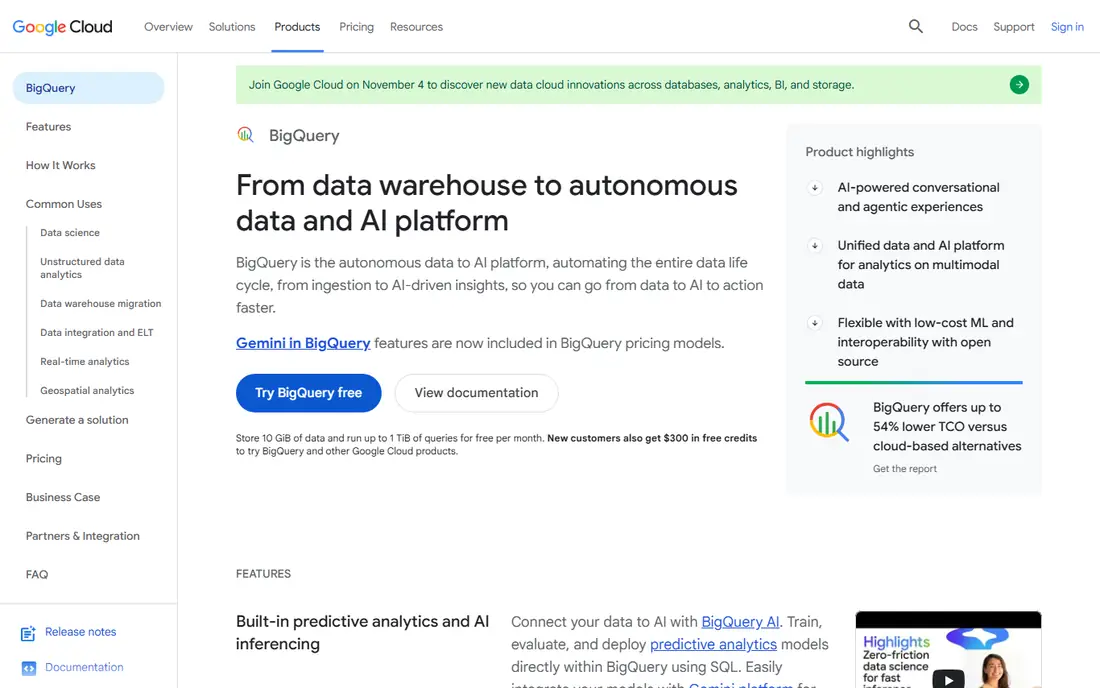
BigQuery charges $6.25 per TB scanned on demand, with no compute to provision and no idle cost, which suits unpredictable, ad hoc analytics. The free tier covers the first 1 TB of queries and 10 GB of storage each month, and flat rate slots suit predictable workloads. Built in ML and native GCP integration add value for Google shops.
The risk is scan volume: a badly written query over a large table costs real money, and on demand pricing rewards careful partitioning and clustering. For a GCP native team with spiky analytics, BigQuery is the best value alternative to Snowflake.
What we like- True serverless, no clusters to manage
- First 1 TB of queries and 10 GB of storage free each month
- Built in ML and GCP integration
Watch out for- On demand costs scale with bytes scanned
- Unpredictable queries can surprise
- Best value needs GCP commitment
#2Amazon Redshift
Best for: AWS native analytics4.3/5 on
G2 (404 reviews, checked Oct 2026)
Visit aws.amazon.com
Starting price$1.50 per hour
Free planFree trial
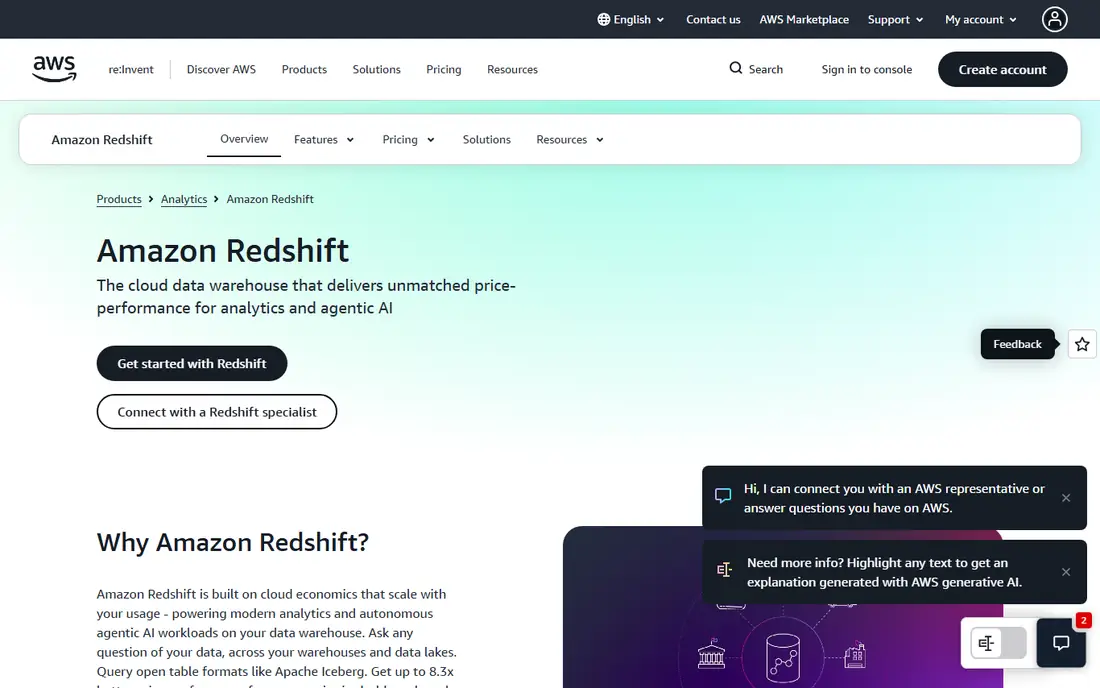
Amazon Redshift suits AWS native teams, with Serverless from $1.50 per hour and provisioned RA3 nodes for steady, predictable workloads. Reserved nodes cut costs up to 75 percent for committed use, and integration with S3, Glue, and other AWS services is deep.
Serverless pricing at about $0.375 per RPU hour can run higher than expected for heavy workloads, and provisioned clusters charge around the clock unless stopped. For an AWS locked team migrating from Snowflake, Redshift is the natural home.
What we like- Serverless from $1.50 per hour
- RA3 nodes for steady workloads
- Deep AWS ecosystem integration
Watch out for- Serverless runs about $0.375 per RPU hour and can cost more than expected
- Provisioned clusters pay 24/7 unless stopped
- AWS locked
#3Microsoft Fabric
Best for: Microsoft and Power BI teams4.6/5 on
G2 (47 reviews, checked Oct 2026)
Visit microsoft.com
Starting priceSee website
Free planFree trial
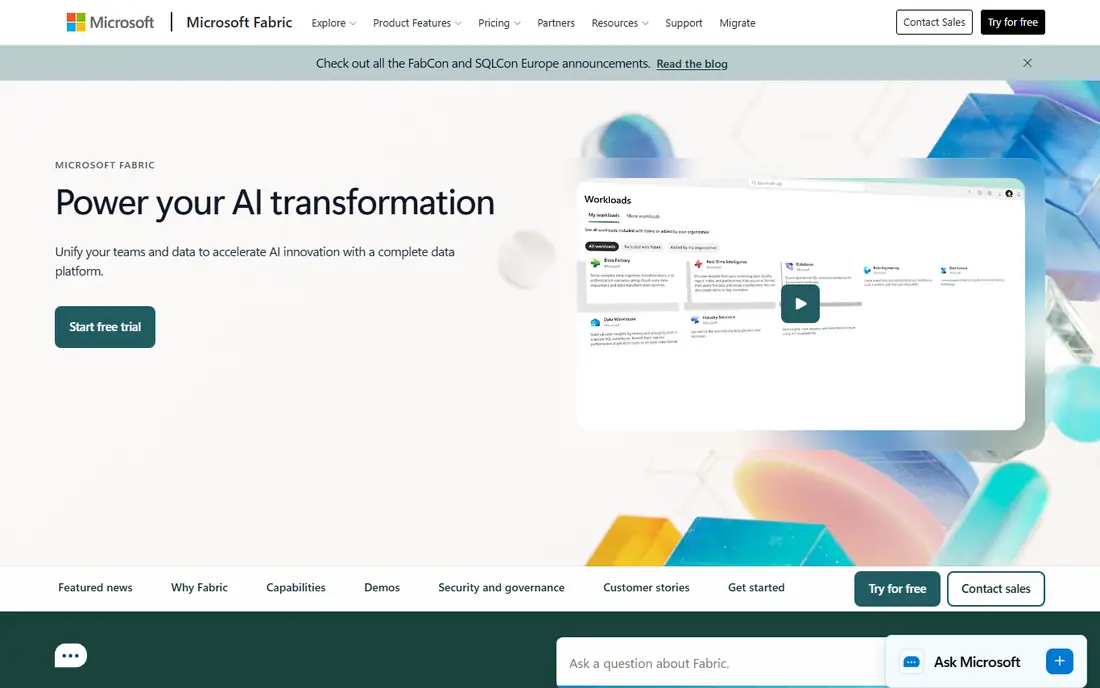
Microsoft Fabric unifies analytics, data engineering, and Power BI in one SaaS capacity model, with capacity SKUs from F2 to F2048. In a recent benchmark of a typical BI workload, 10 TB stored and 40 TB scanned a month, Fabric came out cheapest at $323 per month, against $421 for BigQuery and $870 for Snowflake Standard.
Capacity pricing is bundle dependent and hard to compare line by line, and Fabric is Azure only. For a Microsoft and Power BI team, Fabric is the ecosystem pick and, on that benchmark, the cheapest.
What we like- Unified SaaS analytics with Power BI integration
- Cheapest in a recent benchmark at $323 per month for a typical BI workload
- Capacity model bundles services
Watch out for- Capacity pricing is bundle dependent and hard to compare
- Azure only
- Licensing complexity with Microsoft 365
Starting price$0.22 per DBU
Free planFree trial
Databricks suits teams that need SQL, ML, and streaming on one platform, with a lakehouse built on Delta Lake over object storage. SQL Classic starts at $0.22 per DBU, SQL Pro at $0.55, and SQL Serverless at $0.70, which includes cloud instance cost. Governance through Unity Catalog and AI features add enterprise depth.
Total costs often run $50,000 to $200,000 per year at scale, and pure BI teams may find the platform heavier than needed. For a team whose Snowflake gap is ML and streaming, Databricks is the lakehouse answer.
What we like- Lakehouse with Delta Lake on object storage
- SQL, ML, and streaming on one platform
- SQL Classic from $0.22 per DBU
Watch out for- Serverless SQL at $0.70 per DBU costs more
- Total costs often run $50,000 to $200,000 per year
- Complexity for pure BI teams
Starting priceFree
Free planYes
ClickHouse is the performance per dollar leader for real time analytics, with a columnar engine built for high throughput queries over events, logs, and dashboards. Open source is free to self host, and ClickHouse Cloud starts near $53 per month with a 30 day trial and $300 in credits.
Self hosting needs engineering time, and governed enterprise BI features trail Snowflake. For a real time analytics workload where speed per dollar matters most, ClickHouse is the strongest alternative.
What we like- Free open source
- Cloud from about $53 per month
- Fastest performance per dollar for event and log analytics
Watch out for- Self hosting needs engineering time
- Less suited to governed enterprise BI
- Ecosystem smaller than BigQuery or Redshift
#6Firebolt
Best for: Sub second customer facing apps4.5/5 on
G2 (14 reviews, checked Oct 2026)
Visit firebolt.io
Starting priceSee website
Free planFree trial
Firebolt is a specialist engine built for sub second queries in customer facing apps, with engine based pay per use pricing. It suits high concurrency dashboards and user facing analytics where latency directly affects the product experience.
Pricing is not published in the sources used here, so confirm the current rate, and the ecosystem is narrower than BigQuery or Redshift. For a customer facing analytics product that needs speed, Firebolt is the specialist pick.
What we like- Engine based pay per use
- Sub second queries for customer facing apps
- Efficient for high concurrency dashboards
Watch out for- Pricing not published in the sources used here
- Narrower ecosystem than leaders
- Specialist focus limits general BI use
#7Starburst
Best for: Query federation4.3/5 on
G2 (121 reviews, checked Oct 2026)
Visit starburst.io
Starting price$0.50 per compute hour
Free planFree trial
Starburst lets teams query across data sources without moving data first, built on the open Trino engine, from $0.50 per compute hour. That suits organizations with data spread across warehouses, lakes, and operational systems, where centralizing everything in Snowflake is costly or slow.
Federation adds latency for heavy joins, and governance needs careful setup. For a team whose Snowflake pain is data movement and centralization cost, Starburst is the federation answer.
What we like- Query across sources without moving data
- From $0.50 per compute hour
- Trino based open engine
Watch out for- Federation adds latency for heavy joins
- Governance needs setup
- Costs scale with compute hours
Starting price$1 per compute hour
Free planFree trial
Dremio offers an Iceberg native lakehouse with a semantic layer, from about $1 per compute hour, which suits teams standardizing on open table formats. Queries run directly on data in object storage, avoiding warehouse lock in and duplication.
The ecosystem is smaller than Databricks, and lakehouse setup needs engineering skill. For a team betting on Iceberg and open formats, Dremio is the open lakehouse alternative to Snowflake.
What we like- Iceberg native lakehouse
- Semantic layer included
- From about $1 per compute hour
Watch out for- Smaller ecosystem than Databricks
- Lakehouse setup needs engineering skill
- Enterprise features sit on higher tiers
How we chose
We ranked alternatives by workload fit and total cost, not headline price alone. Serverless tools scored on ad hoc value, provisioned tools on steady workload value, lakehouses on ML and streaming depth, and specialists on latency. Prices are vendor list prices as of October 2026, with the benchmark workload of 10 TB stored, 40 TB scanned a month, and 160 hours of active compute used to compare totals.
We noted the cost gap plainly. That benchmark put Fabric at $323 per month, BigQuery at $421, Snowflake Standard at $870, Databricks SQL Serverless at $1,126, and Redshift Serverless at $1,200, with Synapse Dedicated at $2,624. The gap comes from paying for bytes read versus paying for capacity held, which is why the same workload costs 8 times more on one platform than another. Snowflake itself is excluded, since this article covers alternatives.
Buying guide
Start with the workload, not the vendor. Ad hoc and spiky analytics suit BigQuery on demand. Steady, predictable BI suits Redshift provisioned or Fabric capacity. ML and streaming suit Databricks. Real time and customer facing analytics suit ClickHouse or Firebolt. Federation suits Starburst, and open formats suit Dremio.
Next, price your actual workload. Model storage, scanned bytes or compute hours, and concurrency, then run a trial on real queries. A platform that looks cheap per unit can cost more if your queries scan more data or hold capacity idle. Watch idle costs: BigQuery on demand charges nothing when idle, while provisioned clusters charge around the clock.
Finally, check ecosystem and governance. GCP teams suit BigQuery, AWS teams suit Redshift, Microsoft teams suit Fabric, and multi cloud teams should weigh Databricks or ClickHouse. Confirm data sharing, access controls, and compliance needs before signing, since those features differ sharply across platforms. Also confirm the trial terms and any credits before you commit, since trial credits and free tiers vary by platform and region.
Frequently asked questions
What is the cheapest Snowflake alternative?
For a typical BI workload in a recent benchmark, Microsoft Fabric came out cheapest at $323 per month, followed by BigQuery at $421. ClickHouse is cheapest for real time analytics, with open source free and Cloud from about $53 per month.
Which Snowflake alternative is best for AWS teams?
Amazon Redshift, with Serverless from $1.50 per hour and deep AWS integration. It suits AWS native teams migrating from Snowflake, with reserved nodes cutting costs up to 75 percent.
Which alternative is best for ML and AI workloads?
Databricks, with SQL, ML, and streaming on one lakehouse platform from $0.22 per DBU. It suits teams whose Snowflake gap is machine learning depth.
Is BigQuery really serverless?
Yes. BigQuery on demand charges $6.25 per TB scanned with no clusters to provision and no idle cost, which suits unpredictable analytics. Flat rate slots suit predictable workloads.
Why do warehouse costs vary so much?
Because pricing models differ: paying for bytes read, for compute hours, or for capacity held produces very different bills for the same workload. Model your actual queries and storage before choosing.
Sources we checked (0)
Is your product missing or out of date?
We review this list regularly. Vendors can request a listing, send updated pricing or ask about featured placement.

Shihab Mia · Founder, Rankite
Shihab has 5+ years in B2B and SaaS SEO. He writes Rankite's software buying guides from pricing pages, documentation and public user reviews. More about Shihab.