How we make this list: we compare pricing pages, product documentation and public user reviews. Ratings come from G2, Capterra or Trustpilot, with the date we checked them.
Key takeaways
- Talend is the closest Pentaho replacement, combining ETL and data integration with governance and more than 1,000 connectors.
- Apache NiFi is the best free open-source option for real-time data flows, with no licensing cost at all.
- KNIME suits small businesses and analysts, with a free open-source platform for data preparation and machine learning.
- Power BI is the cheapest BI entry point for Microsoft shops, at $14 per user per month for Pro.
- Tableau leads on visual analysis, with Viewer plans from $15 per user per month and Creator at $75.
Quick comparison
| Tool | Best for | Starting price | Free plan |
|---|
 Talend | Closest Pentaho replacement | See website | Free trial |
 Apache NiFi | Free real-time flows | $0 | Yes |
 KNIME | Analyst-friendly data prep | $0 | Yes |
 Microsoft Power BI | Microsoft shops | $14 per user per month | Yes |
 Tableau | Visual analysis | $15 per user per month | Free trial |
 Qlik Sense | Associative exploration | $300 per month | Free trial |
 Informatica | Enterprise governance | See website | Free trial |
 Airbyte | Open-source ELT pipelines | $0 | Yes |
Is your product missing or out of date?
We review this list regularly. Vendors can request a listing, send updated pricing or ask about featured placement.
The best Pentaho alternatives
#1Talend
Best for: Closest Pentaho replacement4.0/5 on
G2 (65 reviews, checked Oct 2026)
Visit talend.com
Starting priceSee website
Free planFree trial
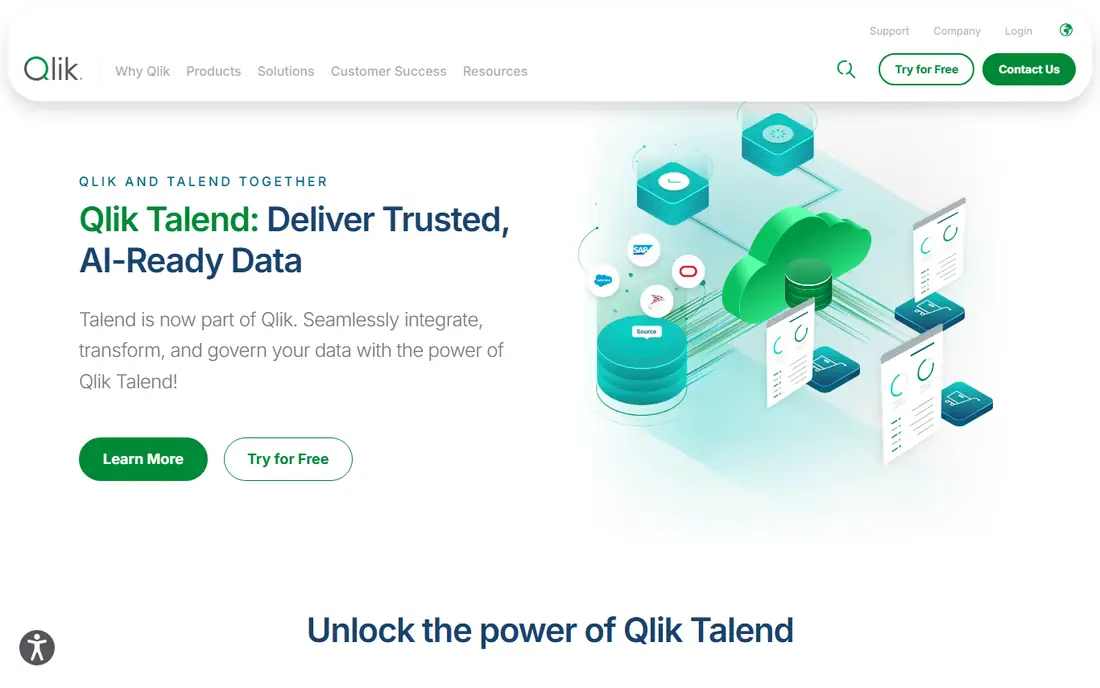
Talend is the closest Pentaho replacement, combining ETL and data-integration capabilities similar to Pentaho's Data Integration and analytics suite. Its low-code interface lets data engineers build pipelines visually, while coding options handle complex transformations, and integrated data quality and governance features cover the compliance needs that enterprises expect. With more than 1,000 connectors, Talend reaches nearly every common source and target.
Talend is now part of Qlik, which changes the roadmap: Qlik bundles its Talend-based data integration layer into every Cloud Analytics tier as of 2026. Enterprise pricing runs from about $12,000 a year in published guides, though one source cites near $4,800 a year from user reviews, so request a quote. For a team migrating from Pentaho that wants the most similar enterprise tool, Talend is the natural choice.
What we like- More than 1,000 connectors
- Integrated data quality and governance
- Low-code UI with coding options
Watch out for- Enterprise pricing from about $12,000 a year
- Now part of Qlik, which changes the roadmap
Starting price$0
Free planYes
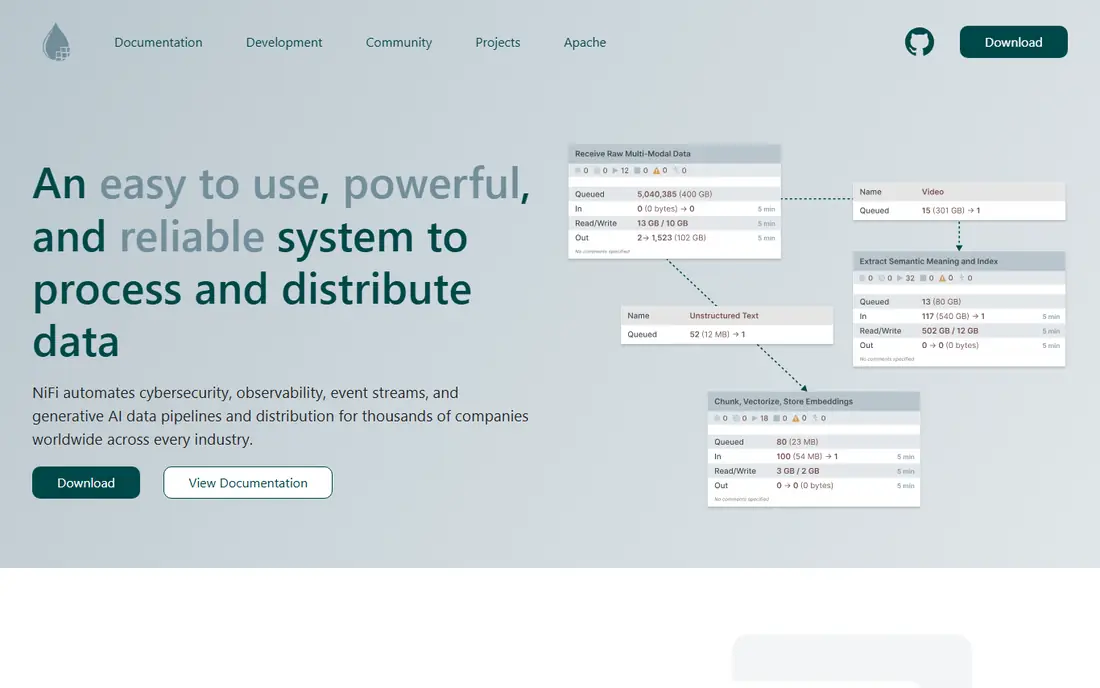
Apache NiFi is the best free open-source alternative to Pentaho, with no licensing cost and a visual designer for real-time data flows. Data moves between systems through processors connected on a canvas, with back-pressure, prioritization and provenance tracking built in. That provenance record, showing exactly where each record came from and what happened to it, is unusually strong for a free tool.
NiFi needs engineering skill to run well: clustering, security and monitoring are the team's responsibility, and vendor support comes only through third parties. For a team with data engineering capacity that wants a free, real-time integration platform, NiFi delivers the most capability for zero license cost.
What we like- Completely free and open source
- Real-time data flows
- Visual flow designer
Watch out for- Needs engineering skill to run
- No vendor support without a third party
#3KNIME
Best for: Analyst-friendly data prep4.5/5 on
G2 (118 reviews, checked Oct 2026)
Visit knime.com
Starting price$0
Free planYes
KNIME suits small businesses and analysts, with a free open-source platform for data preparation, blending and machine learning. Visual workflows let analysts build pipelines by connecting nodes rather than writing code, and built-in machine learning nodes cover classification, clustering and forecasting without a separate tool. That analyst focus is why KNIME pairs well with a BI tool such as Power BI or Tableau.
KNIME scales less smoothly than Talend for large enterprise pipelines, and the server edition for collaboration and scheduling is paid. For a small team or an analyst-led group that wants free, visual data preparation, KNIME is the best starting point.
What we like- Free open-source platform
- Visual workflows
- Machine learning built in
Watch out for- Scales less smoothly than Talend for enterprise pipelines
- Server edition is paid
Starting price$14 per user per month
Free planYes
Microsoft Power BI is the cheapest BI entry point for Microsoft shops, with Pro at $14 per user per month after a rise from $10 in April 2025, the first price change in the product's history. Power Query connects to several hundred data sources, and Direct Lake mode, generally available across OneLake since March 2026, removes the need to duplicate or manually refresh large datasets before querying them. Governance runs through Microsoft Purview, one layer across email, files and BI content.
Power BI's value is strongest inside Microsoft 365, so teams outside that ecosystem get less benefit. For a small team of 10 to 15 report builders, Power BI Pro is close to the cheapest entry point in BI, and its Microsoft integration is unmatched.
What we like- Deepest Microsoft integration
- Hundreds of data sources
- Cheapest BI entry point
Watch out for- Pro price rose from $10 to $14 in April 2025
- Best value only inside Microsoft 365
#5Tableau
Best for: Visual analysis4.4/5 on
G2 (3,787 reviews, checked Oct 2026)
Visit tableau.com
Starting price$15 per user per month
Free planFree trial
Tableau leads on visual analysis, with an interface that analysts consistently rate highest for exploration. Viewer plans start at $15 per user per month, Explorer at $42 and Creator at $75, separating people who view dashboards from people who build them. Multi-cloud support is strong, and the analyst community produces a large library of techniques and extensions.
Creator pricing at $75 per user per month adds up for a large builder team, and governance sits closer to Salesforce Data Cloud, which suits Salesforce shops best. For a team where analysts drive decisions through visual exploration, Tableau remains the benchmark BI tool.
What we like- Best visual exploration
- Strong multi-cloud support
- Large analyst community
Watch out for- Creator tier costs $75 per user per month
- Governance sits closer to Salesforce Data Cloud
#6Qlik Sense
Best for: Associative exploration4.4/5 on
G2 (929 reviews, checked Oct 2026)
Visit qlik.com
Starting price$300 per month
Free planFree trial
Qlik Sense uses an associative engine that lets users explore data freely, clicking any value to see related data across all fields without predefined queries. That exploration style suits analysts who do not know what question to ask yet. Qlik has moved almost entirely to a capacity model, charging for data volume instead of headcount, with Starter from $300 a month for 10 users and 10 GB of data.
Once a team grows past roughly 50 users, Qlik's capacity model can end up cheaper than per-user pricing, since the price stops moving when headcount does. The capacity model is confusing at first, and the community is smaller than Tableau's or Power BI's. For a growing team that shares dashboards widely, Qlik's capacity pricing is a genuine advantage.
What we like- Associative engine for free exploration
- Capacity pricing
- Talend integration built in
Watch out for- Capacity model is confusing at first
- Smaller community than Tableau or Power BI
Starting priceSee website
Free planFree trial
Informatica is the enterprise-grade option, with AI-driven integration, strong data governance and metadata management, and multi-cloud plus on-premises support. Large enterprises managing complex data governance and compliance choose Informatica when data quality, lineage and policy enforcement matter as much as pipeline speed. Its metadata management is the deepest on this list.
Pricing is enterprise-level, with guides citing from about $5,000 a year for entry products and far more for full platform deals, and implementation is complex. For a large enterprise with strict governance requirements, Informatica's depth justifies the cost. Smaller teams should choose Talend, NiFi or KNIME instead.
What we like- Enterprise-grade AI-driven integration
- Strong governance and metadata
- Multi-cloud support
Watch out for- Enterprise-priced from about $5,000 a year
- Complex to implement
#8Airbyte
Best for: Open-source ELT pipelines4.4/5 on
G2 (78 reviews, checked Oct 2026)
Visit airbyte.com
Starting price$0
Free planYes
Airbyte is the best open-source ELT option, with hundreds of connectors and a free self-hosted edition. It moves data from sources into warehouses with minimal setup, and its cloud option adds zero-maintenance pipelines for teams that do not want to run infrastructure. That ELT focus matches modern cloud data stacks, where transformation happens inside the warehouse rather than in the pipeline.
Airbyte covers extraction and loading only, so transformation needs a separate tool such as dbt. For a small or mid-size team building a cloud data warehouse pipeline on a budget, Airbyte's free tier and connector library make it the fastest path to working pipelines.
What we like- Free open-source ELT
- Hundreds of connectors
- Zero-maintenance cloud option
Watch out for- ELT-only focus
- Transformation needs a separate tool such as dbt
How we chose
We compared data tools on integration depth, connector coverage, governance, pricing transparency and fit for small, mid-size and enterprise teams. We used vendor pricing pages and recent comparison guides for rates, and we favored tools with a free tier or published entry price. We did not claim hands-on testing. Instead we weighed what each tool moves, how it governs data, and what it costs per user or per month, so data teams can match a tool to their stack and budget.
ETL versus ELT versus BI
Pentaho combined ETL and analytics in one suite, so a replacement decision starts by separating the two jobs. ETL tools such as Talend, NiFi and Informatica transform data before loading it, which suits regulated workloads where data must be cleaned before it lands. ELT tools such as Airbyte load raw data first and transform it inside the warehouse, which suits cloud stacks with cheap storage and tools such as dbt.
BI tools such as Power BI, Tableau and Qlik Sense visualize data but do not replace a pipeline: they need clean, modeled data to work well. A team migrating from Pentaho usually needs both a pipeline tool and a BI tool, unless it chooses Talend inside Qlik, which bundles both. Decide which half matters more, then pick the tool that leads on that half and covers the other adequately.
Frequently asked questions
What is the closest alternative to Pentaho?
Talend is closest, combining ETL and data-integration capabilities similar to Pentaho's Data Integration suite, with governance and more than 1,000 connectors. KNIME is the closest free option for analyst-led teams.
Is there a free Pentaho alternative?
Yes. Apache NiFi, KNIME and Airbyte are all free and open source, and Power BI offers a free desktop edition. NiFi suits engineering teams, KNIME suits analysts, and Airbyte suits cloud ELT pipelines.
Why are companies switching away from Pentaho?
Companies switch for modern cloud-native architecture, easier maintenance, lower licensing costs and stronger integration ecosystems than Pentaho's traditional platform. Its architecture and licensing trajectory make it a poor foundation for new projects, according to recent migration guides. Teams also cite difficulty hiring engineers who want to work on older platforms. A modern stack makes recruiting easier as well as maintenance cheaper over time for growing teams.
Should I choose Power BI or Tableau?
Power BI is cheaper and best for Microsoft shops, at $14 per user per month for Pro. Tableau leads on visual exploration and multi-cloud support, with Viewer from $15 and Creator at $75 per user per month. Choose Power BI for cost and Microsoft integration, Tableau for visual analysis depth.
What is the difference between ETL and ELT?
ETL transforms data before loading it into a target, which suits regulated workloads. ELT loads raw data first and transforms it inside the warehouse, which suits cloud stacks. Talend and Informatica are ETL-led, while Airbyte is ELT-led.
Sources we checked (8)
- https://www.talend.com
- https://nifi.apache.org
- https://www.knime.com
- https://powerbi.microsoft.com
- https://www.tableau.com
- https://www.qlik.com
- https://www.informatica.com
- https://airbyte.com
Is your product missing or out of date?
We review this list regularly. Vendors can request a listing, send updated pricing or ask about featured placement.

Shihab Mia · Founder, Rankite
Shihab has 5+ years in B2B and SaaS SEO. He writes Rankite's software buying guides from pricing pages, documentation and public user reviews. More about Shihab.