How we make this list: we compare pricing pages, product documentation and public user reviews. Ratings come from G2, Capterra or Trustpilot, with the date we checked them.
Key takeaways
- Prismatic is the best overall pick, with code-native and low-code building plus an embedded marketplace and MCP support.
- Nango is the best code-first pick, with 1,000-plus APIs, open-source infrastructure, and self-hosting.
- Merge is the best unified API pick, with normalized data across HRIS, ATS, CRM, and accounting.
- Cyclr is the best published-price pick for embedded iPaaS, from $1,595 a month.
Quick comparison
| Tool | Best for | Starting price | Free plan |
|---|
 Prismatic | Overall embedded iPaaS | See website | No |
 Nango | Code-first integrations | Free | Yes |
 Workato Embedded | Enterprise scale | See website | No |
 Tray Embedded | Enterprise automation | See website | No |
 Merge | Unified API | $650/month | No |
 Cyclr | Published pricing | $1,595/month | No |
 Pandium | Code-first marketplace | See website | No |
 Apideck | Accounting unified API | See website | No |
Is your product missing or out of date?
We review this list regularly. Vendors can request a listing, send updated pricing or ask about featured placement.
The best Paragon alternatives
Starting priceSee website
Free planNo
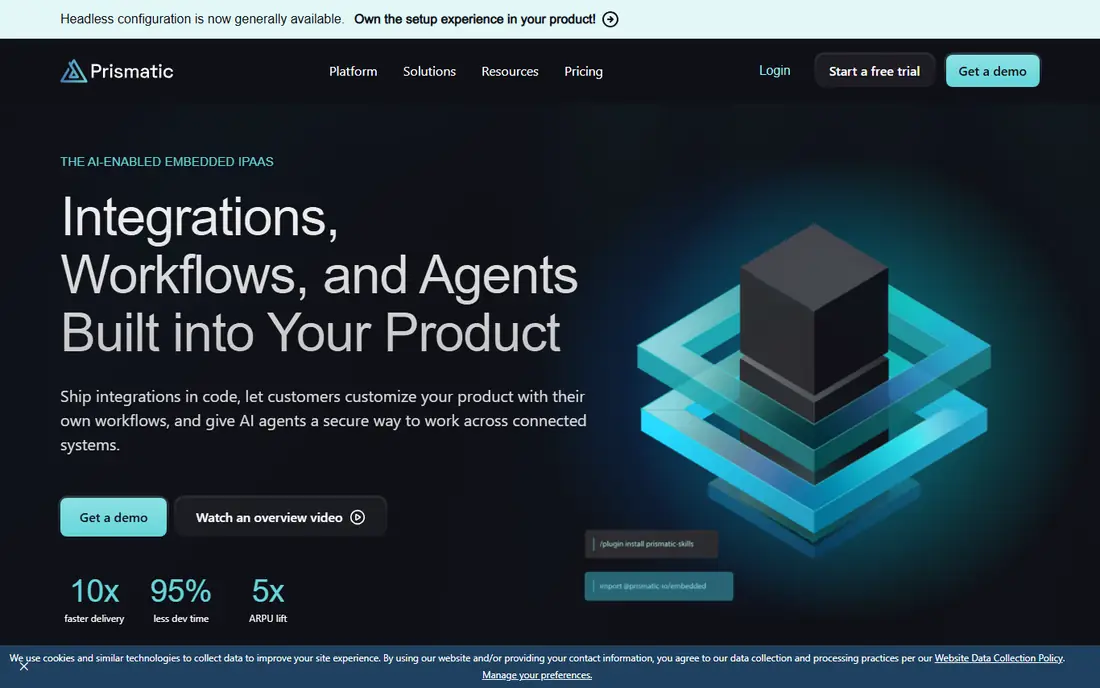
Prismatic is the best overall pick. Its homepage presents the AI-enabled embedded iPaaS for B2B software companies, with integrations, workflows, and agents built into your product, trusted by engineering teams from Fortune 500s to startups. Developers build in TypeScript with AI tools, ship one integration to each customer or a bespoke one per account, end users assemble multi-step workflows inside the product with an AI copilot, and the MCP flow server exposes integrations and workflows as agent-ready tools. The platform handles auth, logging, versioning, monitoring, security, compliance, and scaling, with open-source connectors that teams can read, fork, and extend.
Prismatic pricing is quote-based, published as per active instance, so it is listed as "See website". The trade-off is cost transparency: you need a sales conversation to price it. For B2B SaaS teams that want one platform for integrations, workflows, and agents, Prismatic is the best Paragon alternative here.
What we like- Code-native TypeScript plus low-code builder
- Embedded marketplace and workflow builder
- MCP flow server for AI agents
- Open-source connectors
- Enterprise security
Watch out for- Quote-based pricing
- Per-customer model needs scoping for large customer counts
Starting priceFree
Free planYes
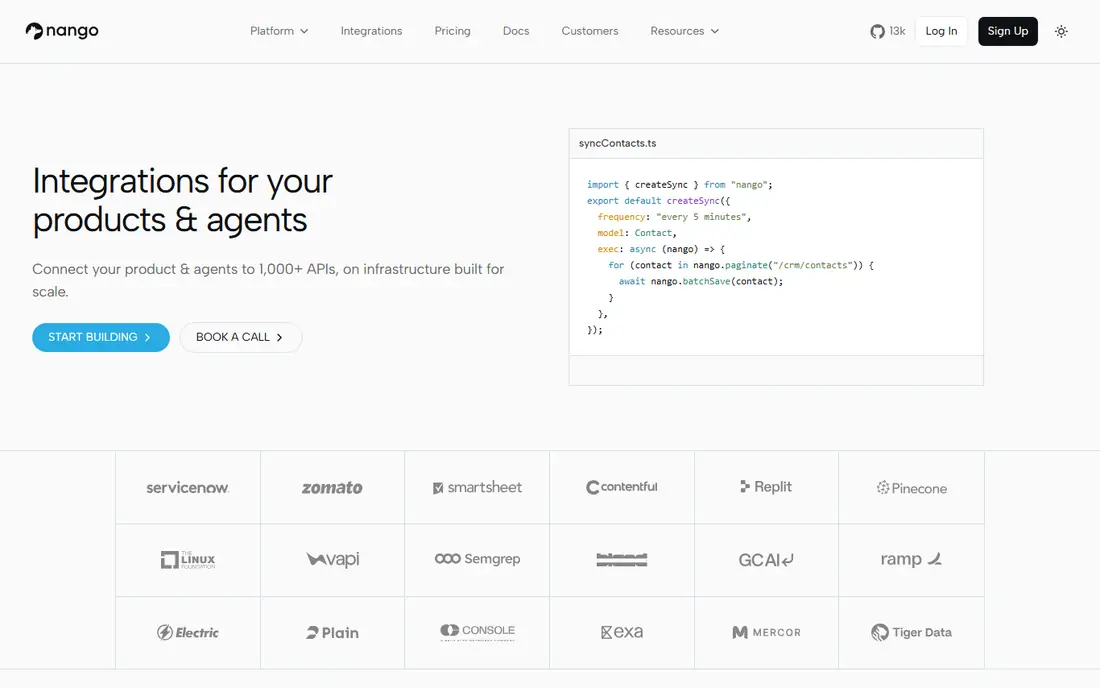
Nango is the best code-first pick. Its homepage presents integrations for products and agents, connecting to 1,000-plus APIs on infrastructure built for scale, with integration code generated from plain English descriptions, rapid coverage expansion, per-customer customization, MCP and tools for agents, webhooks and triggers, auth and credential handling including OAuth and token refresh, and managed incremental syncs. The production runtime offers integrations as code, API-first and agent-friendly design, local development with CI/CD and environments, tenant isolation, resumable executions, retry and rate-limit handling, and logs, metrics, and alerts.
Nango offers a free tier, with usage-based pricing covering connections, API requests, sync records, and function executions. The trade-off is audience: Nango is built for developers, so business teams cannot self-serve workflows the way they can in Prismatic or Tray. For developer-led teams and AI products, Nango is the best pick here.
What we like- 1,000-plus APIs with 10,000-plus templates
- AI-generated integration code
- Managed syncs and webhooks
- Automatic token refresh
- Self-hostable
- 100 percent open-source infrastructure
Watch out for- Code-first by design, so non-technical teams need developer help
- Usage-based pricing needs usage estimates
Starting priceSee website
Free planNo
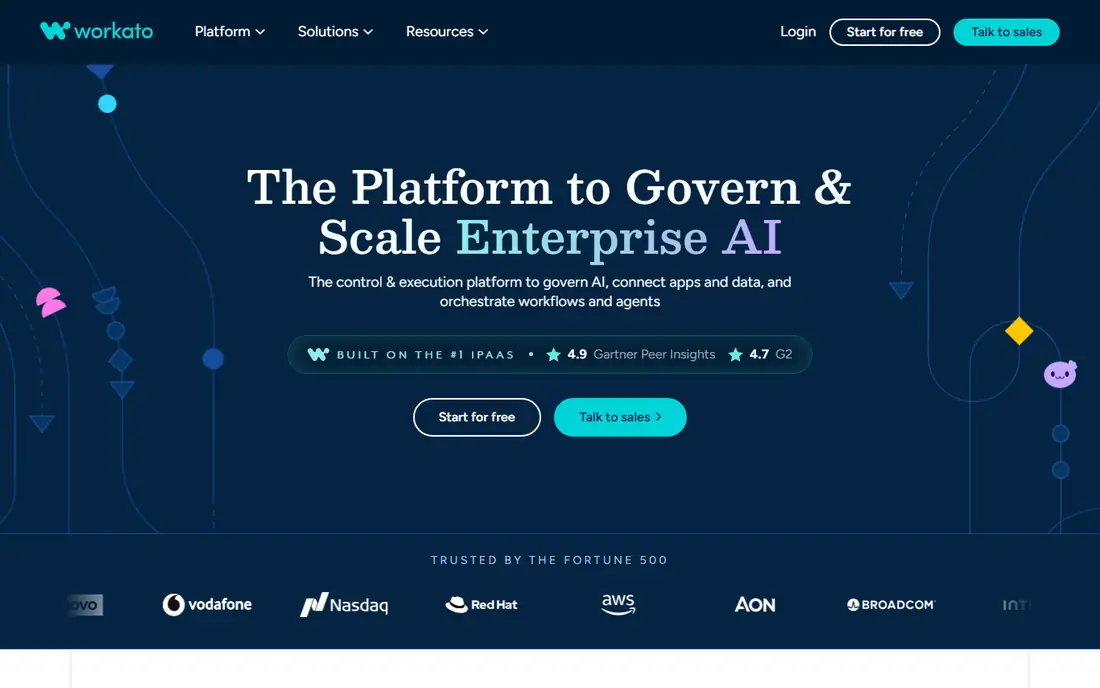
Workato Embedded is the enterprise pick. Workato's homepage presents one unified AI platform for building, running, and governing agents, models, MCPs, workflows, and integrations at scale, with connectivity to 17,000-plus apps, APIs, databases, files, and MCP servers, plus centralized governance over identity, policy, approvals, security, observability, and cost. Its embedded integrations product offers branded access and fully embedded options, with the largest published connector catalog among embedded tools at 1,200-plus connectors.
Workato pricing is quote-based, so it is listed as "See website". The trade-off is weight: Workato originated as an enterprise iPaaS, so its embedded version carries enterprise complexity and cost that small SaaS teams may not need. For enterprise SaaS with complex automation needs, Workato Embedded is the best pick here.
What we like- 1,200-plus connectors in embedded catalog
- Branded and fully embedded options
- Enterprise governance, approvals, and observability
- 17,000-plus apps across the platform
Watch out for- Enterprise pricing and complexity
- Heavier than purpose-built embedded tools for small SaaS
Starting priceSee website
Free planNo
Tray Embedded is the enterprise automation pick. Tray's homepage presents an orchestration platform for integration, automation, and agents, with integration, automation, AI agents, and MCP governance across 700-plus connectors, built as one platform with governance in the chassis. Tray Build offers visual low-code building, Tray Headless offers code-native building with Claude Code, Codex, and other coding assistants, and the MCP gateway governs every tool call with audit and observability.
Tray pricing is quote-based, so it is listed as "See website". The trade-off to note is token handling: published comparisons report that Tray sends an expiry-warning webhook 7 to 10 days before OAuth expiration and requires manual re-prompting, while Paragon and Nango refresh tokens automatically. For enterprise teams that value low-code automation with strong governance, Tray Embedded is the best pick here.
What we like- 700-plus connectors
- Visual low-code plus code-native building
- MCP gateway with governance
- SOC 1 and SOC 2 Type 2, HIPAA, and GDPR compliance
- Agent builder
Watch out for- Enterprise pricing
- Does not automatically refresh end-user OAuth tokens, unlike Paragon and Nango
Starting price$650/month
Free planNo
Merge is the best unified API pick. Its homepage presents the universal context engine for AI, connecting AI agents to company data, tools, and models, with a unified API and embeddable component that let teams add a new HRIS integration by checking a box, plus integration observability tooling that customers say would have taken 3 months to build. Merge covers HRIS, ATS, CRM, accounting, and other categories with normalized data models, so one integration serves every provider in the category.
Published comparisons list Merge at $650 a month for 10 linked accounts, with a free development tier. The trade-off is scope: Merge standardizes data schemas rather than offering deep custom workflow logic, so teams needing complex per-customer workflows should pair it with or choose an embedded iPaaS instead. For teams that need normalized data fast across many providers, Merge is the best pick here.
What we like- One normalized API per category
- HRIS, ATS, CRM, accounting, and more
- Embeddable Merge Link UI
- Integration observability
- SOC 2 Type II, ISO 27001, HIPAA, and GDPR
Watch out for- Unified API model, not full workflow automation
- Pricing per linked account scales with customer count
Starting price$1,595/month
Free planNo
Cyclr is the best published-price pick. Its homepage presents one platform for embedded integration, AI interoperability, and data governance, with a multi-tenanted native embedded iPaaS, embeddable tools and API for rich user experiences, repeatable template-based integration, and over 600 SaaS connectors plus universal connectivity tools. Cyclr also offers headless access through embedded experiences, APIs, MCP servers, and service-led workflows, with governed customer control over authentication, permissions, usage, and access.
Published comparisons list Cyclr from $1,595 a month on a native pay-as-you-go model. The trade-off is entry cost: Cyclr costs more to start than Nango or Merge, though its pricing is clearer than most enterprise tools. For budget-conscious teams that want published pricing and white-label consoles, Cyclr is the best pick here.
What we like- Multi-tenanted native embedded iPaaS
- 600-plus SaaS connectors
- White-labeled consoles
- MCP and AI interoperability
- Private cloud and self-hosted options
- SOC 2 Type II and GDPR
Watch out for- Higher entry price than Nango or Merge
- Visual builder feels dated next to Prismatic
Starting priceSee website
Free planNo
Pandium is the best code-first marketplace pick. Its homepage presents an embedded iPaaS for building and launching SaaS integrations fast, giving product leaders a first-class integration experience, engineers full code-level control while offloading auth, maintenance, and DevOps, and partnership leaders a scalable tech partnerships program. Pandium combines AI-generated code with solid infrastructure, works with existing repos and languages, and offers an embeddable marketplace so customers can discover, install, and manage integrations, plus analytics on which integrations customers install, use, and depend on.
Pandium pricing is a platform fee plus usage per customer and connection, quote-based, so it is listed as "See website". The trade-off is developer dependence: Pandium is built for engineering teams, not business users. For teams that want code control plus a customer-facing marketplace, Pandium is the best pick here.
What we like- Full code-level control in any language
- AI code generation
- Embeddable marketplace and setup UIs
- Integration analytics
- Git-based workflows
Watch out for- Platform fee plus usage pricing, quote-based
- Code-first model needs developer capacity
Starting priceSee website
Free planNo
Apideck is the accounting pick. Its homepage presents the unified API for accounting integrations, with one API for QuickBooks, Xero, NetSuite, Exact, and 55-plus accounting and ERP systems, covering accounts payable, accounts receivable, bank feeds, expense management, payroll accounting, and tax automation. Apideck normalizes inconsistent APIs into one structure while exposing raw downstream data, logs every request, response, and webhook centrally, and processes API calls in real time without storing your data.
Apideck offers a 30-day free trial with flexible pricing for all company sizes, listed as "See website" since homepage pricing was not shown. The trade-off is focus: Apideck covers accounting and ERP only, so it suits vertical SaaS and fintech products rather than general integration needs. For accounting integrations, Apideck is the best Paragon alternative here.
What we like- One unified API for 55-plus accounting and ERP systems
- Real-time API calls with no data storage
- Centralized logging
- Custom field mapping
- 30-day free trial
Watch out for- Accounting and ERP focus only
- Not a general embedded iPaaS
How we chose
We compared these tools on embedded experience, developer model, connector coverage, token and auth handling, AI and MCP support, and pricing transparency. We opened each vendor's homepage to confirm the product exists today and matches its description, and we used published comparison guides where homepage pricing was not shown. We did not claim hands-on testing. Paragon itself is published as usage-based per Connected User with 100-plus integrations and a white-labeled Connect Portal, so teams comparing on price should model per-customer costs, not just platform fees.
What to verify in a trial
Start by building one real integration for your most-requested system, since catalog size means little if your customers use niche tools. Next, test token refresh and failure handling, since expired OAuth tokens are the most common integration breakage. Finally, model pricing at your real customer count, since per-linked-account and per-instance pricing diverge fast as you scale.
Frequently asked questions
What is Paragon?
Paragon is an embedded integration platform for B2B SaaS, letting products offer native integrations inside their own app through a white-labeled Connect Portal, with workflow building, real-time actions, data sync, and MCP support for AI products. It prices by Connected User.
What is the difference between an embedded iPaaS and a unified API?
An embedded iPaaS (Prismatic, Cyclr, Pandium) lets you build custom workflows and marketplaces inside your product. A unified API (Merge, Apideck) gives one normalized API per category, so one integration covers every provider in that category, but with less custom workflow logic.
Which Paragon alternative is best for AI products?
Prismatic and Nango, both with MCP servers that expose integrations as agent-ready tools. Nango is the code-first choice, while Prismatic adds low-code workflow building for customers.
Which is cheapest to start?
Nango, with a free tier and usage-based pricing, is cheapest to start. Merge lists $650 a month for 10 linked accounts, while Cyclr starts at $1,595 a month with published pricing.
Do these tools refresh OAuth tokens automatically?
Paragon and Nango do. Published comparisons report that Tray Embedded does not, instead sending an expiry warning 7 to 10 days ahead. Confirm token behavior for any tool before committing.
Can I self-host an embedded integration platform?
Nango is self-hostable and 100 percent open-source infrastructure. Cyclr offers private cloud and self-hosted deployment. Most others are cloud-only.
Sources we checked (8)
- https://prismatic.io
- https://www.nango.dev
- https://www.workato.com
- https://www.tray.ai
- https://www.merge.dev
- https://www.cyclr.com
- https://www.pandium.com
- https://www.apideck.com
Is your product missing or out of date?
We review this list regularly. Vendors can request a listing, send updated pricing or ask about featured placement.

Shihab Mia · Founder, Rankite
Shihab has 5+ years in B2B and SaaS SEO. He writes Rankite's software buying guides from pricing pages, documentation and public user reviews. More about Shihab.