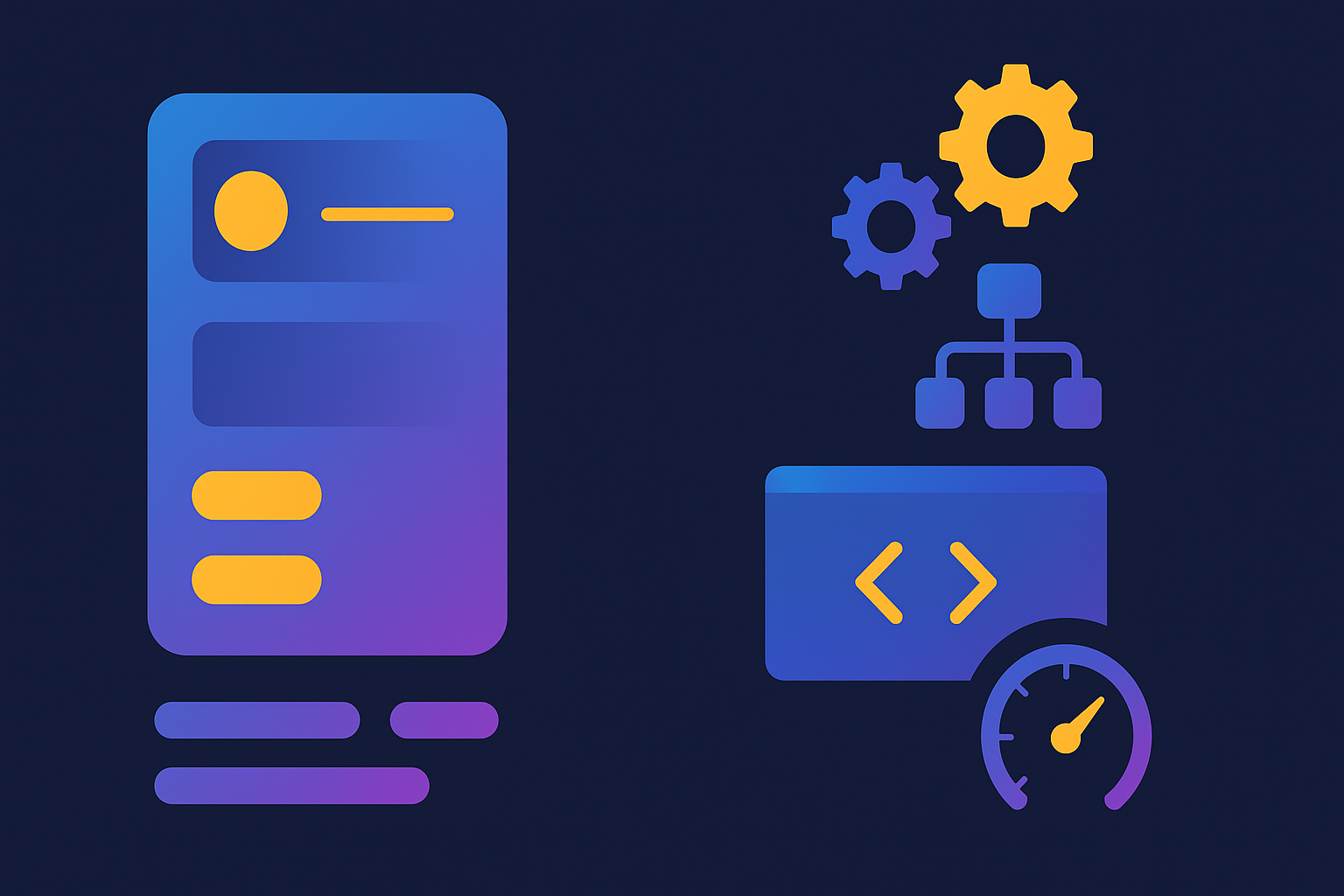
On-page SEO vs technical SEO comes down to one split: on-page SEO optimizes what the reader sees, and technical SEO optimizes what the search engine has to process first. On-page covers content, keywords, titles, and internal links. Technical covers crawling, indexing, speed, and structured data. You need both, because content only ranks on a site engines can actually reach and read.
On-page SEO optimizes the content and visible elements of a page, including keywords, titles, headings, images, and internal links, so the page matches what a searcher wants. Technical SEO optimizes the site's backend, including crawlability, indexing, page speed, HTTPS, and structured data, so search engines can reach and understand that content in the first place. On-page is what a reader sees. Technical is the plumbing they never notice.
The simplest way to hold the two apart is the question each one answers. On-page SEO asks, "does this page satisfy the query?" Technical SEO asks, "can Google crawl, render, and index this page at all?" A page can fail either test independently, which is why treating them as one job is where most sites go wrong.
On-page SEO is the work you do inside a page to make it the clearest, most relevant answer to a search. It is the layer readers and search engines both experience directly, and it is where most day-to-day SEO effort lives. If you want the page-level content angle in depth, our guide to what content optimization is covers it further.
The core on-page elements are:
On-page SEO is usually owned by content strategists, writers, and marketers, since most of it is editorial judgment rather than code. That accessibility is exactly why it tends to be where teams find the fastest wins.
Technical SEO is the work that makes your site easy for search engines to crawl, render, index, and trust. It rarely changes what a visitor sees, but it decides whether your content is eligible to rank at all. Get it wrong and even brilliant pages stay invisible.
The core technical elements are:
Google's Core Web Vitals give technical SEO concrete pass marks. A page is considered good when Largest Contentful Paint is under 2.5 seconds, Interaction to Next Paint is under 200 milliseconds, and Cumulative Layout Shift is under 0.1.
Technical SEO is usually owned by developers or a dedicated technical SEO specialist, because much of it touches code, hosting, and site architecture. Some of it, like submitting a sitemap or checking indexing in Search Console, needs no code at all. The highest-stakes technical project is moving a site, which needs its own SEO migration strategy so you do not lose rankings in the switch.
Here is the two side by side across the dimensions that actually decide how you plan the work: what each covers, the example tasks, the tools, who owns it, and when to prioritize it.
| Dimension | On-Page SEO | Technical SEO |
|---|---|---|
| What it covers | Content and visible page elements | Site infrastructure and backend |
| Main question | Does this page satisfy the search? | Can engines crawl and index it? |
| Example tasks | Keyword targeting, title and meta tags, headings, internal links, image alt text | Sitemaps, robots.txt, fixing crawl and index errors, Core Web Vitals, HTTPS, schema |
| Tools | Google Search Console, Ahrefs or Semrush, a readability checker | Search Console, PageSpeed Insights, Screaming Frog, Rich Results Test |
| Who owns it | Content strategists, writers, marketers | Developers, technical SEO specialists |
| Visible to users? | Yes, directly shapes the reading experience | Mostly invisible, felt as speed and reliability |
| When to prioritize | Ongoing, once the site is crawlable and indexable | First, and whenever crawling, speed, or indexing breaks |
Notice that structured data and page speed sit close to the border. Schema is technical to implement but exists to make on-page content easier to understand, which is a useful reminder that the two disciplines serve the same goal from opposite ends.
Fix the technical basics first, because a page that cannot be crawled or indexed will never rank regardless of how good the content is. Once crawling, indexing, HTTPS, and mobile rendering work reliably, most ongoing effort should shift to on-page SEO, since content relevance and search intent decide which of the crawlable pages actually wins the query. In practice this is a sequence, not a rivalry: technical clears the runway, on-page flies the plane.
The reason the order matters is scale. Ahrefs analyzed roughly one billion pages and found that about 96% get no organic search traffic from Google at all. Some of that is thin content, an on-page problem, and some is pages that are slow, duplicated, or never indexed, a technical problem. Winning means clearing both hurdles, not picking one.
On-page and technical SEO are two halves of the same page. Technical SEO makes the page reachable, fast, and indexable. On-page SEO makes it relevant and satisfying once it can be reached. When both are strong, they compound: a fast, crawlable site lets your best content get discovered quickly, and strong content gives that technical foundation something worth ranking. When one is weak, it caps the other.
This is why the biggest gains often come from doing both in step rather than treating them as separate projects. When we worked with Zluri, coordinating on-page optimization with a clean technical foundation grew their organic traffic by 45%. The content changes only paid off because the pages underneath them were crawlable, fast, and properly indexed. If you are pressure-testing your own foundation, our SEO audit checklist walks through both layers in order.
Off-page SEO is the third pillar, and it is worth naming so the picture is complete. On-page and technical SEO both happen on your own site. Off-page SEO covers signals earned elsewhere, mainly backlinks from other sites and brand mentions across the web, that tell search engines your content is trusted and authoritative. You control on-page and technical directly; off-page you earn.
The three fit together cleanly. Technical SEO gives search engines access, on-page SEO earns relevance for the query, and off-page SEO builds the authority that helps you outrank equally relevant competitors. A page that nails all three is hard to beat, which is the entire point of an integrated strategy rather than three disconnected checklists.
You do not need a bloated stack. A focused set covers the bulk of both jobs.
Tools point you at the work, but the judgment about intent, priorities, and trade-offs stays human. Knowing whether a stalled page needs a technical fix or a content rewrite is exactly the kind of call that separates results from busywork.
What is the difference between on-page SEO and technical SEO? On-page SEO optimizes the content and visible elements of a page, including keywords, titles, headings, and internal links, so it matches what a searcher wants. Technical SEO optimizes the site's backend, including crawling, indexing, speed, and structured data, so search engines can reach and understand that content in the first place.
Should I do on-page or technical SEO first? Fix the technical basics first, because a page that cannot be crawled or indexed will never rank no matter how good the content is. Once crawling, indexing, HTTPS, and mobile rendering work, most ongoing effort shifts to on-page SEO, since content and intent decide which crawlable page actually wins the query.
Can you do on-page SEO without technical SEO? Only up to a point. You can write excellent, well-structured content, but if the page is blocked in robots.txt, loads slowly, or is not indexable, Google may never rank it. On-page SEO delivers its full value only on a technically sound foundation.
Is on-page SEO part of technical SEO? No, they are separate disciplines under the same umbrella. On-page SEO covers content and visible page elements. Technical SEO covers site infrastructure. Some elements like structured data and page speed sit close to the line, but the two are usually managed as distinct workstreams.
Are Core Web Vitals on-page or technical SEO? Core Web Vitals are technical SEO. They measure loading, interactivity, and visual stability, which depend on code, hosting, and site architecture rather than content. Google's thresholds are LCP under 2.5 seconds, INP under 200 milliseconds, and CLS under 0.1.
Do I need a developer for technical SEO? Often, but not always. Basics like submitting a sitemap, checking indexing in Search Console, or editing robots.txt can be done without code. Deeper work such as improving Core Web Vitals, fixing render-blocking scripts, or resolving crawl issues usually needs a developer or a technical SEO specialist.
Which has a bigger impact on rankings, on-page or technical SEO? It depends on your starting point. If the site has technical problems that block crawling or indexing, technical SEO delivers the bigger gains. If the technical foundation is already sound, on-page SEO usually moves rankings more, because content relevance and search intent decide which eligible page ranks first.
Where does off-page SEO fit in? Off-page SEO is the third pillar. On-page and technical SEO happen on your own site, while off-page SEO covers signals earned elsewhere, mainly backlinks and brand mentions. All three work together: technical enables access, on-page earns relevance, and off-page builds authority.
How long does each take to show results? Technical fixes that unblock indexing or speed can show up within days to a few weeks. On-page changes to an existing page that nearly ranks can move in weeks, while building new content in a competitive topic can take several months. Track rankings and clicks in Search Console to confirm the direction.
Can I handle on-page and technical SEO myself or do I need an agency? You can handle a lot alone with Search Console, an SEO tool, and consistency. An agency helps when technical issues need developer time, when topics are competitive, or when you want on-page and technical work coordinated so they compound instead of fighting each other.
Run one page through both lenses. Confirm it is crawlable, fast, and indexed, then check that the content matches the query better than anything ranking above it. If a page is stalling and you cannot tell whether the problem is technical or on-page, that is the exact diagnosis we run first. Request a free SEO audit from Rankite and we will show you which layer is holding your rankings back.
Get a free, no-obligation SEO audit and a 30-minute strategy session. We'll show you exactly where the growth is hiding.
Fill out the form and we'll get back to you within one business day. Prefer email? Write to us directly at contact@rankite.com.