How we make this list: we compare pricing pages, product documentation and public user reviews. Ratings come from G2, Capterra or Trustpilot, with the date we checked them.
The short answer
HubSpot is the better CRM for teams that want the easiest setup and the most usable free plan, because its free CRM covers up to 2 users and Sales Hub Starter costs 7 dollars per seat per month billed annually for new customers. Zoho CRM is the better CRM for teams that want the most function per dollar, because it is free for up to 3 users and Professional costs 23 dollars per user per month billed annually, against 90 dollars for HubSpot Professional.
Key takeaways
- HubSpot CRM is free for up to 2 users, then Starter at 7 dollars per seat per month billed annually for new customers, with a 20 dollar list price, and Professional at 90 dollars plus a 1,500 dollar one time onboarding fee.
- Zoho CRM is free for up to 3 users, then Standard at 14 dollars, Professional at 23 dollars, Enterprise at 40 dollars and Ultimate at 52 dollars per user per month billed annually.
- HubSpot Professional at 90 dollars a seat costs nearly four times Zoho Professional at 23 dollars, which is 670 dollars a month for a 10 person team.
- HubSpot is easier to use, while Zoho gives more features per dollar, including AI agents and Blueprint on Professional.
HubSpot vs Zoho CRM at a glance
|
HubSpot Sales Hub |
Zoho CRM |
| Starting price |
Free for up to 2 users; Starter 7 dollars per seat per month billed annually for new customers |
Free for up to 3 users; Standard 14 dollars per user per month, annual billing |
| Mid tier |
Professional 90 dollars per seat per month, annual billing, plus 1,500 dollar onboarding |
Professional 23 dollars per user per month, annual billing |
| Top tier |
Enterprise 150 dollars per seat per month, plus 3,500 dollar onboarding |
Enterprise 40 dollars, Ultimate 52 dollars per user per month, annual billing |
| Free plan |
Yes, up to 2 users |
Yes, up to 3 users |
| Best for |
Teams that want the easiest CRM |
Teams that want the most value |
| AI |
HubSpot Credits, 500 on Starter, 3,000 on Professional |
Zia AI agents, included from Professional |
Which CRM is cheaper?
Zoho CRM is cheaper at every tier, and the gap grows as you scale. HubSpot free plan covers up to 2 users with contact management, deal tracking and meeting links. Starter at 7 dollars per seat per month billed annually for eligible new customers, 20 dollars list, covers up to 15 pipelines and 50 workflows. Professional at 90 dollars per seat per month billed annually, or 100 dollars billed monthly, adds sequences, forecasting and playbooks, plus a mandatory 1,500 dollar one time onboarding fee.
Zoho free edition covers up to 3 users. Standard at 14 dollars per user per month billed annually, or 20 dollars billed monthly, adds email integration, mass email, built in calling, multiple pipelines and forecasting. Professional at 23 dollars, or 35 dollars monthly, adds Zia AI agents, Blueprint process management, CPQ, inventory and portals. Enterprise at 40 dollars, or 50 dollars monthly, adds territory management, sandboxes and field level encryption. Ultimate at 52 dollars covers large deployments. Zoho adds local taxes on top, and prices are geo rendered, so the figures you see outside the US may differ.
The gap is stark at team scale. Ten users cost 900 dollars a month on HubSpot Professional plus 1,500 dollars once, against 230 dollars a month on Zoho Professional, a difference of 670 dollars a month, or 8,040 dollars a year.
Which CRM is easier to use?
HubSpot is easier to use, and it is the clearest win in this comparison. The interface is clean, the setup wizard walks a new team through pipelines, deal stages and email connection in a day, and the help centre and free academy cover most questions without a consultant. Sales reps adopt it faster, because the daily workflow of logging calls, sending email and moving deals is visible on one screen.
Zoho CRM is functional rather than polished. The setup wizard covers pipelines, custom fields and email connection in a day, but the menus run deep and the terminology feels dated next to HubSpot. Support quality varies by plan, with faster help on higher tiers.
How do sales features compare?
Both CRMs cover the core sales job: contacts, companies, deals, pipelines, tasks, email and calendar sync. HubSpot sequences, meeting scheduling, email templates and calling are built in and easy to find, and its marketing, service and content hubs share one contact record, so a team that buys more than Sales Hub gets a single system.
Zoho answers with more features per dollar. Professional at 23 dollars adds inventory management and CPQ, features HubSpot reserves for higher tiers or add ons. Enterprise at 40 dollars adds territory management and sandboxes, where HubSpot charges 150 dollars for the same class of feature. Zoho also brings its own app ecosystem. More than 45 Zoho apps, covering books, desk, campaigns, projects and people, share one login and one billing account.
How do automation and AI compare?
HubSpot automation is simpler and faster to build. Workflows cover lead rotation, deal stage changes, email sends and task creation with a visual builder most admins learn in an afternoon. HubSpot Credits fund AI agents and sit at 500 credits on Starter, 3,000 on Professional and 5,000 on Enterprise.
Zoho automation is cheaper and, on Professional, deeper in places. Blueprint enforces the steps of a sales process, so a deal cannot skip a stage without approval. Zia AI agents ship on Professional at 23 dollars a seat and cover lead scoring, prediction and a conversational assistant.
Which CRM should you pick?
Pick HubSpot if your team has fewer than 50 seats, no dedicated CRM admin, and a sales process that fits in 15 pipelines. Pick Zoho CRM if your budget is tight, your team is comfortable with a busier interface, and you want AI agents and process enforcement at 23 dollars a seat.
Quick comparison
| Tool | Best for | Starting price | Free plan |
|---|
 HubSpot Sales Hub | Small and mid size teams that want to start fast without a consultant | Free for up to 2 users; Starter 7 dollars per seat per month billed annually for new customers, 20 dollars list; Professional 90 dollars | Yes, up to 2 users |
 Zoho CRM | Budget conscious teams that want a full CRM for under 25 dollars a seat | Free for up to 3 users; Standard 14 dollars, Professional 23 dollars, Enterprise 40 dollars per user per month billed annually | Yes, up to 3 users |
 Salesforce Sales Cloud | Large and complex sales organisations that need deep customisation | Free Suite for up to 2 users; Starter Suite 25 dollars per user per month, Pro Suite 100 dollars, Enterprise 165 dollars | Yes, Free Suite for up to 2 users with limits |
 Pipedrive | Small sales teams that want a visual pipeline and nothing else in the way | Essential 14 dollars, Advanced 29 dollars, Professional 49 dollars per user per month billed annually | No, 14 day trial only |
 Freshsales | Small teams that want the lowest paid entry price in this list | Growth 9 dollars, Pro 39 dollars, Enterprise 59 dollars per user per month billed annually | No permanent free plan on the main pricing page, 21 day trial; some pages list a free tier for up to 3 users |
 monday CRM | Visual teams that already work in boards and want CRM on the same platform | Basic 12 dollars, Standard 17 dollars, Pro 28 dollars per seat per month billed annually, minimum 3 seats | No, 14 day trial only |
 Close | Outbound teams that sell by phone and email and want calling built in | Solo 9 dollars per user per month billed annually, 19 dollars billed monthly; Essentials 35 dollars discounted, Growth 109 dollars, Scale 149 dollars | No, 14 day trial only |
 Copper | Teams that live in Gmail and Google Workspace and want the CRM inside their inbox | Starter 9 dollars, Basic 23 dollars, Professional 59 dollars, Business 99 dollars per user per month billed annually | No, 14 day trial only |
Is your product missing or out of date?
We review this list regularly. Vendors can request a listing, send updated pricing or ask about featured placement.
The 8 best CRMs in this comparison
#1HubSpot Sales Hub
Best for: Small and mid size teams that want to start fast without a consultant4.4/5 on
G2 (14,364 reviews, checked Oct 2026)
Visit hubspot.com
Starting priceFree for up to 2 users; Starter 7 dollars per seat per month billed annually for new customers, 20 dollars list; Professional 90 dollars
Free planYes, up to 2 users
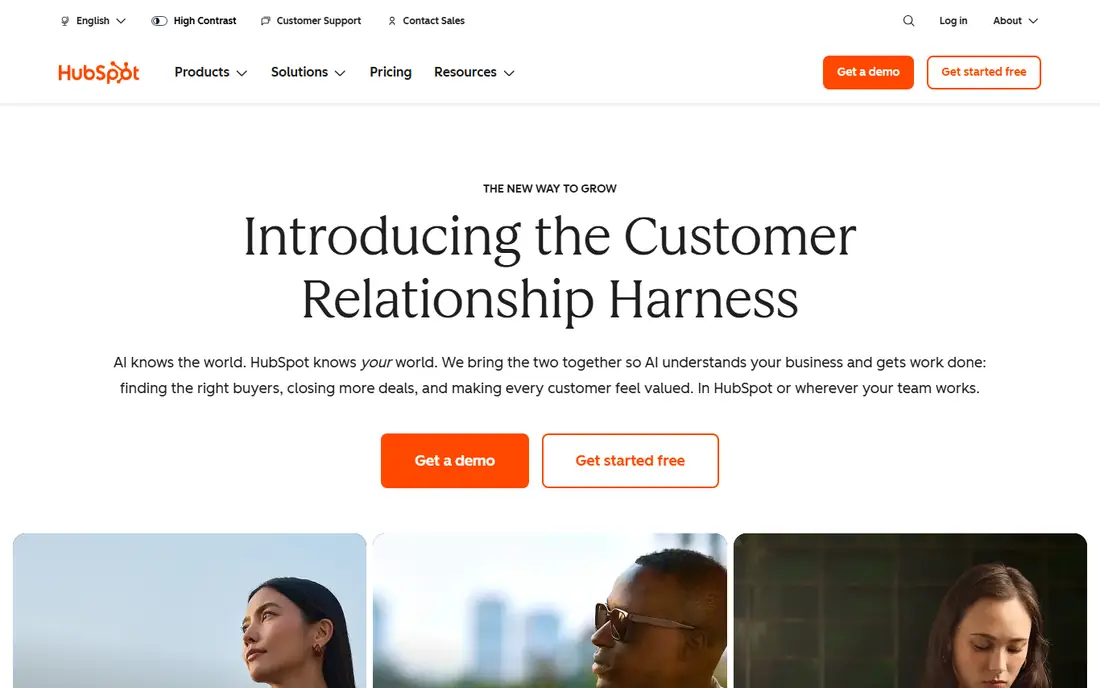
HubSpot is the fastest route from zero to a working CRM. The free plan covers up to 2 users with contacts, deals and meeting links, and Starter adds pipelines and workflows at 7 dollars per seat per month billed annually for eligible new customers. Professional at 90 dollars per seat per month billed annually adds sequences, forecasting and playbooks, plus the mandatory 1,500 dollar onboarding fee. Enterprise at 150 dollars per seat per month adds up to 1,000 workflows. The seat model is the trap to watch. A team that grows from 5 to 25 seats on Professional goes from 450 dollars a month to 2,250 dollars a month plus onboarding.
What we like- Easiest setup in this list, free plan is genuinely usable, sequences and meeting links built in, marketing and service hubs share one contact record
Watch out for- Mandatory 1,500 dollar onboarding fee on Professional and 3,500 dollars on Enterprise, Starter list price is 20 dollars and the 7 dollar rate is a new customer offer, per seat costs climb fast above Starter
#2Zoho CRM
Best for: Budget conscious teams that want a full CRM for under 25 dollars a seat4.1/5 on
G2 (2,952 reviews, checked Oct 2026)
Visit zoho.com
Starting priceFree for up to 3 users; Standard 14 dollars, Professional 23 dollars, Enterprise 40 dollars per user per month billed annually
Free planYes, up to 3 users
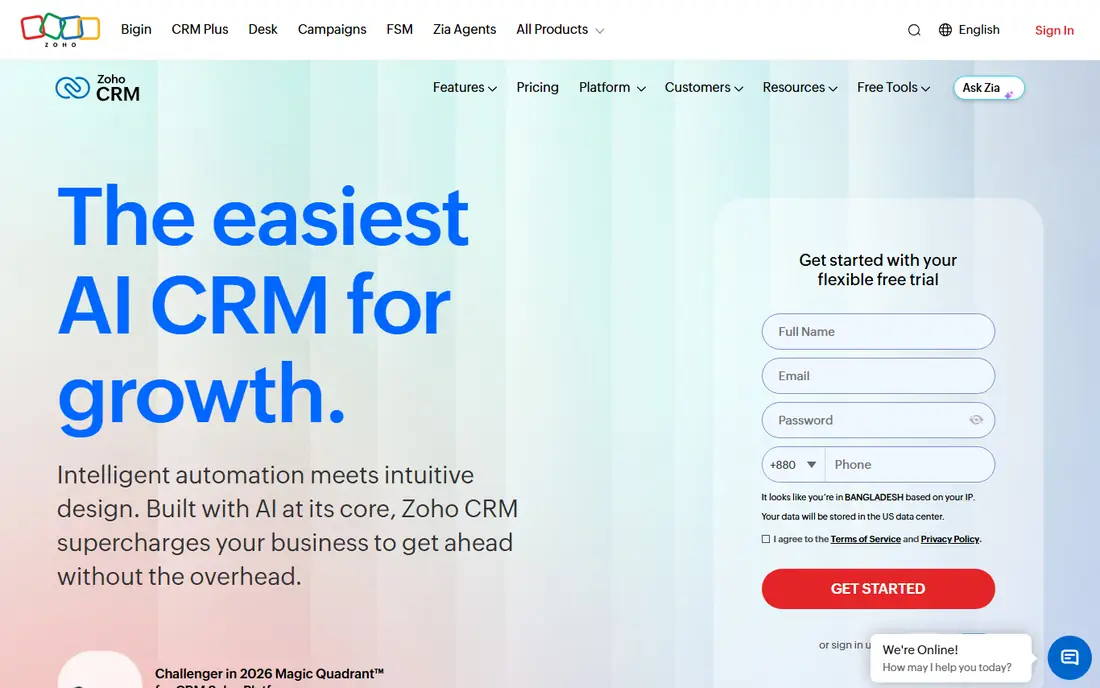
Zoho CRM is the value pick in this comparison. Free covers up to 3 users, Standard at 14 dollars per user per month billed annually adds email integration, multiple pipelines and forecasting, Professional at 23 dollars adds Zia AI agents, Blueprint, CPQ and inventory, and Enterprise at 40 dollars adds territory management, sandboxes and field level encryption. Ultimate at 52 dollars covers large deployments. Zoho prices are geo rendered, so the figures you see outside the US may differ, and local taxes are added on top.
What we like- Cheapest full CRM here, free plan covers 3 users, Professional adds AI agents and Blueprint process management, wide Zoho app ecosystem
Watch out for- Interface feels dated next to HubSpot, advanced features need the higher tiers, support quality varies by plan
#3Salesforce Sales Cloud
Best for: Large and complex sales organisations that need deep customisation4.4/5 on
G2 (27,571 reviews, checked Oct 2026)
Visit salesforce.com
Starting priceFree Suite for up to 2 users; Starter Suite 25 dollars per user per month, Pro Suite 100 dollars, Enterprise 165 dollars
Free planYes, Free Suite for up to 2 users with limits
Salesforce is the standard for enterprise CRM because it can model almost any sales process. Starter Suite at 25 dollars per user per month covers the basics, Pro Suite at 100 dollars adds forecasting and advanced automation, and Enterprise at 165 dollars adds territory management and deeper customisation. In September 2026 Salesforce replaced Enterprise, Unlimited and Agentforce 1 editions with new Core, Advanced and Max editions for new customers only, so new buyers should confirm which edition names appear on the live pricing page.
What we like- Deepest customisation and reporting in the category, huge AppExchange marketplace, Flow automation handles complex processes, scales to thousands of seats
Watch out for- Needs an admin or partner to set up, Enterprise price is listed as 165 dollars on some pages and 175 dollars on others, only Starter can be billed month to month, implementation costs add up
#4Pipedrive
Best for: Small sales teams that want a visual pipeline and nothing else in the way4.3/5 on
G2 (5,034 reviews, checked Oct 2026)
Visit pipedrive.com
Starting priceEssential 14 dollars, Advanced 29 dollars, Professional 49 dollars per user per month billed annually
Free planNo, 14 day trial only
Pipedrive suits teams that live in the pipeline. Essential at 14 dollars per user per month billed annually covers pipeline and contact management. Advanced at 29 dollars adds full email sync and workflow automation. Professional at 49 dollars adds forecasting, revenue reporting and group email. Power at 64 dollars and Enterprise at 99 dollars cover larger teams. Some current pages list Advanced at 34 dollars and Professional at 59 dollars, which conflicts with the 29 and 49 dollar figures, so confirm the live price before you budget.
What we like- Cleanest pipeline view in the category, no mandatory onboarding fees, no contact limits on any tier, easy for reps to adopt
Watch out for- No permanent free plan, useful add ons such as LeadBooster and Smart Docs cost extra, some pages list Advanced at 34 dollars and Professional at 59 dollars, so confirm the live price
#5Freshsales
Best for: Small teams that want the lowest paid entry price in this list4.5/5 on
G2 (1,237 reviews, checked Oct 2026)
Visit freshworks.com
Starting priceGrowth 9 dollars, Pro 39 dollars, Enterprise 59 dollars per user per month billed annually
Free planNo permanent free plan on the main pricing page, 21 day trial; some pages list a free tier for up to 3 users
Freshsales is the cheapest way into a real CRM. Growth at 9 dollars per user per month billed annually covers contact lifecycle stages, built in chat, email and phone, basic workflows and a product catalogue. Pro at 39 dollars adds Freddy AI contact scoring, sales sequences, deal insights and multiple pipelines. Enterprise at 59 dollars adds forecasting insights, field level permissions, sandbox and audit logs. The free plan situation is unclear, because the main pricing page shows no free tier, only a 21 day trial.
What we like- Cheapest paid tier here at 9 dollars, built in phone, email and chat, Freddy AI scoring on Pro, 21 day trial with full access
Watch out for- No free plan on the main pricing page, sequences need Pro at 39 dollars, smaller marketplace than HubSpot or Salesforce
#6monday CRM
Best for: Visual teams that already work in boards and want CRM on the same platform4.5/5 on
G2 (1,810 reviews, checked Oct 2026)
Visit monday.com
Starting priceBasic 12 dollars, Standard 17 dollars, Pro 28 dollars per seat per month billed annually, minimum 3 seats
Free planNo, 14 day trial only
monday CRM is part of the monday work platform, and it shows in the interface. Basic at 12 dollars per seat per month billed annually covers unlimited pipelines and contacts with 1,000 active contacts and deals. Standard at 17 dollars adds two way Gmail and Outlook sync, an AI email generator and 250 automations a month. Pro at 28 dollars adds forecasting, email sequences, quotes and invoices, mass email and 25,000 automations a month. Ultimate is custom priced. Every paid tier needs at least 3 seats.
What we like- Board based interface teams learn fast, automations scale with the plan, quotes and invoices on Pro, unlimited contacts and deals on Pro
Watch out for- 3 seat minimum on every paid tier, no free plan, email sequences need Pro at 28 dollars, Ultimate is custom priced
#7Close
Best for: Outbound teams that sell by phone and email and want calling built in4.7/5 on
G2 (2,069 reviews, checked Oct 2026)
Visit close.com
Starting priceSolo 9 dollars per user per month billed annually, 19 dollars billed monthly; Essentials 35 dollars discounted, Growth 109 dollars, Scale 149 dollars
Free planNo, 14 day trial only
Close is built for teams whose bottleneck is outbound volume. Solo at 9 dollars per user per month billed annually, or 19 dollars billed monthly, covers 1 user with the core CRM, an AI assistant and up to 10,000 leads. Essentials at 49 dollars list, often discounted to 35 dollars, removes the single user limit and adds team collaboration with built in calling and SMS. Growth at 109 dollars and Scale at 149 dollars add automated workflows and a predictive dialer.
What we like- Built in calling, SMS and email in one screen, Solo plan is cheap for a single rep, AI assistant Chloe included, strong for high volume outbound
Watch out for- No free plan, calling and SMS usage is billed separately from the seat price, Solo is limited to 1 user and 10,000 leads, Essentials at 49 dollars list is the real team starting point
#8Copper
Best for: Teams that live in Gmail and Google Workspace and want the CRM inside their inbox4.5/5 on
G2 (1,158 reviews, checked Oct 2026)
Visit copper.com
Starting priceStarter 9 dollars, Basic 23 dollars, Professional 59 dollars, Business 99 dollars per user per month billed annually
Free planNo, 14 day trial only
Copper is the CRM for teams that live in Gmail. It captures email and calendar activity automatically, shows contact and deal details in a Gmail sidebar, and needs no separate email sync to configure. Starter at 9 dollars per user per month billed annually covers basic contacts with a 1,000 contact cap, Basic at 23 dollars adds custom pipelines and 2,500 contacts, Professional at 59 dollars adds workflow automation and 15,000 contacts, and Business at 99 dollars adds unlimited contacts and premium support. One 2026 directory lists only three tiers without Starter, so Starter may have been withdrawn.
What we like- Native Google Workspace integration, activity captured from Gmail automatically, simple setup for Google teams, no separate email sync to configure
Watch out for- Only works with Google Workspace, not Outlook or Microsoft 365, no permanent free plan, Starter may have been withdrawn, so confirm the live plans
Frequently asked questions
Is HubSpot really free?
HubSpot CRM is free for up to 2 users, with contact management, deal tracking, meeting links and basic reporting, and no credit card is required. The free plan caps at 2 users, 1,000 contacts and 2,000 marketing email sends a month.
Is Zoho CRM really free?
Zoho CRM free edition covers up to 3 users with contact and lead management, tasks and basic reporting, and no credit card is required. Paid tiers start at Standard, 14 dollars per user per month billed annually.
Can I migrate from HubSpot to Zoho CRM?
Yes. Zoho offers a migration wizard and import tools for contacts, companies, deals and activities, and most teams complete the move in days rather than weeks. The hard part is rebuilding workflows, sequences and reports, because HubSpot workflows and Zoho Blueprint do not map one to one. Budget a week for a simple migration and a month for a heavily customised HubSpot setup.
Does Zoho CRM integrate with Gmail and Outlook?
Yes. Zoho CRM integrates with both Gmail and Outlook for email sync, calendar and contacts, and it works with Google Workspace and Microsoft 365. HubSpot also integrates with both.
Which CRM has better reporting, HubSpot or Zoho?
HubSpot reporting is easier to build and covers the standard sales reports most teams need, such as pipeline, forecast and rep activity, without an admin. Zoho reporting covers the same standard reports, and Enterprise adds custom dashboards and anomaly detection. Neither matches Salesforce for complex custom reporting, but for most teams under 50 seats, both are enough.
How we picked
We compared HubSpot and Zoho CRM on price, ease of use, sales features, automation and integrations, using list prices checked on 17 November 2026. HubSpot Starter list price is 20 dollars per seat per month, with a 7 dollar new customer rate on annual billing. Last verified 17 November 2026.
Sources we checked (8)
- https://www.hubspot.com
- https://www.zoho.com/crm
- https://www.salesforce.com
- https://www.pipedrive.com
- https://www.freshworks.com/crm
- https://monday.com/crm
- https://close.com
- https://www.copper.com
Is your product missing or out of date?
We review this list regularly. Vendors can request a listing, send updated pricing or ask about featured placement.

Shihab Mia · Founder, Rankite
Shihab has 5+ years in B2B and SaaS SEO. He writes Rankite's software buying guides from pricing pages, documentation and public user reviews. More about Shihab.