How we make this list: we compare pricing pages, product documentation and public user reviews. Ratings come from G2, Capterra or Trustpilot, with the date we checked them.
Flink alternatives at a glance
Apache Spark Structured Streaming is the best Flink alternative for teams that already run Spark, because it adds streaming to a batch platform they know. Kafka Streams and ksqlDB suit teams that live on Kafka, while Dataflow and Stream Analytics suit teams that want a managed service. RisingWave fits SQL-first teams that also need to serve query results.
Key takeaways
- Flink is the strongest option for true real-time processing, so most alternatives trade latency or state handling for simplicity.
- Spark Structured Streaming is free open source and suits mixed batch plus stream workloads with latency in the low seconds.
- Kafka Streams and ksqlDB run inside the Kafka ecosystem, which removes a separate processing cluster for Kafka teams.
- Dataflow, Kinesis Data Analytics and Stream Analytics are pay-per-use managed services, so costs rise with volume and are hard to forecast.
- RisingWave and ksqlDB are streaming databases, so they serve query results directly, while Flink needs a separate store for serving.
Flink alternatives compared
| Tool | Best for | Starting price | Free plan |
| Apache Spark Structured Streaming | Mixed batch plus stream | Free open source | Yes, open source |
| Kafka Streams | Kafka-native processing | Free open source | Yes, open source |
| ksqlDB | SQL on Kafka topics | Usage-based via Confluent | Free trial |
| Apache Beam | Portable pipelines | Free open source | Yes, open source |
| Google Cloud Dataflow | Managed Beam runner | Usage-based per vCPU-hour | Free trial credits |
| Amazon Kinesis Data Analytics | Serverless streaming in AWS | Usage-based per KPU-hour | Free tier |
| Azure Stream Analytics | SQL-based processing in Azure | Per streaming unit | Free trial |
| RisingWave | SQL streaming database | Free open source; Cloud from $0.14 per hour | Free self-hosted |
Why do teams look for a Flink alternative?
Apache Flink is the strongest option for true stream processing, with sub-second latency, event-time semantics and mature state handling. Teams leave for practical reasons. Running Flink in production is operationally heavy: a self-managed cluster needs staff who understand checkpointing, state backends and scaling, and the talent pool is thin. Some teams do not need sub-second latency, and Spark Structured Streaming covers their low-seconds needs with a team they already have. Kafka teams often prefer Kafka Streams or ksqlDB, because the processing runs inside the Kafka cluster they already operate. Cloud teams may prefer a managed service such as Dataflow or Stream Analytics, which removes cluster operations entirely. Cost is also a factor: managed services charge per use, which is cheap at low volume and expensive at high volume. Finally, some teams want to query streaming results directly, and a streaming database such as RisingWave or ksqlDB serves results without a separate store.
Check latency requirements first, because the tools here split into true real-time, micro-batch and SQL layers. Flink handles sub-second latency; Spark Structured Streaming works in low seconds; ksqlDB suits simple transforms with higher latency. Check state handling, since Flink manages large state well and some alternatives keep state in memory with limits. Check the ecosystem fit: Kafka Streams only makes sense on Kafka, Beam needs a runner, and Dataflow needs Google Cloud. Check exactly-once guarantees, because not every tool offers them and a duplicate event can corrupt downstream totals. Check pricing at your real volume, since usage-based managed services can cost $95 to $115 per terabyte processed against $42 for a self-managed Kafka plus Flink stack in production benchmarks. Check the licence, because ksqlDB uses the Confluent Community Licence rather than an open-source licence, and Materialize uses a Business Source Licence.
How much do Flink alternatives cost?
Four tools here are free open source, and four are usage-based managed services. Apache Spark Structured Streaming, Kafka Streams, Apache Beam and RisingWave cost nothing for the software itself; you pay only for the infrastructure you run them on. ksqlDB is included in Confluent Platform and Confluent Cloud on usage-based pricing. Google Cloud Dataflow charges per vCPU-hour plus memory and data processed, so workload spikes translate directly into billing spikes. Amazon Kinesis Data Analytics charges per Kinesis Processing Unit hour, and Azure Stream Analytics charges per streaming unit. RisingWave Cloud starts at around $0.14 per hour for a managed deployment. Production benchmarks from 2026 put self-managed Kafka plus Flink at about $42 per terabyte processed, Kafka plus Spark at $48, and managed Kinesis plus Lambda at $115, though your numbers will differ by region and workload. Model the cost at your real event volume before choosing.
How do you move streaming pipelines from Flink?
Moving from Flink is a pipeline rewrite, not a lift and shift. Start by listing every Flink job, its sources, its windowing and state logic, and its sinks, then map each one to the new tool's model. Flink SQL jobs move most easily to ksqlDB, RisingWave or another SQL engine, while DataStream API jobs need rewriting in the new framework. Check state migration, because Flink checkpoints and savepoints do not transfer to another engine, so plan a cutover point where the new pipeline starts from a fresh state. Run both pipelines in parallel and compare output row counts and values before cutting over, since silent differences in event-time handling cause most migration failures. Confirm connector coverage for your sources, because CDC from PostgreSQL or MySQL and Iceberg sinks vary by tool. Budget two to six weeks per complex pipeline, with a pilot job first.
Quick comparison
| Tool | Best for | Starting price | Free plan |
|---|
 Apache Spark Structured Streaming | Mixed batch plus stream workloads on Spark | Free open source; infrastructure cost only, third-party reported, checked 13 Nov 2026 | Yes; open source under Apache 2.0 |
 Kafka Streams | Kafka-native stream processing without a separate cluster | Free open source; Confluent Cloud usage-based for managed Kafka, third-party reported, checked 13 Nov 2026 | Yes; open source under Apache 2.0 |
 ksqlDB | SQL transforms on Kafka topics | Usage-based via Confluent Cloud; included in Confluent Platform, third-party reported, checked 13 Nov 2026 | Free trial on Confluent Cloud; no permanent free tier |
 Apache Beam | Portable pipelines that run on any engine | Free open source; runner cost only, third-party reported, checked 13 Nov 2026 | Yes; open source under Apache 2.0 |
 Google Cloud Dataflow | Managed Beam pipelines on Google Cloud | Usage-based per vCPU-hour, memory and data processed, third-party reported, checked 13 Nov 2026 | Free trial credits; no permanent free tier |
 Amazon Kinesis Data Analytics | Serverless streaming in AWS | Usage-based per Kinesis Processing Unit hour, third-party reported, checked 13 Nov 2026 | Free tier with limited usage for new accounts |
 Azure Stream Analytics | SQL-based processing in Azure | Per streaming unit, usage-based, third-party reported, checked 13 Nov 2026 | Free trial; no permanent free tier |
 RisingWave | SQL streaming database that serves query results | Free open source; Cloud from about $0.14 per hour, third-party reported, checked 13 Nov 2026 | Yes; self-hosted open source under Apache 2.0 |
Is your product missing or out of date?
We review this list regularly. Vendors can request a listing, send updated pricing or ask about featured placement.
The 8 best Flink alternatives compared
#1
Apache Spark Structured Streaming
Best for: Mixed batch plus stream workloads on Spark
Visit spark.apache.org
Starting priceFree open source; infrastructure cost only, third-party reported, checked 13 Nov 2026
Free planYes; open source under Apache 2.0
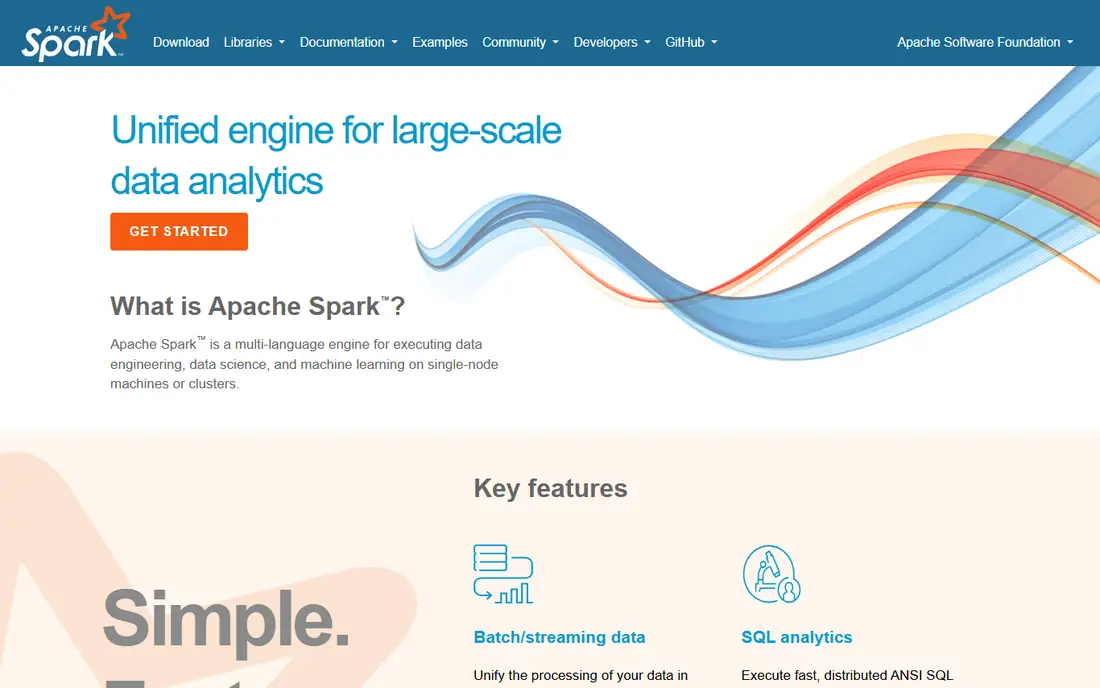
Apache Spark Structured Streaming is the best Flink alternative for teams that already run Spark. It adds streaming to the batch platform they know, using the same Spark SQL and DataFrame API, so the team does not need to learn a new framework. It suits mixed batch plus stream workloads and BI pipelines, where latency in the low seconds is acceptable. It is free open source under Apache 2.0 and runs self-hosted, on Databricks or on EMR. The trade-offs are real: it is a micro-batch engine rather than a true streaming engine, so sub-second use cases stay with Flink, and its state handling is less mature for complex stateful joins. For a Spark team that needs streaming without a second platform, it is the pick.
What we like- Mature ecosystem, unified batch and streaming API, wide connector support, large talent pool
Watch out for- Micro-batch latency in the low seconds rather than sub-second, and state handling is less mature than Flink
Starting priceFree open source; Confluent Cloud usage-based for managed Kafka, third-party reported, checked 13 Nov 2026
Free planYes; open source under Apache 2.0
Kafka Streams is the stream processing library built into Apache Kafka, and it suits teams that already run Kafka and want processing without a separate cluster. It is a client library rather than a cluster, so you deploy it as part of your application and it reads from and writes to Kafka topics. That removes the operational burden of a Flink cluster entirely. It supports exactly-once processing and state stores backed by Kafka, which covers most filtering, aggregation and join workloads. The limits are that it only works on Kafka, and complex stateful processing with large state is harder than in Flink. For a Kafka team that wants simple, reliable stream processing, Kafka Streams is the pick.
What we like- Runs inside your Kafka cluster, no separate processing cluster, strong exactly-once support, simple deployment
Watch out for- Tied to Kafka, and complex stateful joins are harder than in Flink
Starting priceUsage-based via Confluent Cloud; included in Confluent Platform, third-party reported, checked 13 Nov 2026
Free planFree trial on Confluent Cloud; no permanent free tier
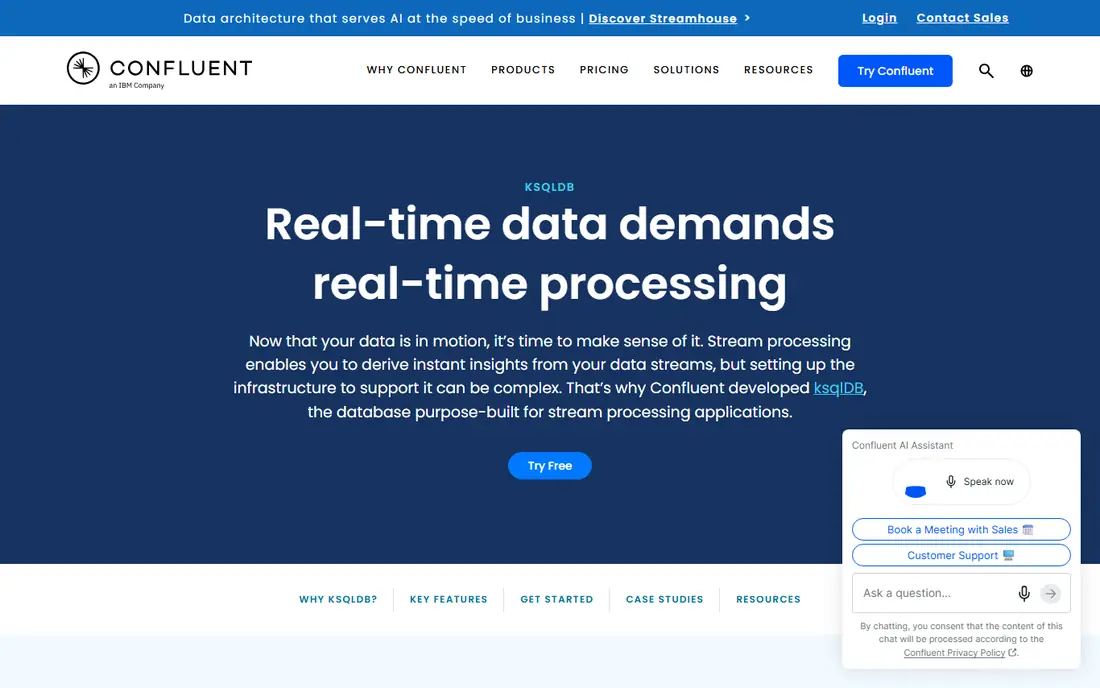
ksqlDB is the streaming database that runs on Kafka Streams, and it suits teams that want to process Kafka topics with SQL instead of code. You write SQL queries against topics, and ksqlDB runs them as Kafka Streams applications under the hood, with pull queries on tables for lookups. That makes it fast for filtering, lightweight transformations, simple aggregations and CDC event routing. The limits are that it is tightly coupled to Kafka, it uses the Confluent Community Licence rather than an OSI open-source licence, and it is not the right tool for complex stateful joins or sub-100 ms latency. For a Kafka team that wants SQL-first streaming, ksqlDB is the pick.
What we like- SQL interface over Kafka, pull queries on tables, quick prototyping, no Java code needed
Watch out for- Confluent Community Licence rather than open source, and it is not built for complex stateful joins or sub-100 ms latency
Starting priceFree open source; runner cost only, third-party reported, checked 13 Nov 2026
Free planYes; open source under Apache 2.0
Apache Beam is the unified programming model for batch and streaming pipelines, and it suits teams that want portability. You write the pipeline once, then run it on Flink, Spark, Dataflow or another runner without code changes, which protects you from being locked to one engine. Beam has strong windowing, triggers and event-time handling, and it is free open source under Apache 2.0. The trade-offs are that Beam needs a runner, so you still operate or pay for an engine, and the abstraction layer adds overhead compared with writing directly against Flink. For a team that runs pipelines across clouds or wants to switch runners later, Beam is the pick.
What we like- One pipeline model for batch and streaming, portable across runners, strong windowing and triggers
Watch out for- Needs a runner such as Flink, Spark or Dataflow, and the abstraction adds overhead
Starting priceUsage-based per vCPU-hour, memory and data processed, third-party reported, checked 13 Nov 2026
Free planFree trial credits; no permanent free tier
Google Cloud Dataflow is the most widely used managed runner for Beam pipelines, and it suits teams on Google Cloud that want streaming without operating a cluster. It runs Beam pipelines as a fully managed service with autoscaling, so you submit the pipeline and Dataflow handles workers, scaling and retries. It integrates with BigQuery, Pub/Sub and the rest of Google Cloud, which makes it the natural choice for a Google shop. The limits are usage-based pricing per vCPU-hour, memory and data processed, which means workload spikes translate directly into billing spikes, and the service ties you to Google Cloud. For a Google Cloud team that wants managed streaming, Dataflow is the pick.
What we like- Fully managed Beam runner, autoscaling, no cluster operations, strong Google Cloud integration
Watch out for- Usage-based cost is hard to forecast, and it ties you to Google Cloud
Starting priceUsage-based per Kinesis Processing Unit hour, third-party reported, checked 13 Nov 2026
Free planFree tier with limited usage for new accounts
Amazon Kinesis Data Analytics is the serverless streaming service for teams that run on AWS. It runs Flink applications and SQL queries over Kinesis streams without servers to manage, and it integrates natively with S3, Redshift and the rest of AWS. That makes it the closest AWS-native parallel to a Flink deployment. Pricing is usage-based per Kinesis Processing Unit hour, which keeps small workloads cheap but grows with volume. Production benchmarks put a Kinesis plus Lambda stack at around $115 per terabyte processed, against $42 for self-managed Kafka plus Flink, so model the cost at your real volume. For an AWS shop that wants streaming without cluster operations, Kinesis Data Analytics is the pick.
What we like- Serverless with no servers to manage, SQL and Flink application support, native AWS integration
Watch out for- Usage-based cost grows fast at high volume, and it locks you into AWS
Starting pricePer streaming unit, usage-based, third-party reported, checked 13 Nov 2026
Free planFree trial; no permanent free tier
Azure Stream Analytics is the SQL-based streaming service for Microsoft shops, and it suits teams that want to process streams with SQL rather than code. Analysts write familiar SQL queries against Event Hubs or IoT Hub streams, and the service runs them as a fully managed job with no cluster to operate. It integrates with Azure Synapse, Power BI and the rest of the Microsoft stack, which makes it easy to feed dashboards. Pricing is per streaming unit, so the bill grows with throughput and the number of units you provision. The limits are that it is Azure-only and that complex stateful processing is harder than in Flink. For an Azure team that wants SQL-first streaming, Stream Analytics is the pick.
What we like- SQL query language that analysts already know, fully managed, native Azure integration, low-code setup
Watch out for- Per-unit pricing adds up at scale, and it is Azure-only
Starting priceFree open source; Cloud from about $0.14 per hour, third-party reported, checked 13 Nov 2026
Free planYes; self-hosted open source under Apache 2.0
RisingWave is the streaming database for teams that want to query streaming results directly. It ingests events from Kafka, Pulsar, Kinesis and CDC sources, keeps materialised views continuously up to date, and lets you query them through the PostgreSQL wire protocol without a separate serving store. It is open source under Apache 2.0, with a managed cloud from around $0.14 per hour, and it streams natively into Iceberg. The trade-offs are a younger ecosystem than Flink or Spark, and a different architecture: it is a database, not a general stream processor, so it does not replace Flink for arbitrary stream transformations. For a SQL-first team that needs live dashboards on streaming data, RisingWave is the pick.
What we like- PostgreSQL wire protocol, materialised views you can query directly, native Iceberg streaming, elastic cloud scaling
Watch out for- Younger ecosystem than Flink or Spark, and it is a database rather than a general stream processor
Frequently asked questions
Is Spark Structured Streaming better than Flink?
It depends on latency and team skills. Spark Structured Streaming is better when your team already runs Spark, your workload mixes batch and stream, and latency in the low seconds is acceptable. Flink is better for true real-time processing with sub-second latency, complex event processing and large stateful joins. Most teams that switch do so because they already have Spark expertise, not because Spark is faster.
Which Flink alternative is free?
Apache Spark Structured Streaming, Kafka Streams, Apache Beam and RisingWave are all free open source under Apache 2.0, so you pay only for infrastructure. ksqlDB is free to run in Confluent Platform, though it uses the Confluent Community Licence rather than an open-source licence. Dataflow, Kinesis Data Analytics and Stream Analytics are managed services with usage-based pricing and no permanent free tier.
Can I use SQL instead of Flink code?
Yes, ksqlDB, Azure Stream Analytics, RisingWave and Flink SQL itself all let you process streams with SQL. ksqlDB suits Kafka teams, Stream Analytics suits Azure teams, and RisingWave suits teams that also need to serve query results. SQL covers filtering, aggregation and simple joins well, but complex stateful processing and custom logic still need code in Flink, Spark or Kafka Streams.
What is the difference between a stream processor and a streaming database?
A stream processor such as Flink or Spark transforms streams and writes results to a sink, so you query the results somewhere else, such as Kafka, PostgreSQL or Iceberg. A streaming database such as RisingWave or ksqlDB keeps query results continuously up to date and lets you query them directly. Pick a stream processor for transformations and a streaming database when serving live results matters.
How much does managed stream processing cost?
Managed services charge by usage, so the cost depends on volume. Production benchmarks from 2026 put self-managed Kafka plus Flink at about $42 per terabyte processed, Kafka plus Spark at $48, and managed Kinesis plus Lambda at $115. Dataflow charges per vCPU-hour plus data processed, and RisingWave Cloud starts at around $0.14 per hour. Model the cost at your real event volume before choosing.
Sources we checked (11)
- https://spark.apache.org
- https://kafka.apache.org
- https://ksqldb.io
- https://beam.apache.org
- https://cloud.google.com/dataflow
- https://aws.amazon.com/kinesis/data-analytics/
- https://azure.microsoft.com/en-us/products/stream-analytics
- https://risingwave.com
- https://www.integrate.io/blog/best-google-dataflow-alternatives/
- https://risingwave.com/blog/best-streaming-databases-real-time-analytics-2026/
- https://abemon.es/en/insights/real-time-data-pipelines-practical-guide/
Is your product missing or out of date?
We review this list regularly. Vendors can request a listing, send updated pricing or ask about featured placement.

Shihab Mia · Founder, Rankite
Shihab has 5+ years in B2B and SaaS SEO. He writes Rankite's software buying guides from pricing pages, documentation and public user reviews. More about Shihab.