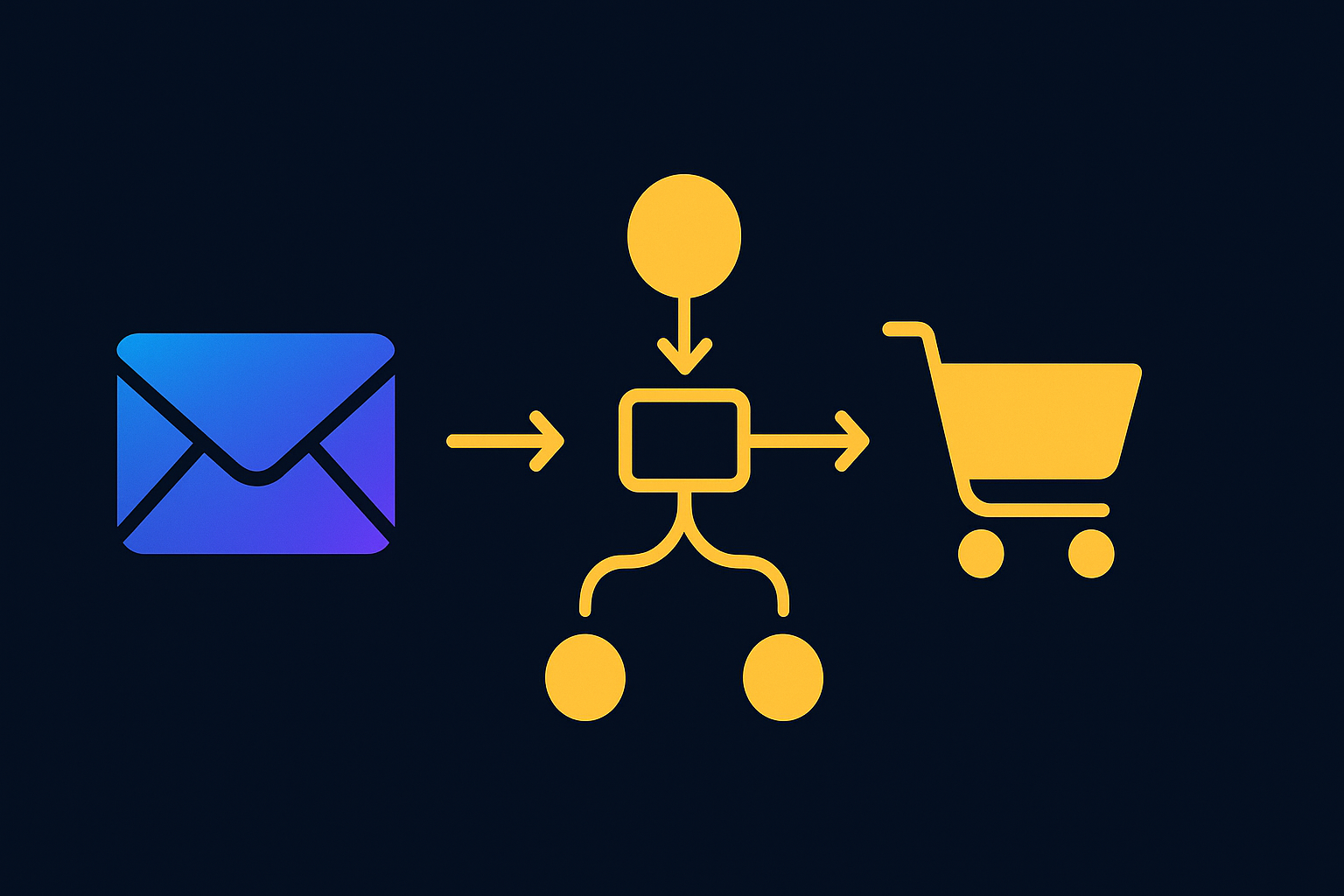
Ecommerce email marketing is using email to turn store visitors into first-time buyers and first-time buyers into repeat customers. It runs on two engines: automated flows triggered by what a shopper just did, like abandoning a cart or joining your list, and broadcast campaigns sent to segments of that list. The flows are where most of the money hides, and this guide walks through the five that matter, the benchmarks to judge them against, and the tools to run them.
Ecommerce email marketing is the practice of emailing shoppers and customers to sell products, recover lost sales, and build repeat purchases. It differs from general email marketing because every message ties back to a store: a product someone viewed, a cart they left, an order they placed. That direct link to buying behavior is what makes it convert so well.
Put simply, ecommerce email splits into two jobs: automated flows that react to shopper behavior, and campaigns that you schedule and send to segments. Flows run in the background and catch people at high-intent moments. Campaigns are your newsletters, launches, and sales. Most stores obsess over campaigns and neglect flows, which is exactly backwards. If you sell to other businesses rather than consumers, the logic shifts, and our guide on B2B email marketing covers that longer, committee-driven cycle instead.
The reason this channel keeps earning its place is ownership. You are not renting an audience from a platform that can throttle your reach overnight. You own the list, so once someone subscribes you can reach them for free, again and again, for as long as they stay engaged. That is why email quietly outperforms almost every paid channel on return.
Email is one of the highest-return channels in ecommerce, full stop. Litmus puts the average return at about $36 for every $1 spent, which is hard for paid ads to match once you factor in rising acquisition costs. But the headline number hides the more useful insight: not all email pulls its weight equally.
The split between automated flows and one-off campaigns is stark. Omnisend's 2026 ecommerce marketing report found that automated flows generate about 37% of all email-driven sales while making up only around 2% of total sends. They earn that outsized share because they land when a shopper is already close to buying, not when your calendar says it is newsletter day.
The practical takeaway is an order of operations. Before you plan your next campaign calendar, build the flows. A store with no welcome series and no cart recovery is leaving the highest-converting email it could send unsent. Once the flows are live and earning, campaigns become the layer on top, not the whole strategy.
Five automated flows carry most of the load in a healthy ecommerce program. Omnisend found that welcome and abandoned cart messages alone drove about 76% of all automation-generated orders, so if you only ever build two, build those. Here is the full set, mapped to where each one catches the shopper.
The welcome series greets a new subscriber and turns fresh interest into a first purchase. It is your highest-engagement moment, because the person just chose to hear from you. Send three to five emails over the first week: a warm hello and any signup incentive, a bit of your brand story and bestsellers, then a nudge with social proof. Welcome flows consistently post some of the strongest revenue per recipient of any automation, which is why they belong at the top of the build list.
Browse abandonment catches shoppers who viewed a product but never added it to their cart. It is a lighter touch than a cart reminder, since intent is lower, so keep it helpful rather than pushy: show the item they looked at, add a couple of related products, and answer the obvious question of why it is worth buying. This flow reaches a large group that most stores ignore entirely.
Abandoned cart is the single highest-value flow in most stores. Roughly seven in ten online carts are abandoned, so recovering even a slice is real money. Klaviyo's 2026 data puts abandoned cart revenue per recipient near $3.07, well above any campaign. Send the first reminder within about an hour while the product is still fresh, a second around 24 hours later, and a third near 48 hours, and hold any discount back for the later sends so you do not teach shoppers to abandon on purpose.
The post-purchase flow starts the moment someone buys, and its job is the second sale. Confirm the order, set delivery expectations, then follow up to ask for a review, suggest a complementary product, and share how to get the most from what they bought. Repeat customers are far cheaper to sell to than new ones, and this flow is where a one-time buyer becomes a regular. Back-in-stock alerts sit near here too, and Omnisend found they convert at about 6.46%, the highest of any automation type.
The winback flow re-engages customers who have gone quiet, usually 60 to 120 days since their last purchase depending on your typical buying cycle. Remind them what they liked, show what is new, and if needed offer a reason to return. Some will come back and some will not, and that is fine: a winback flow also tells you who to stop emailing, which protects your deliverability. To spot which visitors and buyers are drifting in the first place, our guide on how to monitor website traffic covers the tracking that feeds these segments.
You cannot tell if your email is working without a yardstick, and the honest answer is that flows and campaigns should be judged on completely different scales. Klaviyo's 2026 benchmarks, drawn from more than 183,000 brands, put average ecommerce campaign open rate near 31% and click rate around 1.69%, with revenue per recipient close to $0.10. Automated flows sit in a different league, with click rates near 5.58% and far higher revenue per send.
One benchmark deserves a warning label. Open rate has become unreliable because Apple Mail Privacy Protection preloads tracking pixels for Apple Mail users, which can make up a large share of a consumer list, and auto-registers an open whether or not anyone read the email. MailerLite still reports a healthy ecommerce open rate in the low thirties, but treat that as a rough sanity check, not a performance metric.
The metrics worth steering by are the ones a bot cannot fake: click rate, placed order rate, and revenue per recipient. Those tie directly to money and to real human action. Set your own baseline across a few months, then chase steady improvement against it rather than a generic industry average, since your niche, list quality, and price point all move the numbers.
Segmentation is the fastest way to lift results without sending more email, because a relevant message to the right group beats a generic one to everyone. Mailchimp found that segmented campaigns earn about 14.31% higher open rates and 100.95% higher click rates than non-segmented sends, so even simple segmentation roughly doubles clicks. In ecommerce, purchase behavior is the most powerful thing to segment on.
Start with the segments that map to the customer lifecycle, then layer richer data on top:
You do not need all of this on day one. Begin with lifecycle stage, which your platform can build automatically from order history, and add behavior and category segments as your data grows. Email works best as one part of a wider growth system, and our monthly SEO management service covers how owned channels like email, content, and search reinforce each other.
The right platform depends on your stack and your stage, but for most stores the choice comes down to three names. Klaviyo is the default for Shopify: it plugs straight into store data, offers deep segmentation and predictive analytics, and scales as revenue grows, which is why so many mid-market brands run on it. Omnisend is a strong, lower-cost alternative with email and SMS built into the same flows, popular with small and mid-size stores that want power without Klaviyo's price. Mailchimp works for very early stores but its ecommerce flows and segmentation are thinner, so growing stores tend to outgrow it.
| Platform | Best for | Watch out for |
|---|---|---|
| Klaviyo | Shopify stores wanting deep segmentation and predictive data | Pricing climbs quickly as your list grows |
| Omnisend | Small to mid-size stores wanting email plus SMS at lower cost | Fewer advanced integrations than Klaviyo |
| Mailchimp | Very early stores and simple newsletters | Weaker ecommerce flows and segmentation |
Whichever you pick, the platform is not the strategy. A store on Klaviyo with no flows built loses to a store on Omnisend that has its welcome and cart sequences dialled in. Choose based on where your store already lives, get the flows running first, then grow into the advanced features. If you would rather hand the whole channel to a team, compare that against building in-house on our email marketing agency page.
Most underperforming programs share the same handful of errors. Fix these before you chase anything advanced.
None of these fixes are technical. They are decisions about order of operations and discipline, which is what separates an email program that funds the business from one that just fills inboxes.
What is ecommerce email marketing? Ecommerce email marketing is using email to turn store visitors into first-time buyers and first-time buyers into repeat customers. It combines two parts: automated flows triggered by shopper behavior, like an abandoned cart or a signup, and broadcast campaigns sent to segments of your list. In most stores the automated flows quietly do most of the selling.
How much revenue does ecommerce email marketing actually drive? Email is one of the highest-return channels in ecommerce. Litmus puts the average return at about $36 for every $1 spent. Omnisend's 2026 report found that automated flows generate roughly 37% of all email-driven sales from only about 2% of sends, because they reach shoppers at the exact moment they are ready to buy.
What are the most important ecommerce email flows? Five flows do the heavy lifting: the welcome series, browse abandonment, abandoned cart, post-purchase, and winback. Omnisend found that welcome and abandoned cart messages alone drove about 76% of all automation-generated orders, so those two are the first ones any store should build.
What is a good open rate and click rate for ecommerce email in 2026? Klaviyo's 2026 benchmarks, drawn from more than 183,000 brands, put average ecommerce campaign open rate near 31% and click rate around 1.69%. Automated flows perform far better, with click rates near 5.58%. Because Apple Mail Privacy Protection inflates open rates, judge your program on click rate, placed order rate, and revenue per recipient instead.
When should an abandoned cart email be sent? Send the first abandoned cart email within about an hour, while the shopper still remembers the product, then follow with a second after roughly 24 hours and a third after 48 hours. The first message should be a simple reminder, and only the later ones should introduce an incentive so you do not train buyers to abandon carts for a discount.
Should I use Klaviyo, Mailchimp, or Omnisend for ecommerce email? Klaviyo is the default for Shopify stores that want deep segmentation and predictive data, and it scales well as revenue grows. Omnisend is a strong, lower-cost alternative with email and SMS built in, popular with small and mid-size stores. Mailchimp works for very early stores but its ecommerce flows and segmentation are weaker, so most growing stores move off it.
How do I segment an ecommerce email list? Segment on purchase behavior first: new subscribers, one-time buyers, repeat buyers, and lapsed customers each need a different message. Layer in engagement level, product category, and average order value. Mailchimp found segmented campaigns earn about 100.95% higher click rates than non-segmented sends, so even basic segmentation roughly doubles clicks.
How often should I email my ecommerce customers? Most stores can send two to four campaigns a week to engaged subscribers on top of their automated flows, but there is no single right number. Watch your unsubscribe and spam-complaint rates, and pull back on segments that stop engaging. Sending more to people who open and click, and less to those who do not, protects your deliverability.
Is email or SMS better for ecommerce? They do different jobs, so the best stores use both. Email carries the detail, the images, and the storytelling, and it costs almost nothing to send. SMS is short, immediate, and ideal for time-sensitive moments like a cart reminder or a flash sale. Run them together in the same flows rather than choosing one.
Do I need an agency to run ecommerce email marketing? You can build the core flows yourself with a good platform and some discipline. An agency helps when you want to move faster, run advanced segmentation and testing, or connect email to your wider search and content strategy so every channel pulls in one direction. Many stores start in-house and bring in help once email revenue justifies it.
Pick one gap and close it this week. If you have no welcome series or cart recovery, build those two flows first, since Omnisend's data says they alone can drive the majority of your automation revenue. If your flows already run, move your reporting off open rate and onto clicks, orders, and revenue per recipient. If you are ready to send, our email marketing templates give you a welcome and follow-up to start from, and our guide to direct email marketing covers the mechanics of getting a single campaign into the inbox correctly before you automate it. Our SEO pricing page shows what it costs to have email, content, and search run as one program. Prefer to talk it through? Book a free call and we will map your flows with you.
Get a free, no-obligation SEO audit and a 30-minute strategy session. We'll show you exactly where the growth is hiding.
Fill out the form and we'll get back to you within one business day. Prefer email? Write to us directly at contact@rankite.com.