How we make this list: we compare pricing pages, product documentation and public user reviews. Ratings come from G2, Capterra or Trustpilot, with the date we checked them.
Key takeaways
- FreeTaxUSA offers the cheapest path to filing: $0 federal for all tax situations including small business, plus $15.99 per state.
- Keeper publishes the clearest pricing for full-service help: $199/year Standard, $399/year Premium, $1,199/year for S-Corps and partnerships.
- TurboTax Business and H&R Block remain the mainstream choices for DIY business returns, with Block Advisors adding human help.
- If you sell online across state lines, sales tax automation (Avalara, TaxJar) matters more than which income-tax software you pick.
- Vertex and Sovos serve larger or more complex operations; most small businesses should start with the simpler tools first.
Quick comparison
| Tool | Best for | Starting price | Free plan |
|---|
 TurboTax Business TurboTax Business | DIY business tax returns | See website | No |
 H&R Block H&R Block | DIY plus human expert help | See website | No |
 TaxAct TaxAct | Value-priced guided filing | See website | Yes (Free Edition for simple returns) |
 FreeTaxUSA FreeTaxUSA | Cheapest federal filing | $0 federal + $15.99 per state | Yes (free federal for everyone) |
 Keeper Keeper | Freelancers and S-Corps with expert help | $199/year (Standard) | 14-day free trial |
 Avalara Avalara | Full sales-tax compliance automation | See website | No |
 TaxJar TaxJar | Sales tax for ecommerce sellers | See website | No |
 Vertex Vertex | Enterprise indirect tax | See website | No |
 Sovos Sovos | Global compliance and 1099 reporting | See website | No |
Is your product missing or out of date?
We review this list regularly. Vendors can request a listing, send updated pricing or ask about featured placement.
The best software for small business taxes
Starting priceSee website
Free planNo

TurboTax Business is the default choice for a reason: it is the only mainstream DIY product built specifically for business entities, covering Forms 1065, 1120, and 1120S with the same guided interview approach that made TurboTax famous. If your books live in QuickBooks, the data flows across with minimal re-entry, which removes the most painful part of business tax prep.
The honest downsides: it is desktop software in a cloud world, which means installing, updating, and backing up files yourself. Intuit does not publish the price plainly, so comparison shopping takes effort. And the interview format that helps beginners can slow down owners who know exactly what they are doing. For straightforward entity returns prepared in-house, it remains the path of least resistance.
What we like- Handles partnerships, S-Corps, and C-Corps
- Guided interview format
- Deep integration with QuickBooks
Watch out for- Desktop software, not cloud
- Pricing is not transparent on the site
- Easy to overpay for features you do not need
Starting priceSee website
Free planNo
H&R Block's advantage is not software at all. It is the option to start DIY online and hand off to a human when the return gets complicated, through Block Advisors, its small-business arm. With thousands of offices nationwide, it is also the only option here where you can sit across a desk from someone. The company adds bookkeeping services, entity formation help, and year-round small-business support around the tax core.
The trade is consistency. Reviewers praise individual preparers and offices far more than the brand as a whole, so your experience depends heavily on who you get. Online pricing scales with return complexity, and the upsell prompts are persistent. For owners who want software with a human safety net, especially first-time filers, the hybrid model is genuinely useful.
What we like- Block Advisors pairs software with small-business tax pros
- Thousands of offices for in-person help
- Bookkeeping services available
Watch out for- Online DIY pricing varies by complexity
- Upsells are frequent
- Quality varies by office and preparer
Starting priceSee website
Free planYes (Free Edition for simple returns)
TaxAct has spent years as the value alternative, and the comparison table on its own homepage leans into it: free federal filing to start, expert help for $45 more, and a pro-filed option from $99. The standout is the maximum refund and accuracy guarantee covering up to $100,000, which is stronger coverage than competitors offer. For cost-conscious filers, the math usually favors TaxAct.
The catch for this audience: the Free Edition covers simple 1040s only, and business income, freelance income, and rental property all require paid editions. The interface gets the job done but lacks TurboTax's polish, and support is thinner. For sole proprietors and simple Schedule C filers who want guided filing without the brand premium, TaxAct is the budget pick that still takes accuracy seriously.
What we like- Lower prices than TurboTax and H&R Block
- $100,000 accuracy guarantee
- Live expert help for $45 extra
Watch out for- Free Edition excludes business income
- Interface less polished than competitors
- Business editions cost extra
Starting price$0 federal + $15.99 per state
Free planYes (free federal for everyone)
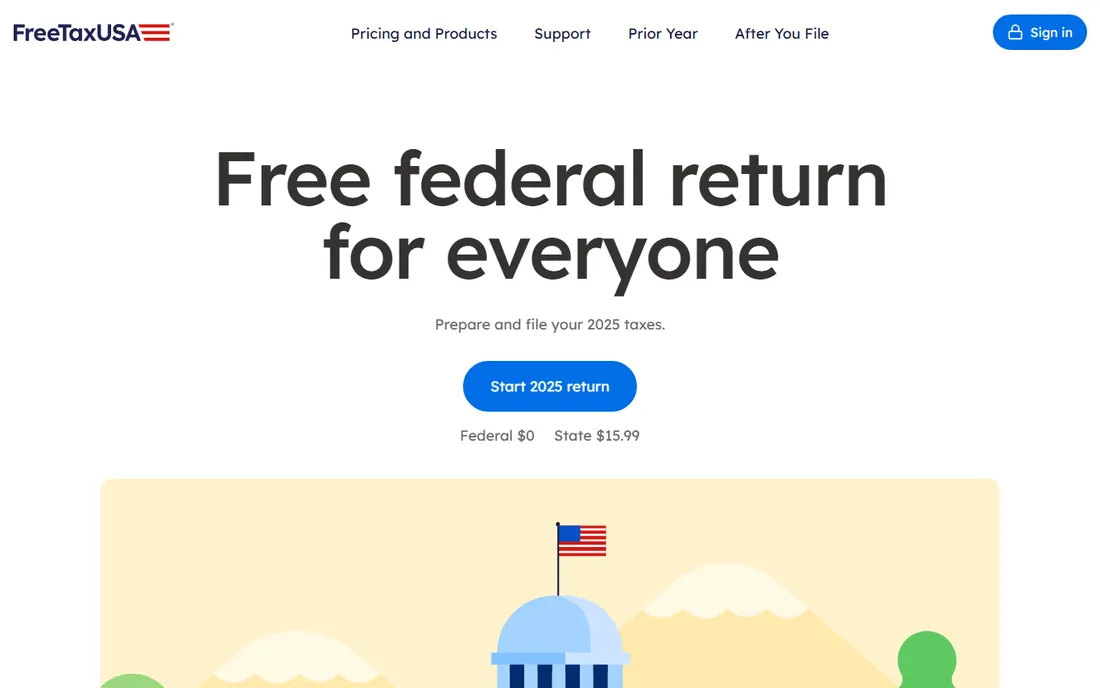
FreeTaxUSA's pitch fits in one sentence: free federal filing for everyone, with all tax situations included. Unlike competitors whose free tiers exclude business income, FreeTaxUSA covers small business, freelance, rental, and investment income at $0 federal, charging only $15.99 per state return. The pricing table is printed right on the homepage, which tells you everything about the company's philosophy. Customers rate it 4.8 out of 5.
What you give up is guidance. The interview is functional rather than friendly, and there is no business-specific edition with entity return support. Pro support costs $64.99 extra. For sole proprietors comfortable with their own books who resent paying $100+ for what is essentially data entry, FreeTaxUSA is the cheapest legitimate way to file.
What we like- Free federal for all tax situations including small business
- Simple flat pricing
- 4.8-star customer rating
Watch out for- State returns cost $15.99 each
- Fewer hand-holding features
- No dedicated small-business product tier
Starting price$199/year (Standard)
Free plan14-day free trial
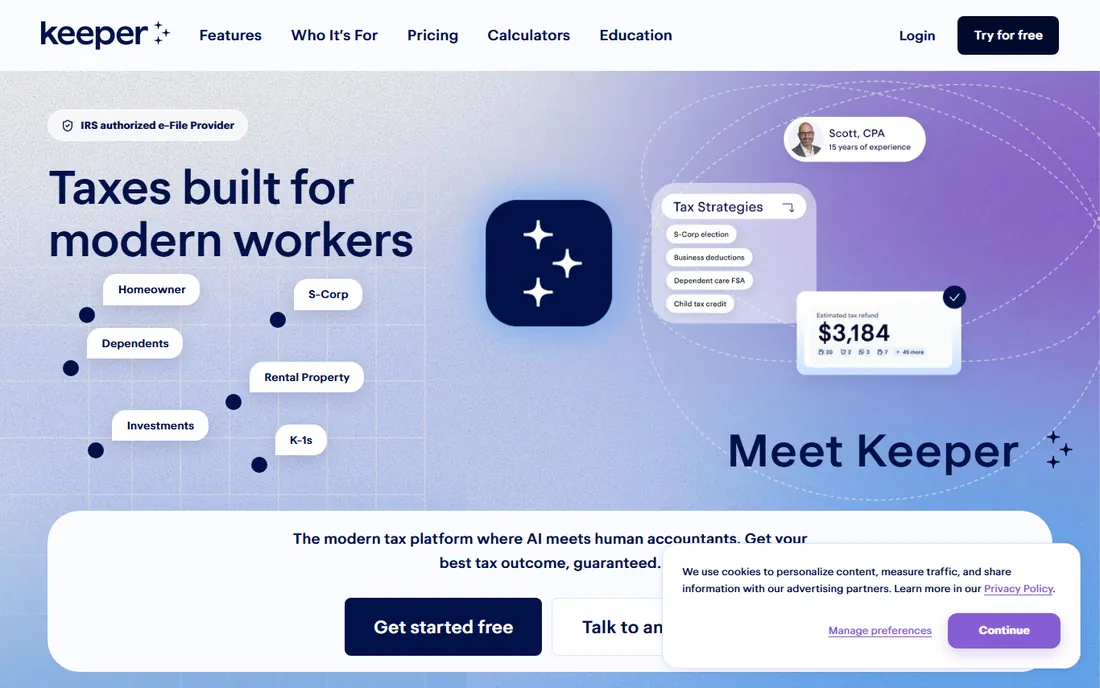
Keeper started as an expense-tracking app for freelancers and grew into full tax filing with human experts attached. The pricing is refreshingly flat and published: $199/year Standard for W-2 workers, contractors, and sole proprietors; $399/year Premium for complex situations with a dedicated accountant; $1,199/year Business for S-Corp and partnership filing with quarterly support. A 14-day free trial lets you test before paying.
The model suits owners who want more than software but less than a traditional CPA relationship. AI scans your linked accounts for missed deductions year-round, and the Premium and Business tiers add real accountants. The Business tier price is a real commitment, and very complex entities may still need a traditional firm. For freelancers, creators, and small S-Corps, Keeper's combination of technology and human help at a published price is hard to beat.
What we like- Published flat pricing
- AI finds missed deductions
- Dedicated accountant on Premium
- 4.8 stars on Trustpilot
Watch out for- Business tier at $1,199/year is a jump
- Newer company than Intuit or H&R Block
- Best for simpler entities
Starting priceSee website
Free planNo
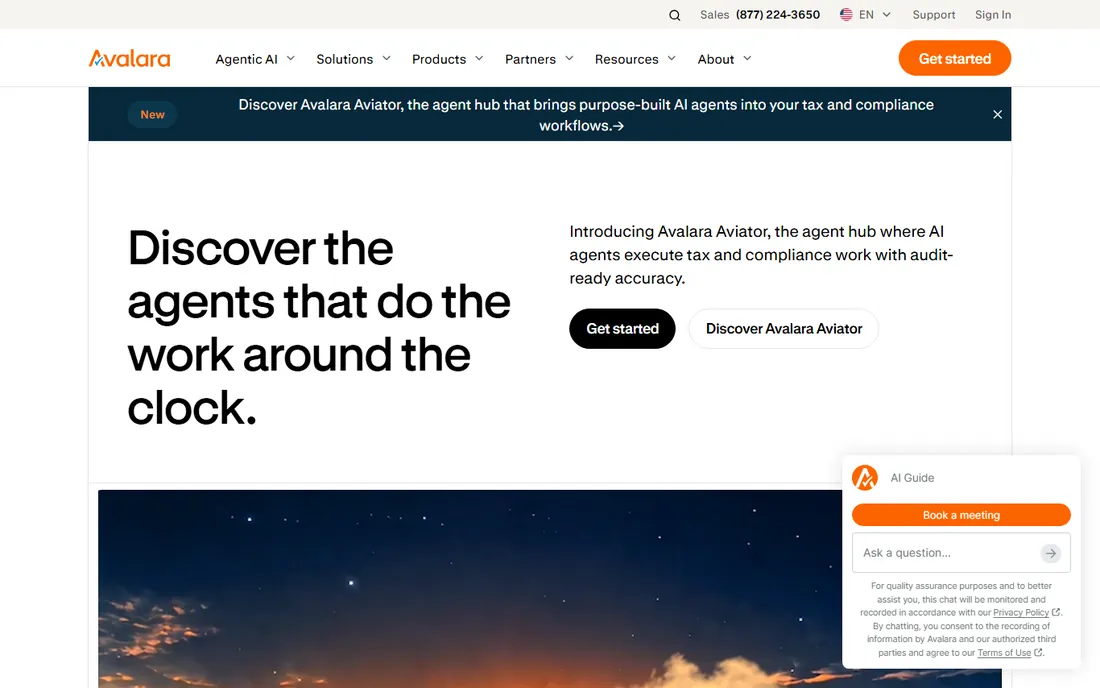
Avalara is the heavyweight of the sales tax world, processing over 54 billion transactions a year across 190+ countries with more than 1,400 integrations. For a small business, the relevant products handle the full lifecycle: monitoring where you have nexus, calculating the right rate at checkout, and filing returns automatically. It plugs into QuickBooks, Shopify, NetSuite, and just about everything else.
The honest assessment: Avalara is built to scale from startup to enterprise, which means small sellers may find more platform than they need at a price that requires a sales conversation. Businesses with simple single-state sales tax should look at TaxJar first. But if you sell in many states, have complex product taxability, or plan to grow into Avalara's depth, starting here avoids a painful migration later.
What we like- 54 billion+ transactions processed yearly
- 190+ countries
- 1,400+ integrations
- Handles nexus, calculation, and filing
Watch out for- Quote-based pricing
- More platform than most small businesses need
- Implementation takes planning
Starting priceSee website
Free planNo
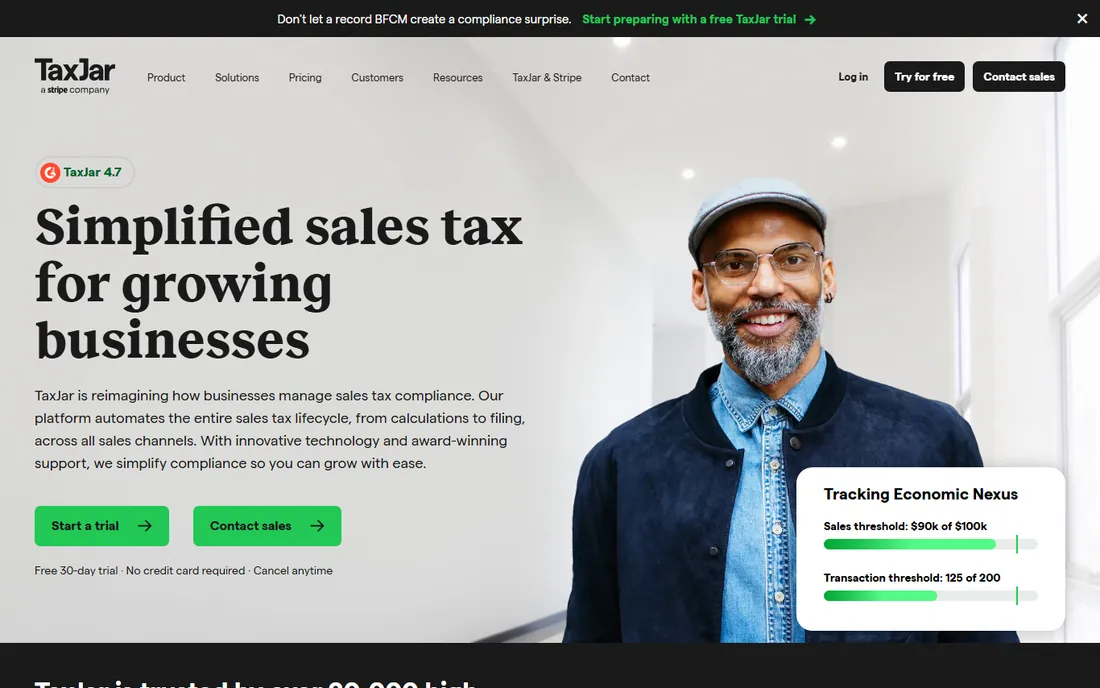
TaxJar does one thing, sales tax for online sellers, and does it well. The platform tracks economic nexus against state thresholds, calculates rates across 11,000 jurisdictions in real time, and its AutoFile feature submits returns with a claimed 100% on-time filing rate in 2025. Integrations with Shopify, Amazon, and WooCommerce cover where most small ecommerce businesses sell. As a Stripe company, it sits close to the payments flow.
The narrowness is both virtue and limit. Businesses that also need VAT, exemption certificate management at scale, or complex enterprise features will outgrow it toward Avalara or Vertex. Pricing requires a conversation. For the classic small ecommerce business selling in a dozen states and dreading filing day, TaxJar is the simplest competent answer.
What we like- Purpose-built for online sellers
- AutoFile submits returns automatically
- Integrations with Shopify, Amazon, WooCommerce
Watch out for- Quote-based pricing
- Narrower than Avalara
- Now a Stripe company, which shapes the roadmap
Starting priceSee website
Free planNo
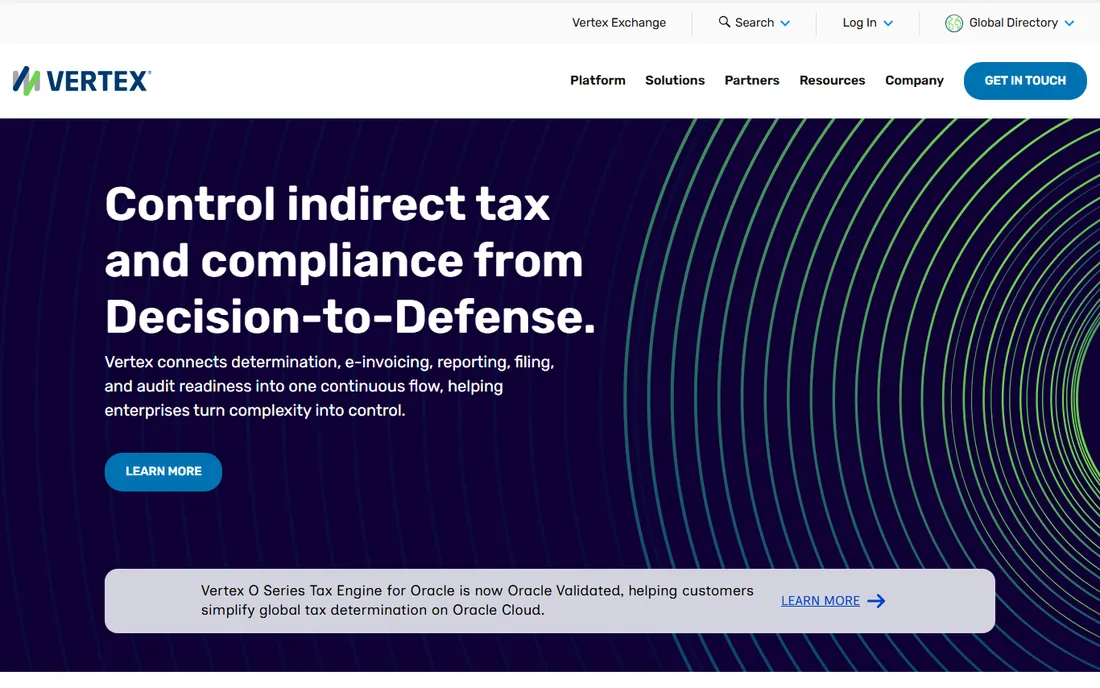
Vertex is the enterprise answer to indirect tax, connecting tax determination, e-invoicing, reporting, filing, and audit readiness in one flow. Its customer list (Walmart, Siemens, Ford) signals where it plays: complex, multi-entity, multi-country operations where tax accuracy is a systems problem. For a growing business approaching that complexity, Vertex is the platform tax departments standardize on.
For most readers of this list, Vertex is aspirational rather than practical. Pricing and implementation are enterprise-grade, and a 20-person company will get more value from TaxJar or Avalara. Include it on your radar if you are scaling fast, selling internationally, or operating in industries with tricky taxability. Otherwise, revisit when the business justifies it.
What we like- Deep indirect-tax engine
- Global e-invoicing and compliance
- Trusted by Walmart, Siemens, and Ford
Watch out for- Enterprise sales motion and pricing
- Overkill for typical small businesses
- Implementation is a project
Starting priceSee website
Free planNo
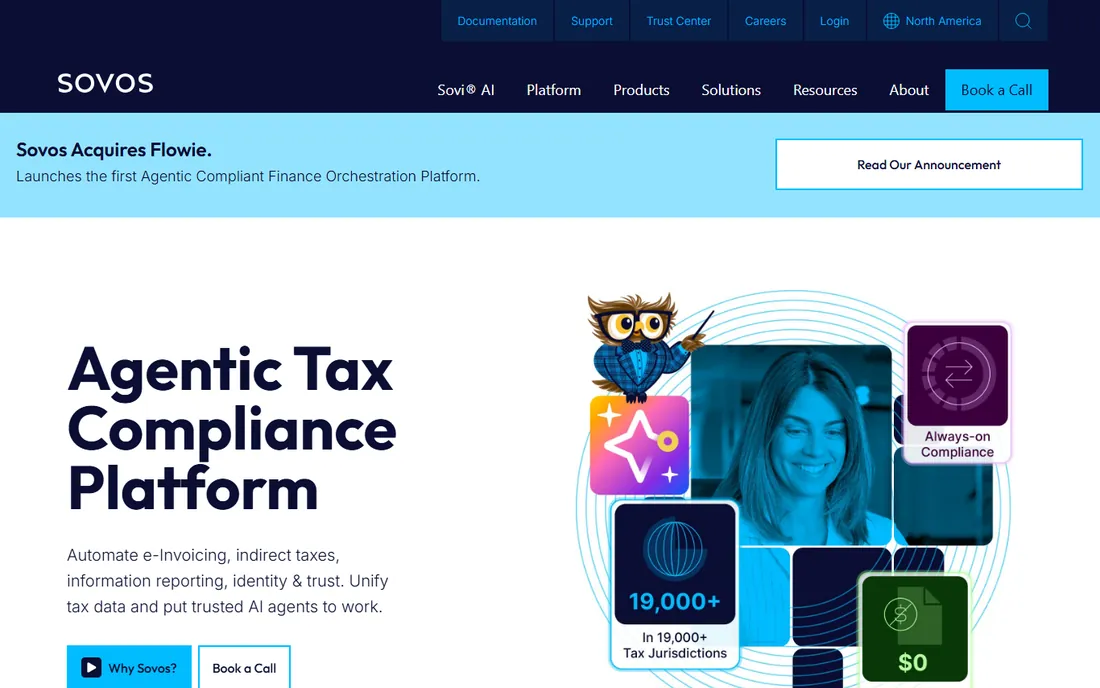
Sovos covers the compliance corners the others miss. Beyond indirect tax, the platform handles e-invoicing mandates, 1099 and information reporting, tax withholding, and unclaimed property, across roughly 200 countries. The 1099 reporting capability is the most relevant piece for small businesses: if you pay contractors, Sovos-style reporting automation keeps you compliant without spreadsheet gymnastics. Half the Fortune 500 runs on it.
Like Vertex, Sovos is enterprise-shaped, and small businesses will usually find simpler tools for each job. But for companies with international exposure, complex reporting obligations, or growth plans that will soon demand this depth, Sovos is worth evaluating early. At minimum, understand what it does before you build compliance processes you will later need to rebuild.
What we like- 100,000+ companies on the platform
- ~200 countries covered
- Strong 1099 and information reporting
- Half the Fortune 500
Watch out for- Enterprise orientation
- Quote-based pricing
- Broader than small-business needs
Why you need two kinds of tax software
Income tax software answers the question "how much do I owe on what I earned." Sales tax software answers "how much do I collect, where, and how do I remit it." They are different problems with different deadlines, and confusing them is how businesses end up compliant on one and exposed on the other.
The practical setup for most small businesses: one tool from the first half of this list for income tax filing (FreeTaxUSA for the budget-conscious, Keeper for freelancers wanting help, TurboTax Business or H&R Block for mainstream DIY), plus one from the second half if you sell taxable goods or services across state lines (TaxJar for ecommerce simplicity, Avalara as you scale). Service businesses with no product sales can often skip the second half entirely. Product businesses selling online cannot.
What to check before you commit
First, match the tool to your entity type. Sole proprietors filing Schedule C have very different needs from S-Corps filing 1120S, and only some tools handle entity returns. Keeper's Business tier and TurboTax Business are built for entities; FreeTaxUSA's free federal covers sole proprietor situations but not corporate returns.
Second, count the states. Income tax filing is mostly federal plus your home state, but sales tax multiplies fast: every state where you have nexus is a registration, a filing calendar, and a potential penalty. If that count is more than two or three, sales tax automation stops being optional.
Third, price the whole year, not the sticker. A $0 federal return plus three state filings, or a $199 annual plan with quarterly estimate support, or a sales tax platform with per-filing fees, each tell a different story at tax time. And fourth, check who answers when something goes wrong: software-only tools leave you reading help articles, while Keeper, H&R Block, and Block Advisors put humans on the call.
How we chose
We split the category into its two real jobs: filing small business income taxes and automating sales tax compliance. For income tax, we selected widely used DIY and assisted filing tools; for sales tax, the leading automation platforms. We verified each product is live on its own website today. Pricing comes from vendor pages where published: FreeTaxUSA and Keeper publish theirs, which we confirmed on their homepages; the rest are quote-based or vary by complexity, so we mark them rather than guessing. We excluded general accounting software (QuickBooks, Xero) since bookkeeping and tax filing are different jobs.
Frequently asked questions
What is the cheapest way for a small business to file taxes?
FreeTaxUSA offers free federal filing for all tax situations including small business income, with state returns at $15.99 each. For most sole proprietors, that is the lowest legitimate cost. Keeper at $199/year adds deduction-finding AI and human support if you want help beyond software.
Do I need separate software for sales tax?
If you sell taxable products across state lines, yes. Income tax tools do not track nexus, calculate checkout rates, or file state sales tax returns. TaxJar and Avalara automate that entire lifecycle. Service businesses with no taxable product sales generally do not need sales tax software.
What is sales tax nexus?
Nexus is the connection between your business and a state that obligates you to collect and remit sales tax there. It used to mean physical presence; since the 2018 Wayfair decision, economic activity alone (sales volume or transaction counts) can create nexus. TaxJar and Avalara monitor your nexus exposure automatically.
Should I use TurboTax Business or hire a CPA?
TurboTax Business handles straightforward entity returns well and costs far less than a CPA. Hire a CPA or use Keeper's Business tier when you have multi-state operations, complex equity situations, IRS notices, or simply want year-round planning advice rather than once-a-year filing.
How much does small business tax software cost?
DIY filing ranges from $0 federal (FreeTaxUSA) to a few hundred dollars for business editions. Assisted options like Keeper run $199 to $1,199 per year depending on complexity. Sales tax automation is quote-based and scales with transaction volume and filing count. Always model state filings and add-ons, not just the headline price.
When are small business taxes due?
It depends on the entity and the tax. Sole proprietors and single-member LLCs generally file with personal returns by April 15, with quarterly estimated payments through the year. S-Corps and partnerships file by March 15. Sales tax filing frequencies vary by state and volume. Confirm your specific deadlines with the IRS and your state; this article is not tax advice.
Sources we checked (9)
- https://turbotax.intuit.com
- https://www.hrblock.com/
- https://www.taxact.com/
- https://www.freetaxusa.com/
- https://www.keepertax.com/
- https://www.avalara.com/
- https://www.taxjar.com/
- https://www.vertexinc.com/
- https://sovos.com/
Is your product missing or out of date?
We review this list regularly. Vendors can request a listing, send updated pricing or ask about featured placement.

Shihab Mia · Founder, Rankite
Shihab has 5+ years in B2B and SaaS SEO. He writes Rankite's software buying guides from pricing pages, documentation and public user reviews. More about Shihab.