How we make this list: we compare pricing pages, product documentation and public user reviews. Rankite is independent; if a vendor ever pays for a featured spot, that listing is clearly labeled Partner.
Key takeaways
- No single platform covers the whole development lifecycle, so most firms run two or three of these: one for deals, one for construction, one for money.
- Northspyre is the closest thing to an end-to-end development platform, tracking projects from acquisition through stabilization with live financial data.
- Dealpath owns the front end of the business: sourcing, pipeline, comps and investment committee workflow for acquisition teams.
- Procore and Autodesk Forma are construction-phase tools; pick them for the build, not for underwriting or investor reporting.
- Juniper Square and ARGUS Developer handle the capital side: fundraising and investor management on one side, feasibility and project economics on the other.
Quick comparison
| Tool | Best for | Starting price | Free plan |
|---|
 Northspyre Northspyre | Development firms wanting one system from acquisition to stabilization | See website (custom quote) | No |
 Dealpath Dealpath | Acquisitions teams screening and executing deals at volume | See website (custom quote) | No |
 Procore Procore | Developers running large or multi-project construction programs | See website (priced on annual construction volume) | No |
 Autodesk Forma Autodesk Forma | Design-led developers and BIM-heavy project teams | See website (custom quote) | No |
 Buildertrend Buildertrend | Residential developers, home builders and remodelers | See website (custom quote) | No |
 Projectmates Projectmates | Owner-developers who need configurable construction project controls | See website (custom quote) | No |
 Juniper Square Juniper Square | Developers raising capital from outside investors | See website (custom quote) | No |
 ARGUS Developer ARGUS Developer | Feasibility studies and project-level financial modeling | See website (custom quote) | No |
 Yardi Voyager Yardi Voyager | Developers holding and operating stabilized assets | See website (custom quote) | No |
Is your product missing or out of date?
We review this list regularly. Vendors can request a listing, send updated pricing or ask about featured placement.
The best software for real estate developers, compared
Most "real estate software" roundups are property management tools in disguise. Developers do not need another rent roll. A developer buys land, lines up capital, manages a multi-year build, then leases or sells. That workflow needs deal tracking, development accounting, construction controls and investor reporting, and no single product does all four well. The nine tools below cover the real stack developers actually buy, grouped by the job each one does.
#1
Northspyre
Best for: Development firms wanting one system from acquisition to stabilization
Visit northspyre.com
Starting priceSee website (custom quote)
Free planNo
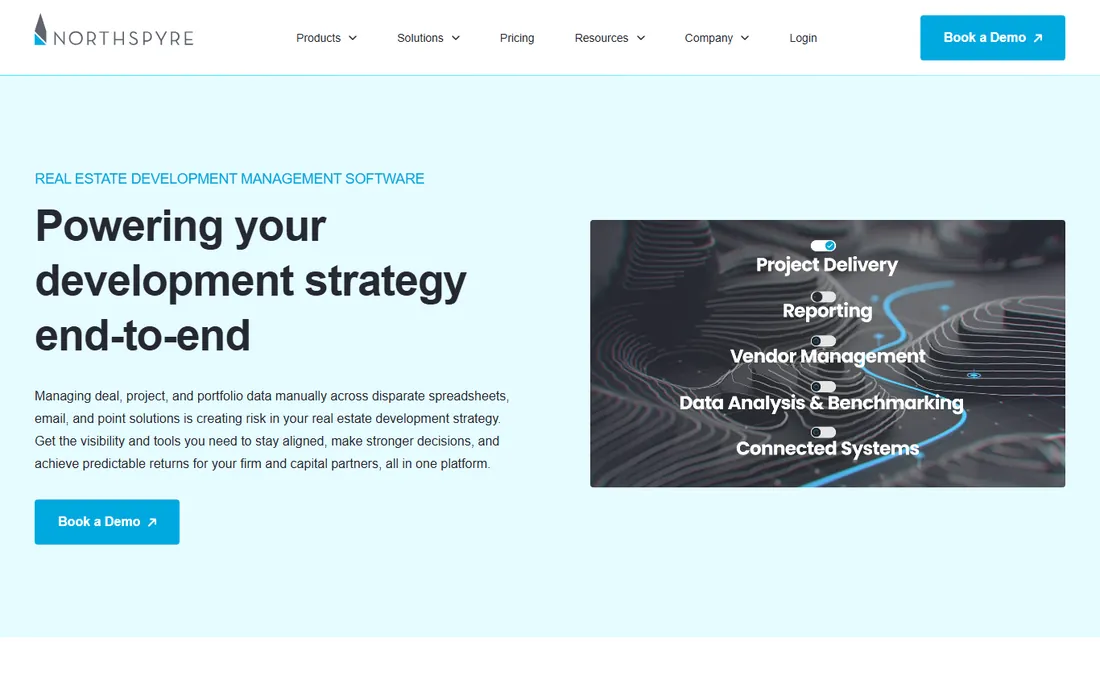
Northspyre is the only product on this list designed around how developers actually work, from the first deal model to the stabilized asset. It combines deal pipeline, budgeting, forecasting, vendor management and draw tracking in one platform, with the financial data updating as costs land. For firms running several projects at once, that live portfolio view is the selling point: leadership sees where every project stands without waiting for month-end spreadsheets.
The trade is commitment. This is not software you trial on a Friday afternoon. Pricing is custom, onboarding is guided, and the value shows up once the whole team works inside it. Firms still running development accounting out of Excel will need to change habits, not just tools. If you want one system of record for development, start here. If you want a quick win on one project, look at the construction tools below.
What we like- Purpose-built for the full development lifecycle, not adapted from generic PM software
- Real-time budget, forecast and cash flow visibility across the portfolio
- Structured data that replaces spreadsheet-based cost tracking
Watch out for- Enterprise sales motion with no published pricing, so budgeting requires a sales conversation
- Implementation is a real project, not a signup-and-go tool
#2
Dealpath
Best for: Acquisitions teams screening and executing deals at volume
Visit dealpath.com
Starting priceSee website (custom quote)
Free planNo
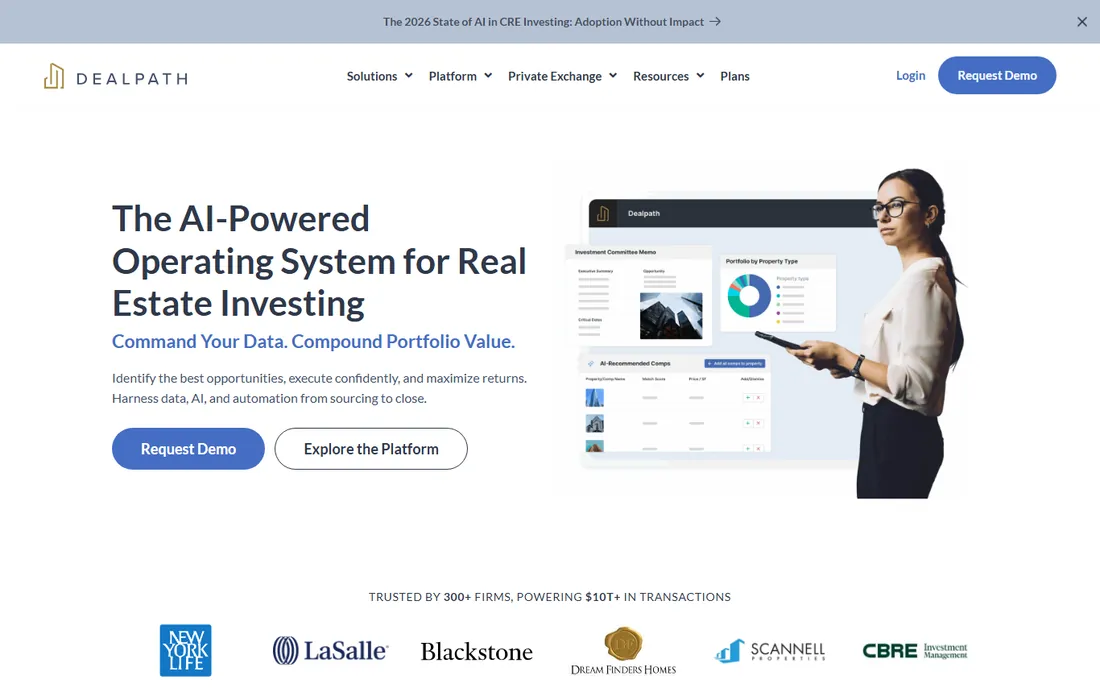
Dealpath runs the front half of the development business. Brokers feed listings in, the team screens with AI-assisted comps, underwriting models get compared side by side, and the investment committee approves inside the platform. The company says the platform powers more than $10 trillion in transactions, and its customer list reads like a directory of institutional real estate investors. For developers who live or die on deal flow, the pipeline discipline alone justifies it.
Know what you are buying, though. Dealpath is an investing platform, not a construction tool. Once the deal closes and the hard hats arrive, you hand off to something like Procore or Northspyre. Firms that both acquire and develop often pair Dealpath with one of those. If your pipeline is a shared inbox and a spreadsheet, this is the upgrade.
What we like- Deal pipeline purpose-built for real estate investing, from sourcing to close
- Proprietary comps database that compounds in value as the team uses it
- Investment committee and approval workflows with a clean audit trail
Watch out for- Aimed at investment firms and larger developers, likely overkill for a two-person shop doing one project a year
- No published pricing
#3
Procore
Best for: Developers running large or multi-project construction programs
Visit procore.com
Starting priceSee website (priced on annual construction volume)
Free planNo
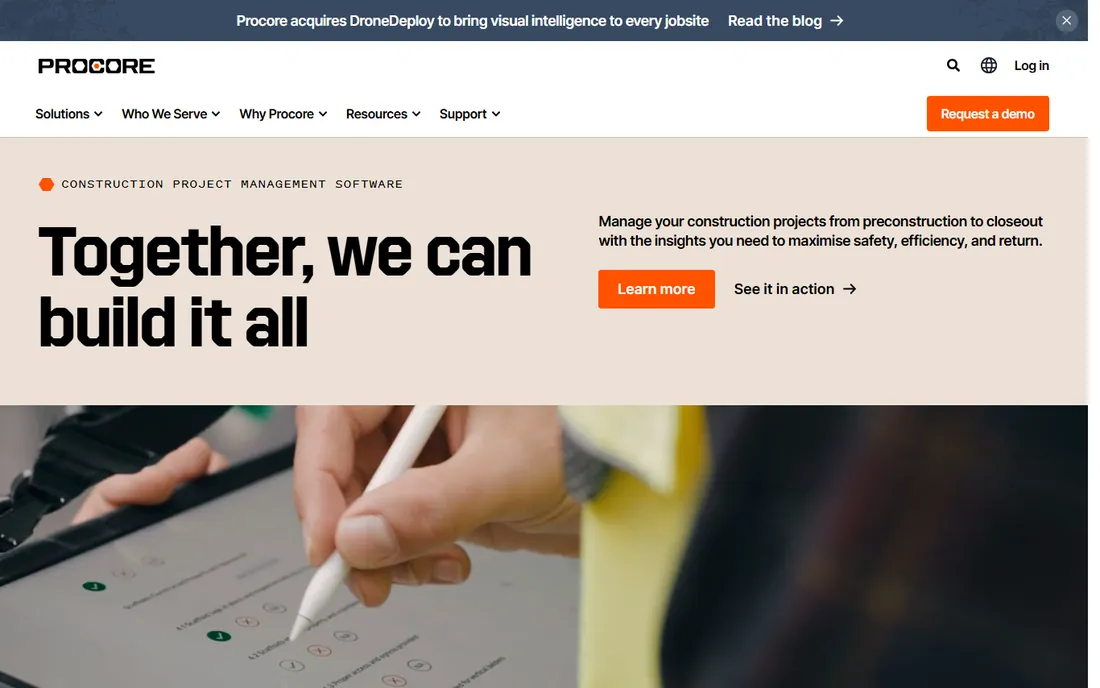
Procore is the default construction management platform for serious builders, and developers who act as their own GC or manage multiple GCs use it to keep every project legible. Drawings, RFIs, submittals, change orders, budgets and schedules live in one place, and the field app keeps site teams connected to the office. The pricing model is unusual and worth understanding: Procore charges on annual construction volume, not per user, so everyone from the intern to the lender can have access.
The catch for developers is scope. Procore manages the build brilliantly and knows nothing about your capital stack. Pair it with a development management or investor platform for the full picture. Smaller developers doing one or two residential projects at a time will find Buildertrend or Projectmates a better fit for both price and complexity.
What we like- Deepest construction feature set on the market, from preconstruction to closeout
- Unlimited users, so the whole project team can work in it without per-seat math
- Strong financial management integrations with major accounting systems
Watch out for- Volume-based pricing means small developers can find it expensive relative to project size
- The breadth of the platform takes real onboarding effort
Starting priceSee website (custom quote)
Free planNo
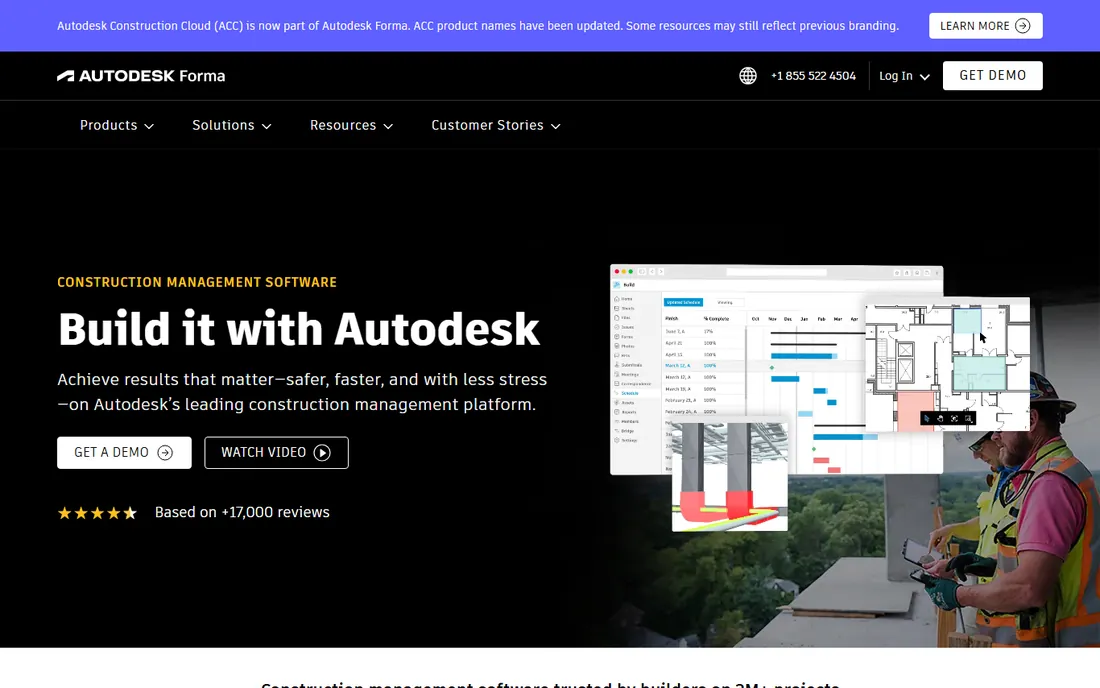
Autodesk Forma, formerly Autodesk Construction Cloud, is the platform for developers whose projects live in models. If your architects deliver in Revit and your estimators quantify from models, Forma connects design, preconstruction and field execution in one environment. Model coordination, clash detection and 4D/5D simulation are the differentiators. For large commercial and mixed-use developers, it is often already the standard because the design team demands it.
Smaller developers should be honest about fit. Without a BIM workflow, much of Forma's power goes unused, and you pay enterprise prices for it. The sales process is consultative and the pricing is custom. This is the right pick when the project complexity justifies it, not a default for every developer.
What we like- Native BIM coordination, model-based estimating and clash detection that generic PM tools cannot touch
- More than 400 integrations with ERP, CRM and document systems
- Flexible user, project and account-based pricing options
Watch out for- Quote-only pricing with no public numbers to budget against
- The learning curve is real for teams without BIM experience
Starting priceSee website (custom quote)
Free planNo
Buildertrend is where residential developers go when spreadsheets break. Scheduling, budgeting, selections, change orders, client portals and payments run in one system, and the company reports that most of its customers connect estimates directly to job costing. The onboarding is genuinely hands-on: their team sets up your jobs and workflows with you over the first weeks, which matters because residential developers rarely have an in-house systems person.
The boundary is clear. This is residential software. Commercial developers, and residential developers planning to move into commercial, will outgrow it. Within its lane, though, it is the most complete option, and the client-facing tools (portals, selections, daily logs) help smaller developers look as organized as the big firms.
What we like- Built specifically for residential construction workflows, including selections and client communication
- Dedicated onboarding managers who configure the system with your real data
- Financial tools that connect estimates directly to job costing
Watch out for- Residential focus means it is a poor fit for commercial or multifamily developers
- Pricing is quote-based, so comparison shopping takes calls
#6
Projectmates
Best for: Owner-developers who need configurable construction project controls
Visit projectmates.com
Starting priceSee website (custom quote)
Free planNo
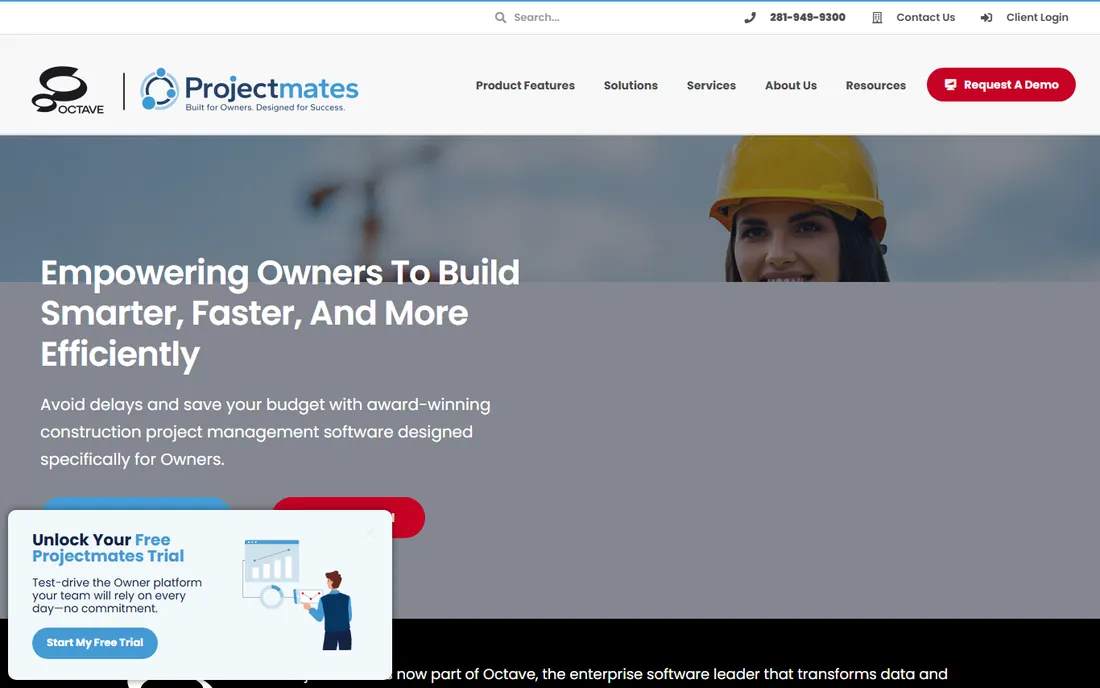
Projectmates takes the owner's perspective on construction management. Where contractor tools optimize the GC's workflow, Projectmates is designed for the party writing the checks: budget control, document management, bid management and capital project reporting across a portfolio. It is now part of Octave, and it has deep roots with institutional owners, which shows in the compliance and reporting depth.
For a private developer, the pitch is control without becoming a GC. You get visibility into every project, standardized processes across developments, and reporting your lenders and partners will accept. The trade is ecosystem: your contractors probably already know Procore, so expect some change management. Firms that self-perform or manage their own construction should compare both.
What we like- Built for owners rather than contractors, so the workflows match the developer's side of the table
- Highly configurable to existing processes instead of forcing a template
- Strong in regulated and institutional sectors like government, healthcare and education
Watch out for- Less name recognition than Procore, which can matter when onboarding GCs and consultants
- Enterprise sales process with no self-serve option
Starting priceSee website (custom quote)
Free planNo
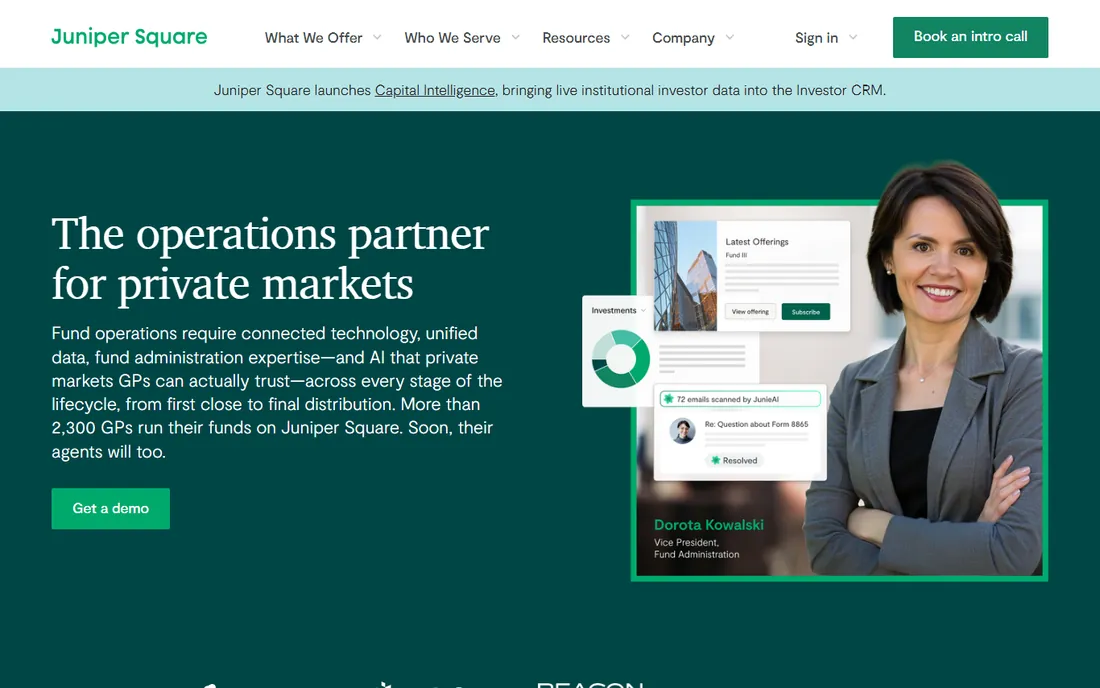
The moment a developer takes outside money, the business changes. Capital calls, distributions, K-1s, investor updates and fundraising pipelines become a second full-time job. Juniper Square absorbs it. More than 2,300 general partners run their funds on the platform, and the investor-facing portal is the part developers notice first: LPs get a professional dashboard instead of emailed PDFs, which genuinely helps the next raise.
The honest question is scale. A developer syndicating one deal with five investors does not need this. A developer building a pipeline of projects with dozens of LPs does. If you are moving from deal-by-deal syndication toward a fund model, Juniper Square is the infrastructure for that transition. Pair it with a development management tool for the project side.
What we like- Full fund operations in one system: investor CRM, fundraising, onboarding, fund accounting and reporting
- Investor portal that makes a small GP look institutional
- Purpose-built for private markets rather than adapted from generic CRM
Watch out for- Built for fund managers, so single-project sponsors may find it more than they need
- Pricing is enterprise and quote-based
#8
ARGUS Developer
Best for: Feasibility studies and project-level financial modeling
Visit altusgroup.com
Starting priceSee website (custom quote)
Free planNo
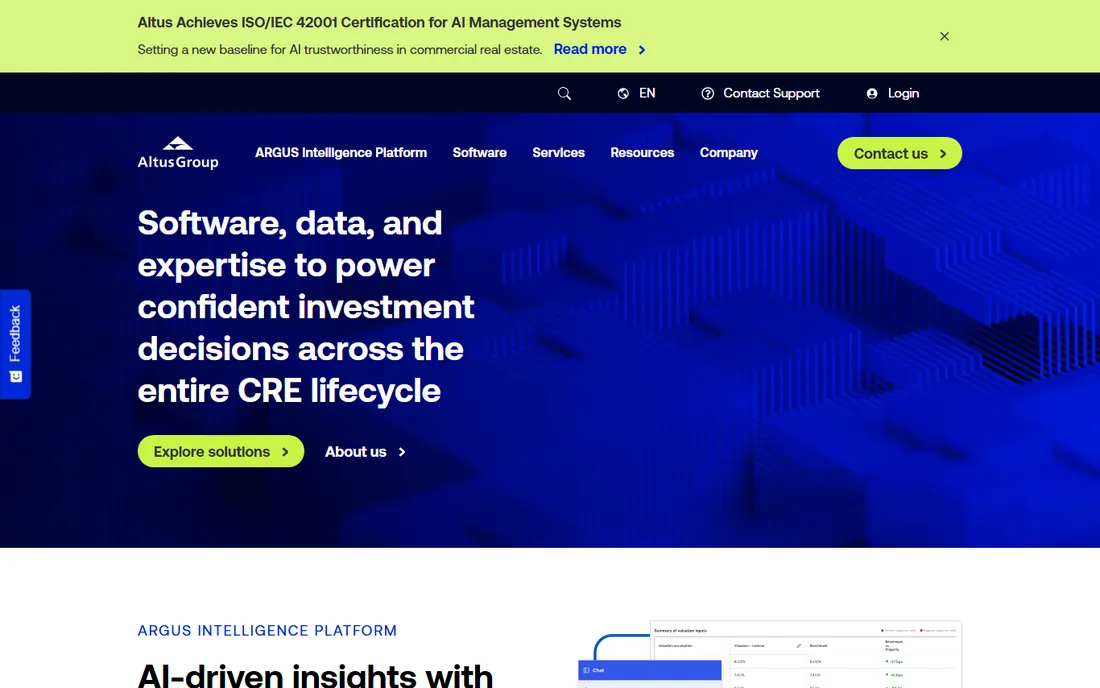
Before a developer commits capital, somebody has to prove the deal works. ARGUS Developer is the software for that job: feasibility analysis, residual valuations, development appraisals and phased cash flow modeling across complex, multi-stage projects. It sits inside Altus Group's ARGUS platform alongside ARGUS Enterprise, the valuation standard institutional investors expect. When a lender asks for your model, an ARGUS file speaks the industry's language.
Understand its lane. ARGUS models the economics; it does not manage the project. Developers use it at acquisition and refinancing, then run the build in something like Northspyre or Procore. The software rewards training: new analysts should budget real learning time. For firms doing ground-up development, though, it is close to mandatory.
What we like- Purpose-built for development feasibility, residual land valuation and multi-stage project cash flows
- Part of the ARGUS Intelligence Platform, the industry standard for CRE valuation
- Scenario modeling that stands up to lender and partner scrutiny
Watch out for- A modeling and analysis tool, not a project management platform
- The ARGUS learning curve is famously steep for newcomers
#9
Yardi Voyager
Best for: Developers holding and operating stabilized assets
Visit yardi.com
Starting priceSee website (custom quote)
Free planNo
Developers do not stay developers forever. Once projects stabilize, the business becomes asset management: leasing, operations, accounting, investor reporting. Yardi Voyager is the platform the industry's largest owner-operators run, with modules for property management, investment lifecycle, procurement and energy. For developers building a hold portfolio, it is the eventual destination.
Do not buy it too early. Yardi is an enterprise system with enterprise implementation, and a developer with two projects under construction will drown in it. The right time is when stabilized assets and headcount justify the investment. Until then, the development-phase tools above are the better spend.
What we like- Complete property management, accounting and investment management in one suite
- Handles multifamily, commercial, affordable and other asset classes
- New AI platform layer for portfolio analytics and reporting
Watch out for- Implementation is a major undertaking with long timelines
- Pricing is entirely quote-based and the total cost surprises first-time buyers
Why almost nobody publishes prices
In practice, not one tool on this list shows you a price before a sales call. That is not an accident. Development software is sold on annual contract value tied to your portfolio size, project count or construction volume, and vendors price-discriminate freely. Two developers can pay very different amounts for the same platform.
Budget accordingly. Expect five figures annually for the construction platforms at real project scale, and enterprise pricing for the capital-side tools. Get at least two quotes, ask what the price covers per project versus per user, and pin down implementation fees, which vendors love to quote separately. The cheapest quote is rarely the cheapest total cost once onboarding and integrations land.
What to look for before you buy
Match the tool to your phase
Map your pipeline honestly. If most of your pain is finding and underwriting deals, buy for the front end (Dealpath, ARGUS). If the pain is construction chaos, buy for the build (Procore, Buildertrend, Projectmates, Autodesk Forma). If the pain is investor management, buy for the capital side (Juniper Square). Buying a construction platform to fix a deal problem wastes a year.
Count projects, not just users
Pricing models vary: per user, per project, on construction volume, on assets under management. Model your cost at your actual scale over three years, not at the starter quote. A per-user tool gets expensive with a big field team; a volume-based tool gets expensive as your pipeline grows. Ask every vendor for the three-year math in writing.
Demand accounting integration
Development lives and dies on the draw process, and the draw process lives in accounting. Whatever you buy must integrate with your accounting system, whether that is QuickBooks, Sage, Yardi or a fund administrator. Ask for the integration by name, ask who supports it, and ask for a reference customer using it. A beautiful dashboard fed by manual CSV uploads is a trap.
Plan the implementation
None of these tools deliver value on signup. Budget 4 to 12 weeks for implementation, assign an internal owner, and migrate one live project first before rolling out the portfolio. Vendors that offer dedicated onboarding (Buildertrend and Projectmates both emphasize it) earn their fees here. The firms that fail at these rollouts fail on change management, not software.
How we chose
We started with the categories developers actually shop: development management software, real estate development project management, deal management for real estate, construction management for developers, real estate fund administration and development feasibility software. For each candidate we opened the vendor's homepage, checked the product's stated audience and feature set, and compared it against public reviews on G2 and Capterra and practitioner discussion on Reddit. Where a vendor published no pricing, we wrote "See website" rather than repeating third-party estimates. We excluded pure property management tools, generic project management apps and consumer home-design software as out of scope for developers.
Frequently asked questions
What software do real estate developers actually use?
Most development firms run a small stack: a deal or underwriting tool for acquisitions (Dealpath, ARGUS Developer), a development or construction management platform for the build (Northspyre, Procore, Buildertrend), and an investor or fund platform if they raise outside capital (Juniper Square). Single-project developers often get by with one construction tool plus spreadsheets.
How much does real estate development software cost?
Expect custom quotes across the board. Construction platforms typically run into five figures per year at real project scale, priced per user, per project or on construction volume. Enterprise tools for funds and large developers cost more. Always get implementation fees in writing, since vendors often quote them separately from the subscription.
Can I just use Procore or Buildertrend for everything?
They cover construction well and little else. Neither does deal underwriting, investor management or development-phase financial modeling. Developers who try to stretch a construction tool across the whole business usually end up back in spreadsheets for the capital side. Pair the build tool with something built for deals or money.
What is the difference between Northspyre and Procore?
Northspyre is built for developers and tracks the full development lifecycle including budgets, forecasts and draws from acquisition to stabilization. Procore is built for construction execution: drawings, RFIs, schedules and field coordination. Many firms use both, with Procore running the jobsite and Northspyre running the development business.
Do I need Juniper Square if I only syndicate occasionally?
Probably not. Juniper Square pays off when you manage many investors across multiple deals or run a fund structure. For a one-off syndication with a handful of investors, your attorney's documents plus a simple investor update process will do. Revisit when the investor count or deal count makes manual management painful.
Is ARGUS still relevant with all the new AI tools?
Yes, for one reason: it is the language lenders and institutional partners speak. Newer tools model deals faster, but an ARGUS file is still the expected deliverable in institutional commercial real estate. Learn the new tools for speed, keep ARGUS for credibility.
Sources we checked (12)
- https://northspyre.com
- https://dealpath.com/
- https://www.procore.com
- https://construction.autodesk.com
- https://construction.autodesk.com/pricing/
- https://buildertrend.com/
- https://projectmates.com/
- https://junipersquare.com/
- https://altusgroup.com/
- https://yardi.com/
- https://www.g2.com/categories/real-estate-development
- https://www.capterra.com/real-estate-development-software/
Is your product missing or out of date?
We review this list regularly. Vendors can request a listing, send updated pricing or ask about featured placement.

Shihab Mia · Founder, Rankite
Shihab has spent more than a decade helping SaaS and e-commerce brands grow through search. He writes Rankite's software buying guides from pricing pages, documentation and public user reviews. More about Shihab.