How we make this list: we compare pricing pages, product documentation and public user reviews. Ratings come from G2, Capterra or Trustpilot, with the date we checked them.
Key takeaways
- Istio gives the deepest traffic control and policy set, while Linkerd gives the simplest path to encrypted service traffic.
- Cilium suits teams already running Cilium networking, since mesh features arrive without a separate sidecar fleet.
- Consul and Kuma suit mixed estates where some services still run on virtual machines rather than Kubernetes alone.
- Most open source meshes cost nothing to download, so the real cost is the engineering time needed to run them well.
Quick comparison
| Tool | Best for | Starting price | Free plan |
|---|
 Istio | Large Kubernetes estates | Free (open source) | Yes |
 Linkerd | Simple, light meshes | Free (open source) | Yes |
 Consul | Mixed Kubernetes and VM estates | Free (open source) | Yes |
 Kuma | Multi-cluster and multi-cloud | Free (open source) | Yes |
 Cilium | eBPF networking teams | Free (open source) | Yes |
 Traefik Mesh | Small, simple clusters | Free (open source) | Yes |
 Gloo Mesh | Multi-cluster governance | See website | Free trial |
 Google Cloud Service Mesh | Google Cloud workloads | See website | Free trial |
Is your product missing or out of date?
We review this list regularly. Vendors can request a listing, send updated pricing or ask about featured placement.
Starting priceFree (open source)
Free planYes
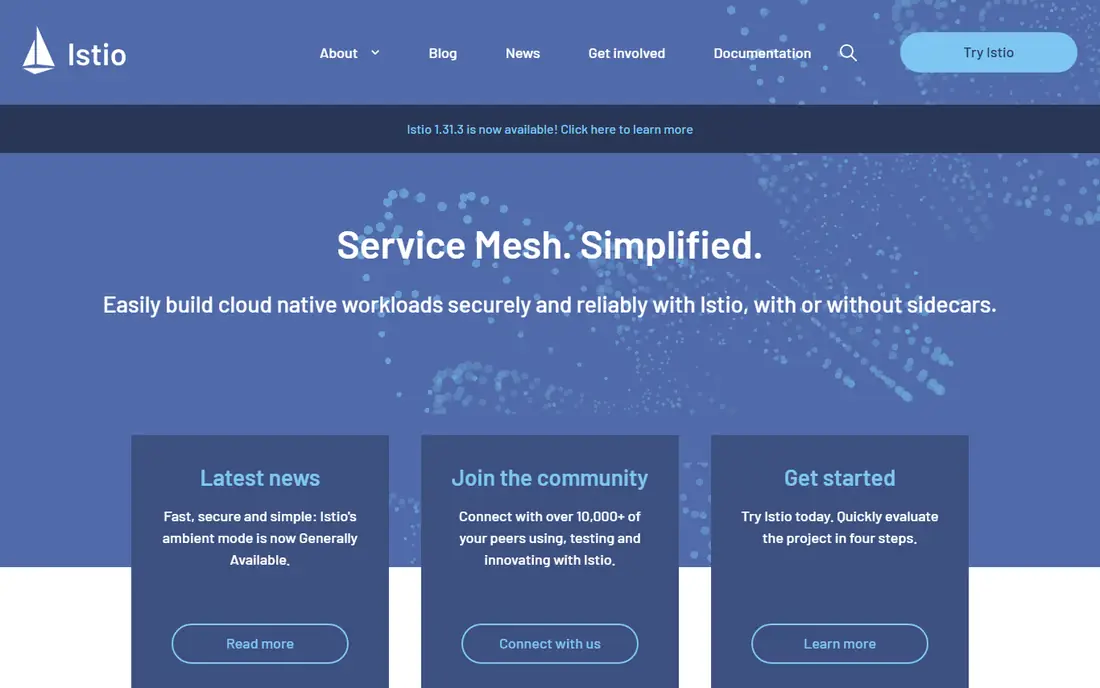
Istio is the most capable mesh on this list, and it shows in the breadth of its traffic controls. Teams can split traffic by weight, mirror requests, inject faults for testing, and enforce authorization policy per workload, all from one control plane. Ambient mode, which moves much of the data plane out of per-pod sidecars, cuts the resource tax that gave older Istio installs a bad name.
The catch is complexity. Istio has many moving parts, and small teams can spend more time tuning it than using it. It fits best where a platform team owns the mesh as a product, with clear upgrade and policy change routines. Solo teams with a handful of services will often find Linkerd faster to live with.
What we like- Deepest traffic controls
- Strong mTLS and policy model
- Large community and vendor support
Watch out for- Steep learning curve
- Heavier control plane
- Needs real operational attention
Starting priceFree (open source)
Free planYes
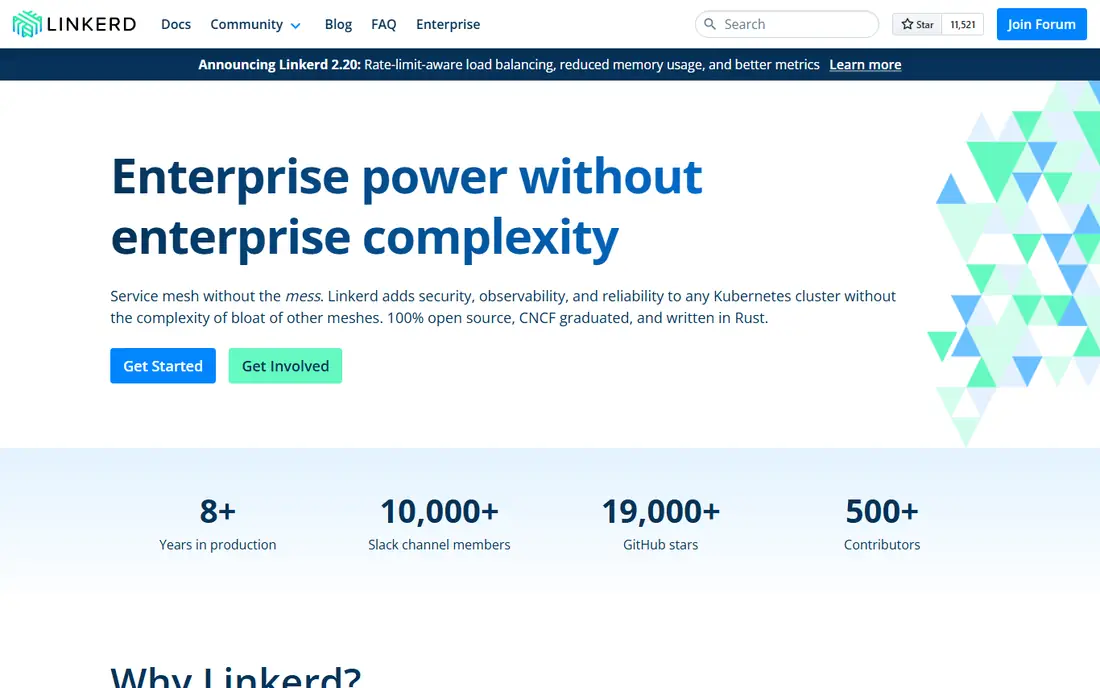
Linkerd takes the opposite approach from Istio: it does a smaller set of jobs and does them with little fuss. Its Rust-based proxy is light on memory and CPU, mTLS is on by default, and the built-in dashboards show success rate, latency, and request volume per route without extra wiring. Installation is a short command sequence, and most teams see encrypted traffic within an hour.
The trade is depth. Linkerd lacks some of Istio's finer traffic shaping and policy options, and its extension ecosystem is smaller. For teams whose main needs are encryption, retries, observability, and simple traffic splits, that trade is usually worth it. Linkerd is the mesh to pick when operational simplicity matters more than feature count.
What we like- Very light proxy
- Automatic mTLS
- Clear dashboards and golden metrics
Watch out for- Narrower traffic policy set
- Smaller extension ecosystem than Istio
Starting priceFree (open source)
Free planYes
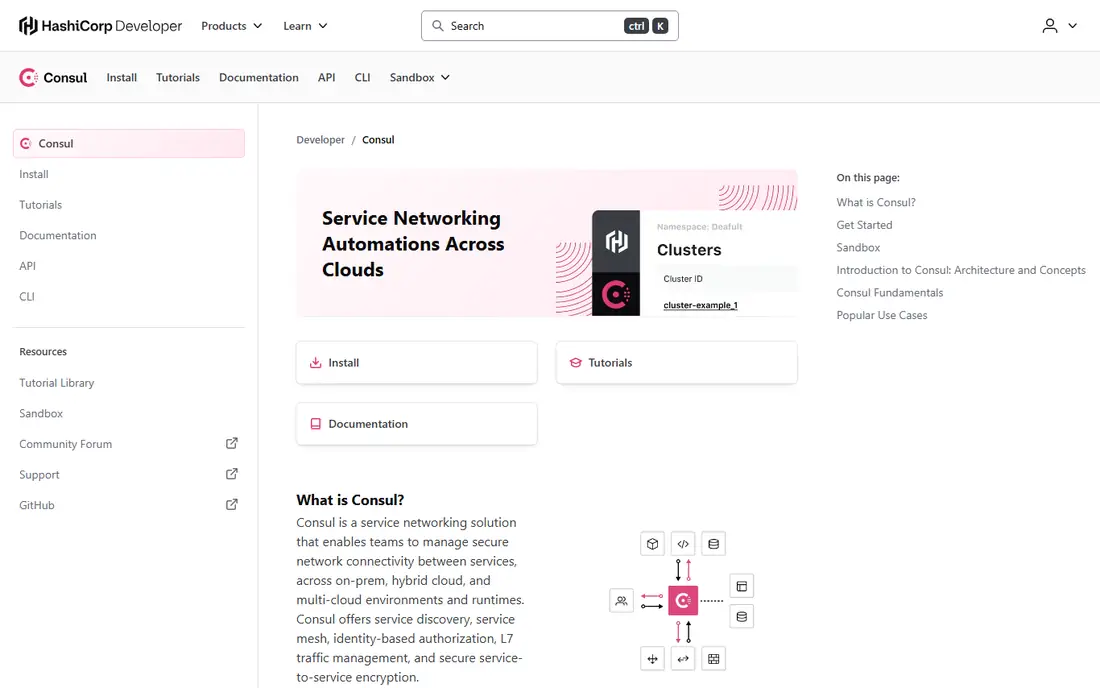
Consul started as a service discovery tool, and that history is its strength. Where services span Kubernetes clusters and virtual machines, Consul gives them one registry, one identity system, and one set of intentions governing which services may talk. Consul Connect adds mTLS and authorization on top of that registry, so mixed estates get mesh security without running two control planes.
The downside is scope. Consul is a broad platform, and teams that only need a Kubernetes mesh may find its discovery, key-value, and configuration features to be extra surface to learn. HashiCorp's enterprise tier also gates some governance and multi-cluster features. Even so, for hybrid estates, Consul remains the most coherent single choice.
What we like- Strong service discovery
- Works across Kubernetes and VMs
- Mature identity model
Watch out for- Mesh features sit inside a larger product
- Enterprise features are paid
Starting priceFree (open source)
Free planYes
Kuma is built around one idea: a single control plane should govern meshes running anywhere. Its multi-zone model lets a global control plane set policy while zone control planes run close to workloads, which suits teams spread across clouds and regions. It uses Envoy as its data plane, so traffic features will feel familiar to anyone who has worked with Envoy before.
Kuma's community is smaller than Istio's, which shows in fewer third-party guides and integrations. Kong sells enterprise support and a management console for teams that want a vendor behind the project. Kuma fits best for platform teams that value portability across clouds over the deepest single-cluster feature set.
What we like- Runs on Kubernetes and VMs
- Multi-zone design
- Envoy-based data plane
Watch out for- Smaller community than Istio
- Enterprise support sits with Kong
Starting priceFree (open source)
Free planYes
Cilium approaches the mesh from the networking layer rather than the proxy layer. Because it uses eBPF in the Linux kernel, it can enforce policy and collect telemetry without injecting a sidecar into every pod. For teams already running Cilium as their container network interface, turning on mesh features is a small step rather than a new deployment.
The catch is coupling. Cilium mesh makes most sense when Cilium already handles networking, and its L7 traffic features depend on how the cluster is configured. Teams on other network plugins face a migration before they see the benefit. Where Cilium is already in place, though, it is the lowest-friction mesh available.
What we like- Kernel-level processing
- No sidecars needed
- Strong network policy
Watch out for- Tied to Cilium networking
- L7 features vary by setup
Starting priceFree (open source)
Free planYes
Traefik Mesh is the lightest option here, designed for teams that want basic mesh behavior without adopting a large platform. It uses a per-node proxy rather than per-pod sidecars, and configuration follows Traefik's familiar routing model. Small clusters can add traffic control and service discovery with little new operational load.
The limits are real. Traefik Mesh offers far less in security policy and observability depth than Istio or Linkerd, and its community is small. It suits development clusters, small production estates, and teams already invested in Traefik ingress. Larger estates with strict policy needs should look higher up this list.
What we like- Very easy setup
- Non-invasive design
- Familiar Traefik routing
Watch out for- Thin feature set
- Limited policy depth
- Small community
Starting priceSee website
Free planFree trial
Gloo Mesh is a commercial management layer built on Istio, aimed at organizations running many clusters. It adds centralized policy, multi-cluster discovery, and gateway integration on top of Istio's data plane, with a console for teams that must prove consistent policy across estates. Solo.io sells support and enterprise features around it.
Because it builds on Istio, Gloo Mesh inherits Istio's learning curve, and pricing is quote-based rather than published. It fits enterprises that already chose Istio and now need governance across dozens of clusters. Smaller teams will get little extra value over plain Istio for the added cost.
What we like- Strong multi-cluster policy
- Gateway integration
- Enterprise support
Watch out for- Paid product
- Istio-based, so Istio complexity remains
Starting priceSee website
Free planFree trial
Google Cloud Service Mesh is Google's managed Istio offering, and its main selling point is the removal of control plane operations. Google runs the control plane, while teams keep Istio-style configuration for traffic and security. Integration with Google Cloud monitoring, logging, and identity makes it a natural pick for workloads already on that cloud.
The limits follow from that focus. Multi-cloud estates gain less, and costs ride on top of normal cloud usage rather than a flat license. Teams committed to Google Cloud, or running Anthos across sites, will find it the easiest managed route to an Istio-class mesh.
What we like- Managed control plane
- Deep Google Cloud integration
- Istio-compatible config
Watch out for- Google Cloud centered
- Pricing tied to cloud usage
How we chose
We compared pricing pages, project documentation, and public user reviews for meshes that are actively maintained in 2026. We favored tools with clear mTLS support, traffic management, and observability, and we checked whether each project still receives releases. AWS App Mesh was left out because its support window ends in 2026, which makes it a poor starting point for new projects. Open Service Mesh was also left out, since the project is archived and no longer maintained.
What to check before you commit
A mesh changes how every service talks, so the evaluation should focus on operations, not feature lists. Start with a single non-critical namespace, enable mTLS, and watch latency and error rates for a week before widening the rollout. Measure proxy resource use per pod or per node, since that cost recurs on every workload you add.
Fit the mesh to your estate
Count your clusters, clouds, and VM-based services before shortlisting. A Kubernetes-only estate can pick on simplicity, while a mixed estate should weight discovery and identity more heavily. Check whether your team already runs the networking or gateway pieces a mesh builds on, since reuse cuts both setup time and failure modes.
Budget for operations, not licenses
Open source meshes cost nothing to download, but they still need upgrades, certificate rotation, and policy reviews. Ask who owns the mesh on call, how upgrades are tested, and how policy changes are reviewed. Include time for training, since a mesh that only one engineer understands becomes a risk when that person is away. A mesh with a vendor support contract can be cheaper than a free one if your team has no platform engineers to spare.
Test the failure modes
Break things on purpose in staging: kill proxies, expire certificates, and push a bad policy. Note how errors surface and how fast traffic recovers. A mesh that fails quietly, or that needs manual repair after a bad rollout, will cost more in incidents than any license fee.
Frequently asked questions
Do I need a service mesh for a small application?
No, not usually. A handful of services behind an ingress controller and standard TLS can be simpler and cheaper to run. A mesh earns its place once service-to-service traffic grows hard to secure, observe, and control by hand.
Is mTLS automatic in these tools?
Mostly yes. Linkerd enables mTLS by default, and Istio, Consul, and Kuma enable it with modest configuration. Check the default policy for each tool, since some allow plain traffic until you set a strict mode.
How much latency does a mesh add?
It varies by design. Sidecar proxies add a hop per request, while eBPF-based designs like Cilium add less. Measure with your own traffic mix rather than trusting vendor figures, and test under load, not only at idle.
Can I run a mesh across multiple clouds?
Yes, with the right tool. Kuma and Consul are built for multi-cloud and VM estates, and Gloo Mesh governs Istio across clusters. Single-cluster meshes need extra federation work to reach the same result.
Should I pick Istio or Linkerd?
Pick Istio when you need deep traffic policy, complex authorization, and a large ecosystem. Pick Linkerd when you need encrypted, observable traffic with the least operational load. Many teams prototype with Linkerd and move only if they hit its limits.
Sources we checked (8)
- https://istio.io
- https://linkerd.io
- https://www.consul.io
- https://kuma.io
- https://cilium.io
- https://traefik.io
- https://www.solo.io
- https://cloud.google.com
Is your product missing or out of date?
We review this list regularly. Vendors can request a listing, send updated pricing or ask about featured placement.

Shihab Mia · Founder, Rankite
Shihab has 5+ years in B2B and SaaS SEO. He writes Rankite's software buying guides from pricing pages, documentation and public user reviews. More about Shihab.