How we make this list: we compare pricing pages, product documentation and public user reviews. Ratings come from G2, Capterra or Trustpilot, with the date we checked them.
Key takeaways
- This article is general information, not medical advice. Whether a psychiatric service dog fits your treatment plan is a decision for you and your clinician.
- Under the ADA, a service dog is defined by training, not breed: a dog individually trained to perform tasks for a person with a disability. Any breed can qualify, and no registry or certificate exists.
- A psychiatric service dog is not an emotional support animal. ESAs provide comfort by presence, need no task training, and have no public access rights under the ADA.
- Cost is the hard part: a professionally trained psychiatric service dog typically runs $15,000 to $30,000 or more. Owner training is legal and far cheaper, but takes one to two years of consistent work.
Quick comparison
Is your product missing or out of date?
We review this list regularly. Vendors can request a listing, send updated pricing or ask about featured placement.
The best service dog breeds for anxiety and depression

#1
Labrador Retriever
Best for: The all round first choice
Visit akc.org
Starting priceSee website
Free planNo
The Labrador is the default psychiatric service dog because it combines the traits the work demands: emotional steadiness, eagerness to learn tasks, comfort with strangers and crowds, and enough size to deliver effective deep pressure. Programme after programme selects Labs first, which also means the most training knowledge and breeder experience exists for this breed.
Its challenges are the ordinary ones of a large, energetic young dog. A Labrador puppy is a bulldozer of enthusiasm for its first eighteen months, and a handler whose condition makes consistent daily training hard should plan support, a professional trainer's guidance at minimum.
What we like- The most used service breed for a reason: steady temperament, high trainability, and a strong desire to work with people
- Big enough for deep pressure therapy and mobility adjacent tasks
- Forgiving of first time handlers
Watch out for- Young Labs are boisterous and need a year or more of maturity before task reliability
- Food motivation aids training and threatens waistlines
- Shedding is constant
- Popularity means puppy scams and poor breeders are common

#2
Golden Retriever
Best for: Gentle, people focused handlers
Visit akc.org
Starting priceSee website
Free planNo
Golden Retrievers earn their place on attunement: the breed reads people closely, which is the raw material for tasks like responding to rising anxiety, initiating contact during dissociation, and settling into pressure work calmly. Handlers who want a dog that seeks them out often land on a Golden, and service programmes have used the breed for decades.
The same sensitivity is the risk. A poorly bred or under socialised Golden can absorb a handler's anxiety instead of working through it, which is why breeder selection and early professional assessment matter more here than the breed label. Ask hard questions about health testing and longevity in the line; Goldens are not the longest lived breed on this list.
What we like- Exceptionally attuned to human emotion, the trait handlers cite most
- Soft, patient manner suits anxiety tasks and public work
- Highly trainable with a strong retrieve for medication tasks
- A classic service breed with deep programme support
Watch out for- Sensitivity can tip into anxiety in the dog itself if the line is poorly bred
- Heavy shedding and grooming needs
- Cancer rates in the breed are a documented concern, ask breeders directly
- Needs substantial daily exercise and engagement

#3
Standard Poodle
Best for: Handlers with allergies
Visit akc.org
Starting priceSee website
Free planNo
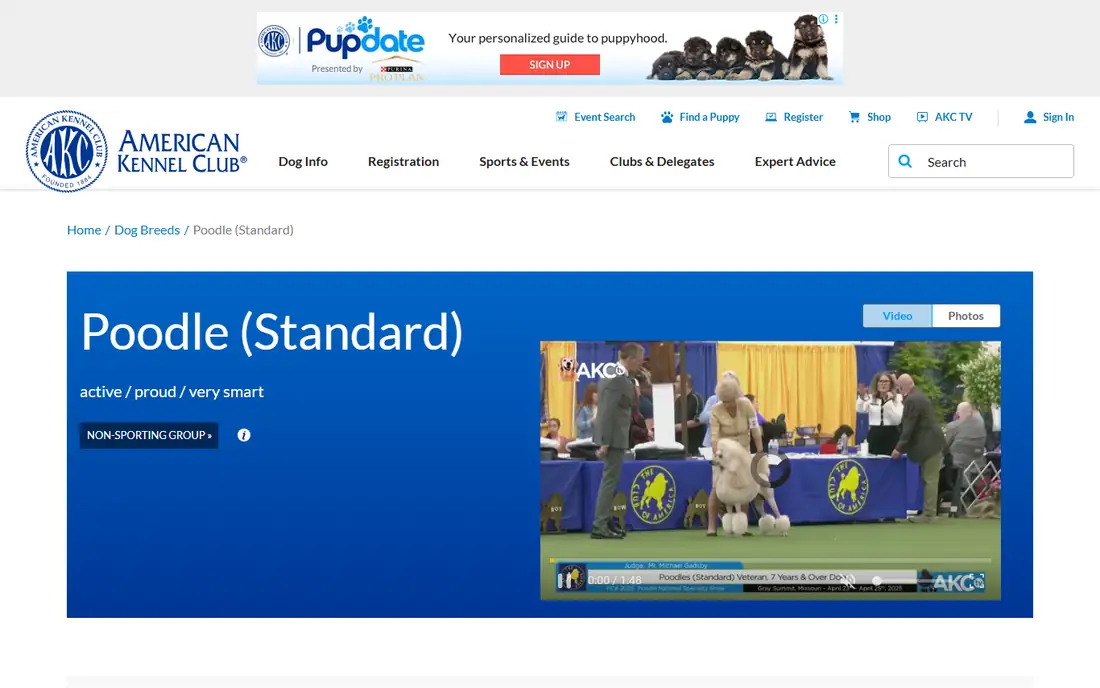
The Standard Poodle is the service breed hiding in plain sight. Before it was a fashion dog it was a working retriever, and it brings a retriever's trainability and task focus with a coat that sheds minimally, which is why programmes place Standards with handlers whose allergies rule out Labs and Goldens.
Plan for the coat honestly: a working poodle needs regular professional grooming or a handler willing to learn the clippers, and skipping it produces matting that hurts the dog. Standards can also be more environmentally sensitive than Labs, so early socialisation to noise, crowds, and surfaces is not optional.
What we like- A low shedding, low dander coat, the standard answer for allergic handlers
- Highly intelligent and task capable, a historic working breed under the haircut
- Athletic enough for active handlers, calm enough for public access
- Long lived for a large breed
Watch out for- Coat care is a real, recurring cost and time commitment
- Intelligence means boredom behaviours if under worked
- Some lines are more reserved or noise sensitive, selection matters
- Miniature and toy poodles are too small for pressure tasks, the standard is the service size

#4
Cavalier King Charles Spaniel
Best for: Smaller living spaces, calm tasks
Visit akc.org
Starting priceSee website
Free planNo
The Cavalier suits handlers whose task list fits a small dog: grounding through contact, interrupting spirals by demanding interaction, alerting to rising anxiety it has learned to read, and providing pressure across a lap or chest rather than a whole body. For apartment dwellers and frequent travellers, its size solves practical problems the big breeds create.
Be clear eyed about two limits. A 15 pound dog cannot perform the weight based pressure work a Lab can, so handlers whose clinicians recommend deep pressure therapy should look up the list. And this breed has significant hereditary health problems; a Cavalier from a breeder who does not screen hearts and brains is a heartbreak risk.
What we like- A small, gentle companion breed suited to apartments and travel
- Affection driven, happiest in close contact, which suits grounding and lap pressure
- Lower exercise and food costs than the large breeds
- Easy to transport for handlers who fly or use transit often
Watch out for- Too light for true deep pressure therapy on an adult
- The breed carries serious known health issues, heart and neurological, so breeder health testing is essential
- Separation anxiety is common in a breed bred for constant companionship
- Fewer programmes train Cavaliers for psychiatric work

#5
German Shepherd Dog
Best for: Confident, task heavy work
Visit akc.org
Starting priceSee website
Free planNo
The German Shepherd's service history runs from guide dogs to military work, and its psychiatric task ceiling is the highest here: complex sequences, room checks, crowd blocking, and boundary work are natural to a breed built to think alongside a handler.
That intensity is the entry requirement. A Shepherd bonds hard, guards readily, and notices everything, which means sloppy socialisation produces a reactive dog, and a reactive dog cannot work in public and may have to be washed from training. This is a breed for handlers with dog experience and professional training support. Matched well, it is superb; matched casually, it is the hardest dog on this list.
What we like- The original service breed, with unmatched task learning capacity
- Strong at boundary and space creation tasks in crowds
- Loyal and handler focused to a fault
- Size and presence suit handlers who feel safer with a substantial dog
Watch out for- Protective instincts can become reactivity if socialisation or breeding is poor, a public access liability
- Needs an experienced, consistent handler
- Shedding is heavy and constant
- Some venues and insurers treat the breed with suspicion, unfairly but really

#6
Border Collie
Best for: Handlers who can match high energy
Visit akc.org
Starting priceSee website
Free planNo
Border Collies learn anxiety interruption tasks almost uncomfortably fast; the breed watches its handler the way other dogs watch a thrown ball. For a handler whose life is active and outdoors, a collie can be a remarkable psychiatric partner, reading mood shifts early and working all day.
The honesty this breed demands is about the handler's worst weeks, not their best. A Border Collie needs serious physical and mental work every day, and depression can make that impossible precisely when the dog is most needed. A collie whose needs go unmet does not rest quietly; it unravels, and so does the working partnership. Choose this breed only if your support system can cover the dog on your bad days.
What we like- Arguably the most intelligent and observant breed here, quick to learn subtle anxiety cues
- Tireless work ethic for handlers with active, outdoor lives
- Medium size suits lap pressure work and tight spaces
- Long working lifespan in well bred lines
Watch out for- The highest exercise and mental work demands on this list, daily, without exception
- Understimulated collies invent jobs, including herding and anxious behaviours
- Sensitivity to movement and noise can complicate public access training
- A poor match for handlers whose depression can flatten activity for days

#7
Havanese
Best for: A small dog for grounding and alerts
Visit akc.org
Starting priceSee website
Free planNo
The Havanese is Cuba's companion breed, and companionship is engineered into it: a dog that wants to be on you and involved in everything. For anxiety work built on contact, grounding, and early mood response, that clinginess is the qualification. It is also small enough for handlers who cannot manage a 70 pound dog.
Its limits are the small dog limits from the Cavalier entry, lighter pressure, vulnerability in crowds, more grooming than its size suggests, with an added caveat: fewer breeders and programmes work with Havanese as service prospects, so a handler may need to owner train with professional guidance rather than buy a placed dog.
What we like- A sturdy small breed bred for companionship, cheerful and people centred
- Low shedding coat suits sensitive households
- Portable for travel, small apartments, and handlers with limited strength
- Trainable and eager, with a clownish streak that lifts mood by design
Watch out for- Too small for weight based pressure tasks
- Coat needs regular grooming despite the low shedding
- Small dog fragility matters in crowded public spaces
- A less common service choice, so programme support and breeder experience are thinner

#8
Australian Shepherd
Best for: Active handlers, routine based tasks
Visit akc.org
Starting priceSee website
Free planNo
The Australian Shepherd suits the handler whose treatment plan runs on routine: medication at set times, walks that anchor the day, structure the dog enforces by expecting it. Aussies learn schedules completely, and their medium large build delivers genuine pressure work that the small breeds cannot.
Manage the herding heritage honestly. Young Aussies may nip at heels and chase movement, behaviours that training must extinguish before public work, and their energy budget is second only to the Border Collie's here. For an active handler who wants a dog that organises the day by needing it organised, the Australian Shepherd is a strong candidate; for a quiet apartment life, it is a mismatch.
What we like- A bright, energetic working breed that thrives on routine based tasks like medication schedules
- Strong handler focus and quick learning
- Medium to large size gives real pressure capability
- A good match for rural and suburban active households
Watch out for- Despite the name it is an American breed with herding instincts, including nipping at heels in untrained youngsters
- Energy and intelligence demands approach the Border Collie's
- Herding movement sensitivity needs managing in public access work
- Shedding and grooming are significant
How we chose
We selected breeds that service dog programmes and trainers most commonly place or accept for psychiatric work, weighing trainability for the standard psychiatric tasks, deep pressure, behaviour interruption, medication tasks, and grounding, alongside temperament stability in public. Legal framing uses 2026 sources comparing ADA service animal rules with ESA status, and cost figures come from WellnessWag's PSD cost analysis. The AKC links in the website fields are breed information pages. Online registries are not endorsed anywhere here, because no official registry exists.
What to look for in a service dog breed for anxiety and depression
Start with the tasks, not the breed. Sit down, ideally with your clinician, and list what the dog must actually do: interrupt a panic spiral, apply pressure, fetch medication, enforce a routine, check a room. The list eliminates breeds immediately: pressure work needs weight, travel needs portability, cue reading needs attunement. Then judge your own capacity with equal honesty: training takes one to two years of near daily sessions, and the dog needs exercise and care on your worst days too.
Investigate the individual, not the label. Meet breeders, ask for health testing records, ask what happens to puppies that wash out, and if you are owner training, have a professional trainer assess any candidate dog's temperament before you commit, because most pet dogs do not have the nerve for public access work. Finally, ignore anyone selling registration, certificates, or ID cards: the ADA requires none, and paid paperwork adds no rights. Money offered for instant certification is a scam aimed at people in distress.
Frequently asked questions
What is the difference between a psychiatric service dog and an emotional support animal?
Training and rights. A psychiatric service dog is individually trained to perform tasks that mitigate a psychiatric disability, and it has full public access rights under the ADA. An emotional support animal provides comfort by its presence, requires no task training, and is not a service animal under the ADA: it has no right to enter shops or restaurants, airlines have treated ESAs as pets since 2021, and its only recognition is as a housing accommodation under the Fair Housing Act, where rules and enforcement have shifted in 2026, so verify your local position.
How much does a psychiatric service dog cost?
A fully trained dog from a professional organisation typically costs $15,000 to $30,000 or more, reflecting up to two years of training, and nonprofit programmes that place dogs free or cheaply carry waitlists that can run to years. Owner training is legal under the ADA and far cheaper: sources put it from a few hundred to a few thousand dollars depending on how much professional guidance you buy, plus the dog itself and a year or two of your time. Ongoing care runs to roughly $1,000 to $3,000 a year. There is no legitimate fee for registration or certification, because neither exists.
Can I train my own dog as a psychiatric service dog?
Yes. The ADA allows handlers to train their own service dogs and requires no certification, test, or professional programme. The standards are behavioural: the dog must perform its tasks reliably, be under control, housebroken, and behave appropriately in public, where it can legally be removed if it is disruptive. Realistically, most people use a professional trainer's help at least for assessment and public access skills, and many pet dogs wash out. That is the normal outcome rate, and a washed dog is still your dog.
Which breed is best if I live in a small apartment?
Of the breeds here, the Cavalier King Charles Spaniel and the Havanese fit small spaces best, with lower exercise needs and a size that suits lifts, transit, and small rooms. Match them to a task list that does not require full body pressure work. If your clinician recommends deep pressure therapy, a smaller dog's weight will not deliver it, and that is the honest conversation to have with your clinician and a trainer.
Is this article medical advice?
No. It is general information about dog breeds and US disability law as reported in October 2026. Whether a psychiatric service dog is appropriate for your condition, which tasks would help, and how one fits alongside therapy or medication are questions for the clinician treating you. If you are in crisis, contact your local emergency services or, in the US, call or text 988 for the Suicide and Crisis Lifeline.
Sources we checked (0)
Is your product missing or out of date?
We review this list regularly. Vendors can request a listing, send updated pricing or ask about featured placement.

Shihab Mia · Founder, Rankite
Shihab has 5+ years in B2B and SaaS SEO. He writes Rankite's software buying guides from pricing pages, documentation and public user reviews. More about Shihab.