How we make this list: we compare pricing pages, product documentation and public user reviews. Ratings come from G2, Capterra or Trustpilot, with the date we checked them.
Key takeaways
- Judge every company here on the ongoing monthly rate, never the first month. The famous 1 dollar first month is real, and it is rent only: add an admin fee around 29 dollars, a lock and required protection cover, and day one costs about 65 dollars even on the best promotion.
- Rates rise. After any promotion ends you pay the street rate, and the industry's standard practice is periodic increases on existing tenants, often within the first year. Ask each facility how often it raises in place tenants and by how much; the answer is the comparison.
- A 10 by 10 unit, the standard benchmark, averages roughly 80 to 150 dollars a month nationally in current comparisons, with big city and climate controlled units at two to three times that.
- Month to month terms are the consumer's protection in this industry. Every company here rents monthly, so a bad rate increase is answered by moving, and the companies know it.
Quick comparison
Is your product missing or out of date?
We review this list regularly. Vendors can request a listing, send updated pricing or ask about featured placement.
The best self storage companies
Starting priceSee website
Free planNo
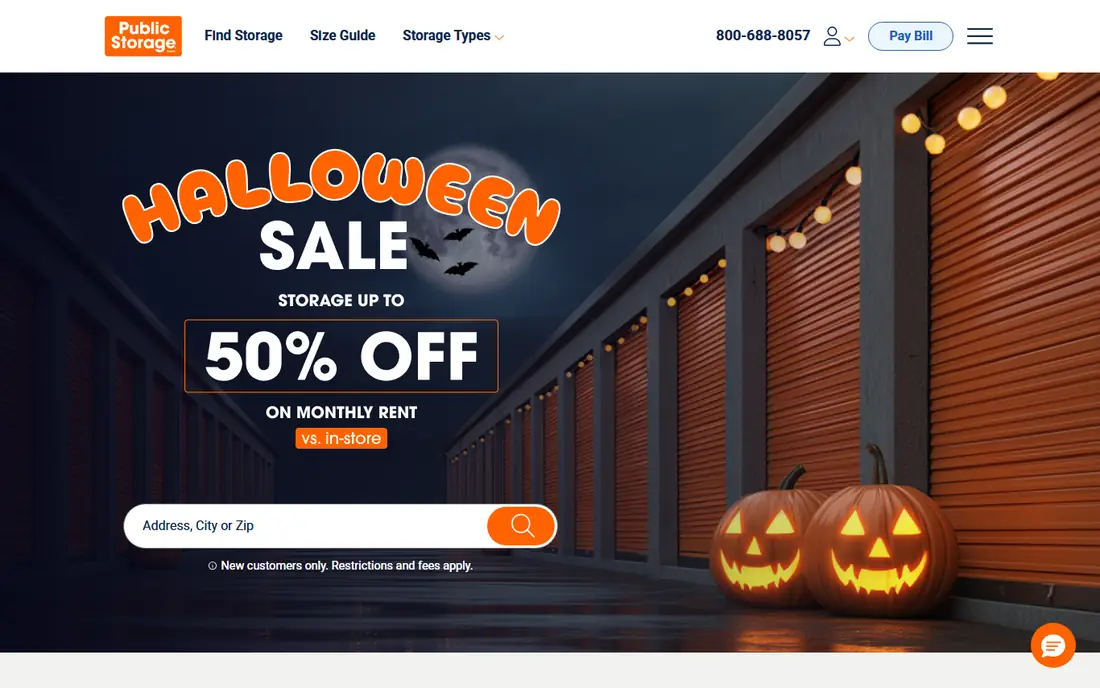
Public Storage is the market's default: unmatched convenience and headline deals, priced honestly only from month two onward.
Reserve online even if you plan to visit. The online rate for your unit is frequently the better one, and the reservation costs nothing and holds the promotion.
What we like- Public Storage is the name on the orange doors everywhere: thousands of US locations, the deepest big city coverage in the industry, online rental with contactless move in, and the most aggressive promotions, including its famous 1 dollar first month on select units and percentage discounts across the first months. Month to month terms are standard. For availability of a specific size near a specific address, it is the likeliest answer in America.
Watch out for- The promotion ends, and reviews and pricing guides are consistent that rent rises after it, on top of scheduled increases over time. An admin fee around 29 dollars, a lock and a protection plan around 15 dollars a month unless you prove your own cover, build the real move in cost. Facility age and quality vary widely across its enormous estate. Online prices are often lower than walk in prices for the same unit, a two tier habit worth knowing before you visit.
Starting priceSee website
Free planNo
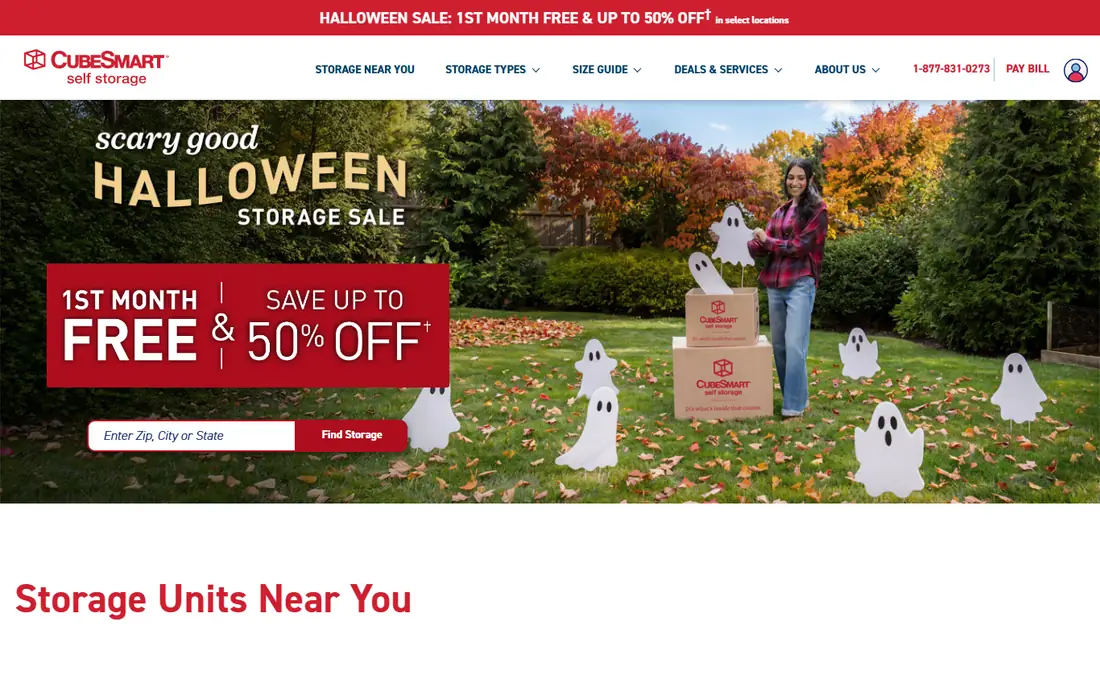
CubeSmart is the digital convenience pick of the big three: book online, take the online rate, manage everything from the phone, and expect a tidier facility than the industry's average.
Its referral economics make it the social choice too: households moving in clusters can sequence referrals and shave real money off several first months.
What we like- CubeSmart operates around 1,500 locations with a service led reputation, strong online booking discounts, its own 1 dollar first month style promotions and online only rate cuts, and extras like free moving truck use at some locations. Its app and account experience rate well in reviews. Military discounts and referral offers add small genuine edges. Facilities skew modern in its managed growth markets.
Watch out for- It manages many sites for third party owners, so standards and even branding vary behind the logo. Rate increases follow the same industry pattern. Coverage is thinner in the West and rural areas than the top two. Climate controlled availability varies sharply by site.
Starting priceSee website
Free planNo
U-Haul is the move in motion answer: when the truck is already rented, its storage offer is the path of least resistance and often the cheapest first month in the market at zero.
Separate the decisions at renewal time. The bundle won month one; by month four you are a storage tenant like any other, and the street rate comparison applies to you too.
What we like- U-Haul is the only operator in all 50 states and the only one that is also the moving company: truck, trailer, boxes, labour marketplaces and storage in one transaction, including a widely offered first month free storage promotion tied to truck and trailer rentals. Its roughly 2,000 company owned storage locations plus affiliates put a unit near almost every move in America. For the classic use case, the household between homes this month, the bundle is unbeatable logistics.
Watch out for- Storage is its second business, and it shows: facility standards vary from modern flagships to basic lots, and the storage product gets less investment attention than the truck fleet. Standalone storage pricing without a truck rental is mid field. Its best promotion requires the rental bundle. Account and facility tech trail the storage pure plays.
Starting priceSee website
Free planNo
StorageMart is the tidy operator pick: where it has a facility near you, it commonly wins the visit test, and storage is a product you experience by visiting.
Judge it in person at dusk. Lighting, cleanliness and gate condition at the hour you will actually come are worth more than any brand promise in this guide.
What we like- StorageMart, a large family grown operator with hundreds of locations across the US, Canada and the UK, built its name on cleanliness standards, well lit facilities and straightforward pricing with regular first month offers. Reviews consistently praise its sites' upkeep relative to price. Its charity tie ins, storing a unit's value in community giving programmes, are unusual in the industry. For a tenant who visits their unit monthly, the facility experience is the product, and StorageMart sells a good one.
Watch out for- Its footprint, while large, is regional compared with the giants, so your town may have none. Online tooling is a step behind CubeSmart's polish. Increase practices follow industry norms. Premium urban coverage is limited.
Starting priceSee website
Free planNo
SmartStop is the new build pick: in its markets, often the newest facility on the storage corridor, which in this industry is a genuine feature and not a slogan.
If your storage is long term, a newer building's roof and climate systems are the closest thing to insurance the product offers. Price that against the giants' promotions honestly, over twelve months, not one.
What we like- SmartStop is a fast growing listed operator whose estate skews newer, with modern builds, strong climate controlled stock and a digital first rental experience in its US and Canadian markets. Newer facilities mean better lifts, better lighting and better drainage than the industry's 1980s stock, which is most of what tenants actually experience. Promotions compete with the giants in its markets.
Watch out for- Growth means patchwork coverage
- Many regions have no site. A younger brand carries less review history per facility. Pricing and increase behaviour follow the market's standard model. Some locations are acquired rather than built, diluting the newness advantage street by street.
Starting priceSee website
Free planNo
Safeguard is the valuables pick: when the unit holds business stock, instruments or records, its security specification is a rational place to spend the difference.
Ask for the security specifics in writing, alarm per unit, access logs, camera coverage, because that specification, not the brand story, is what you are paying the premium for.
What we like- Safeguard positions at the premium end: facilities built around security and access technology, computer controlled individual unit alarms and access logging, climate control as a standard rather than an upgrade in many sites, and a design led estate concentrated in major metros. For business records, equipment and anything whose loss would hurt, its per unit security pitch is the strongest in this list.
Watch out for- Premium means price: its rates sit above local averages in its expensive home markets. The estate is concentrated, strong in the New York metro and selected cities, absent most elsewhere. Promotions are less theatrical than the giants'. If your need is a cheap 5 by 5 for seasonal clutter, its strengths are wasted spend.
Starting priceSee website
Free planNo
Prime completes the map because storage is regional: in much of the East it will be the third quote beside the two giants, and third quotes are where tenants save their real money.
Never rent storage from a single quote. Prime's existence in the East, and its equivalent regional operators elsewhere, is the standing reminder that the corridor always has another door.
What we like- Prime Storage is one of the largest private operators, with a dense estate across the Eastern US built by acquiring and upgrading local facilities, professionalised under one brand with online rental and standard modern features. In its regions it often operates the best located independent feeling sites with big operator systems behind them. Acquisition led growth keeps its facilities varied and frequently well sited on the roads people actually use.
Watch out for- Varied is the honest word: an acquired estate means the facility experience depends on when your site joined and how much was spent on it. National brand awareness is low. Promotions and pricing are locally set against the giants nearby. Coverage west of its heartland is thin to absent.
How we chose
We selected the largest and most distinct self storage operators serving US customers in 2026, from the national giants to premium and regional specialists, since the keyword asks for companies rather than apps. Behavioural facts, promotions, fees and rate practices, come from current pricing guides and operator reviews as of October 2026, including Public Storage's 1 dollar first month terms, its roughly 29 dollar admin fee and protection plan costs, and national 10 by 10 averages of about 80 to 150 dollars. Location counts are approximations from current comparisons. No unit was rented for this guide, and every price must be confirmed for your facility and move in date.
How to rent storage without overpaying
Price month twelve, not month one. Take the street rate, add the protection plan and fees, and multiply out a year, assuming at least one increase, because the industry's standard programmes deliver them. Compare that total across three facilities within your acceptable drive. That is the only honest leaderboard in storage.
Ask the increase question out loud. How often do in place tenants get increases here, and what was the last one. Staff answer it daily; the answer is recorded nowhere in the advertising, which is precisely why it is the question that separates informed tenants from the yield model.
Right size ruthlessly and revisit quarterly. Households rent for the move in peak and keep paying for it through the year. A smaller unit, a charity drop and a ruthless afternoon with the boxes routinely saves 30 dollars a month forever, which beats any promotion ever printed.
Frequently asked questions
Is the 1 dollar first month real?
Yes, at Public Storage, CubeSmart and others on select units for new customers, and it covers rent only. The realistic day one total adds an admin fee of about 29 dollars at Public Storage, a lock if you need one at around 20 dollars, and a protection plan around 15 dollars a month unless you document your own cover, landing near 65 dollars before the truck. From month two you pay the unit's regular rate, which is the number your decision should be built on.
How often do storage companies raise rent?
There is no regulated schedule. The large operators run existing customer increase programmes that typically begin within the first several months and recur periodically, sized to what each local market tolerates. Across a two year tenancy, paying 20 to 40 percent more than your move in street rate is a common experience in tenant reporting. Month to month terms are your remedy: you can always leave, and facilities price that risk into how far they push.
What size unit do I need?
A 5 by 5 holds boxes and a small room's overflow. A 5 by 10 takes a studio. A 10 by 10, the benchmark in this guide, holds a one to two bedroom home's furniture. A 10 by 20 is a multi room house or a car plus contents. Every operator's site runs a size guide; use it, then rent one size smaller than your instinct, because instinct packs air and furniture Tetris is a real and learnable skill.
Do I need climate controlled storage?
For wood furniture, electronics, instruments, photographs, documents and anything you would not leave in a garage through your state's worst season, yes, and it typically adds a quarter to a half to the rent. For tools, plastic bins and short summer stays, usually not. In humid and in very cold states the calculation tilts further toward climate control for anything kept beyond a few months.
Can a storage company sell my things if I miss payments?
Yes, under state lien laws, after notice and a process that varies by state. Storage contracts grant the operator a lien on stored property for unpaid rent, and auctions of delinquent units are the industry's legal remedy, dramatised on television and routine in reality. Autopay and a current phone number and address on file are the entire defence; most lost units are lost to a stale contact detail, not a dramatic default.
Sources we checked (0)
Is your product missing or out of date?
We review this list regularly. Vendors can request a listing, send updated pricing or ask about featured placement.

Shihab Mia · Founder, Rankite
Shihab has 5+ years in B2B and SaaS SEO. He writes Rankite's software buying guides from pricing pages, documentation and public user reviews. More about Shihab.
 Public Storage
 Extra Space Storage
 CubeSmart
 U-Haul
 StorageMart
 SmartStop Self Storage
 Safeguard Self Storage
 Prime Storage