How we make this list: we compare pricing pages, product documentation and public user reviews. Ratings come from G2, Capterra or Trustpilot, with the date we checked them.
Key takeaways
- Collectr is the best all round collection tracker, with scanning, portfolio value over time and prices drawn from real marketplace sales.
- TCGplayer and eBay sold listings are the price sources serious sellers trust most, because they show what cards actually sold for rather than what sellers ask.
- Ludex and CollX lead on camera scanning speed for big collections, and PriceCharting is the deep archive for vintage and graded card prices.
- Every figure these apps show is a market estimate that swings with condition and grading: for a genuinely valuable card, a professional grading company or appraiser is the authority, not an app.
Quick comparison
| Tool | Best for | Starting price | Free plan |
|---|
 Collectr | Tracking a collection and its total value | Free | Yes |
 TCGplayer | Market prices from the biggest card marketplace | Free | Yes |
 PriceCharting | Price history for raw and graded cards | Free | Yes |
 Ludex | Fast scanning and cataloguing | Free | Yes |
 CollX | Scanning cards and tracking at shows | Free | Yes |
 eBay | Checking real sold prices yourself | Free | Yes |
 Pokellector | Set completion and checklists | Free | Yes |
Is your product missing or out of date?
We review this list regularly. Vendors can request a listing, send updated pricing or ask about featured placement.
The best Pokemon card value apps
Starting priceFree
Free planYes
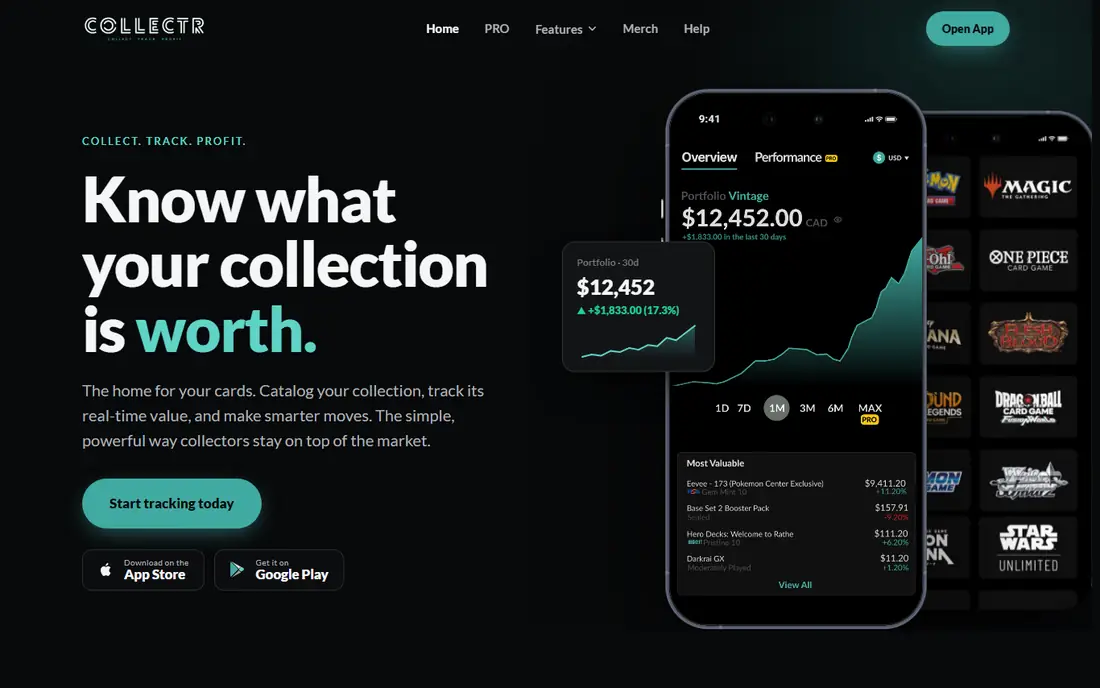
What we like- Collectr was built for exactly this job: scan or search your cards, build your collection, and watch a portfolio value update from marketplace pricing, with charts over time, wishlist and showcase features, and coverage across Pokemon and the other major trading card games. Its database and price sourcing lean on real sales data, and the app handles raw and graded copies as the separate assets they are. For a collector who wants one home screen answering what do I own and what is it worth this month, Collectr is the most complete answer here, free for core use with a Pro tier for advanced portfolio tools.
Watch out for- Portfolio totals inherit the estimate problem in full: the number assumes your condition grading is accurate and that every card could sell at the tracked price at once, neither of which survives contact with a real buyer. Scanner accuracy varies with lighting and card finish, foils especially, so bulk scanning needs a checking pass. Some advanced analytics sit behind Pro. Thin vintage cards can carry stale prices where sales are rare.
Starting priceFree
Free planYes
What we like- TCGplayer is the largest dedicated marketplace for trading cards in the US, and its market price, built from actual sales across thousands of sellers, is the reference figure much of the hobby quotes. The app scans cards into a collection view, shows prices by condition, and connects directly to buying and selling when a price tempts you either way. Because so many other tools license or mirror TCGplayer data, going to the source removes one layer of delay and error. For pricing a modern card to sell this month, this is the number to beat.
Watch out for- Market price is a snapshot of a moving market and lags fast rises and falls by days. Condition pricing depends on sellers grading honestly, so the near mint figure blends strict and generous gradings. The collection tracking is a side feature beside Collectr's purpose built portfolio. International collectors find thinner coverage and shipping friction. Vintage and very rare cards trade too rarely here for the price to mean much, which is PriceCharting and eBay territory.
Starting priceFree
Free planYes
What we like- PriceCharting tracks prices from completed sales across marketplaces and organises them the way collectors think: by card, by condition and by grading company and grade, with charts running back years. That history is its distinction, because a card's trend and its graded population economics matter more than today's snapshot for anything valuable. It covers games and comics too, which suits mixed collections, and the site is free for lookups with paid tiers for collection management volume. For vintage Pokemon, first edition era cards and graded slabs, this is usually the first serious check.
Watch out for- The interface is a database, not a delight, and the mobile experience trails the app first rivals. Prices derived from marketplace sales inherit every mislabelled listing and misgraded raw card in the source data, so outliers need a human eye. Scanning is not its strength. The free tier's collection limits push committed users to pay. Use it as the research desk beside a friendlier tracker rather than as your only tool.
Starting priceFree
Free planYes
What we like- Ludex competes on the camera: point it at a card and it identifies the card, set and variant quickly, prices it from market data, and files it into your digital binder, a workflow built for the shoebox problem, hundreds of cards to catalogue in an afternoon. It covers Pokemon alongside sports cards, which makes it the scanner for mixed household collections, and its value totals and trending views keep casual collectors oriented. The free tier covers real use, with premium adding higher scan volumes and extras.
Watch out for- Speed trades against certainty on edge cases: similar artworks, promos and foreign language cards can misidentify, so any card that scans as valuable deserves a manual check of set number and variant before the total goes in a spreadsheet of record. Pricing is sourced from market data like everyone else and carries the same condition caveat. Serious portfolio analytics are thinner than Collectr's. The scan limits on free use arrive quickly during a genuine shoebox session.
Starting priceFree
Free planYes
What we like- CollX was designed for the card show floor as much as the desk: scan a card, get its value from marketplace data, track your collection, and use its buy and sell features with other collectors in the same ecosystem. The scanning is quick, the price shown is tied to recent sales, and having the reference in your pocket while negotiating over a binder is the entire use case, one where seconds matter. It covers Pokemon strongly alongside sports. Free use covers scanning and tracking at a level casual and mid level collectors stay within for a long time.
Watch out for- Show floor prices move faster than any app's refresh, and a hot card at a show prices by the room, not the database
- Use CollX as a floor for negotiations, not the ceiling. Identification errors on variants happen as with all scanners. Its marketplace features add fees and shipping questions when used for selling. Portfolio depth and long history trail Collectr and PriceCharting, so pair it with one of those for the collection of record.
#6eBay
Best for: Checking real sold prices yourself1.2/5 on
Trustpilot (19,286 reviews, checked Oct 2026)
Visit ebay.com
Starting priceFree
Free planYes
What we like- EBay sold listings are the hobby's court of final appeal: filter a card's listings to completed sold items and you see what buyers actually paid, on real dates, for copies described as that condition or carrying that grade, which no algorithm can summarise better than you can reading twenty of them. The app makes this a two minute check, and for rare, vintage and graded cards it is routinely more accurate than every tool above, because several of them are summarising this very data with a lag. Every serious collector should know this search exists.
Watch out for- It is manual work: no collection tracking, no portfolio total, and condition descriptions in listings are seller poetry that you must discount yourself. Auctions, best offers accepted at hidden prices and mislabelled items all muddy the record, so read the distribution, not the top result. For a thousand card collection, eBay is a spot check tool, not a system. Pair it with Collectr for the inventory and use eBay to audit the ten cards that carry the collection's value.
Starting priceFree
Free planYes
What we like- Pokellector serves the completionist: full set checklists for Pokemon expansions old and new, tracking which cards you own by set, visual galleries that make gaps obvious, and price information beside the cards for orientation. Set collectors think in checklists, not portfolios, and this is the cleanest expression of that mindset, free on the web and in app form. Its set database depth, including older and special releases, is where it beats the portfolio apps, which care about value first and completeness second.
Watch out for- Pricing is a secondary feature here and should be cross checked before any sale. The portfolio and market analytics are minimal beside Collectr. The site's presentation is functional rather than modern. If your collection is a value portfolio rather than a set quest, this is a companion rather than the main tool. If it is a set quest, the reverse is true, which is why it earns the final place on its own terms.
How we chose
We compared apps and services a Pokemon collector can use free in October 2026 to identify cards, estimate values and track a collection, and weighted the quality of the underlying price data first, because a beautiful app quoting stale numbers is worse than an ugly one quoting last week's sales. Scanning speed, graded card handling and set depth follow. Every entry's figures rest, in the end, on marketplace sales, chiefly TCGplayer and eBay, and we say so in the open rather than letting seven apps look like seven independent opinions. None of these tools is an appraisal, and the guide's advice on professional grading for valuable cards is part of the selection criteria, not a footnote.
How to get honest values from these apps
Build the system once. Catalogue in Collectr or a scanner app so the inventory exists, then audit by value: the top ten cards by app value get manual eBay sold listing checks, in your copies' real condition, and a PriceCharting look at their graded prices to decide whether grading fees make sense. A card worth 40 dollars raw and 300 dollars as a top grade with a 25 dollar grading fee is a decision; the same maths on a 15 dollar card is a donation to the grading company.
Keep condition honest in your own records, because the app total is only your input wearing a suit. Note that selling realises less than the screen says: marketplace fees, shipping, and buyers paying the low end of the range for raw cards typically take ten to twenty percent off the headline. For insurance or estate purposes, document the collection with photos and the graded certificates, and get a written appraisal for anything a five figure total rests on. Apps are for knowing your collection. Professionals are for proving it.
Frequently asked questions
How accurate are Pokemon card value apps?
Accurate for liquid modern cards in honestly graded condition, where hundreds of sales pin the price down, and rough for rare, vintage or thinly traded cards, where a handful of sales can be months apart. The other big variable is you: the app prices the condition you tell it, and sellers and apps both skew optimistic. Treat an app's portfolio figure as the ceiling of what a collection might fetch sold patiently card by card, and expect a dealer buying the lot to offer a fraction of it, commonly half or less, which is the price of immediacy, not a scam.
Should I get my best cards professionally graded?
When the maths works: grading makes sense where the graded price at a realistic grade, minus grading fees and shipping, clearly beats the raw price, and where you may sell or insure the card. It also protects and authenticates, which matters for storage and inheritance even without a sale. It makes little sense for bulk, played condition cards or modern cards worth less than the grading fee. Use PriceCharting's grade by grade prices and eBay sold listings for graded copies to run the numbers before sending anything away.
Why does the same card show different prices in different apps?
Because the apps refresh on different schedules, weight marketplaces differently, and define condition buckets at different strictness. One may headline TCGplayer's market price, another an average of eBay sales, a third its own marketplace, and each updates on its own cycle in a market that moves weekly for popular cards. Small differences are normal data plumbing. Large differences mean one source is stale or the card trades thinly, and the tiebreaker is always the same: read the recent sold listings yourself.
Can I sell directly through these apps?
Some of them: TCGplayer and eBay are marketplaces where listing is the core function, and CollX carries buy and sell features inside its community. Collectr, Ludex and the trackers primarily value and organise, then point you outward to sell. Wherever you sell, price from sold data rather than listed prices, photograph condition honestly including flaws, and remember fees and shipping come out of the headline. Local card shops buy at trade prices below market in exchange for instant cash and no postage risk, which is a fair trade for many collections.
How do I value a childhood collection found in a binder?
Slowly, and with expectations set. Most childhood collections are worth modest sums: the famous cards were printed in large numbers and played condition copies are the common case. Scan the lot with Ludex or Collectr to find the names that matter, check holos, first editions and any card the app flags above twenty dollars against eBay sold listings in its true condition, and keep the rest as the nostalgia it is. If a genuinely valuable card surfaces, stop, sleeve it, and get a professional opinion before selling to the first offer that arrives.
Sources we checked (0)
Is your product missing or out of date?
We review this list regularly. Vendors can request a listing, send updated pricing or ask about featured placement.

Shihab Mia · Founder, Rankite
Shihab has 5+ years in B2B and SaaS SEO. He writes Rankite's software buying guides from pricing pages, documentation and public user reviews. More about Shihab.