How we make this list: we compare pricing pages, product documentation and public user reviews. Ratings come from G2, Capterra or Trustpilot, with the date we checked them.
Key takeaways
- A period app is a calendar with estimates. It is not contraception, and its predictions are not medical advice. Teen cycles are often irregular for the first few years, which makes app predictions less reliable, not more.
- Privacy is the deciding feature for teens: cycle data is sensitive health data, and since 2022 in the US it can carry legal weight. Apps that store data only on your phone, like Euki and Apple Health, remove risks that account based apps cannot.
- Flo, the most downloaded app here, settled with the FTC in 2021 over sharing health data with analytics firms; its later Anonymous Mode exists because of that history. Turn it on if you use Flo.
- Every app here has a genuinely usable free version. No teen needs to pay for period tracking; paid tiers add analysis and content, not accuracy.
Quick comparison
| Tool | Best for | Starting price | Free plan |
|---|
 Euki | Maximum privacy, data stays on phone | Free | Yes |
 Clue | Science led tracking, strong privacy stance | Free | Yes |
 Apple Health Cycle Tracking | iPhone owners, nothing extra to install | Free | Yes |
 Flo | Education content and ease of use | Free | Yes |
 Spot On | Sexual health education from Planned Parenthood | Free | Yes |
 Stardust | A playful design teens actually open | Free | Yes |
 Drip | Open source, verifiable privacy | Free | Yes |
 Samsung Health | Galaxy phone owners, built in tracking | Free | Yes |
Is your product missing or out of date?
We review this list regularly. Vendors can request a listing, send updated pricing or ask about featured placement.
The best period apps for teens
Starting priceFree
Free planYes
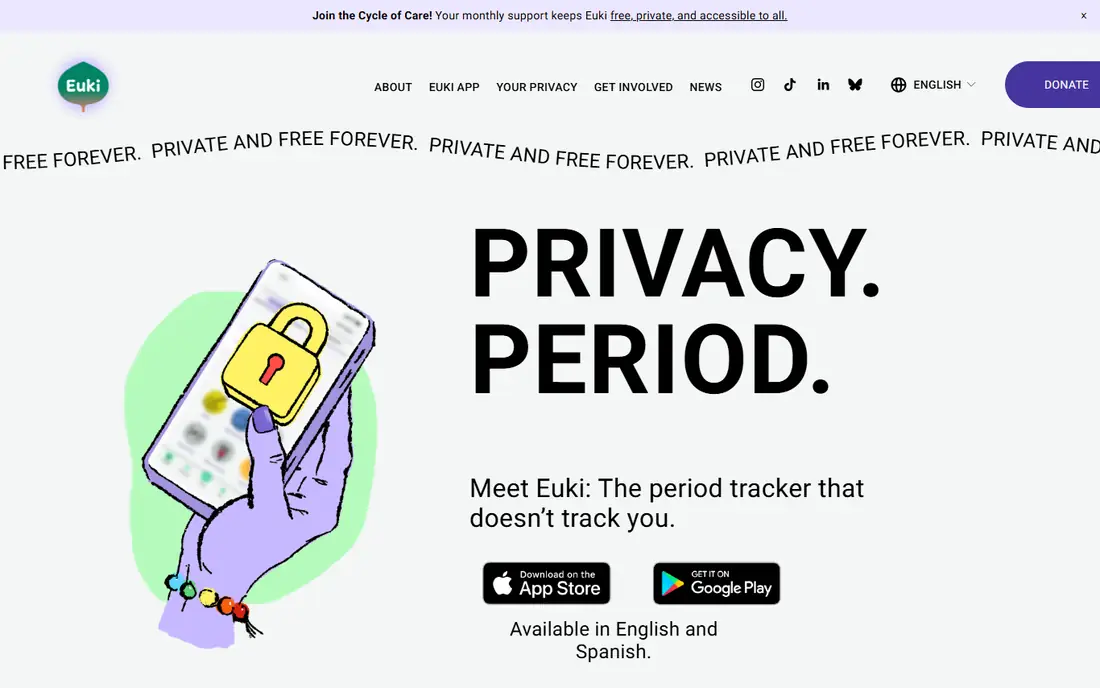
For a teen, Euki is the safest default in this category: the data lives in one place, the phone, under a PIN, with a decoy if that PIN is ever demanded.
Its makers publish their privacy reasoning openly, which is the correct posture for this data. If you remember one name from this guide in a privacy argument, it is this one.
What we like- Euki, built by university reproductive health researchers with privacy as the founding brief, stores everything on your device, requires no account, collects no central database of cycles, and includes a decoy PIN screen that opens a fake display if someone demands you open the app. It tracks periods, symptoms and more, and carries built in sexual health information. It is completely free on iPhone and Android. In privacy comparisons it sits in the top tier with the open source apps.
Watch out for- No account means no sync and no backup: lose the phone and the history is gone unless you export it yourself. Updates arrive more slowly than the commercial apps. The design is functional rather than fun, which matters for daily habits. Prediction features are basic next to the data hungry giants, because it refuses to hoard the data that feeds theirs.
Starting priceFree
Free planYes
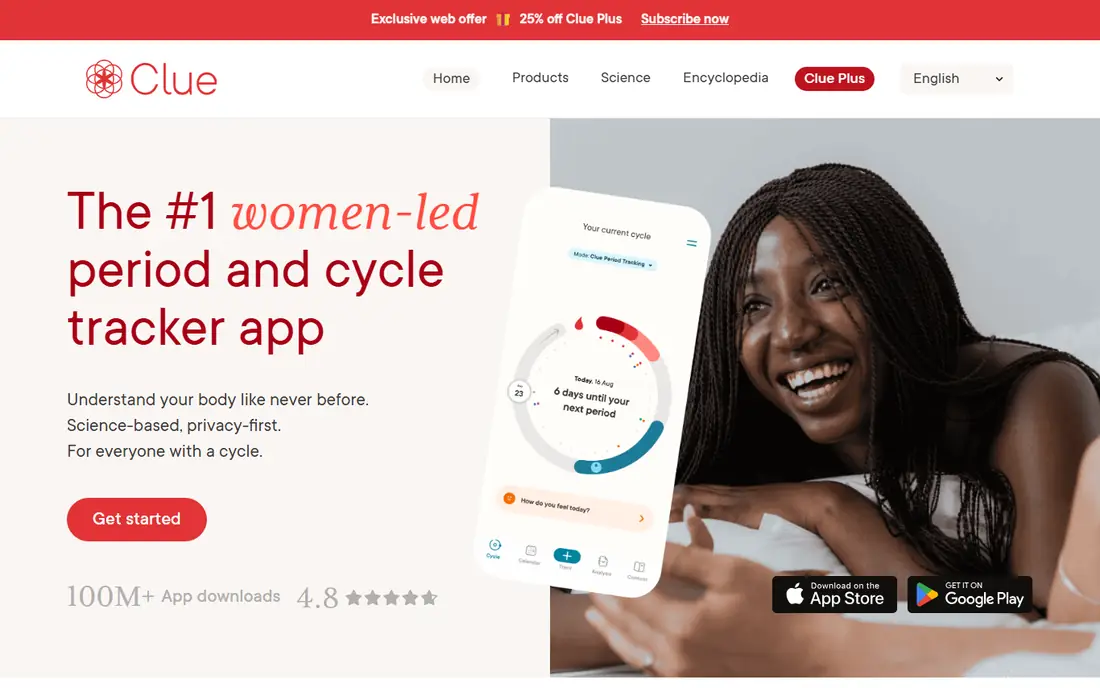
Clue is the mainstream pick for a privacy aware teen: a real company with a public record of saying no, educational depth, and a free tier that is not a demo.
Its research partnerships with universities suit the user who wants to understand what is happening, not just when. For school health class level curiosity, it is the best library here.
What we like- Clue, from Berlin, is the science first tracker: content reviewed against medical literature, no pink clichés, tracking for cycles, symptoms and patterns, and education written for understanding your body rather than selling you things. It operates under European GDPR rules and has publicly committed to protecting user data, including stating it would not hand data to US authorities. The free version covers full core tracking. Clue Plus, around 9.99 dollars a month in app pricing, adds deeper analysis.
Watch out for- It uses accounts and cloud storage, so data exists on company servers, protected by policy and European law rather than by physics. Some advanced insights sit behind Plus. Its tone is clinical, which some teens find dry next to Flo or Stardust. Predictions depend on consistent logging like everyone else's.
#3
Apple Health Cycle Tracking
Best for: iPhone owners, nothing extra to install
Visit apple.com
Starting priceFree
Free planYes
For iPhone teens, this is the zero decision option: private by architecture, already installed, good enough at the core job, and immune to the app store's data economy.
Turn on irregular cycle notifications and log honestly for a few months before judging its predictions. Its quiet competence wins over time.
What we like- If you have an iPhone, you already own this app. Cycle Tracking inside Apple Health logs periods, symptoms and factors, gives predictions and fertile window estimates, and stores the data on the device, protected by the phone's encryption and, with two factor iCloud, end to end encrypted backup. No separate account, no separate company, no ads, no upsell. Apple Watch wearers can log from the wrist. It costs nothing and tracks nothing for advertisers.
Watch out for- IPhone only, obviously. The education library is thin compared with Clue and Flo. Predictions carry the same irregular teen cycle limits as everyone, displayed with more confidence than they deserve. Sharing features exist for health data generally, so check the sharing settings are off unless deliberately chosen. Android households get nothing.
Starting priceFree
Free planYes
Flo is a good app with a past. With Anonymous Mode on and Premium resisted, a teen gets the best content library here at a privacy level that is managed rather than structural.
The education content is its real strength for younger users: puberty and cycle questions answered plainly, without embarrassment, by a source more reliable than a comment thread.
What we like- Flo is the most downloaded period app in the world, with hundreds of millions of installs, and its polish shows: friendly logging, clear cycle visuals, a large library of expert reviewed health content, anonymous community forums where awkward questions get answered, and an AI assistant grounded in its medical board's material. The free version tracks fully. Premium, around 9.99 dollars a month or about 50 to 60 dollars a year depending on the offer, adds personalised insights and courses.
Watch out for- The privacy history is the serious entry in this row. Flo settled with the US Federal Trade Commission in 2021 over sharing users' health data with analytics and advertising firms despite promising otherwise. It responded with independent audits and an Anonymous Mode that detaches your identity from your health data, which any Flo user should switch on immediately, since it is opt in, not default. Many features sit behind Premium prompts.
Starting priceFree
Free planYes
Spot On earns its place on trust: the organisation behind it answers teen health questions for a living, and the app has nothing to sell you.
For a first tracker paired with real questions, Spot On plus a school nurse or clinic beats a smarter algorithm. It is the only app here whose advice layer is the product.
What we like- Spot On is Planned Parenthood's own period and birth control tracker, built for exactly this audience: tracking for cycles and for birth control methods, reminders, and direct access to trustworthy sexual health education from the organisation teens are told to ask. It collects minimal data and is free, with no premium tier and no advertising model to serve. Its guidance tone is honest and non judgmental.
Watch out for- It is education first and analysis light: pattern insights are basic next to Clue. Development pace is slower than the commercial apps. Some content assumes US services and clinics. Its design is friendly but plain.
Starting priceFree
Free planYes
Stardust is the fun pick, and fun is not trivial in a habit app. Choose it with eyes open: enjoy the design, lean on other sources for health facts, and keep the privacy settings tight.
If a teen will actually log in Stardust and ignore Euki, Stardust used daily beats Euki abandoned. Habit is a feature; just do not mistake the horoscope for the health content.
What we like- Stardust wraps cycle tracking in astrology and lunar framing, with a design language teens genuinely enjoy, which matters because a tracker only works if it gets opened. It offers cycle predictions, symptom logging, an anonymous mode and, per its listings, end to end encrypted data, with a Premium tier around 5 dollars a month for extra features. Its social buzz among young users is unmatched here.
Watch out for- The astrology layer is entertainment, not information, and the science content is thinner than Clue's or Flo's. Its encryption claims drew questions from privacy researchers when it launched, including around what metadata could still be seen, so treat the privacy story as marketing until independently verified. Cloud accounts mean server side data exists. Prediction depth is standard.
#7Drip
Best for: Open source, verifiable privacy4.4/5 on
G2 (480 reviews, checked Oct 2026)
Visit dripapp.org
Starting priceFree
Free planYes
Drip is for the teen, or the parent helping choose, who wants proof rather than promises. In a category built on trust, verifiable code is the gold standard.
Most teens will pick something friendlier. But its existence sets the bar the commercial apps should be measured against, and for Android users it is genuinely usable day to day.
What we like- Drip is free, open source and on device: anyone can read its code and confirm it does what it claims, which is the strongest form of privacy promise an app can make. It stores data locally, needs no account, and covers period and fertility sign tracking with a calm, minimal interface. Privacy roundups place it in the top tier alongside Euki and Periodical. It comes from a Berlin based collective focused on health data rights.
Watch out for- Android first, with iOS availability more limited, and its development pace is slow, with a minimal feature set by design. No sync, no backup, no content library, no predictions beyond the basics. The interface will feel bare to anyone arriving from Flo.
Starting priceFree
Free planYes
Samsung Health is the Android equivalent of the Apple argument: the built in option is private enough for many, free, and present. Its weakness is depth; it tracks, it does not teach.
If the teen in question lives on a Galaxy phone and wants simple predictions next to her step count, it does the job with no new download and no new data relationship.
What we like- Samsung Health ships on Galaxy phones with women's health cycle tracking built in: period logging, predictions and symptom notes inside the health app the phone already runs, integrated with steps, sleep and the Galaxy Watch. No new company gets your data beyond the platform you already use, and there is no subscription. For Galaxy owning teens it is the path of least resistance.
Watch out for- Cycle data sits inside a Samsung account cloud rather than purely on device, under Samsung's privacy policies, so read the sharing and research settings and tighten them. The education content is minimal. Predictions are basic. iPhone users are excluded entirely, and the feature hides inside a large fitness app where it is easy to forget.
How we chose
We selected period tracking apps genuinely suited to teenagers in 2026: privacy architecture first, then education quality, then ease of use. Prices and privacy details come from store listings, the apps' own documentation and published privacy comparisons as of October 2026, including the FTC's 2021 Flo settlement record. Contraception marketed apps were excluded deliberately, because that is an adult medical decision, not a teen app category. No app was hands on tested for this guide, and nothing in it is medical advice.
A parent and teen guide to using these apps safely
Choose the storage before the features. Decide together whether cycle data may sit on a company's servers or must stay on the phone. That single decision ranks this list for you: Euki, Drip and Apple Health on one side, the account based apps on the other.
Log the minimum. Start dates and symptoms are what predictions need. The more intimate the logging categories, the more sensitive the record, so use what helps and skip the rest without guilt.
Keep a paper backup of the basics. A wall calendar with discreet marks has survived every data breach in history. For doctor visits, the last three start dates are what matters, and they can live outside any app.
Know the visit triggers. However the tracking is done, a doctor should hear about periods that stop for three months, bleeding through a pad or tampon every hour, pain that painkillers do not touch, or cycles still wildly irregular two to three years after they began. The app cannot judge these. A person can.
Frequently asked questions
Are period app predictions accurate for teenagers?
Only loosely, and less than for adults. Cycles in the first years commonly vary between about 21 and 45 days, so the pattern the app learns keeps moving. Treat predictions as a packing reminder, carry supplies a few days either side of the guess, and never treat a predicted safe or fertile day as a fact about your body. Accuracy improves as cycles settle with age and as you log more months.
Can a period app be used as birth control?
No. The apps in this guide are trackers, not contraception, and their fertile window estimates are far too unreliable for that purpose, especially with irregular teen cycles. Dedicated contraceptive apps exist for adults, cleared by regulators and used with daily temperature measurements under strict rules, and they are a conversation for a doctor, not an app store choice. Anyone who needs contraception needs a clinician or a sexual health clinic, which Spot On's publisher can help find.
What happens to period data stored by an app?
It depends on the app's architecture. On device apps like Euki and Drip hold data on your phone only, so deleting the app deletes the data and no company can hand over what it never had. Account based apps store data on company servers under their privacy policies; it can be subject to legal requests, and policies change. Since 2022, US privacy advocates have advised treating cycle data as sensitive for exactly this reason. Reading the policy, and preferring no account options, is the practical protection.
Is Flo safe to use after its FTC settlement?
Flo settled with the FTC in 2021 over sharing health data with third party firms, without admitting all the claims, and has since added independent audits and an Anonymous Mode that separates identity from health data. Those are real changes, but Anonymous Mode is opt in, so a Flo user who never enables it gets the standard account based model. With it on, many privacy reviewers consider Flo acceptable; without it, an on device app is the safer recommendation for a teen.
Should parents be able to see a teen's period app?
That is a family decision, and the apps here mostly assume the account holder is the user. A workable middle path many families use: choose the app together using this guide's privacy logic, let the teen log privately, and agree that health warning signs, missed periods for months, severe pain, very heavy bleeding, go to a parent and a doctor. Privacy in logging and openness about health problems can coexist.
Sources we checked (0)
Is your product missing or out of date?
We review this list regularly. Vendors can request a listing, send updated pricing or ask about featured placement.

Shihab Mia · Founder, Rankite
Shihab has 5+ years in B2B and SaaS SEO. He writes Rankite's software buying guides from pricing pages, documentation and public user reviews. More about Shihab.