How we make this list: we compare pricing pages, product documentation and public user reviews. Ratings come from G2, Capterra or Trustpilot, with the date we checked them.
Best-in-Class Database Software for Data Security: What to Buy First
Direct answer: For most security-first teams, Oracle Database is the top pick because it combines transparent data encryption, Database Vault, and deep auditing in one mature platform. PostgreSQL is the best low-cost alternative, with no licence fee and strong row-level security. If your data lives in the cloud, Snowflake or Amazon Aurora may fit better, because they add managed patching and built-in encryption.
Key takeaways:
- Encryption at rest and in transit is now a baseline, not a premium feature, in all eight tools in this guide.
- Role-based access control, auditing, and key management matter more than the database engine itself for most compliance work.
- PostgreSQL is the only tool here with no licence fee, while MongoDB Enterprise Advanced has no published price and needs a sales quote.
What makes a database best in class for data security
A secure database protects data in three places: at rest on disk, in transit across the network, and in use by applications and staff. The tools in this guide cover all three, with encryption, strong authentication, fine-grained access control, and audit logs that show who read or changed sensitive rows. They also support separation of duties, so a database administrator cannot read application data without the right grant.
How do encryption and access control differ across these databases
Encryption and access control solve different problems. Encryption stops an attacker who steals a disk or a backup file from reading the data. Access control stops an authorised user from seeing rows they should not see. You need both. Transparent data encryption covers the first case. Row-level security, column masking, and database vault features cover the second. The best tools here offer both, and they let you manage keys outside the database.
Authentication is the third leg. Look for multifactor authentication, single sign-on, Kerberos, LDAP, and certificate-based login. Enterprise editions usually add the strongest options, while free or community editions may leave some out. Check the edition table on each vendor page before you commit.
We picked databases with a long record in production use, documented encryption and auditing features, and a clear vendor pricing page or a clear statement that pricing is quote only. Each tool below has an official vendor page that was checked on 15 November 2026. Prices are taken from the vendor pricing page for that date, or marked quote where the vendor does not publish a price. We did not invent prices, ratings, or test results.
Comparison table: 8 best-in-class database software options for data security
| Tool |
Best for |
Starting price (checked 15 Nov 2026) |
Free plan |
Deployment |
| Oracle Database |
Large regulated enterprises |
$0.0538 per ECPU per hour, Base Database Service Standard |
Free Express Edition and free trial |
On-premises and cloud |
| Microsoft SQL Server |
Windows and Microsoft shops |
$989 per server plus $230 per CAL, Standard server plus CAL |
Free Express and Developer editions |
On-premises and cloud |
| IBM Db2 |
IBM and mainframe estates |
$630 per month, Db2 Database SaaS Performance |
Free Lite tier |
On-premises and cloud |
| PostgreSQL |
Low-cost secure relational work |
$0, no licence fee |
Free, open source |
Self-hosted and managed |
| MongoDB Enterprise Advanced |
Document data on own servers |
quote |
Free for evaluation and development |
Self-managed |
| Snowflake |
Cloud analytics with governance |
$2.00 per Platform Credit, Standard on demand, AWS US East |
30-day free trial, $400 in credits |
Cloud only |
| Amazon Aurora |
AWS relational workloads |
$0.12 per ACU-hour, Aurora Serverless v2 Standard |
AWS Free Tier credits for new accounts |
Cloud only |
| Google Cloud SQL |
Google Cloud relational workloads |
$0.0105 per hour, db-f1-micro shared core |
$300 in new-customer credits, 30-day trial instance |
Cloud only |
Quick comparison
| Tool | Best for | Starting price | Free plan |
|---|
 Oracle Database | Large enterprises in finance, health, and government that need deep control over encryption and separation of duties | $0.0538 per ECPU per hour for Oracle Base Database Service Standard edition (vendor pricing page, checked 15 Nov 2026) | Oracle Database Express Edition is free, with limits on size and features, and Oracle Cloud offers a free trial |
 Microsoft SQL Server | Teams that run Windows, Active Directory, and Microsoft 365 and want database security tied to that identity stack | $989 per server plus $230 per CAL for Standard edition, server plus CAL licensing (Microsoft list price, checked 15 Nov 2026) | Express Edition is free for small production use, and Developer Edition is free for development and testing only |
 IBM Db2 | Large IBM shops, mainframe estates, and regulated teams that already run IBM data and AI products | $630 per month for Db2 Database SaaS Performance plan, billed hourly (IBM pricing page, checked 15 Nov 2026) | Db2 Database SaaS has a free Lite tier for discovery and small development work |
 PostgreSQL | Teams that want strong security without a licence fee, and full control over their own deployment | $0, no licence fee for the software itself (PostgreSQL project FAQ, checked 15 Nov 2026) | Free, open source under the PostgreSQL Licence, with no paid tiers for the core software |
 MongoDB Enterprise Advanced | Teams that store document data on their own servers or private cloud and need commercial support and advanced security | quote (MongoDB does not publish an Enterprise Advanced price; sales provides a quote, checked 15 Nov 2026) | Free for evaluation and development, and MongoDB Atlas has a free M0 tier for small cloud projects |
 Snowflake | Cloud analytics teams that need governed access to shared data across departments and partners | $2.00 per Platform Credit on Standard edition, on demand, AWS US East (Snowflake Service Consumption Table, checked 15 Nov 2026) | 30-day free trial with $400 in credits for new accounts |
 Amazon Aurora | AWS teams that run MySQL or PostgreSQL workloads and want managed security, patching, and fast failover | $0.12 per ACU-hour for Aurora Serverless v2 Standard configuration, US East (AWS pricing page, checked 15 Nov 2026) | New AWS accounts get $100 in credits at sign-up, and Aurora PostgreSQL serverless has a Free Tier option with limits |
 Google Cloud SQL | Google Cloud teams that run MySQL, PostgreSQL, or SQL Server and want a simple managed service | $0.0105 per hour for a db-f1-micro shared-core instance, Enterprise edition, us-central1 (Google Cloud pricing page, checked 15 Nov 2026) | New Google Cloud customers get $300 in free credits, and Cloud SQL offers a 30-day trial instance |
Is your product missing or out of date?
We review this list regularly. Vendors can request a listing, send updated pricing or ask about featured placement.
The eight tools below, in order.
#1
Oracle Database
Best for: Large enterprises in finance, health, and government that need deep control over encryption and separation of duties
Visit oracle.com
Starting price$0.0538 per ECPU per hour for Oracle Base Database Service Standard edition (vendor pricing page, checked 15 Nov 2026)
Free planOracle Database Express Edition is free, with limits on size and features, and Oracle Cloud offers a free trial
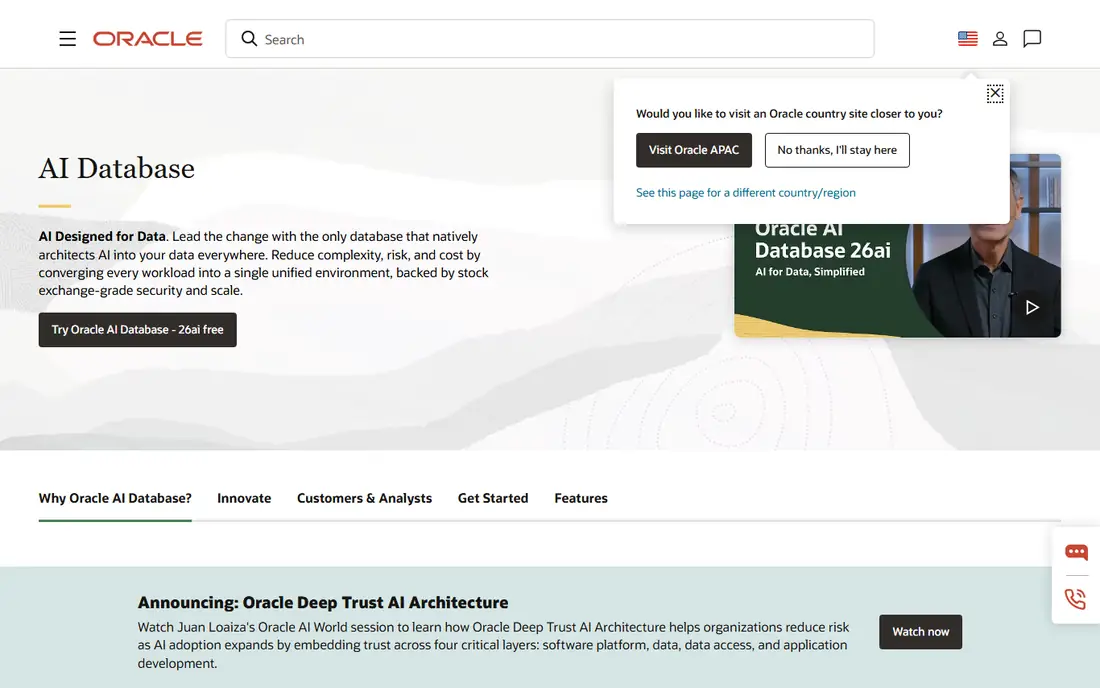
Oracle Database has the deepest security toolkit in this guide. Transparent data encryption protects data at rest without changing application code. Database Vault blocks even privileged users from reading application data unless they hold a specific realm grant. Data Redaction masks sensitive columns in query results. The trade-off is cost and complexity. On-premises Enterprise Edition is listed at $47,500 per processor, with Standard Edition 2 at $17,500 per processor, so buyers should get a written quote first.
What we like- Transparent data encryption, Database Vault, Data Redaction, and unified auditing are mature and well documented
Watch out for- Licensing is complex, with per-processor and per-user options that are easy to misread, and Enterprise Edition features add large cost
#2Microsoft SQL Server
Best for: Teams that run Windows, Active Directory, and Microsoft 365 and want database security tied to that identity stack4.4/5 on
G2 (2,288 reviews, checked Oct 2026)
Visit microsoft.com
Starting price$989 per server plus $230 per CAL for Standard edition, server plus CAL licensing (Microsoft list price, checked 15 Nov 2026)
Free planExpress Edition is free for small production use, and Developer Edition is free for development and testing only
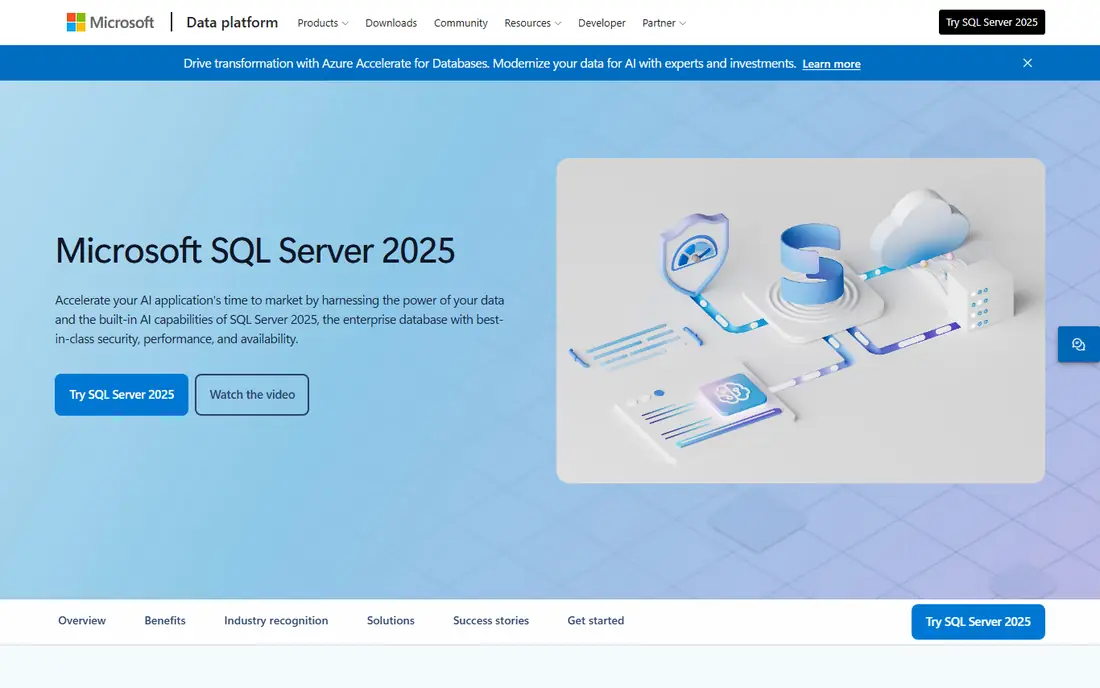
Microsoft SQL Server is a strong fit for Microsoft-centred teams. Always Encrypted keeps sensitive columns encrypted even from database administrators, because the keys stay with the application. Row-level security limits rows by user, and dynamic data masking hides parts of a value in query results. The current release is SQL Server 2025. One price note needs care: some third-party pages list $987 per server and $229 per CAL, while Microsoft list prices show $989 and $230. Use the Microsoft figures for budgeting.
What we like- Always Encrypted, row-level security, dynamic data masking, and auditing are built in, and Entra ID integration is strong
Watch out for- Enterprise Edition is costly at $15,123 per two-core pack, and the highest security features sit in that edition, not in Standard
#3IBM Db2
Best for: Large IBM shops, mainframe estates, and regulated teams that already run IBM data and AI products4.1/5 on
G2 (684 reviews, checked Oct 2026)
Visit ibm.com
Starting price$630 per month for Db2 Database SaaS Performance plan, billed hourly (IBM pricing page, checked 15 Nov 2026)
Free planDb2 Database SaaS has a free Lite tier for discovery and small development work
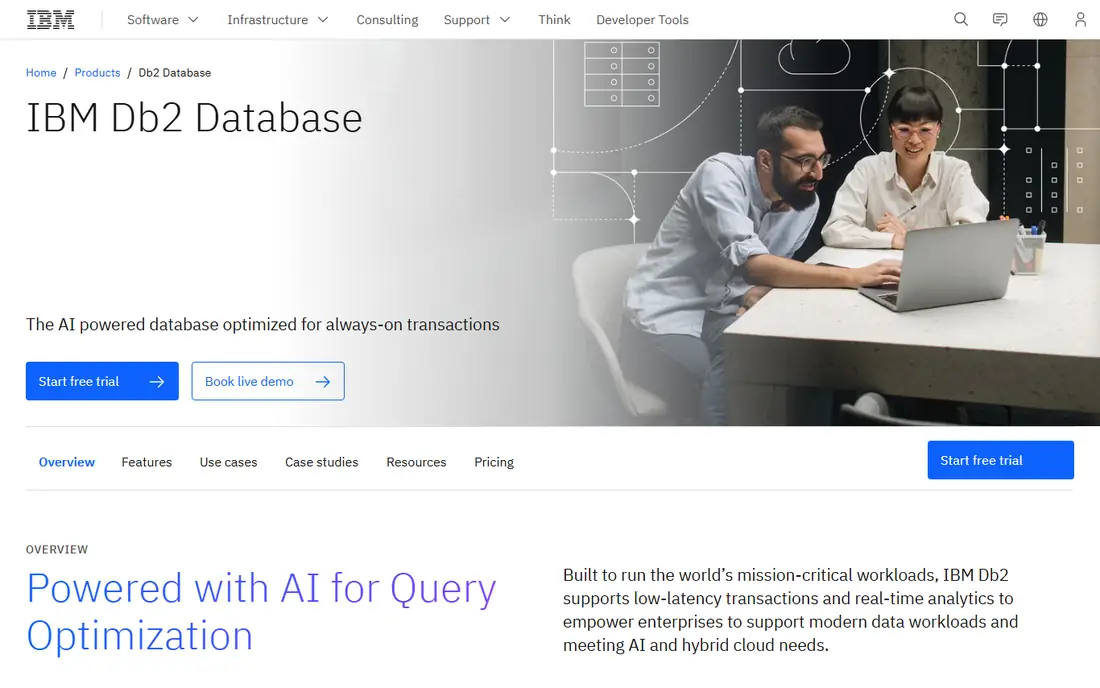
IBM Db2 is a long-standing enterprise database with security features built for regulated use. Native encryption protects data at rest, and label-based access control can restrict rows by security label, which suits defence and health use. Db2 also supports auditing and integration with IBM security tools. The SaaS Performance plan starts at about $630 per month, billed hourly, with compute, storage, and IOPS charged by use. Some third-party listings show older Db2 on Cloud tiers near $99 per month, which conflicts with the current IBM SaaS page, so buyers should use the IBM page for pricing.
What we like- Native encryption, label-based access control, and audit facilities are strong, and Db2 runs on premises, in IBM Cloud, and on AWS through RDS for Db2
Watch out for- The full software licence price is not published on the main pricing page, so enterprise buyers must request a quote, and the product range is wide enough to confuse first-time buyers
#4PostgreSQL
Best for: Teams that want strong security without a licence fee, and full control over their own deployment4.4/5 on
G2 (682 reviews, checked Oct 2026)
Visit postgresql.org
Starting price$0, no licence fee for the software itself (PostgreSQL project FAQ, checked 15 Nov 2026)
Free planFree, open source under the PostgreSQL Licence, with no paid tiers for the core software
PostgreSQL is the best value pick in this guide, and its security features are real, not a cut-down trial. Row-level security lets you write policies that filter rows by the current user. You can grant privileges at the column level, so a reporting user sees only the columns they need. Connections can use TLS, and the pgcrypto extension adds encryption and hashing functions. The risk is operational, not technical. The community releases patches, but you must apply them, harden the server, manage keys, and review audit logs yourself. A managed service bills for hosting, so the $0 licence fee does not mean a $0 running cost.
What we like- Row-level security, column privileges, SSL and TLS connections, and a large extension ecosystem, including pgcrypto for encryption functions
Watch out for- There is no vendor support desk by default, so teams must buy support from a third party or run security patching themselves, and managed services charge separately
#5
MongoDB Enterprise Advanced
Best for: Teams that store document data on their own servers or private cloud and need commercial support and advanced security
Visit mongodb.com
Starting pricequote (MongoDB does not publish an Enterprise Advanced price; sales provides a quote, checked 15 Nov 2026)
Free planFree for evaluation and development, and MongoDB Atlas has a free M0 tier for small cloud projects
MongoDB Enterprise Advanced is the self-managed commercial edition of MongoDB. It adds the security features that matter most for sensitive data: encryption at rest, client-side field-level encryption, LDAP and Kerberos authentication, and detailed auditing. The Community Server is free under the SSPL licence, but it lacks several of these enterprise security features, so teams with strict compliance needs should not assume the free edition meets them.
What we like- Encryption at rest, field-level encryption, LDAP and Kerberos authentication, auditing, and Ops Manager for backup and monitoring
Watch out for- The price is not published, so budgeting needs a sales conversation, and the advanced security features are not in the free Community Server
#6Snowflake
Best for: Cloud analytics teams that need governed access to shared data across departments and partners4.6/5 on
G2 (762 reviews, checked Oct 2026)
Visit snowflake.com
Starting price$2.00 per Platform Credit on Standard edition, on demand, AWS US East (Snowflake Service Consumption Table, checked 15 Nov 2026)
Free plan30-day free trial with $400 in credits for new accounts
Snowflake is a cloud data platform, not a traditional transactional database, and its security model fits analytics well. Data is encrypted at rest and in transit by default. Role-based access control, row access policies, and dynamic data masking let teams share one governed copy of data instead of copying files around. Access history and query history give auditors a clear trail. A Platform Credit costs $2.00 on Standard, $3.00 on Enterprise, and $4.00 on Business Critical, on demand in AWS US East, and an X-Small warehouse uses 1 credit per hour, doubling with each size step. New Gen2 warehouses use 1.35 credits per hour at X-Small on AWS.
What we like- Role-based access control, dynamic data masking, row access policies, end-to-end encryption, and detailed access history
Watch out for- Costs are hard to predict, because credit use depends on warehouse size, query time, and edition, and the credit price rises to $3.00 on Enterprise and $4.00 on Business Critical
#7Amazon Aurora
Best for: AWS teams that run MySQL or PostgreSQL workloads and want managed security, patching, and fast failover4.5/5 on
G2 (456 reviews, checked Oct 2026)
Visit aws.amazon.com
Starting price$0.12 per ACU-hour for Aurora Serverless v2 Standard configuration, US East (AWS pricing page, checked 15 Nov 2026)
Free planNew AWS accounts get $100 in credits at sign-up, and Aurora PostgreSQL serverless has a Free Tier option with limits
Amazon Aurora is a managed relational database that is compatible with MySQL and PostgreSQL. It stores data in a distributed volume that is replicated across three Availability Zones, with six copies of each write. Encryption at rest uses AWS Key Management Service, and IAM database authentication lets you use AWS identity controls instead of long-lived database passwords. Pricing is usage based: Aurora Serverless v2 Standard costs $0.12 per ACU-hour, with storage at $0.10 per GB per month and IOPS at $0.20 per million requests. Provisioned instances start at about $0.29 per hour for a db.r5.large in US East.
What we like- Encryption at rest with AWS KMS, IAM database authentication, VPC isolation, and automatic patching and backup
Watch out for- Costs vary by instance size, storage, and IOPS, so a busy workload can cost far more than the starting ACU rate suggests, and the service only runs inside AWS
#8
Google Cloud SQL
Best for: Google Cloud teams that run MySQL, PostgreSQL, or SQL Server and want a simple managed service
Visit cloud.google.com
Starting price$0.0105 per hour for a db-f1-micro shared-core instance, Enterprise edition, us-central1 (Google Cloud pricing page, checked 15 Nov 2026)
Free planNew Google Cloud customers get $300 in free credits, and Cloud SQL offers a 30-day trial instance
Google Cloud SQL is a fully managed service for MySQL, PostgreSQL, and SQL Server. Google encrypts data at rest and in transit by default, and you can use customer-managed encryption keys for extra control. IAM integration ties database access to Google Cloud identity, and private IP keeps the instance off the public internet. Pricing is per vCPU and per GiB of memory: Enterprise edition dedicated-core instances cost $0.0413 per vCPU-hour plus $0.007 per GiB-hour in us-central1, while Enterprise Plus costs more and adds a higher availability SLA. The cheapest entry point is the shared-core db-f1-micro at $0.0105 per hour, but that size suits testing only.
What we like- Encryption at rest and in transit by default, IAM integration, private IP options, and automated backups and patching
Watch out for- There is no permanent free tier for a production instance, and high availability doubles the compute rate, which buyers often miss in early estimates
How to choose the right database for your security needs
Start with where your data must live. If policy requires on-premises control, shortlist Oracle Database, Microsoft SQL Server, IBM Db2, PostgreSQL, and MongoDB Enterprise Advanced. If cloud is allowed, add Snowflake, Amazon Aurora, and Google Cloud SQL, and weigh managed patching against vendor lock-in. Next, list your compliance needs in plain terms: which regulations apply, which data is sensitive, who may see it, and how long audit logs must be kept.
Then run a short pilot with real data shapes, not a demo dataset. Test backup and restore, key rotation, and audit log review. Check how long it takes to revoke a user and confirm that their access is gone. Price the pilot at production size, because a small test instance hides the real cost of storage, replicas, and high availability.
Frequently asked questions
What is the most secure database software for sensitive data
There is no single most secure database for every team, because the right choice depends on your stack, your regulations, and your operations. Oracle Database, Microsoft SQL Server, and IBM Db2 offer the deepest on-premises controls, while Snowflake, Aurora, and Cloud SQL add managed patching. PostgreSQL is the strongest low-cost option. Test backup restore and key rotation before you commit.
How much does secure database software cost
Costs vary widely, from $0 in licence fees for PostgreSQL to quote-only pricing for MongoDB Enterprise Advanced. Cloud tools bill by use: Snowflake charges $2.00 per Platform Credit on Standard in AWS US East, Aurora Serverless v2 costs $0.12 per ACU-hour, and Cloud SQL starts at $0.0105 per hour for a tiny test instance. Always model storage, replicas, high availability, and support as well as compute.
Is PostgreSQL secure enough for regulated work
Yes, PostgreSQL can support regulated work when it is configured and operated well. It offers row-level security, column privileges, TLS connections, and the pgcrypto extension for encryption functions. The gap is operational: there is no vendor support desk by default, and your team must apply patches, manage keys, and review audit logs. Many regulated teams use a managed service or buy third-party support to close that gap.
What is the difference between encryption at rest and encryption in transit
Encryption at rest protects data stored on disk, in backups, and in snapshots, so a stolen disk or backup file cannot be read. Encryption in transit protects data as it moves between the application and the database, so it cannot be read on the network. You need both, and you also need access control, because encryption alone does not stop an authorised user from reading rows they should not see.
Should I choose a cloud database or a self-managed database for security
Choose a cloud database if you want the vendor to handle patching, backups, and infrastructure hardening, and you can accept that your data lives in the vendor cloud. Choose a self-managed database if policy requires on-premises control, or you need custom key management and network design. Either way, you still own access policy, key rotation, audit review, and user training.
Sources we checked (16)
- https://www.oracle.com/database/base-database-service/pricing/
- https://www.oracle.com/database/
- https://www.microsoft.com/en-US/sql-server
- https://www.microsoft.com/en-US/sql-server
- https://www.ibm.com/products/db2-database/pricing
- https://www.ibm.com/products/db2-database/
- https://wiki.postgresql.org/wiki/FAQ
- https://www.postgresql.org/
- https://www.mongodb.com/pricing
- https://www.mongodb.com/products/self-managed/enterprise-advanced
- https://www.snowflake.com/legal-files/CreditConsumptionTable.pdf
- https://www.snowflake.com/
- https://aws.amazon.com/rds/aurora/pricing/
- https://aws.amazon.com/rds/aurora/
- https://cloud.google.com/sql/pricing/
- https://cloud.google.com/sql/
Is your product missing or out of date?
We review this list regularly. Vendors can request a listing, send updated pricing or ask about featured placement.

Shihab Mia · Founder, Rankite
Shihab has 5+ years in B2B and SaaS SEO. He writes Rankite's software buying guides from pricing pages, documentation and public user reviews. More about Shihab.