How we make this list: we compare pricing pages, product documentation and public user reviews. Ratings come from G2, Capterra or Trustpilot, with the date we checked them.
Key takeaways
- A data lake needs storage, a table format, a processing engine, and a query engine, and no single tool covers all four well.
- Open formats such as Iceberg and Delta Lake keep tables readable by several engines, which protects you from lock in.
- Cloud object storage is the usual lake foundation, while on premises object storage suits teams with data residency needs.
- Spark remains the workhorse for large pipelines, while Trino suits fast SQL over data in place.
- Start with governance and table maintenance, or a growing lake will become hard to trust and expensive to query.
Quick comparison
| Tool | Best for | Starting price | Free plan |
|---|
 Apache Spark | Large scale processing | See website | Yes |
 Apache Hadoop | Distributed storage and processing | See website | Yes |
 Google Cloud Storage | Cloud object storage for lakes | $0.02 per GiB per month | Yes |
 MinIO | On premises object storage | See website | Yes |
 Apache Iceberg | Open table format for lakes | See website | Yes |
 Databricks | Managed lake processing and SQL | See website | Free trial |
 Trino | Fast SQL over data in place | See website | Yes |
Is your product missing or out of date?
We review this list regularly. Vendors can request a listing, send updated pricing or ask about featured placement.
Starting priceSee website
Free planYes
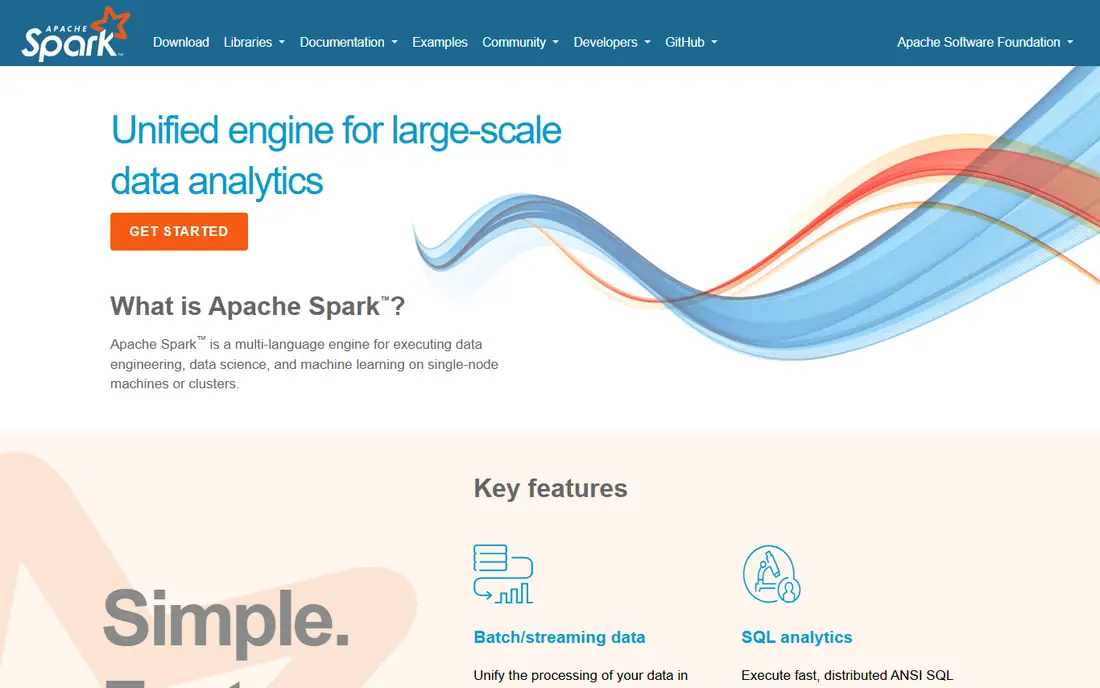
Apache Spark suits teams that need to process large volumes of data in batch, streaming, SQL, and machine learning workloads. It runs on clusters, in the cloud, and inside managed platforms, and it works with Python, SQL, Scala, Java, and R, so different teams can use the same engine. For a data lake, Spark is often the tool that cleans, transforms, and loads raw files into trusted tables.
The honest catch is operations and tuning. Spark jobs that are not partitioned well, that shuffle too much data, or that run on oversized clusters will be slow and costly. Managed Spark services reduce that burden, while self managed Spark gives control at the price of engineering time. Start with a small, well partitioned workload, measure job time and cost, and only then scale to the full lake.
What we like- Unified engine for batch, streaming, SQL, and machine learning
- Wide language support
- Huge ecosystem
Watch out for- Cluster tuning takes skill
- Costs rise with poorly optimised jobs
Starting priceSee website
Free planYes
Apache Hadoop suits organisations with existing on premises big data deployments and teams that already run its ecosystem. Its distributed file system stores large files across many machines, and its processing frameworks handle batch work at scale. For a legacy lake that already runs on Hadoop, keeping and modernising that foundation can be cheaper than a rushed migration.
The trade off is age and effort. Many new lakes are built on cloud object storage with Iceberg or Delta Lake tables and Spark or Trino engines, which are simpler to operate than a full Hadoop cluster. Hadoop still has a place, especially where data must stay on premises, but new projects should compare it carefully with cloud and MinIO based designs before committing to cluster operations.
What we like- Mature distributed file system and processing
- Free and open source
- Large existing deployments
Watch out for- Older architecture than cloud native lakes
- Operating a cluster needs specialist skill
Starting price$0.02 per GiB per month
Free planYes
Google Cloud Storage suits teams building a lake on Google Cloud. It stores any amount of unstructured data, offers storage classes from standard to archive, and connects directly to BigQuery, managed Spark, and machine learning tools. A free tier covers 5 GiB of standard storage plus operations and transfer allowances each month, which is enough to prototype a small lake.
The catch is total cost, not just storage price. Standard storage starts at $0.02 per GiB per month, but network egress, operations, and retrieval fees for colder classes add up, especially for data read across regions. Use lifecycle rules to move old data to cheaper classes, keep compute in the same region as storage where possible, and review storage growth monthly. Good lifecycle discipline keeps a cloud lake affordable as it grows.
What we like- Durable, scalable object storage
- Storage classes for hot and cold data
- Free tier for small use
Watch out for- Egress and operation costs need monitoring
- Google Cloud focused
#4MinIO
Best for: On premises object storage4.3/5 on
G2 (17 reviews, checked Oct 2026)
Visit min.io
Starting priceSee website
Free planYes

MinIO suits teams that want cloud style object storage on their own infrastructure, or in a hybrid setup. It is S3 compatible, so tools built for Amazon S3 often work with MinIO with little change, and it supports lakehouse workloads, AI training data, and analytics. For organisations with data residency rules, or with large on premises GPU clusters, MinIO gives control over where data lives.
The honest limit is operations. Running durable, high performance object storage is not a casual task: disks, networking, backups, and upgrades all need care. Teams that do not want that burden should use managed cloud storage instead. Teams that already operate infrastructure well will find MinIO a flexible foundation for a lake that spans on premises and cloud.
What we like- S3 compatible object storage you can run anywhere
- Strong for AI and lakehouse workloads
- Free open source core
Watch out for- Enterprise features are paid
- You operate the storage yourself
Starting priceSee website
Free planYes
Apache Iceberg suits teams that want lake tables they can read from several engines without copying data. It brings SQL table reliability to object storage, with schema evolution that does not require rewriting tables, hidden partitioning that avoids manual partition errors, and time travel for reproducible queries and rollback. Engines including Spark, Trino, Dremio, Snowflake, and BigQuery support Iceberg, which is a strong reason to choose it for a new lake.
The catch is that Iceberg alone is not a lake. You still need storage, an engine to write and query tables, a catalog, and maintenance for compaction and snapshot expiry. Managed platforms now handle much of that maintenance, while open source setups need scheduled jobs. Choose Iceberg for format freedom, then choose a platform or toolset to operate it well.
What we like- Open format readable by many engines
- Schema evolution and time travel
- Hidden partitioning
Watch out for- It is a format, not a full platform
- Table maintenance still needs tooling
#6Databricks
Best for: Managed lake processing and SQL4.6/5 on
G2 (1,383 reviews, checked Oct 2026)
Visit databricks.com
Starting priceSee website
Free planFree trial
Databricks suits teams that want a managed way to build and query a lake without operating Spark clusters themselves. It combines notebooks, jobs, SQL warehouses, streaming, and machine learning on data stored in open formats, with governance through Unity Catalog. For a team whose lake must support both pipelines and analytics, that managed combination saves significant engineering time.
The trade off is cost and scope. Databricks bills in units that vary by workload, and cloud infrastructure is billed separately, so idle compute and unoptimised jobs raise the bill. Very small lakes may be simpler on BigQuery or a single engine. For growing teams, start with serverless SQL and scheduled jobs, set auto stop rules, and track cost per workload from the start.
What we like- Managed Spark, SQL, and AI on lake data
- Governance through Unity Catalog
- Delta Lake and Iceberg support
Watch out for- Platform plus cloud costs need control
- Complexity for very small lakes
Starting priceSee website
Free planYes
Trino suits teams that need fast SQL over data that already lives in lakes, warehouses, databases, and object storage. It queries data in place, so analysts can join a lake table with a database table in one statement without building a copy pipeline first. Its connector set and SQL support make it a practical query layer for a lakehouse, especially when combined with Iceberg tables.
The honest catch is operations and governance. Trino does not provide managed access control, table maintenance, or support on its own, so your team owns deployment, security, and upgrades, or you buy a managed version such as Starburst. Teams with strong platform engineering will find Trino powerful and low cost. Teams without that skill should prefer a managed query service and use Trino only with a vendor behind it.
What we like- Free, fast federated SQL
- Queries many sources in one statement
- Large connector set
Watch out for- You operate it yourself
- No built in governance or maintenance without a managed vendor
How we chose
We compared vendor documentation and pricing pages, open source project pages, and public reviews, and we opened each official homepage to confirm it belongs to that tool. We favoured tools that play a distinct role in a lake, from storage to format to processing to query, rather than listing several tools that do the same job. Where pricing is usage based or open source, we wrote See website or the verified cloud rate rather than inventing a total cost.
Building a lake that stays usable
Design for the table, not just the file. Raw files belong in a landing zone, cleaned data belongs in governed tables with owners, and analysts should start from certified tables, not from raw dumps. Add data quality checks, retention rules, and a catalog from the beginning, because adding governance later to a large, messy lake is far harder than building it in small.
Choose engines by workload
Use Spark for heavy pipelines, streaming, and machine learning preparation. Use Trino or a managed SQL service for interactive analytics and BI. Use a managed platform when your team lacks platform engineering time, and use open source engines when you have that skill and want control. Mixing engines on open formats is a strength of a modern lake, not a weakness, as long as governance stays central.
Watch the costs that grow quietly
Storage grows with every new source, small files slow queries, and old snapshots consume space. Schedule compaction, expire old snapshots, and move cold data to cheaper storage classes. Review the largest tables, the most expensive queries, and egress charges each month. A lake that is cheap to store but expensive to query has a design problem, not a pricing problem.
Frequently asked questions
What is a data lake?
A data lake is a central store for raw and processed data in many formats, usually in object storage, that teams can query and analyse. Unlike a traditional warehouse, a lake can hold unstructured and semi structured data alongside structured tables, which makes it useful for analytics, machine learning, and exploration.
How is a data lake different from a data warehouse?
A warehouse stores structured, governed data optimised for reporting, while a lake stores data in its original form and adds structure when it is queried or transformed. A lakehouse combines both ideas: lake storage in open formats with warehouse features such as governance, transactions, and fast SQL.
Do I need Hadoop to build a data lake?
No. Hadoop was an early way to build lakes, but most new lakes use cloud object storage or MinIO, an open table format such as Iceberg, and engines such as Spark or Trino. Hadoop still fits existing on premises deployments, but it is not required for a new lake.
What table format should I choose?
Iceberg is a strong default for new lakes because many engines support it and it handles schema evolution, partitioning, and time travel well. Delta Lake is also strong, especially with Spark and Databricks. Choose the format your engines and platform support best, and avoid proprietary formats that lock tables to one vendor.
How do I keep a data lake from becoming a swamp?
Give every table an owner, document its purpose and refresh schedule, add quality checks, and remove or archive unused tables. Provide a certified set of tables for analysts, and keep raw data separate from trusted data. Regular maintenance, including compaction and snapshot expiry, keeps queries fast and costs under control.
Can a small team build a data lake?
Yes, with managed services. A small team can start with cloud object storage, a managed SQL service, and a small set of Iceberg or Delta tables, then add Spark pipelines only as needed. Avoid operating a full open source stack until the team has the engineering time to support it well.
Sources we checked (7)
- https://spark.apache.org
- https://hadoop.apache.org
- https://cloud.google.com/storage
- https://www.min.io
- https://iceberg.apache.org
- https://www.databricks.com
- https://trino.io
Is your product missing or out of date?
We review this list regularly. Vendors can request a listing, send updated pricing or ask about featured placement.

Shihab Mia · Founder, Rankite
Shihab has 5+ years in B2B and SaaS SEO. He writes Rankite's software buying guides from pricing pages, documentation and public user reviews. More about Shihab.