How we make this list: we compare pricing pages, product documentation and public user reviews. Ratings come from G2, Capterra or Trustpilot, with the date we checked them.
Key takeaways
- Alation and Collibra remain the enterprise defaults, while Atlan and Secoda win on speed of adoption for modern data stacks.
- Every enterprise platform here is quote-based, so budget for a sales conversation rather than a card payment.
- Secoda and OpenMetadata are the low-cost entry points: Secoda has a free tier, and OpenMetadata is open source.
- Data discovery is now sold as AI context: the catalog that feeds your agents clean definitions matters more than a search box alone.
- If you run on Azure and Microsoft 365, Purview is hard to beat on integration, but it is weaker outside the Microsoft world.
Quick comparison
| Tool | Best for | Starting price | Free plan |
|---|
 Alation | Large enterprises that need proven search and curation | See website | No |
 Collibra | Regulated organizations where governance is non-negotiable | See website | No |
 Atlan | Modern-stack teams that want fast adoption and collaboration | See website | No |
 Secoda | Small to mid-sized teams that want catalog, lineage and AI search in one place | See website | Yes |
 Select Star | Analytics teams that want automated lineage and documentation fast | See website | Yes |
 data.world | Teams that value a knowledge graph and open collaboration | See website | No |
 Microsoft Purview | Organizations committed to Azure and Microsoft 365 | See website | No |
 OpenMetadata | Engineering-led teams that want an open source catalog | Free | Yes |
Is your product missing or out of date?
We review this list regularly. Vendors can request a listing, send updated pricing or ask about featured placement.
The best data discovery software
#1Alation
Best for: Large enterprises that need proven search and curation4.4/5 on
G2 (98 reviews, checked Oct 2026)
Visit alation.com
Starting priceSee website
Free planNo

Alation built its name on search. Analysts type a question the way they would in a web search engine, and the platform returns tables, columns, dashboards and the people who know them, ranked by usage and trust signals. That matters in a company with thousands of tables, where the real problem is not storage but finding the one table that already answers the question.
The platform now positions itself as an intelligence operating system for data and AI work, with governance and observability folded in. For a buyer, the practical point is breadth: Alation connects to more source types than most rivals, and its curation tools let data stewards certify assets so business users can tell trusted data from experimental work. The catch is the buying process. Pricing is custom, deployments at large companies take real project management, and smaller teams may find the platform more than they need.
What we like- Search-first discovery with machine learning suggestions
- Strong stewardship and curation workflows
- Deep connector coverage across warehouses, BI tools and databases
Watch out for- Quote-based pricing with no public tiers
- Implementation can take months at enterprise scale
- Lineage depth depends on the source system
#2Collibra
Best for: Regulated organizations where governance is non-negotiable4.2/5 on
G2 (102 reviews, checked Oct 2026)
Visit collibra.com
Starting priceSee website
Free planNo
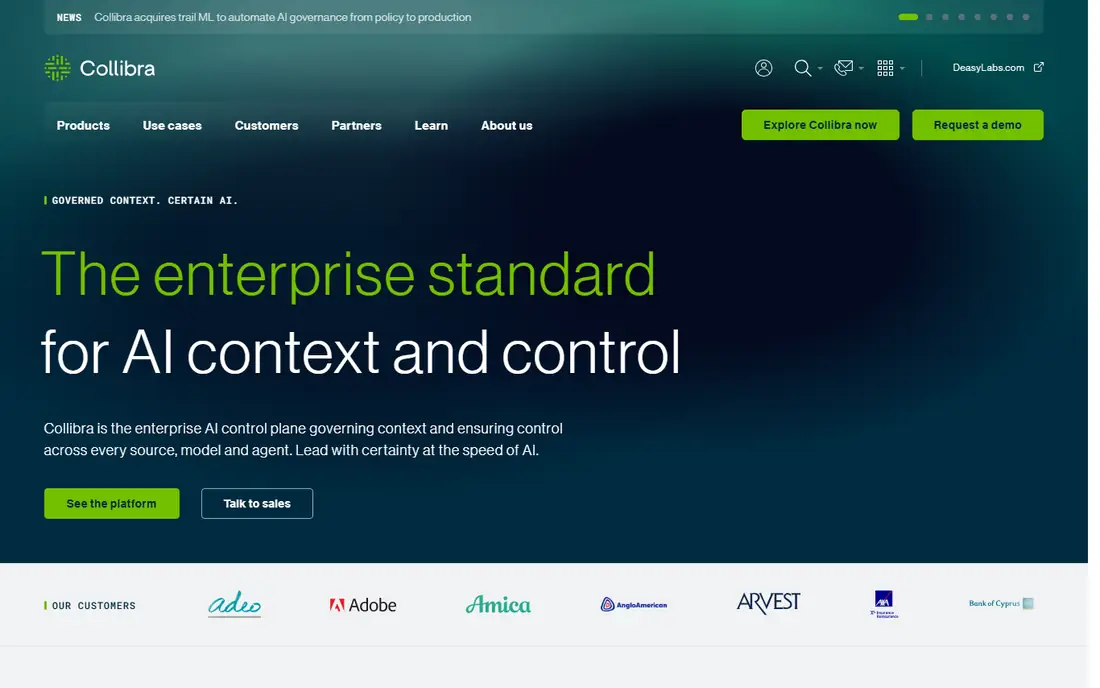
Collibra is the choice when discovery has to come with control. Its business glossary is built on an ontology, which means terms, policies and rules connect to each other instead of sitting in a flat list. A term like customer revenue carries its definition, its owner, its quality rules and its lineage in one place, and that definition can then be served to AI agents as governed context.
That depth is why banks, insurers and healthcare organizations pick Collibra, and why it also demands more upfront work. Stewardship workflows, policy enforcement and certification all need owners and process. If your team just wants analysts to find tables faster, Collibra will feel heavy. If your compliance team needs to prove who approved what and when, few rivals match it.
What we like- Policy-driven governance with workflows and audit trails
- Ontology-based business glossary
- Strong lineage and data quality integration
Watch out for- Quote-based pricing with no public tiers
- Setup can run long in complex estates
- Heavier than needed for teams that only want discovery
#3Atlan
Best for: Modern-stack teams that want fast adoption and collaboration4.5/5 on
G2 (135 reviews, checked Oct 2026)
Visit atlan.com
Starting priceSee website
Free planNo
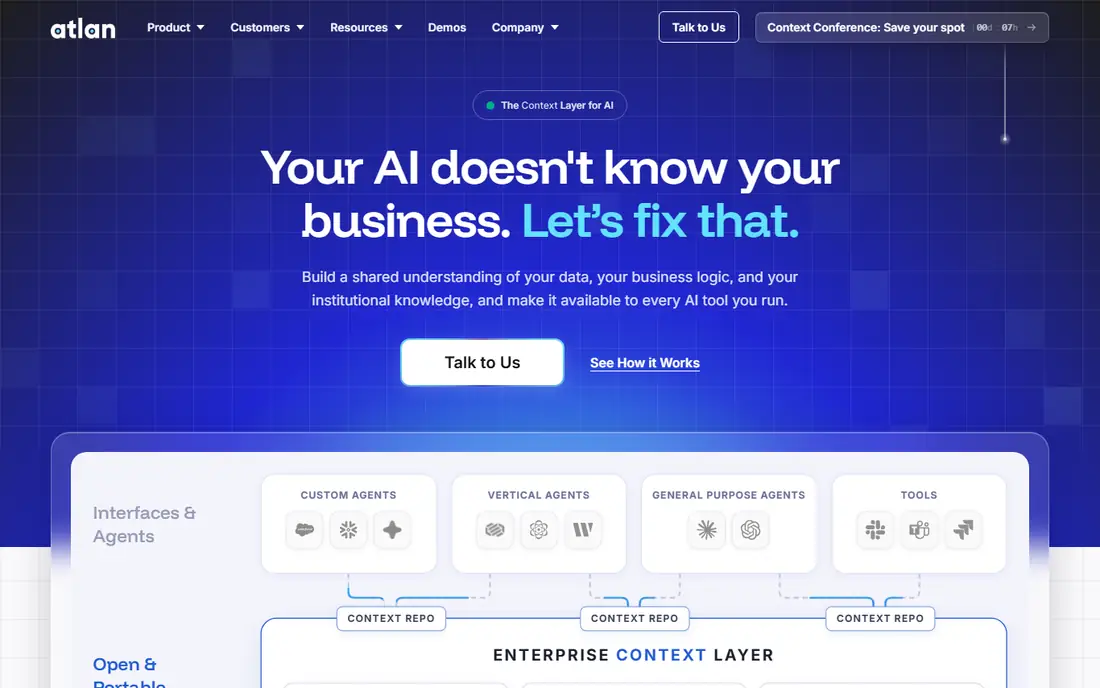
Atlan feels like a product built for the way data teams actually work now. Discovery happens in a search interface with filters, previews and lineage, and teammates discuss assets in place through comments, Slack-style threads and integrations with GitHub and Jira. Column-level lineage is automatic for supported sources, so an analyst can trace a dashboard metric back to its source columns without filing a ticket.
The company now calls itself a context layer for AI, and that framing is honest about where the category is going: the catalog is becoming the place AI agents check before they answer. Atlan's open approach to metadata, including support for modern agent protocols, suits teams building AI features on top of their warehouse. The trade-off is governance depth. Regulated buyers who need Collibra-style policy machinery should test that gap before committing.
What we like- Consumer-style search and collaboration built in
- Automated column-level lineage
- Active metadata that feeds AI tools through open protocols
Watch out for- Quote-based pricing with no public tiers
- Governance depth trails Collibra for strict regulatory programs
- Newer platform with a shorter enterprise track record
#4Secoda
Best for: Small to mid-sized teams that want catalog, lineage and AI search in one place5.0/5 on
Capterra (1 reviews, checked Oct 2026)
Visit secoda.co
Starting priceSee website
Free planYes
Secoda is the pragmatic pick for a team that needs discovery this quarter, not after a six-month program. It connects to your warehouse and BI tools, builds a searchable catalog with lineage and documentation, and layers AI agents on top that answer questions, draft descriptions and watch data health. The free tier makes it possible to prove value on one team before asking for budget.
The platform covers catalog, lineage, governance and observability in one product, which keeps tool sprawl down. Buyers should still check connector coverage for any unusual sources in their stack, and confirm which governance controls sit behind paid tiers. For most mid-sized companies, though, Secoda hits the balance of speed, price and capability that the enterprise suites miss.
What we like- Free tier for getting started
- AI agents for search, documentation and monitoring
- Fast setup compared with enterprise suites
Watch out for- No published prices, so paid tiers still need a sales conversation
- Governance features are lighter than Collibra
- Smaller connector library than Alation
#5
Select Star
Best for: Analytics teams that want automated lineage and documentation fast
Visit selectstar.com
Starting priceSee website
Free planYes
Select Star pitches itself on a simple promise: connect your sources and get a working catalog with lineage and documentation quickly, without a governance program first. Its usage analysis is a genuine differentiator. By showing which tables and columns are actually queried, it helps teams retire unused assets and focus documentation effort where analysts spend their time.
The platform has moved toward AI-ready metadata, framing its catalog as the foundation for AI features built on company data. That makes it a sensible fit for analytics-heavy teams on Snowflake, BigQuery, Databricks and common BI tools. Companies that need heavyweight policy enforcement or stewardship workflows across many business units will likely outgrow it, but for discovery and documentation speed it is hard to fault.
What we like- Automated documentation and lineage with minimal manual setup
- Usage insights show which tables people actually query
- Limited free plan for evaluation
Watch out for- No published prices
- Governance and policy features are lighter than enterprise suites
- Best suited to analytics stacks rather than full enterprise estates
#6
data.world
Best for: Teams that value a knowledge graph and open collaboration
Visit data.world
Starting priceSee website
Free planNo
data.world takes a different technical path from most of this list. Instead of a flat catalog, it builds a knowledge graph that links datasets, terms, metrics and people, so a search can follow relationships rather than just matching keywords. For organizations where the same metric has three definitions in three departments, that structure helps settle arguments with evidence instead of opinion.
The platform is cloud-native and collaboration-first, with discussion and shared projects built in. One note for buyers: data.world is now part of ServiceNow, which may change packaging and integration priorities over time. Ask about the roadmap if you are not already a ServiceNow customer. For teams that want semantic context and open collaboration, it remains one of the more distinctive options available.
What we like- Knowledge graph connects data, definitions and business concepts
- Strong collaboration and discussion features
- Cloud-native with no infrastructure to run
Watch out for- Quote-based pricing with no public tiers
- Knowledge graph modeling takes learning for teams used to flat catalogs
- Now part of ServiceNow, so roadmap questions are fair to ask
#7Microsoft Purview
Best for: Organizations committed to Azure and Microsoft 3654.5/5 on
Capterra (2 reviews, checked Oct 2026)
Visit microsoft.com
Starting priceSee website
Free planNo
Purview is the obvious shortlist entry for any company already standardized on Microsoft. It scans Azure data sources, Microsoft 365 and Power BI natively, classifies sensitive data, and ties discovery into the same governance and compliance story as the rest of the Microsoft security stack. For a Microsoft shop, that integration removes a whole layer of plumbing.
Outside that world, the case weakens. Coverage for non-Microsoft sources exists but is not the product's strength, and the Purview family covers several consoles and concepts that take time to map. Pricing is consumption-based through Azure rather than a flat subscription, so costs scale with scanning volume. If Azure is your center of gravity, start here. If it is not, one of the independent vendors above will fit better.
What we like- Native scanning for Azure, Microsoft 365 and Power BI sources
- Governance, compliance and data loss prevention in one family
- Pay-as-you-go through Azure
Watch out for- Weaker coverage and polish outside the Microsoft ecosystem
- The product family spans several consoles, which confuses first-time buyers
- Pricing depends on Azure consumption
Starting priceFree
Free planYes
OpenMetadata is the open source answer to this category, and it has grown into a serious platform rather than a hobby project. It offers cataloging, lineage, data quality tests, glossary terms and collaboration, with connectors for more than 130 data services. Its newer positioning as an open source context layer, with a native MCP server, speaks directly to teams that want AI agents to read governed metadata without paying a vendor per seat.
The price is free, but the total cost is engineering time. Your team deploys, upgrades and troubleshoots the platform, and while the community is active, there is no vendor support line unless you arrange one. For engineering-led teams comfortable running their own infrastructure, that trade is excellent. For business-led teams that want a vendor to own uptime, a hosted product from this list is the safer pick.
What we like- No license cost and full source access
- 130 plus connectors
- Built-in data quality tests, lineage and a native MCP server for AI agents
Watch out for- You operate and upgrade it yourself
- Support comes from community unless you buy a commercial offering
- Setup effort falls on your own engineers
How we chose
We started from vendor homepages, pricing pages and documentation, then checked each platform against public comparisons and user reviews on G2 and Capterra. A tool made the list only if its official homepage loaded and clearly belonged to the product, and if it genuinely covers data discovery rather than a neighboring category like pure data quality or pipeline orchestration. Prices are quote-based across the enterprise vendors, so we recorded "See website" wherever the vendor does not publish a figure instead of repeating third-party estimates.
What to weigh before you buy
Start with your stack, not the feature list. A catalog earns its keep on connector coverage: if it cannot scan your warehouse, your BI tool and your key databases, the search results will have gaps exactly where analysts look. Shortlist two or three vendors, connect them to a real slice of your estate, and measure how much documentation and lineage appears without manual work.
Then test the human side. Discovery tools fail when nobody curates them, so check who owns definitions, how stewardship workflows run, and whether business users actually enjoy the search experience. A beautiful lineage graph that only engineers open is a failed purchase. Finally, price the whole program, not just the license. Implementation, stewardship time and any consumption charges all belong in the comparison, and a free or open source option can still cost more in engineering hours than a paid product.
Frequently asked questions
What is data discovery software?
Data discovery software scans your databases, warehouses, BI tools and files, then builds a searchable catalog of what exists, what it means, who owns it and where it came from. Analysts use it to find trusted tables instead of asking around or rebuilding work that already exists.
How is data discovery different from a data catalog?
The two overlap heavily. A data catalog is the inventory itself, while discovery is the act of finding and understanding assets inside it, often with search, recommendations and lineage. Most modern products combine both, so buyers should compare the combined experience rather than the labels.
Do I need data discovery if my team is small?
Small teams with one warehouse and a handful of dashboards can often manage with naming conventions and documentation. The case strengthens once you pass roughly fifty active tables, several BI tools, or staff turnover that takes tribal knowledge out the door.
Why is pricing quote-based for most of these tools?
Enterprise data platforms price by data volume, connected sources, user counts and deployment model, which vary too much for a single public price. Expect a discovery call, a proof of concept and a custom quote, and ask what happens to the price as your scanned estate grows.
Can a data catalog help AI projects?
Yes, and this is now a central selling point. AI agents that answer questions from company data need definitions, lineage and quality signals to avoid confident wrong answers. A catalog that serves governed context to agents is becoming as important as the catalog that serves people.
Sources we checked (10)
- https://www.alation.com
- https://www.collibra.com
- https://www.atlan.com
- https://www.secoda.co
- https://www.selectstar.com
- https://data.world
- https://www.microsoft.com/en-us/security/business/microsoft-purview
- https://open-metadata.org
- https://www.ataccama.com/blog/data-discovery-tools
- https://erstudio.com/blog/data-catalog-tools/
Is your product missing or out of date?
We review this list regularly. Vendors can request a listing, send updated pricing or ask about featured placement.

Shihab Mia · Founder, Rankite
Shihab has 5+ years in B2B and SaaS SEO. He writes Rankite's software buying guides from pricing pages, documentation and public user reviews. More about Shihab.