How we make this list: we compare pricing pages, product documentation and public user reviews. Ratings come from G2, Capterra or Trustpilot, with the date we checked them.
Key takeaways
- This is a quote-based category: no vendor here publishes list pricing, so every evaluation runs through sales. The one exception is CastorDoc, which cites a Starter tier at $10,000/year on its own site.
- Enterprise governance suites (Alation, Collibra, Informatica) suit large regulated organizations; modern-stack teams prefer Atlan, Secoda or Select Star for faster time to value.
- Microsoft Purview is the pick for Azure-committed shops; data.world suits teams that want semantic knowledge-graph discovery.
- Two acquisitions reshape the field: data.world is now by ServiceNow, and CastorDoc is now Coalesce Catalog, so confirm roadmaps before signing.
The best data catalog software
Every data team hits the same wall: the data exists, but nobody can find it, trust it, or explain what it means. Analysts ask the same questions in Slack every week. AI projects stall because the models cannot tell a good table from a bad one. A data catalog is the answer: a searchable, governed map of every dataset, its lineage, its owner and its quality.
The nine tools below range from lightweight business-friendly catalogs to enterprise governance platforms. Prices are quote-based across the category; where the vendor publishes a figure we use it, and everywhere else we say so.

#1
Alation
Best for: Large enterprises that need a proven, broad-coverage data catalog
Visit alation.com
Starting priceSee website (subscription, quote-based)
Free planNo

Alation is the category veteran. Analysts find trusted tables through search and usage signals instead of tribal knowledge, and the platform now positions itself as an intelligence layer for AI apps and agents with governance baked in. Connector coverage spans the modern stack: Snowflake, Databricks, Tableau, Power BI and more.
The honest catch is cost and buying friction: expect a guided, sales-led rollout with professional services for lineage and governance configuration, and annual subscriptions custom-quoted per seat type. Setup runs weeks to months. For large enterprises standardizing on the major warehouses and BI tools, it is the proven choice.
What we like- Genuinely mature catalog product, credited with creating the ML data catalog category
- Natural-language search plus behavioral insights show how data is actually used
- 100-plus connectors across warehouses, BI and ETL tools
Watch out for- No published pricing and no self-serve signup
- Everything runs through sales
- Enterprise-class cost base makes it overkill for teams under ~50 data users

#2
Collibra
Best for: Large, regulated organizations where governance, lineage and auditability are non-negotiable
Visit collibra.com
Starting priceSee website (quote-based platform licensing)
Free planNo
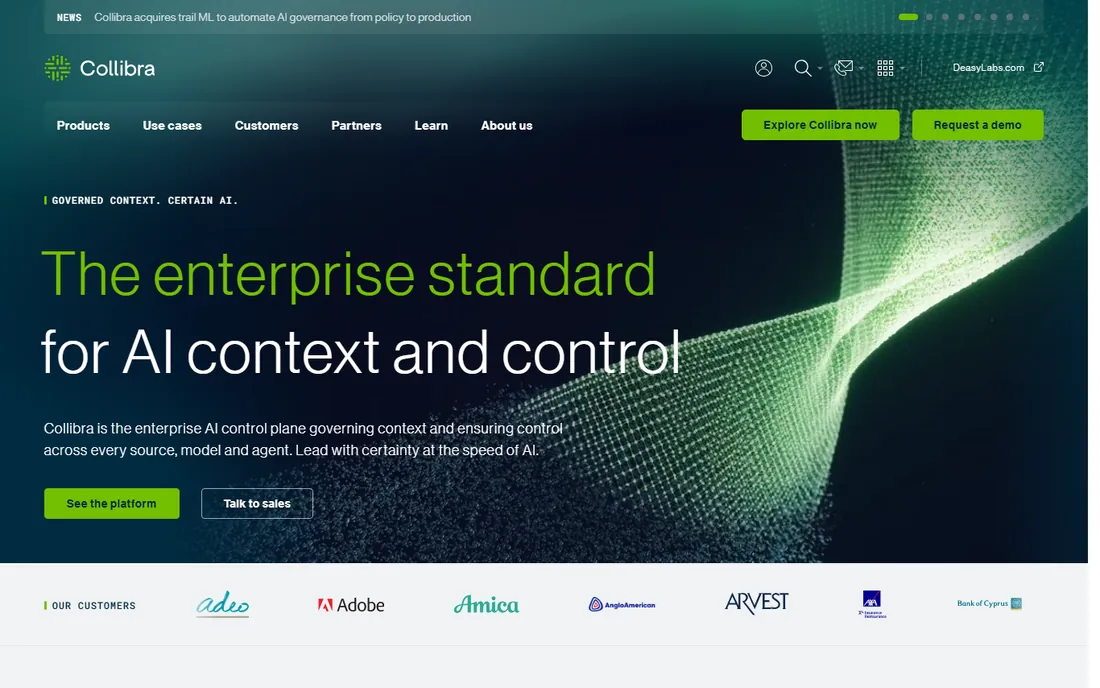
Collibra is the governance-first platform. Its ontology-governed context model enforces meaning, trust and access policy consistently across humans and AI agents, and the Data Marketplace turns the catalog into a curated storefront for data products.
The honest catch is total cost and timeline: plan for significant professional services and months before full production, with multi-year enterprise agreements and tiered user licensing. For financial services, healthcare and government, where auditability is the requirement, it is the enterprise standard.
What we like- Deep, ontology-based governance and stewardship workflows built for heavily regulated industries
- Data Marketplace storefront gives non-technical users a consumer-grade self-service experience
- Proven at very large estate scale
Watch out for- Quote-only pricing with a high entry point, commonly the most expensive option
- Implementation is long (around 6-12 months) and the UX needs real training

#3
Atlan
Best for: Mid-market to enterprise teams on the modern data stack that want fast time-to-value
Visit atlan.com
Starting priceSee website (custom enterprise; free trial available)
Free planNo
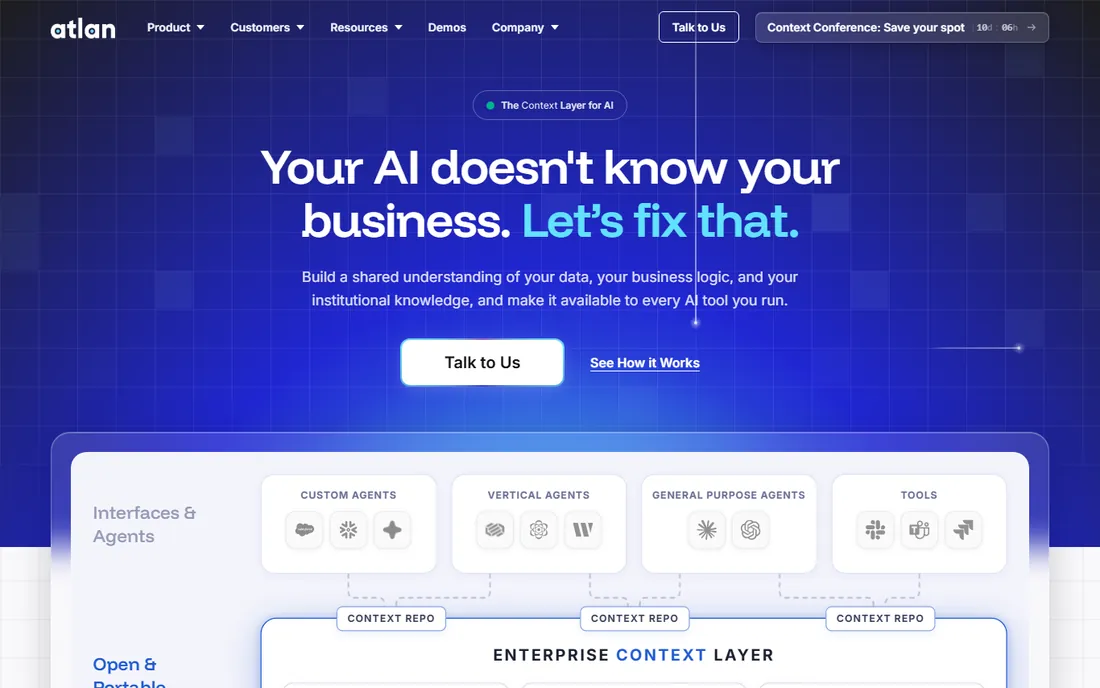
Atlan is the modern-stack favorite. The catalog updates itself from real usage, so documentation stays current without a steward army, and the UX drives the adoption where legacy catalogs stall. Most teams see initial value in weeks with self-service setup and no-code configuration.
The honest catch is that governance depth and complex policy configuration still take months and often professional services. Contracts are annual and custom-quoted per user. For Snowflake, Databricks and dbt shops that want a catalog people will actually use, it is the leading modern pick.
What we like- Active metadata engine keeps the catalog fresh automatically from query patterns and dbt runs
- Modern, Notion-like UX that analysts actually open daily
- Column-level lineage out of the box for Snowflake, dbt, Airflow, Tableau and Power BI
Watch out for- Custom enterprise pricing with no self-serve tier
- Legacy and enterprise connectors (mainframe, SAP) are shallower than Collibra or Informatica

#4
Informatica Enterprise Data Catalog
Best for: Large enterprises with sprawling hybrid estates, including legacy sources newer catalogs cannot reach
Visit informatica.com
Starting priceSee website (consumption-based IPU model via Intelligent Data Management Cloud)
Free planNo
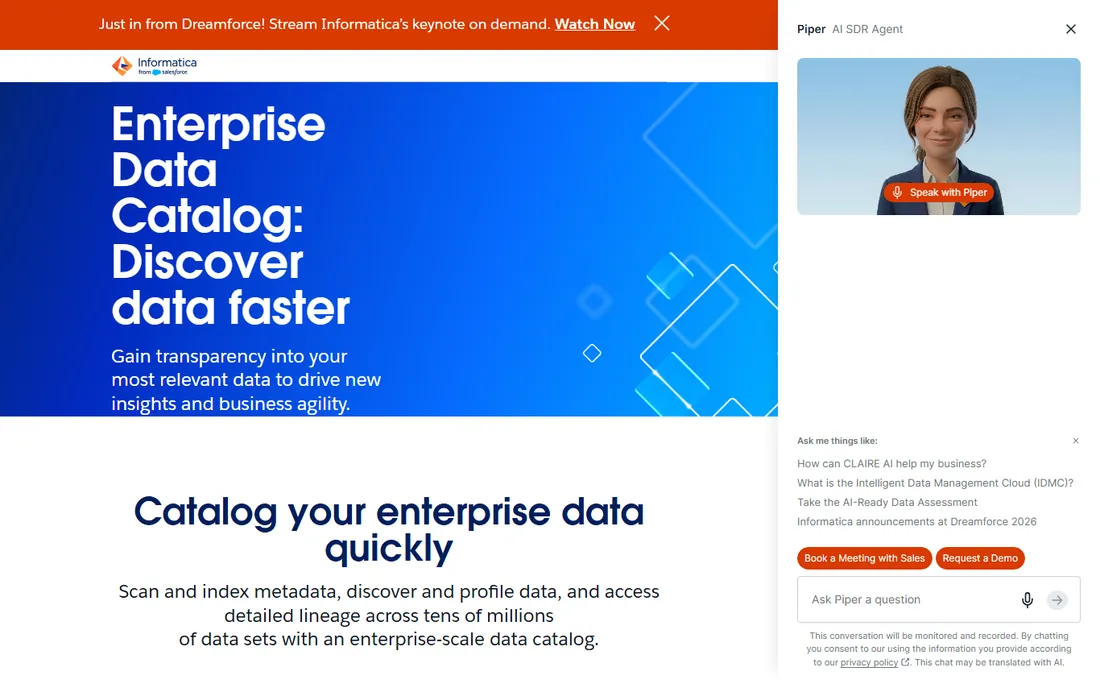
Informatica EDC is the estate-scale scanner. It indexes tens of millions of datasets across cloud and on-premises sources, with AI-driven classification that reduces the steward burden. Lineage and impact analysis support change management at enterprise scale.
The honest catch is commercial complexity: the consumption model and platform upsell make it the most procurement-heavy option here. Setup is a managed implementation running weeks to months depending on source count. For organizations with legacy estates the modern catalogs cannot scan, it is the only real option.
What we like- AI-powered domain discovery, data similarity and business-term association automate curation at enterprise scale
- End-to-end column-level lineage with strong impact analysis
- Automatic scanning across cloud and on-premises sources
Watch out for- Consumption-based pricing makes cost forecasting hard without a sizing exercise
- Buying the catalog often means buying into the broader Informatica ecosystem

#5
Microsoft Purview
Best for: Organizations already committed to Azure and Microsoft 365, where the catalog is part of a broader governance program
Visit microsoft.com
Starting priceSee website (pay-as-you-go through Azure)
Free planNo
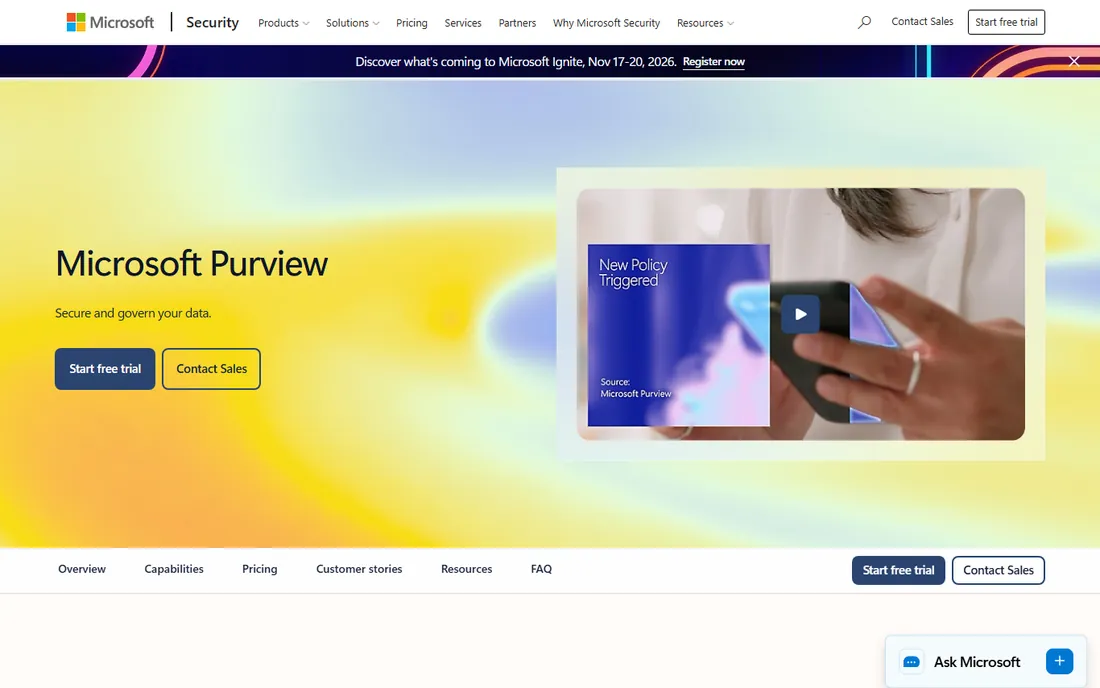
Microsoft Purview is the native choice for Microsoft estates. Scan, classify and govern data without leaving the Microsoft portal, with the unified catalog spanning security, compliance and governance in one surface. Azure billing means no large upfront license.
The honest catch is ecosystem lock-in: if your estate is Snowflake-first or multi-cloud, expect gaps and workarounds, and some features require Microsoft 365 E3/E5 licensing. For Azure-committed organizations, it is the path of least resistance; for everyone else, it is a compromise.
What we like- Unified portal combining the data map, catalog, governance, security and compliance in one Microsoft-native surface
- Native integration with Azure, Microsoft 365 and Power BI means no separate connectors to maintain
- Pay-as-you-go billing lets teams start small
Watch out for- Heavily Microsoft-centric
- Multi-cloud and non-Microsoft stacks get second-class treatment
- Feature availability varies by tenant, license and region

#6
data.world
Best for: Teams that value semantic context and open collaboration around data, especially where a knowledge graph adds meaning
Visit data.world
Starting priceSee website (tiers: Essentials, Standard, Enterprise, Enterprise+; custom quotes)
Free planNo
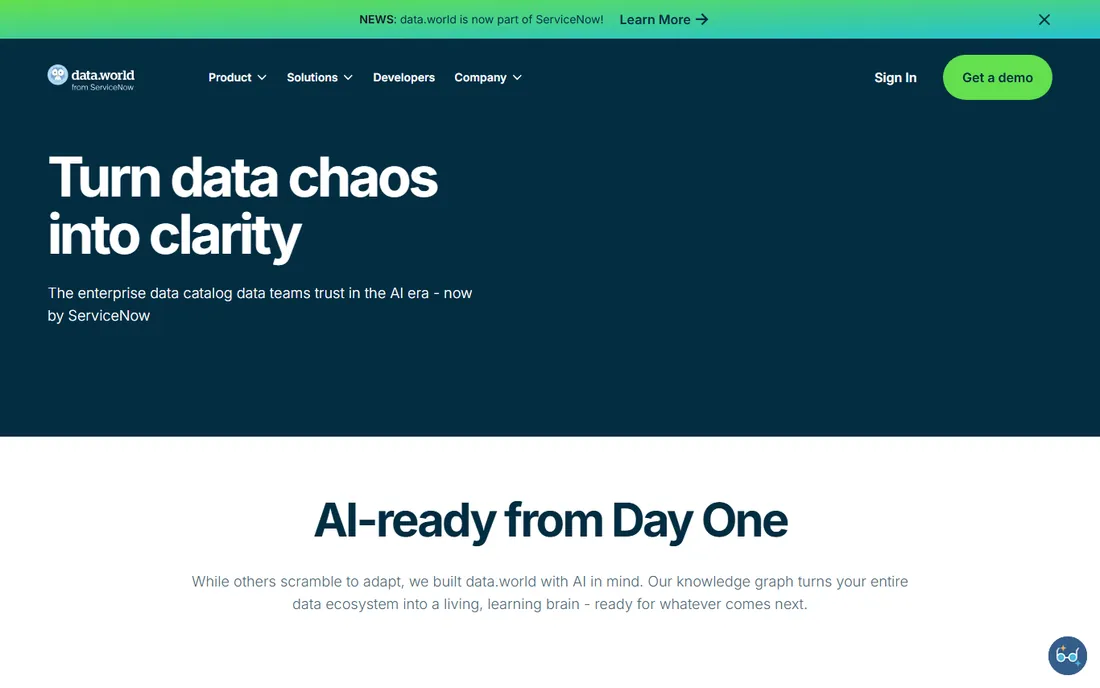
data.world is the semantic catalog. The knowledge graph models relationships, business logic and context natively, which translates well to AI use cases: the catalog understands what data means, not just where it lives. Collaboration features make it a working space for producers and consumers.
The honest catch is the ServiceNow acquisition: the homepage now reads "now by ServiceNow," so expect sales and packaging to change. Verify current terms before committing. Setup is SaaS-fast with collectors for on-prem sources at higher tiers. For teams building AI on governed data, the graph foundation is the differentiator.
What we like- Knowledge-graph foundation gives genuinely semantic discovery, not just keyword search
- Cloud-native SaaS with no infrastructure to manage
- Strong collaboration model: discussions, projects and datasets in one place
Watch out for- Acquisition by ServiceNow creates roadmap and pricing uncertainty
- Quote-only enterprise pricing with no published numbers

#7
Secoda
Best for: Small to mid-sized modern-stack teams that want catalog, lineage, governance and observability in one platform
Visit secoda.co
Starting priceSee website (tiers: Free, Growth, Business, Enterprise; no published figures)
Free planYes (Free tier per the vendor's own site)
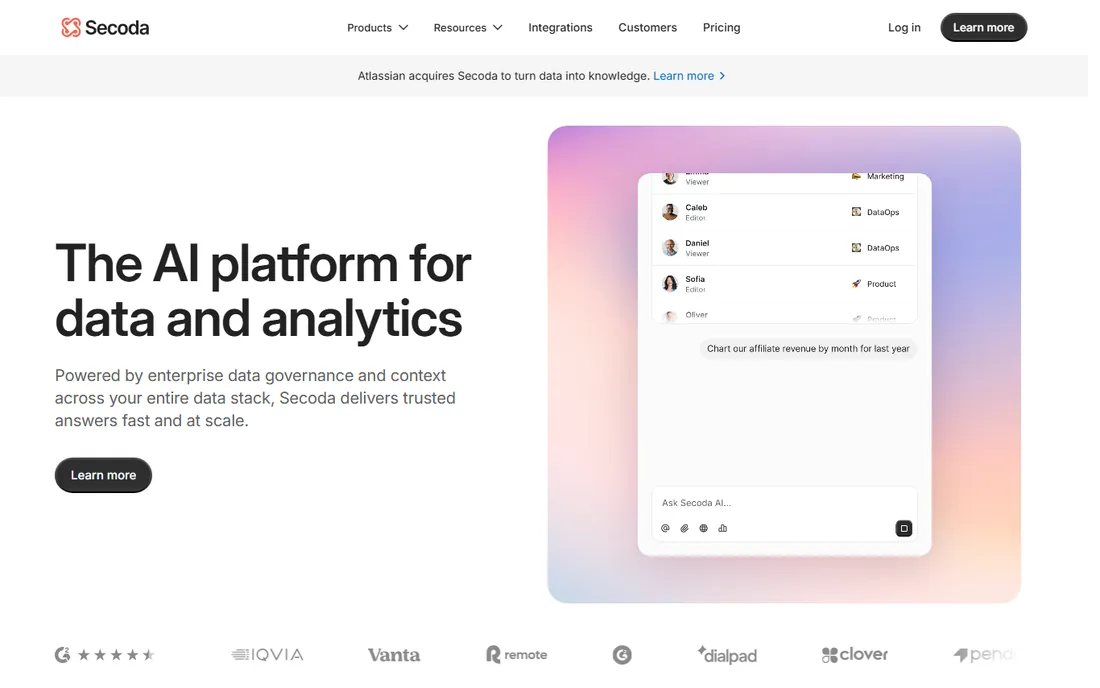
Secoda is the all-in-one challenger. AI-assisted documentation and generated lineage mean a small data team gets catalog value without a steward army, and the workspace covers observability and governance alongside the catalog. Integrations span Snowflake, dbt, Databricks, Tableau, Looker and Power BI.
The honest catch is the Atlassian acquisition (December 2025, per third-party profiles): confirm roadmap and support terms in writing before signing. Setup is quick for standard warehouse and BI stacks. For a lean data team that wants one platform instead of three, it is the most complete package.
What we like- All-in-one platform: catalog, lineage, governance, observability and documentation in a single workspace
- AI agents (search, documentation, governance, observability) built into the core product
- Modern UX that non-technical users can actually use
Watch out for- No published prices
- Quotes are per-customer, which hurts budget planning
- Acquisition by Atlassian introduces product-direction uncertainty

#8
CastorDoc (now Coalesce Catalog)
Best for: Companies that want a lightweight, business-friendly catalog with fast adoption rather than a governance-heavy platform
Visit castordoc.com
Starting priceStarter from $10,000/year (per CastorDoc's own site); Premium and Enterprise custom
Free plan14-day free trial
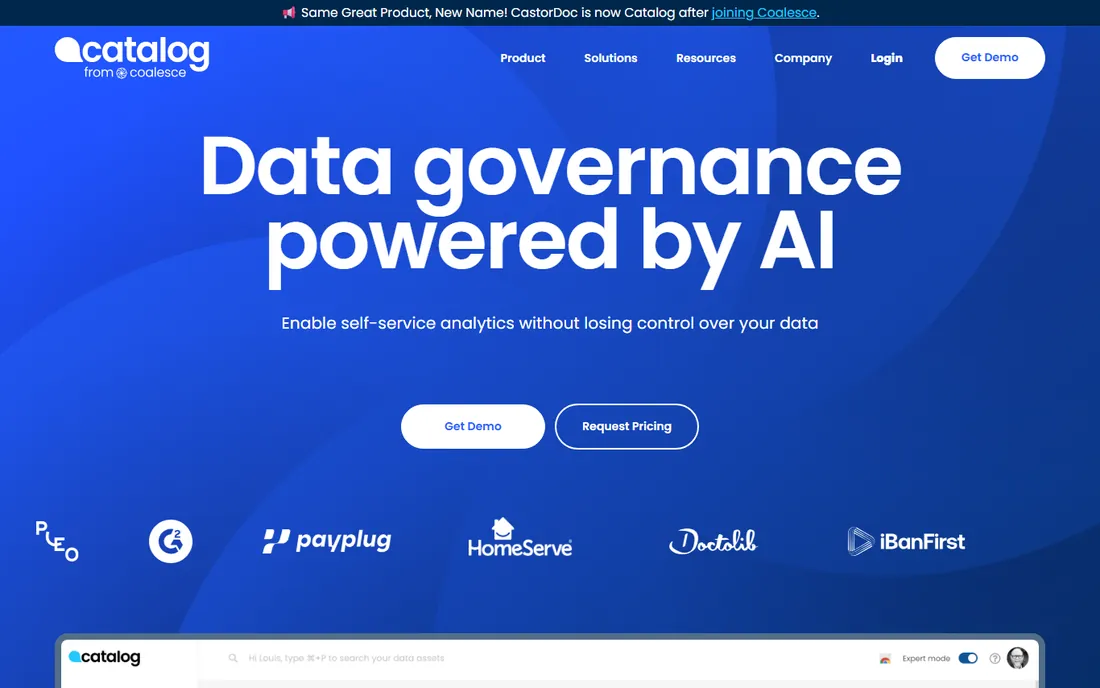
CastorDoc is the business-user catalog. The AI data assistant lets non-technical staff ask questions in plain language and get governed answers, and setup is genuinely fast with a 14-day trial. It is the only vendor here with a published entry price: Starter from $10,000 a year.
The honest catch is the acquisition: you are really evaluating Coalesce Catalog now, so confirm the roadmap with Coalesce directly. For companies where adoption by business users matters more than governance depth, the plain-language experience is the selling point.
What we like- Built for business users, not just data teams
- Plain-language search opens the catalog to non-technical staff
- AI assistant answers data questions conversationally, plus SQL coding assistance
- Plug-and-play setup with metadata ingestion in minutes
Watch out for- Rebrand to Coalesce Catalog after acquisition creates brand and roadmap confusion
- Newer, smaller vendor, less proven at very large enterprise estates

#9
Select Star
Best for: Analytics-heavy teams that want lineage and automated documentation live within a day, without a governance program
Visit selectstar.com
Starting priceSee website (no published figures; free plan with limited sources/tables/users)
Free planYes (limited free plan per the vendor's compare pages)
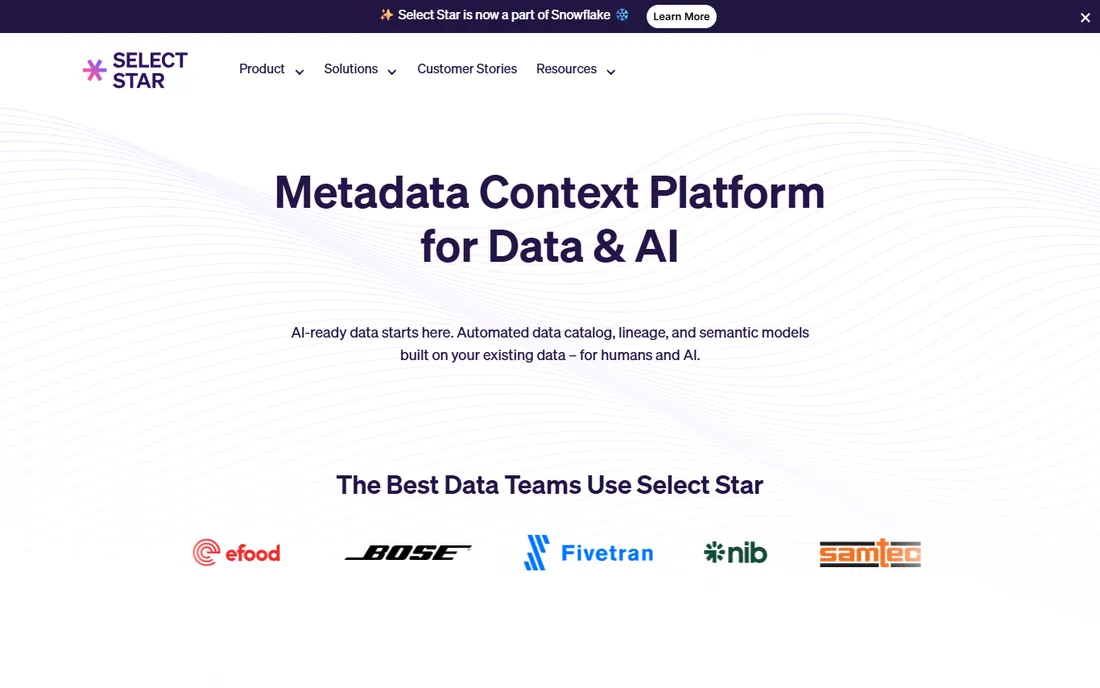
Select Star is the speed pick. Column-level lineage across every integration plus entity-relationship diagrams built from query logs, live within hours of connecting sources. The AI co-pilot answers internal data questions for analysts.
The honest catch is pricing: it requires a sales conversation despite the transparency claim, and enterprise procurement teams may prefer a bigger-name vendor. Setup is the fastest in this set, under 24 hours for standard sources. For analytics teams that want lineage now, not after a governance program, it delivers.
What we like- Fully automated column-level lineage and usage analytics for all integrations, generated within hours of connecting sources
- Auto-generated documentation and an AI co-pilot for analyst questions
- Setup in under 24 hours with zero maintenance
Watch out for- No published pricing despite the "transparent pricing" marketing
- Smaller vendor with a narrower analyst footprint than the enterprise incumbents
The two acquisitions reshaping this category
Two of the nine tools changed owners recently, and both affect buying decisions. data.world was acquired by ServiceNow: the product is now sold through ServiceNow, and packaging, pricing and roadmap will follow ServiceNow's enterprise motion. If you evaluated data.world before, re-evaluate the terms.
CastorDoc was acquired by Coalesce and rebranded as Coalesce Catalog: the castordoc.com domain still resolves, but you are evaluating Coalesce's product now. Confirm the roadmap, support terms and pricing directly with Coalesce before signing. Secoda's acquisition by Atlassian (December 2025, per third-party profiles) is a third watch item: Atlassian has not confirmed the roadmap publicly, so get commitments in writing. In a category where contracts are annual and implementations take months, the vendor's ownership is part of the product.
Governance-first vs. discovery-first: choosing your philosophy
The nine tools split into two philosophies. Governance-first (Collibra, Informatica, Alation at enterprise scale) starts from policy: ontologies, stewardship workflows, audit trails, certified data products. Discovery-first (Atlan, Secoda, Select Star, CastorDoc, data.world) starts from the user: search, lineage, AI assistants, automated documentation.
Neither is wrong; they solve different problems. Regulated industries with audit requirements need governance-first, and the implementation timeline is the price of compliance. Modern-stack teams that need analysts to find trusted data this week need discovery-first, and the lighter governance is the trade. Microsoft Purview sits in the middle for Azure estates. The most common failure mode is buying governance-first when the team needed discovery: a powerful catalog nobody opens is worse than a simple one everyone uses.
How we chose
We started with the categories buyers search: data catalog software, data catalog tools and enterprise data catalog. For each candidate we opened the vendor's official pages, checked capabilities against analyst coverage (Gartner, Forrester) and practitioner reviews on G2 and Capterra, and compared discovery quality, lineage depth, governance capability and implementation reality. No vendor here publishes list pricing, so we recorded "See website" rather than inventing numbers.
Quick comparison
| Tool | Best for | Starting price | Free plan |
|---|
| Alation | Large enterprises that need a proven, broad-coverage data catalog | See website (subscription, quote-based) | No |
| Collibra | Large, regulated organizations where governance, lineage and auditability are non-negotiable | See website (quote-based platform licensing) | No |
| Atlan | Mid-market to enterprise teams on the modern data stack that want fast time-to-value | See website (custom enterprise; free trial available) | No |
| Informatica Enterprise Data Catalog | Large enterprises with sprawling hybrid estates, including legacy sources newer catalogs cannot reach | See website (consumption-based IPU model via Intelligent Data Management Cloud) | No |
| Microsoft Purview | Organizations already committed to Azure and Microsoft 365, where the catalog is part of a broader governance program | See website (pay-as-you-go through Azure) | No |
| data.world | Teams that value semantic context and open collaboration around data, especially where a knowledge graph adds meaning | See website (tiers: Essentials, Standard, Enterprise, Enterprise+; custom quotes) | No |
| Secoda | Small to mid-sized modern-stack teams that want catalog, lineage, governance and observability in one platform | See website (tiers: Free, Growth, Business, Enterprise; no published figures) | Yes (Free tier per the vendor's own site) |
| CastorDoc (now Coalesce Catalog) | Companies that want a lightweight, business-friendly catalog with fast adoption rather than a governance-heavy platform | Starter from $10,000/year (per CastorDoc's own site); Premium and Enterprise custom | 14-day free trial |
| Select Star | Analytics-heavy teams that want lineage and automated documentation live within a day, without a governance program | See website (no published figures; free plan with limited sources/tables/users) | Yes (limited free plan per the vendor's compare pages) |
Is your product missing or out of date?
We review this list regularly. Vendors can request a listing, send updated pricing or ask about featured placement.
Frequently asked questions
What is data catalog software?
Data catalog software is a searchable inventory of an organization's data assets: every table, dashboard and dataset, with its owner, lineage, quality signals and business meaning. Modern catalogs add AI search, automated documentation and governance workflows so analysts and AI agents can find and trust data without tribal knowledge.
How much does data catalog software cost?
No vendor in this category publishes list pricing. CastorDoc cites a Starter tier from $10,000/year; everything else is custom-quoted annual subscriptions, typically per user or by consumption. Expect enterprise contracts to run well into six figures annually plus implementation services.
What is the difference between a data catalog and data governance?
A data catalog is the discovery layer: search, lineage, documentation. Data governance is the control layer: policies, stewardship, access controls, audit trails. Tools like Collibra and Informatica lead with governance; tools like Atlan and Select Star lead with discovery. Most enterprises eventually need both.
Which data catalog is best for Snowflake and dbt?
Atlan, Secoda and Select Star are built for the modern stack with native Snowflake, dbt, Databricks and BI connectors plus automated lineage. Alation also covers the modern stack well at enterprise scale. Informatica reaches further into legacy estates but with more platform weight.
Do I need a data catalog for AI projects?
Increasingly yes. AI agents are only as good as the context they can access: a catalog gives them governed, documented, lineage-tracked data instead of raw tables. Vendors are repositioning around this fast (Alation's "Intelligence Operating System," Atlan's "Context Layer," Collibra's "AI Control Plane"). If your AI roadmap is real, the catalog is infrastructure.
Should I worry about the recent acquisitions in this space?
Yes, enough to ask. data.world is now sold through ServiceNow, CastorDoc is now Coalesce Catalog, and Secoda was acquired by Atlassian. In each case, confirm the product roadmap, support terms and pricing with the current owner in writing before signing a multi-year contract. Acquisitions do not automatically mean a worse product, but they do mean changed packaging.
Sources we checked (11)
- https://alation.com/
- https://www.collibra.com
- https://atlan.com/
- https://www.informatica.com/products/data-catalog/enterprise-data-catalog.html
- https://www.microsoft.com/en-us/security/business/microsoft-purview
- https://data.world/
- https://secoda.co/
- https://castordoc.com
- https://selectstar.com/
- https://www.g2.com/categories/data-catalog
- https://www.capterra.com/data-catalog-software/
Is your product missing or out of date?
We review this list regularly. Vendors can request a listing, send updated pricing or ask about featured placement.

Shihab Mia · Founder, Rankite
Shihab has 5+ years in B2B and SaaS SEO. He writes Rankite's software buying guides from pricing pages, documentation and public user reviews. More about Shihab.