How we make this list: we compare pricing pages, product documentation and public user reviews. Ratings come from G2, Capterra or Trustpilot, with the date we checked them.
Key takeaways
- Airbyte is the best open choice for teams that want self-hosted control, a large connector library and no lock-in on where data lives.
- Hevo is the easiest managed option for teams that want no-code pipelines from apps and databases into a warehouse.
- Qlik Talend Cloud suits enterprises that need integration, quality and governance in one platform, and it is the route for former Stitch users.
- Matillion suits warehouse-centred teams that want visual pipeline building plus AI-assisted pipeline creation.
- Supermetrics is the best choice when the data to aggregate is mostly marketing data from ad platforms and analytics tools.
Quick comparison
| Tool | Best for | Starting price | Free plan |
|---|
 Airbyte | Open data movement with self-hosting options | See website | Yes |
 Hevo Data | No-code pipelines from apps and databases to a warehouse | See website | Free trial |
 Qlik Talend Cloud | Enterprise integration, quality and governance in one platform | See website | Free trial |
 Matillion | Warehouse-centred teams that want visual and AI-assisted pipelines | See website | Free trial |
 Supermetrics | Aggregating marketing data from ad and analytics platforms | See website | Free trial |
 Integrate.io | Low-code pipelines with predictable fixed-fee pricing | See website | Free trial |
 Skyvia | Low-cost no-code integration for smaller teams | See website | Yes |
Is your product missing or out of date?
We review this list regularly. Vendors can request a listing, send updated pricing or ask about featured placement.
#1Airbyte
Best for: Open data movement with self-hosting options4.4/5 on
G2 (78 reviews, checked Oct 2026)
Visit airbyte.com
Starting priceSee website
Free planYes
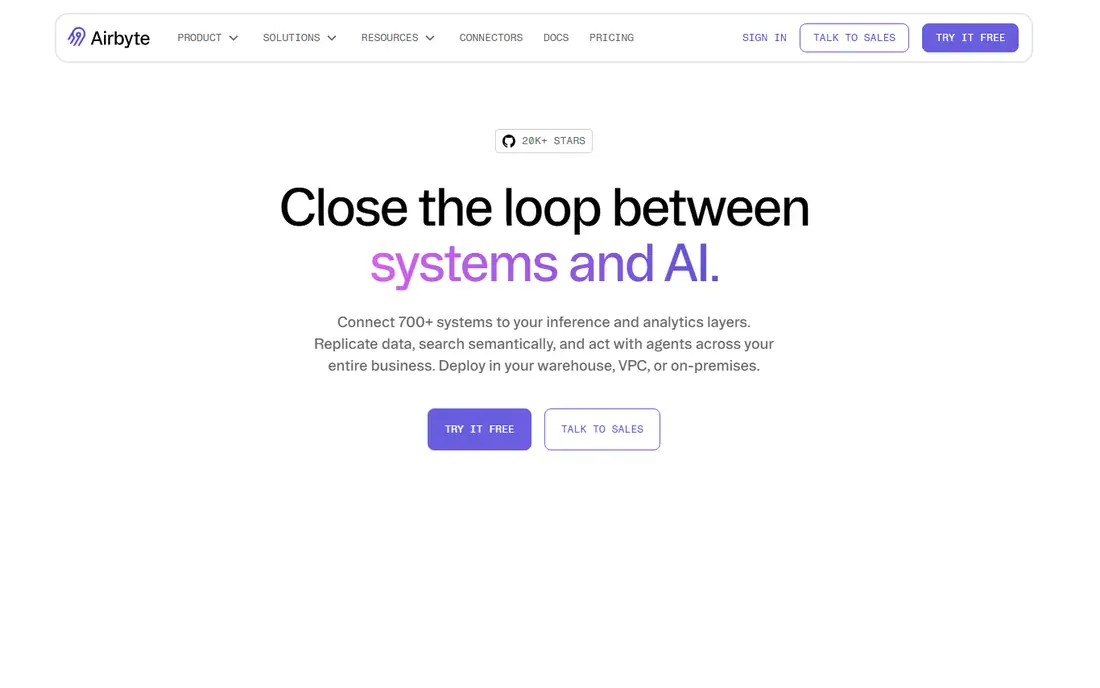
Airbyte has become the default open option for data movement, with connectors for hundreds of systems, replication into warehouses and lakes, and a hybrid deployment model where the data plane runs in your environment while the control plane handles orchestration. That design matters for teams with sovereignty or security rules, since records, credentials and keys stay inside their own environment. Airbyte also positions itself for AI workloads, with semantic search and agent-ready access on top of the same replicated data.
The open-source version is free to self-host, which makes Airbyte the lowest-cost way to start aggregating data, though running it reliably at scale is real engineering work. Managed cloud options remove that burden at a price that depends on volume. Teams should start with the open version for a handful of sources, then compare managed pricing once pipeline counts and volumes grow.
What we like- More than 700 connectors, with open-source self-hosting available
- Data plane can run in your own environment
- Strong fit for analytics and AI workloads
Watch out for- Self-hosting needs operational effort
- Managed pricing depends on volume and capacity
- Connector quality varies, so testing matters
#2Hevo Data
Best for: No-code pipelines from apps and databases to a warehouse4.4/5 on
G2 (295 reviews, checked Oct 2026)
Visit hevodata.com
Starting priceSee website
Free planFree trial
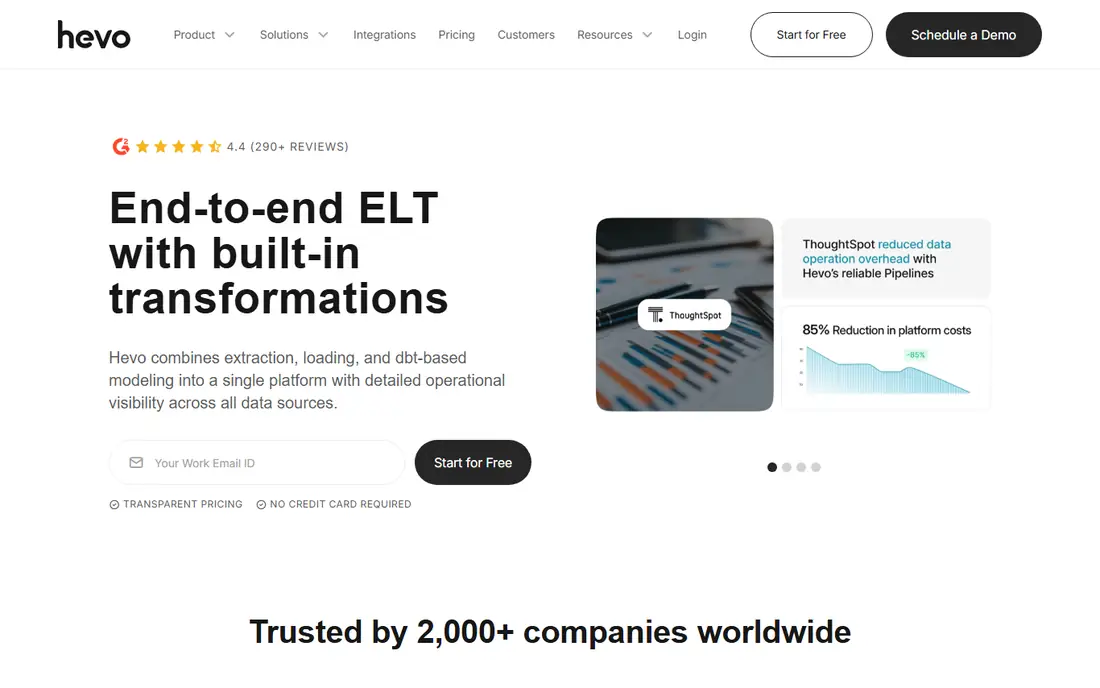
Hevo is built for teams that want pipelines running in an afternoon rather than a sprint. Sources and warehouses are configured in a few clicks, schema changes are handled automatically, and failed records are recovered with alerts rather than silent gaps. Database replication with change data capture keeps high-volume sources close to real time without hammering production databases.
Hevo's pitch is predictable cost control, with usage alerts that warn before a quota is hit, which helps teams avoid surprise bills. The trade-off is that Hevo focuses on moving and lightly preparing data; heavy transformation is better done in the warehouse or with a dedicated transformation tool. For a team that needs clean, analytics-ready data from 170-plus sources without hiring a data engineer, Hevo is one of the easiest managed choices.
What we like- No-code setup with automatic schema drift handling
- Database replication with change data capture
- Clear, predictable pricing positioning
Watch out for- Pricing is usage-based and needs a pricing page check
- Connector count is smaller than Airbyte
- Advanced transformations may need a warehouse tool alongside it
#3Qlik Talend Cloud
Best for: Enterprise integration, quality and governance in one platform3.7/5 on
Capterra (3 reviews, checked Oct 2026)
Visit qlik.com
Starting priceSee website
Free planFree trial
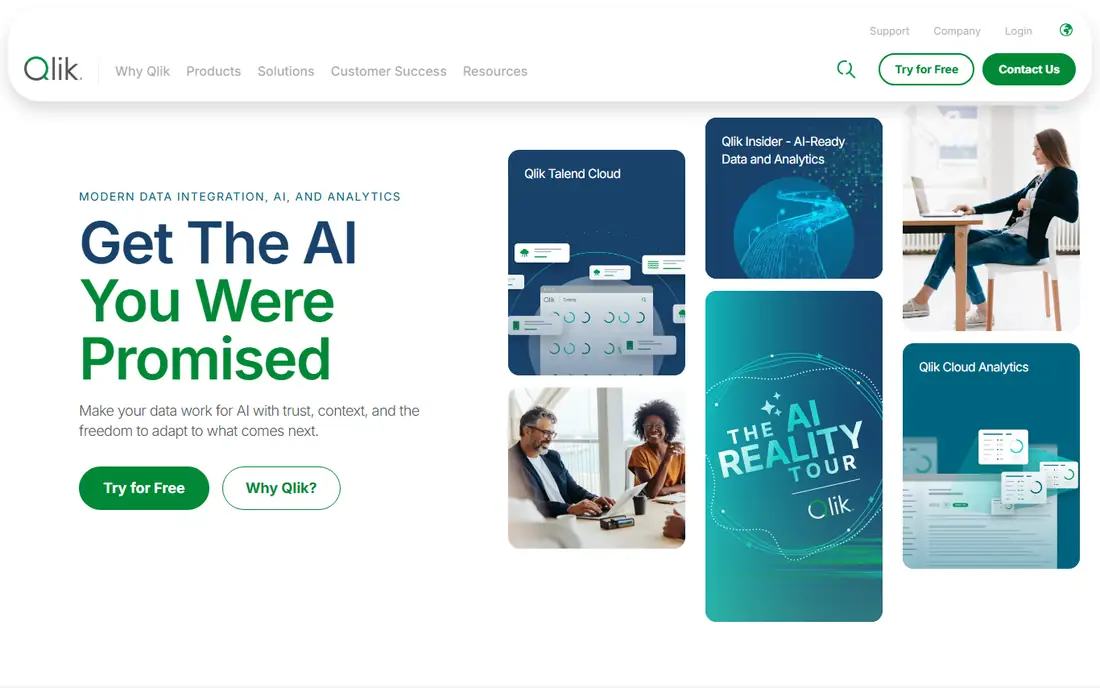
Qlik Talend Cloud is the enterprise answer in this list, combining data integration with data quality, governance and analytics in one platform. Its homepage notes that Stitch is now part of Qlik, with Stitch technology being built into Qlik Talend Cloud and new users directed there, which makes Qlik Talend the natural successor for teams that previously used Stitch. For a large company, that breadth is the point: pipelines, quality rules and governance live under one vendor and one security review.
Smaller teams should be honest about whether they need that breadth. Qlik Talend Cloud is bought through enterprise sales, and its pricing depends on the products and capacity chosen. A startup with five sources will move faster with Hevo or Skyvia. A company that must prove data lineage, quality and access control to auditors will find Qlik's governance features worth the heavier buying process.
What we like- Combines integration, data quality and analytics governance
- The recommended route for former Stitch users
- Strong enterprise compliance story
Watch out for- Enterprise pricing and sales-led buying
- Broader platform can be more than a small team needs
- Qlik's homepage covers a wide product set, so the data integration product must be selected carefully
#4Matillion
Best for: Warehouse-centred teams that want visual and AI-assisted pipelines4.4/5 on
G2 (83 reviews, checked Oct 2026)
Visit matillion.com
Starting priceSee website
Free planFree trial
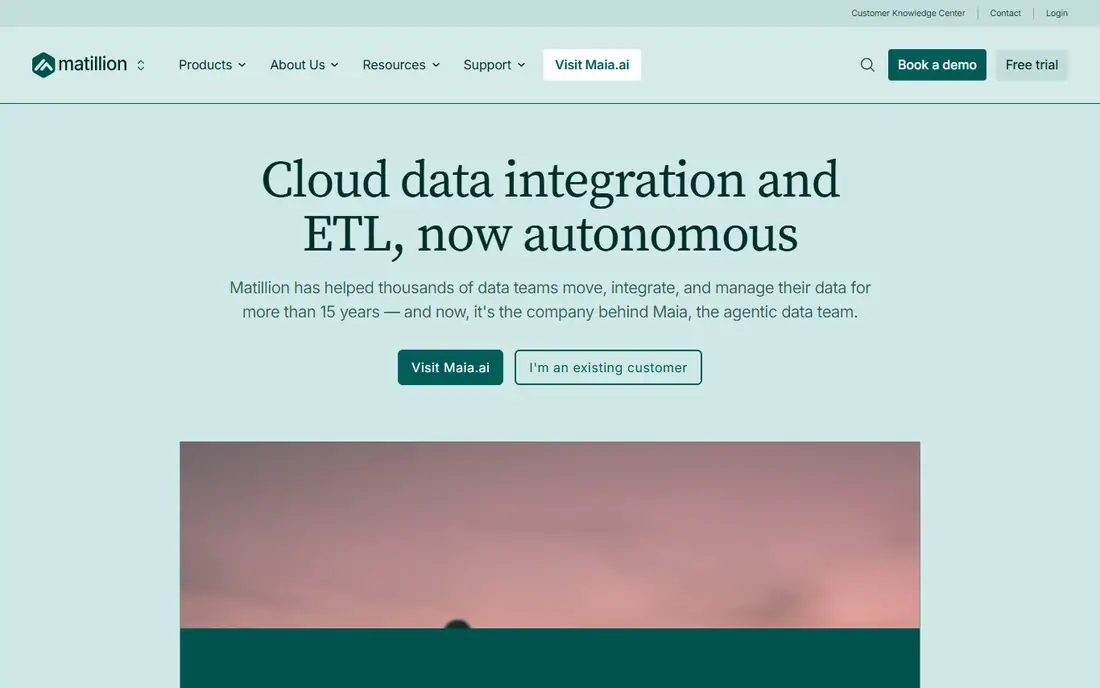
Matillion has spent more than a decade building pipelines for cloud warehouses, and its current platform pairs that experience with AI agents. The Maia layer plans, builds, tests, deploys and fixes pipelines while a human reviews each plan before it runs, which is a sensible control for AI-generated data work. The underlying platform offers more than 150 connectors, orchestration and governance across the major warehouses.
The fit question is warehouse strategy. Matillion shines when a team has already chosen Snowflake, Databricks, BigQuery or Redshift and wants pipelines designed around that warehouse. Teams without a warehouse, or those aggregating mainly marketing data into spreadsheets and dashboards, will find a simpler tool faster. Warehouse teams should trial Matillion's AI features against a real pipeline, since agent quality is the feature that will decide whether it earns its price.
What we like- Visual pipeline building for Snowflake, Databricks, BigQuery and Redshift
- AI agents that plan, build and fix pipelines with human review
- Long track record with warehouse teams
Watch out for- Warehouse-centred design suits warehouse-first teams best
- Pricing needs a pricing page or sales check
- AI agent features are newer and should be trialled
#5Supermetrics
Best for: Aggregating marketing data from ad and analytics platforms4.4/5 on
G2 (824 reviews, checked Oct 2026)
Visit supermetrics.com
Starting priceSee website
Free planFree trial
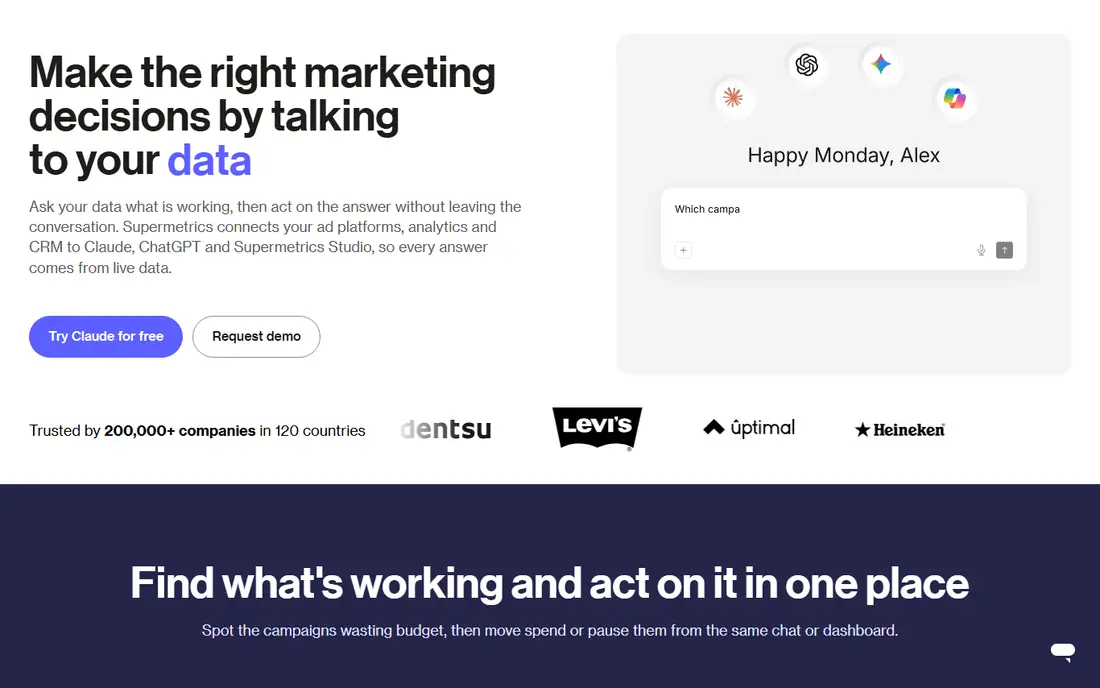
Supermetrics aggregates marketing data better than any general tool here, because that is all it does. It connects ad platforms, analytics and CRM tools, then loads analysis-ready data into BigQuery, Snowflake or another warehouse, or refreshes it directly in Looker Studio, Google Sheets and other reporting tools. Its newer AI features let marketers ask questions of live data in chat tools and turn an answer into a dashboard that updates itself.
The limit is scope. Supermetrics will not move a production database or sync operational data between internal systems, so a company that needs both marketing and operational aggregation will still need a general tool alongside it. For marketing teams and agencies, that specialisation is a strength: connectors, metrics and templates are built for campaign reporting, and the tool stays simple because it does not try to do everything.
What we like- Deep marketing source coverage, with data fed to warehouses, spreadsheets and dashboards
- AI chat access to live marketing data
- Well suited to agencies
Watch out for- Marketing focus means it is not a general data integration tool
- Pricing depends on sources and destinations
- Teams outside marketing will need a broader tool
#6Integrate.io
Best for: Low-code pipelines with predictable fixed-fee pricing4.3/5 on
G2 (213 reviews, checked Oct 2026)
Visit integrate.io
Starting priceSee website
Free planFree trial
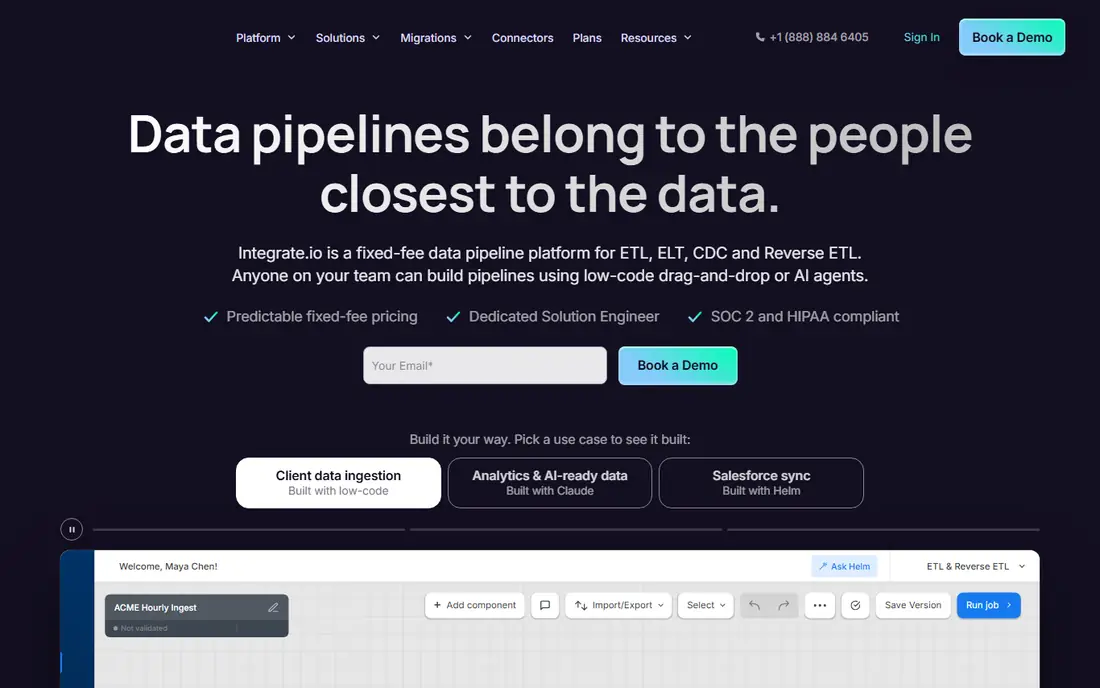
Integrate.io targets a real pain in data tooling: usage-based bills that grow with every row, sync and client. Its fixed-fee model charges for the platform rather than for each unit of data moved, which makes budgeting easier for agencies and operations teams whose volumes grow unevenly. The platform covers ETL, ELT, change data capture and reverse ETL, so the same tool can move data into a warehouse and sync trusted data back into operational apps.
Buying is consultative, with a free pilot and a dedicated solution engineer who builds the first use case with the team. That hands-on start suits teams that want help scoping pipelines, but it means pricing is quoted rather than listed on a simple pricing page. Teams that value predictable cost and human support over self-service speed should shortlist Integrate.io.
What we like- Fixed-fee pricing that does not scale with every row or connector
- ETL, ELT, CDC and reverse ETL in one platform
- Dedicated solution engineers and a free pilot
Watch out for- Pricing is fixed-fee rather than published per-tier, so a quote is needed
- Smaller connector marketing presence than Airbyte
- Reverse ETL use cases need careful scoping
#7Skyvia
Best for: Low-cost no-code integration for smaller teams4.8/5 on
G2 (324 reviews, checked Oct 2026)
Visit skyvia.com
Starting priceSee website
Free planYes
Skyvia is the budget-friendly entry point in this list, with a no-code platform that covers data integration, backup, automation and live access from one account. More than 200 connectors cover cloud apps, databases, storages and warehouses, and a free plan lets a small team start moving data without a purchase. Backup features, including automatic daily backups for Salesforce, add value that pure pipeline tools do not offer.
Skyvia will not match Airbyte's connector count or Qlik's governance depth, and enterprise teams with thousands of pipelines should look higher up this list. For a small business, a nonprofit or a team that needs reliable syncs between a handful of systems at low cost, Skyvia is a strong and honest choice, and its free plan makes it easy to prove the fit before paying.
What we like- No-code integration with more than 200 connectors
- Backup, automation and live data access in one platform
- Free plan available for getting started
Watch out for- Smaller scale than enterprise tools
- Very large or complex pipelines may need a heavier platform
- Pricing tiers depend on records and features used
How we chose
We compared vendor homepages and product documentation, and we weighed each tool by connector range, transformation support, monitoring and alerting, deployment options, governance, and pricing transparency. Tools whose homepages showed they had been folded into another product were represented by the successor product rather than listed under the old name. Where pricing is quoted or usage-based, we list See website rather than guessing a rate.
Aggregating data without creating a second mess
The most common aggregation failure is not a broken connector but a warehouse full of tables nobody trusts, because nobody owns definitions, freshness or quality. Before adding sources, agree on who owns each pipeline, what freshness each dashboard actually needs, and how failures are noticed. A pipeline that refreshes hourly for a monthly board report wastes money, while a pipeline that refreshes daily for an intraday campaign dashboard wastes trust. Monitoring, alerts and a simple data dictionary are cheaper than rebuilding trust after a wrong report.
Start with the decisions, not the connectors
A long connector list is tempting, but aggregation should follow the decisions it serves. List the five reports or analyses that matter most, trace each one back to its sources, and build those pipelines first. That keeps the warehouse small, the definitions clear and the team focused, and it makes it obvious which tool fits: marketing reporting points to Supermetrics, warehouse analytics points to Matillion or Hevo, and a broad enterprise estate points to Qlik Talend.
Frequently asked questions
What is the best data aggregation tool?
Airbyte is best for open, self-hosted data movement, Hevo is best for easy managed pipelines, Qlik Talend Cloud is best for enterprise governance, Matillion is best for warehouse-centred teams, and Supermetrics is best for marketing data. The best choice depends on team size, warehouse strategy and whether the data is mainly marketing or operational.
What is the difference between ETL and ELT?
ETL transforms data before loading it into a destination, while ELT loads raw data first and transforms it inside the destination, usually a cloud warehouse. Modern tools support both, and ELT is common with warehouses because they can transform at scale. The right choice depends on where your team wants transformation logic to live.
Do I need a data warehouse to aggregate data?
No, though most teams end up with one. Supermetrics can refresh spreadsheets and dashboards directly, and Skyvia can sync between apps without a warehouse. A warehouse helps when many sources must be joined, history must be kept, and many teams need the same trusted data.
How much do data aggregation tools cost?
Costs vary widely, from free open-source self-hosting with Airbyte to quoted enterprise pricing with Qlik Talend, with usage-based and fixed-fee models in between. Check the vendor pricing page, and estimate cost from your source count, record volume and refresh frequency rather than from seat count alone.
Can these tools handle real-time data?
Some can, through change data capture and streaming, including Hevo for database replication and Airbyte for near-real-time syncs. True real-time streaming is a separate category from scheduled batch aggregation, so check refresh intervals and latency for your specific sources before buying.
Is Fivetran a good data aggregation tool?
Fivetran is a well-known managed ELT tool, but its homepage could not be confirmed during this review because of a rate limit on the check, so it is not listed here rather than included unverified. Teams comparing managed ELT tools should include it in their shortlist and verify its current pricing directly.
Sources we checked (7)
- https://airbyte.com/pricing
- https://hevodata.com/pricing
- https://www.qlik.com/us/products/talend
- https://www.matillion.com/pricing
- https://www.supermetrics.com/pricing
- https://www.integrate.io/pricing
- https://skyvia.com/pricing
Is your product missing or out of date?
We review this list regularly. Vendors can request a listing, send updated pricing or ask about featured placement.

Shihab Mia · Founder, Rankite
Shihab has 5+ years in B2B and SaaS SEO. He writes Rankite's software buying guides from pricing pages, documentation and public user reviews. More about Shihab.