How we make this list: we compare pricing pages, product documentation and public user reviews. Ratings come from G2, Capterra or Trustpilot, with the date we checked them.
Key takeaways
- Most third-party plans are vehicle service contracts, not factory warranties, so the contract wording matters more than the marketing name.
- Endurance and CarShield suit different buyers, with Endurance acting as a direct provider and CarShield accepting very high-mileage vehicles.
- Olive stands out for an online quote and no waiting period on many plans, while its eligibility limits are tighter than several rivals.
- CARCHEX and autopom help buyers who want a choice of coverage levels or a comparison across administrators.
- Always compare the deductible, waiting period, mileage cap, exclusions and claim limits before choosing on monthly price alone.
Quick comparison
| Tool | Best for | Starting price | Free plan |
|---|
 Endurance | Direct provider with broad coverage tiers | See website | No |
 CarShield | High-mileage and older vehicles | See website | No |
 Olive | Fast online quotes with no waiting period | See website | No |
 CARCHEX | Flexible coverage levels and repair shop choice | See website | No |
 autopom | Comparing plans from several administrators | From $78.99 per month for qualifying vehicles | No |
 Omega Auto Care | Maintenance benefits alongside repair cover | See website | No |
 Protect My Car | Simple plans with roadside support | See website | No |
Is your product missing or out of date?
We review this list regularly. Vendors can request a listing, send updated pricing or ask about featured placement.
The best car warranty companies
Starting priceSee website
Free planNo
Endurance is a direct provider, which means it does not have to pass a claim through a separate seller and a separate administrator in the usual broker model. That structure can make the claims conversation shorter, because the company that sold the plan is also the company handling the contract. Buyers can choose from tiers that run from Secure Plus for core components up to Supreme, which is close to factory-style cover for many systems. Roadside assistance and rental car reimbursement are included on many plans, subject to the contract terms.
The main trade-off is price transparency. Endurance asks for vehicle details before giving a price, so two drivers with similar cars can receive different quotes based on age, mileage, location and tier. A waiting period of 30 days and 1,000 miles applies on many plans, so a fault that appears in the first weeks may not qualify. Endurance also excludes pre-existing conditions and routine maintenance, which is standard in this market but still catches buyers who expect a plan to cover servicing. Read the sample contract, check the deductible, and confirm which repair shops are accepted before signing.
What we like- Direct administration of its own contracts
- Several coverage tiers from powertrain to near bumper-to-bumper
- Choice of certified repair shop
Watch out for- Price depends on a personal quote
- Waiting period applies on most plans
- Routine maintenance is not covered
Starting priceSee website
Free planNo
CarShield is often the first name drivers check when other companies decline their car. Its headline strength is eligibility, with coverage available for vehicles up to 300,000 miles in many cases and no strict age limit on some plans. That makes it a practical option for a 15-year-old car, a high-mileage truck, or a vehicle that has already passed the limits set by online-only providers. Plans range from powertrain-only cover to Diamond, the broadest tier, plus separate plans for motorcycles, ATVs and electric vehicles.
Buyers should still read the exclusions with care. Routine maintenance, wear items, cosmetic damage and pre-existing faults are excluded, and the deductible can vary by plan. CarShield is not available to drivers in California, which is a hard limit for a large group of readers. Monthly payments can also run higher than the advertised starting point once vehicle age, mileage and deductible are factored in. For an older car with few other options, that cost may be worth it. For a newer, lower-mileage car, a cheaper rival may offer similar cover.
What we like- Covers vehicles up to very high mileage
- Several plan tiers including motorcycle, ATV and electric vehicle plans
- Month-to-month payment options on some plans
Watch out for- Not available in California
- Price is quote-based and varies widely
- Some plans carry higher monthly costs than rivals
#3
Olive
Best for: Fast online quotes with no waiting period
Visit olive.com
Starting priceSee website
Free planNo
Olive built its name on a simple buying process. Drivers enter vehicle details online and receive a monthly rate, rather than waiting for a callback to discuss pricing. Coverage can start quickly, with no waiting period on many plans, which matters when a factory warranty has just expired and a driver does not want a gap in cover. Olive pays the repair shop directly for covered repairs, so the driver pays the deductible and any non-covered items rather than paying the full bill and claiming it back.
The limits are tighter than some rivals. Vehicles generally need to be no more than 10 model years old and under 140,000 miles when the plan starts, although total cover can run higher. Pricing also rises sharply for older or higher-mileage vehicles, so a car near the top of the eligibility range can cost far more than a newer car on the same tier. Olive offers Powertrain, Powertrain Plus and Complete Care tiers, plus towing and rental benefits. It is a strong fit for a newer used car bought online, and a weaker fit for a very old or very high-mileage vehicle.
What we like- Online quote without a long sales call
- No waiting period on many plans
- Pays the repair shop directly
Watch out for- Tighter age and mileage limits at sign-up
- Higher prices for older, higher-mileage cars
- Maintenance and wear items excluded
#4
CARCHEX
Best for: Flexible coverage levels and repair shop choice
Visit carchex.com
Starting priceSee website
Free planNo
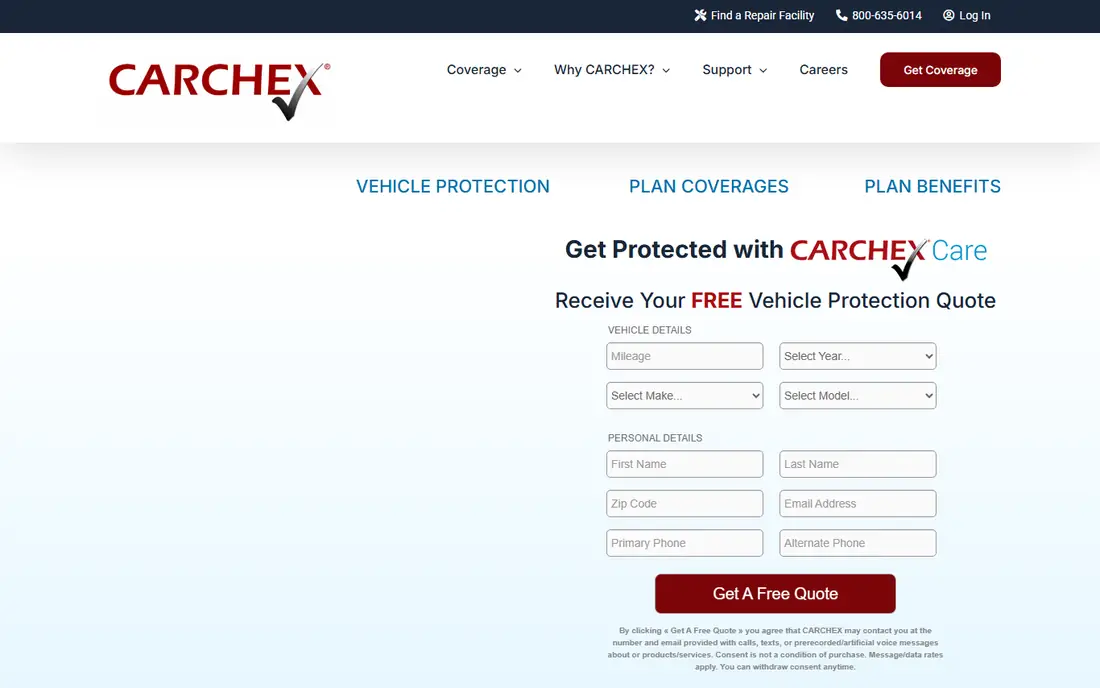
CARCHEX has sold vehicle service contracts since the early 2000s and also offers pre-purchase inspections, which gives it a longer track record than many online-only brands. Its coverage ladder runs from Powertrain and Powertrain Plus up to Platinum, Extra Care and Titanium, the highest tier. Titanium is an exclusionary plan, which means it covers most components except those listed as excluded, and it is the closest option here to a factory warranty in scope. Drivers can use many licensed repair facilities, including independent shops, national chains and dealers, subject to the contract.
The buying process is less instant than Olive. CARCHEX gives a free quote after vehicle details are supplied, and the final price depends on age, mileage, state and coverage level. A waiting period of 30 days and 1,000 miles applies on many plans, and deductibles can be set at different levels. Buyers who value a published sample contract will like that CARCHEX makes one available to review before purchase. Buyers who want an instant online price may prefer a different provider for the first quote, then use CARCHEX as a comparison.
What we like- Five coverage levels including a near bumper-to-bumper tier
- Usable at many licensed repair facilities
- Sample contract available to review
Watch out for- Quote-based pricing with no single published price
- Waiting period applies
- Some plans are sold through partner administrators
Starting priceFrom $78.99 per month for qualifying vehicles
Free planNo
autopom is different from the direct providers on this list because it is an independent broker. Instead of selling only its own contract, it helps drivers compare vehicle protection plans from several administrators and explains the differences in coverage, deductibles, exclusions and waiting periods. That approach suits buyers who feel lost among similar-sounding tiers and want a plain-English comparison before committing. Plans start as low as $78.99 per month for qualifying vehicles, with many drivers paying more depending on vehicle and coverage level.
The broker model has a clear limit. autopom does not decide claims, so the claims experience depends on the administrator behind the chosen plan. Buyers should ask which administrator backs the plan they are offered, and read that administrator's contract rather than relying only on the broker's summary. autopom also notes that coverage, limits, cancellation terms and claims handling vary by plan and administrator. For a driver who wants one company to answer for everything, a direct provider may feel simpler. For a driver who wants choice and guidance, autopom is a useful starting point.
What we like- Compares plans from multiple administrators
- Low-pressure guidance from coverage consultants
- Plans start as low as $78.99 per month for qualifying vehicles
Watch out for- Acts as a broker, not the claims administrator
- Final terms depend on the chosen administrator
- Quote still depends on vehicle details
Starting priceSee website
Free planNo

Omega Auto Care focuses on the gap after a factory warranty ends, with plans that cover mechanical breakdowns plus a maintenance program on many agreements. The maintenance program can include oil changes, brake pad credits, a battery credit, cooling system service and a safety inspection, each with its own cap and limit. That bundle appeals to drivers who want some everyday servicing help alongside protection against a large repair bill. Roadside assistance, towing, rental car reimbursement and trip interruption cover are also part of the wider benefits package.
The maintenance benefits should not be mistaken for full servicing cover. Each benefit has a dollar cap, a count limit and an expiry period, and required factory maintenance inspections at set mileage intervals are not covered by the program. Pricing is quote-based, so the monthly cost depends on the vehicle and plan. Omega also waives the deductible at RepairPal certified shops on some plans, which can lower the cost of a claim if a certified shop is nearby. Check the maintenance caps, the deductible rules and the claim limits before treating the bundle as a reason to pay more.
What we like- Maintenance program included with many agreements
- Deductible waived at RepairPal certified shops on some plans
- Roadside, towing and rental benefits
Watch out for- Pricing is quote-based and not published as a single rate
- Maintenance benefits have caps and time limits
- Plans are sold through dealers and partners in many cases
Starting priceSee website
Free planNo

Protect My Car offers vehicle service contracts with a simpler pitch than some larger competitors. Its site lists claims, customer service and roadside assistance contacts up front, which helps drivers who want a direct phone route when a breakdown happens. Plans include roadside support, and covered repairs follow the usual service contract model, with authorization before work and a deductible where the contract requires one. For drivers who prefer to talk through a plan rather than buy entirely online, that phone-first approach can be reassuring.
The main drawback is detail. Protect My Car publishes less plan-by-plan information on its homepage than Endurance, CarShield or CARCHEX, so buyers need to request the full contract and ask specific questions about covered components, exclusions, waiting periods and claim limits. Pricing is also quote-based, so no single monthly figure applies to every driver. Protect My Car fits best as a comparison quote alongside two or three better-documented providers, rather than as a purchase made on homepage information alone.
What we like- Straightforward plan structure
- Roadside assistance included
- Claims and customer service phone lines listed on its site
Watch out for- Website gives limited plan detail compared with larger rivals
- Pricing is quote-based
- Coverage details depend on the individual contract
How we chose
We compared providers on coverage tiers, eligibility limits, waiting periods, deductibles, repair shop choice, included benefits and how clearly each company explains its contract. Pricing information came from vendor pricing and homepage pages, public reviews and comparison guides, because most car warranty companies set price by quote rather than publishing a single rate. Where a vendor did not publish a fixed price, we wrote See website instead of estimating a figure. We also checked that each company listed here sells or brokers vehicle service contracts in the United States today and fits the category, rather than adding insurers, dealers or unrelated warranty brands to fill the list.
What to check before you buy a car warranty
Start with eligibility, not price. Note the maximum age and mileage at sign-up, the total mileage cap, and any state exclusions. A cheap monthly rate means little if your car is already over the limit or if cover ends soon after purchase. Next, compare the same tier across providers. A powertrain plan from one company may cover the turbocharger and water pump, while another powertrain plan may not, so the tier name alone is not a reliable comparison.
Read the exclusions and the claim limits
Exclusions decide most disputes. Check pre-existing conditions, wear items, maintenance items, seals and gaskets, electronics and high-tech parts. Also check the single-claim limit and the total claim limit, because a plan can cover an engine in theory yet cap payment below the repair cost. Ask whether the repair shop must call for authorization before work starts, and what happens if work starts without it.
Compare the full cost, not just the monthly figure
Add the monthly payment over the full term, plus the deductible per repair visit, plus any down payment or fees. A lower monthly figure with a high deductible can cost more in a year with two repairs than a higher monthly figure with a low deductible. Ask about cancellation terms, refunds and whether the rate is fixed for the term or can change at renewal. If a seller cannot explain these points in writing, treat that as a reason to pause.
Check the waiting period and the repair shop rules
Waiting periods range from none at Olive to 30 days and 1,000 miles at several rivals, and some plans use 60 to 90 days. A waiting period is not a flaw on its own, but it matters if the car already shows a warning light or a fault. Confirm whether any licensed shop can do the work, whether a certified network is required for a deductible waiver, and whether the provider pays the shop directly or reimburses the driver later.
Frequently asked questions
What car company has the best warranty?
For a new car, the best factory warranty usually comes from the manufacturer, not a third-party company, and brands such as Hyundai, Kia and Genesis have long powertrain terms. Third-party companies on this list cover cars after the factory warranty ends, so they answer a different question. Compare them on tier scope, eligibility and claim terms, not on the factory warranty that came with the car.
Which car company has the best warranty for an older car?
CarShield is often the strongest option for very old or high-mileage cars because it accepts vehicles up to very high mileage where other providers stop. Endurance also covers vehicles up to 20 years old with no mileage maximum on some plans. If your car is under 10 years old and under 140,000 miles, Olive and CARCHEX are also worth quoting.
Are extended car warranties worth it?
An extended warranty, in practice a vehicle service contract, can be worth it when a single major repair would strain your budget and the car is out of factory cover. It is less attractive for a reliable, low-mileage car with a healthy repair fund, or for a car with known faults that may count as pre-existing conditions. Compare the total contract cost with the likely repair costs for your model before deciding.
What does a car warranty usually not cover?
Most plans exclude routine maintenance such as oil changes and brake pads, wear items such as tires and wiper blades, cosmetic damage, damage from accidents, and pre-existing conditions. Aftermarket modifications and commercial or rideshare use are also commonly excluded. The full exclusions list sits in the contract, and it overrides any summary on a sales page.
How much does a car warranty cost per month?
Monthly cost depends on vehicle age, mileage, make, location, coverage tier and deductible, so there is no single correct figure. autopom lists plans from $78.99 per month for qualifying vehicles, while many drivers pay more for broader cover or older cars. Get at least three quotes for the same tier and deductible, then compare total term cost.
Can I cancel a car warranty?
Most vehicle service contracts allow cancellation, often with a refund based on time or mileage used and any claims paid, subject to state rules and contract terms. Some plans charge a cancellation fee. Ask for the cancellation and refund formula in writing before purchase, and keep a copy of the contract and all payment records.
Sources we checked (9)
- https://www.endurancewarranty.com/
- https://www.carshield.com/
- https://olive.com/
- https://www.carchex.com/
- https://autopom.com/
- https://www.omegaautocare.com/
- https://protectmycar.com/
- https://money.com/best-extended-car-warranties/
- https://www.consumeraffairs.com/auto_warranty/
Is your product missing or out of date?
We review this list regularly. Vendors can request a listing, send updated pricing or ask about featured placement.

Shihab Mia · Founder, Rankite
Shihab has 5+ years in B2B and SaaS SEO. He writes Rankite's software buying guides from pricing pages, documentation and public user reviews. More about Shihab.