How we make this list: we compare pricing pages, product documentation and public user reviews. Rankite is independent; if a vendor ever pays for a featured spot, that listing is clearly labeled Partner.

Key takeaways
- Stessa is the best free starting point: unlimited properties, automated transaction import and Schedule E reports at no cost, with paid plans from $12/month.
- Baselane combines free landlord banking with bookkeeping and rent collection, which suits investors tired of juggling bank accounts and spreadsheets.
- REI Hub is the pick for short-term rental and mixed portfolios: Airbnb and VRBO payout imports with property-based accounting.
- QuickBooks Online and Xero work when your portfolio outgrows investor-specific tools, but they need real estate add-ons or workarounds for property-level tracking.
Quick comparison
| Tool | Best for | Starting price | Free plan |
|---|
 Stessa Stessa | Investors who want serious rental accounting for free | Free; Manage from $12/month (billed annually) | Yes |
 REI Hub REI Hub | Short-term rental hosts and mixed portfolios | Free tier | Yes |
 Baselane Baselane | Landlords who want banking and bookkeeping in one place | Free core; Smart plan ~$20/month | Yes |
 Landlord Studio Landlord Studio | DIY landlords who want simple, correct rental books | Free tier | Yes |
 QuickBooks Online QuickBooks Online | Investors whose portfolios outgrow landlord-specific tools | See website | Free trial (30 days) |
 Xero Xero | Investors who want unlimited users at a flat price | From $25/month (Early) | Free trial (30 days) |
 Buildium Buildium | Investors who self-manage and need operations plus accounting | From $62/month | Free trial |
 AppFolio AppFolio | Large portfolios run like a business | See website (custom pricing) | No |
 DoorLoop DoorLoop | Growing portfolios that want modern, easy management software | See website | Free trial |
Is your product missing or out of date?
We review this list regularly. Vendors can request a listing, send updated pricing or ask about featured placement.
The best accounting software for real estate investors
Rental accounting is not generic accounting with a different label. You need income and expenses tracked per property and per unit, security deposits handled correctly, Schedule E reports at tax time, and rent collection that reconciles itself. Generic tools can be bent to do this, but investor-specific software does it natively. These nine tools cover both camps, starting with the ones built for landlords.
#1
Stessa
Best for: Investors who want serious rental accounting for free
Visit stessa.com
Starting priceFree; Manage from $12/month (billed annually)
Free planYes
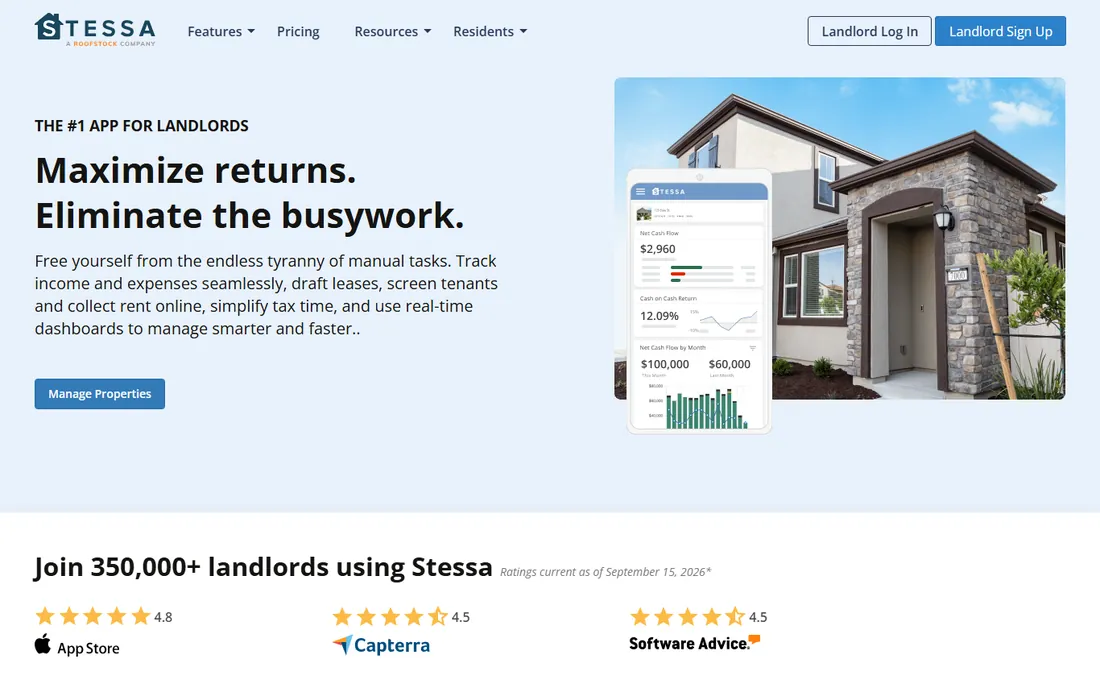
Stessa is the rare free tool with no property limit: connect your bank accounts, and it imports and categorizes transactions by property automatically. Dashboards track income, expenses and cash flow across the portfolio, and tax time produces Schedule E-ready reports. For an investor with a handful of doors, the free tier genuinely covers the accounting.
Paid plans add more: Manage at $12 a month billed annually ($15 monthly) adds advanced reporting and features, while Pro at $28 to $35 adds portfolio-level tools. The AppFolio ownership is worth noting: Stessa keeps expanding into leasing and management features. Start free; pay only when the free reports stop answering your questions.
What we like- Free plan covers unlimited properties with automated bank import and categorization
- Tax-ready Schedule E reports
- Portfolio dashboards show cash flow across all properties
Watch out for- Single-entry accounting, not double-entry: accountants may want more
- Advanced reporting and some leasing features need the $12 to $35/month paid plans
- Now part of AppFolio, so the roadmap follows their strategy
#2
REI Hub
Best for: Short-term rental hosts and mixed portfolios
Visit reihub.net
Starting priceFree tier
Free planYes
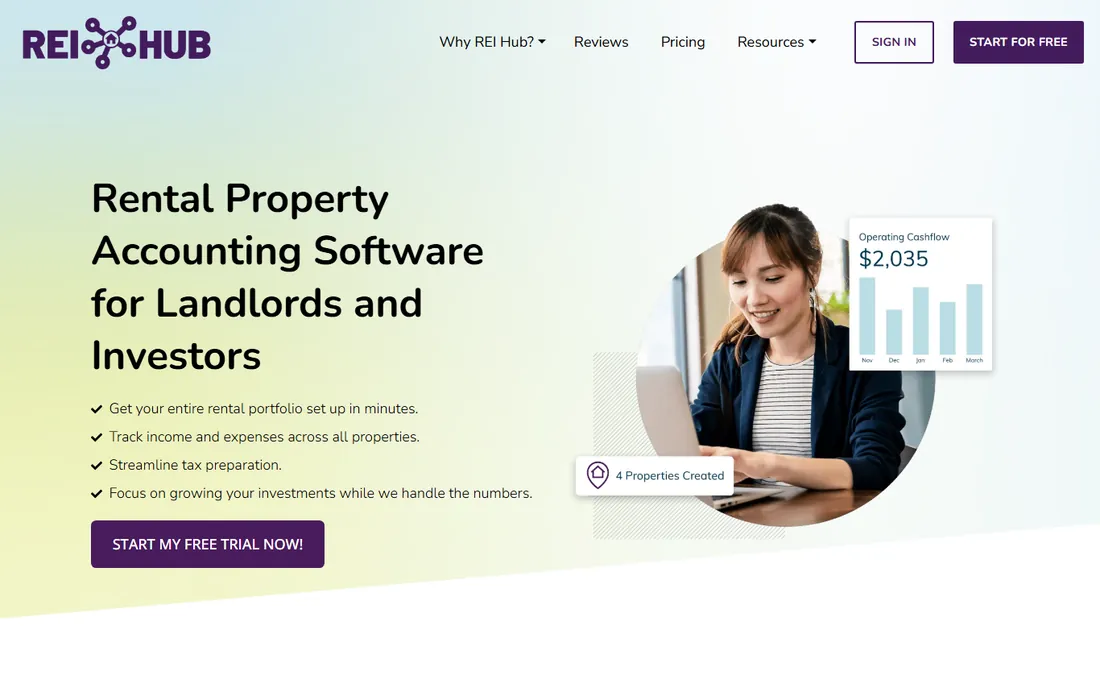
REI Hub is the accountant-approved option: real double-entry bookkeeping organized by property, which matters when your CPA asks for proper books. For short-term rental investors, the Airbnb and VRBO import features solve the hardest part of STR accounting: dozens of payouts with fees, taxes and adjustments that need to land on the right property. Schedule E reports come standard.
The free tier gets you started, with paid plans for larger portfolios. It lacks the banking features of Baselane and the scale of Stessa, but for investors who want correct books rather than pretty dashboards, the double-entry foundation is the argument. Your accountant will thank you.
What we like- Built for how investors actually operate: property-based double-entry accounting
- Airbnb and VRBO payout imports handle STR bookkeeping
- Schedule E reporting included
Watch out for- Smaller company than Stessa or Baselane, so the ecosystem is thinner
- Pricing for paid tiers is less prominently published
- The interface prioritizes function over polish
#3
Baselane
Best for: Landlords who want banking and bookkeeping in one place
Visit baselane.com
Starting priceFree core; Smart plan ~$20/month
Free planYes

Baselane's insight is that landlord bookkeeping starts at the bank account: it gives you free business banking with separate virtual accounts per property, then layers bookkeeping, rent collection and reporting on top. Rent paid through Baselane reconciles automatically. For investors tired of matching bank transfers to properties in a spreadsheet, this removes the busiest work.
The core is free, with the Smart plan around $20 a month adding advanced features. Pure accounting depth does not match REI Hub's double-entry books, but the banking integration saves more hours for most landlords than deeper accounting would. If your pain is operational rather than analytical, start here.
What we like- Free landlord banking with virtual accounts per property, plus integrated bookkeeping
- Rent collection with automatic reconciliation
- Native Airbnb payout imports
Watch out for- The banking-first model means accounting depth trails dedicated tools
- Smart plan features at ~$20/month add up across a large portfolio
- Newer company with a shorter track record
Starting priceFree tier
Free planYes
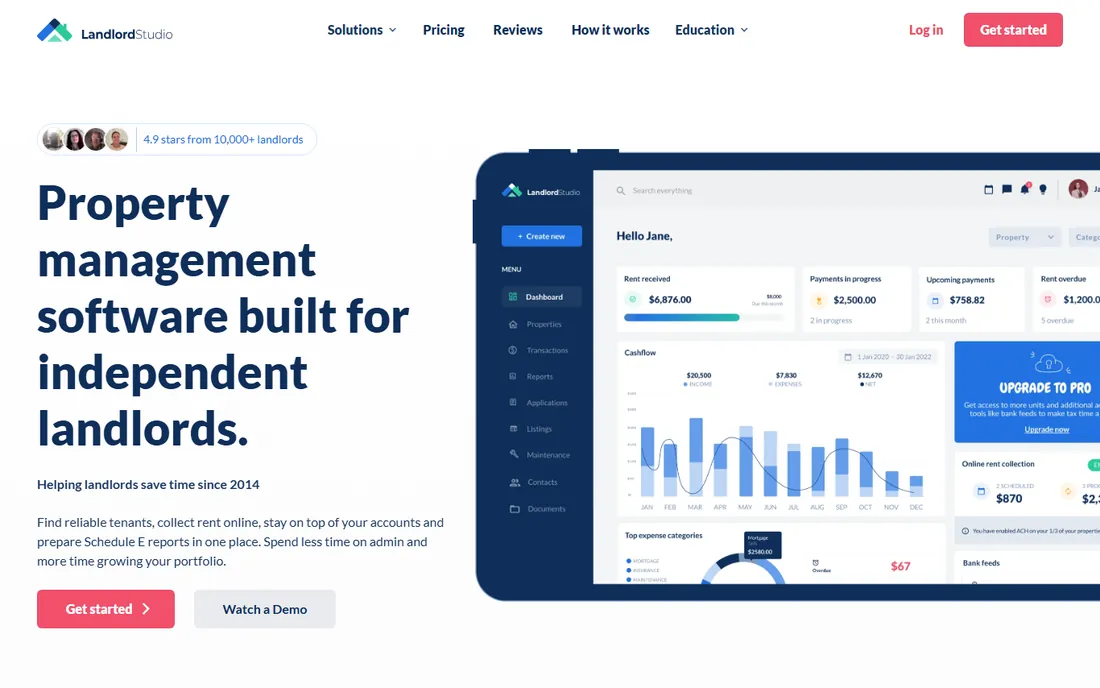
Landlord Studio is the minimalist: track income and expenses per property, generate Schedule E reports, log receipts from your phone. The free tier handles the essentials for a small portfolio without the feature sprawl of bigger platforms. Paid plans add bank connections and advanced reporting at reasonable prices.
It will not collect rent, open bank accounts or manage maintenance. That is the point: it does rental bookkeeping and nothing else, cleanly. For a DIY landlord with under ten units who just wants correct books and easy taxes, it is the least you can buy that still works.
What we like- Free tier covers property-level income and expense tracking with Schedule E reports
- Clean mobile app for logging expenses on the go
- Straightforward pricing for paid plans
Watch out for- Feature depth is modest compared with Stessa or Baselane
- No banking or rent collection built in
- Best for small portfolios rather than growing operations
Starting priceSee website
Free planFree trial (30 days)
QuickBooks Online is the default small-business accounting tool, and it works for real estate investors with caveats. The accounting is proper double-entry, your CPA already uses it, and it scales to payroll and full operations. But properties are not first-class citizens: you track them with classes or locations, and Schedule E reporting needs configuration or add-ons.
Choose QuickBooks when the portfolio becomes a business: multiple entities, employees, or a CPA who insists on it. For pure rental tracking under a dozen units, the investor-specific tools above do more with less setup. QuickBooks wins on accounting depth and ecosystem, not on real estate fit.
What we like- Full double-entry accounting with payroll, invoicing and bank feeds
- Every US accountant knows it
- Scales from one rental to a management company
Watch out for- No native property-level accounting: you need classes, locations or third-party apps
- Rental-specific reports require setup work
- The interface assumes a generic small business
#6
Xero
Best for: Investors who want unlimited users at a flat price
Visit xero.com
Starting priceFrom $25/month (Early)
Free planFree trial (30 days)

Xero's flat pricing with unlimited users is genuinely useful for investors: the bookkeeper, the property manager and the CPA can all access the books without per-seat fees. Early starts at $25 a month, with higher tiers adding multi-currency and advanced features. Bank feeds and reconciliation are best in class.
The real estate gaps are the same as QuickBooks': no native property accounting, so you lean on tracking categories and marketplace apps. Those apps run $20 to $50 a month each and can erode the price advantage. Xero suits the investor who values multi-user access and clean accounting over rental-specific features.
What we like- Unlimited users on every plan: your property manager, bookkeeper and CPA all log in free
- Excellent bank reconciliation
- Large app marketplace for real estate add-ons
Watch out for- Like QuickBooks, it needs workarounds for property-level tracking
- US payroll runs through partners
- The marketplace add-ons that fix real estate gaps cost extra
#7
Buildium
Best for: Investors who self-manage and need operations plus accounting
Visit buildium.com
Starting priceFrom $62/month
Free planFree trial
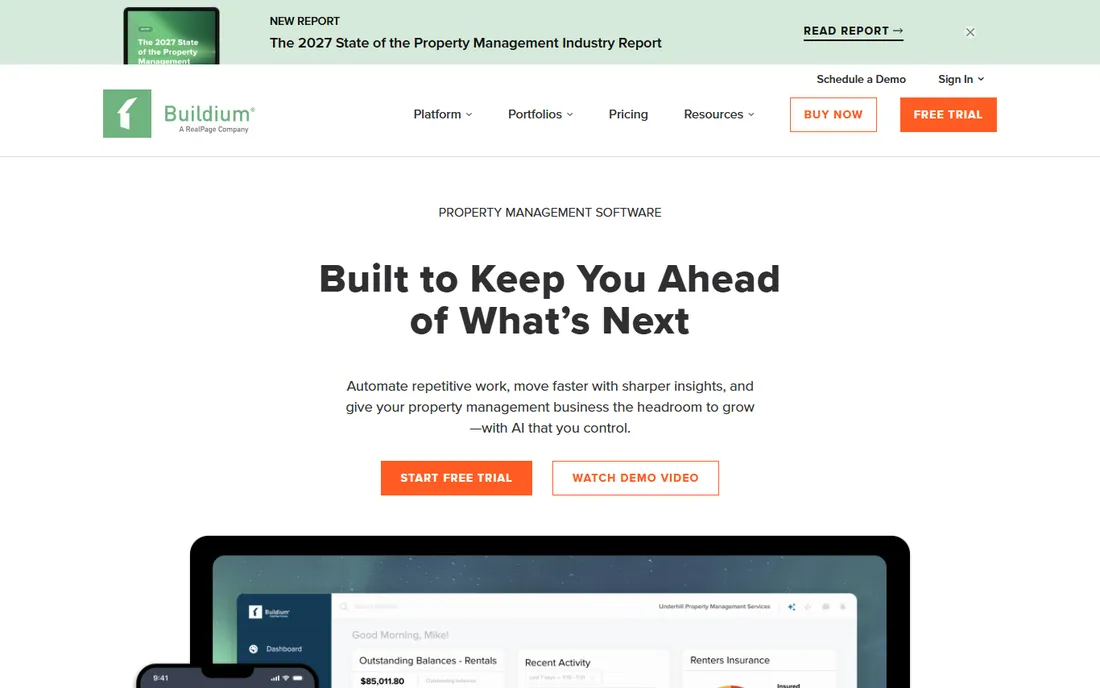
Buildium is property management software with accounting inside, not the reverse. If you self-manage: advertise vacancies, screen tenants, sign leases, collect rent, dispatch maintenance and pay owners, all while the accounting stays correct, including security deposit trust accounting. Starting at $62 a month, it targets managers rather than passive investors.
For the investor who also operates, that combination replaces two or three subscriptions. For the passive investor with a property manager already, it is the wrong tool: you would pay for operations you do not run. Match the software to your role, not just your portfolio size.
What we like- Property management and accounting in one system: leasing, maintenance, rent collection and owner reporting
- Trust accounting for security deposits
- Scales to hundreds of units
Watch out for- $62 a month minimum is overkill for a passive investor with a few doors
- The accounting serves property management, not investment analysis
- Onboarding takes real effort
Starting priceSee website (custom pricing)
Free planNo
AppFolio is the enterprise end of this list: a full property management platform for companies running hundreds or thousands of units, with AI-assisted leasing, maintenance workflows, accounting and investor reporting. Pricing is custom and the minimums put it out of reach for small landlords.
It belongs here because portfolios grow into it. The investor who starts with Stessa (now an AppFolio company) and scales to fifty units eventually needs real management software. When operations become the bottleneck rather than accounting, AppFolio is the destination. Until then, it is overkill.
What we like- The most complete property management platform: AI leasing, maintenance, accounting and owner reporting
- Handles thousands of units
- Stessa now sits inside the same company
Watch out for- Custom pricing with minimums that exclude small investors
- Implementation is a project, not a signup
- Far more software than a passive investor needs
#9
DoorLoop
Best for: Growing portfolios that want modern, easy management software
Visit doorloop.com
Starting priceSee website
Free planFree trial
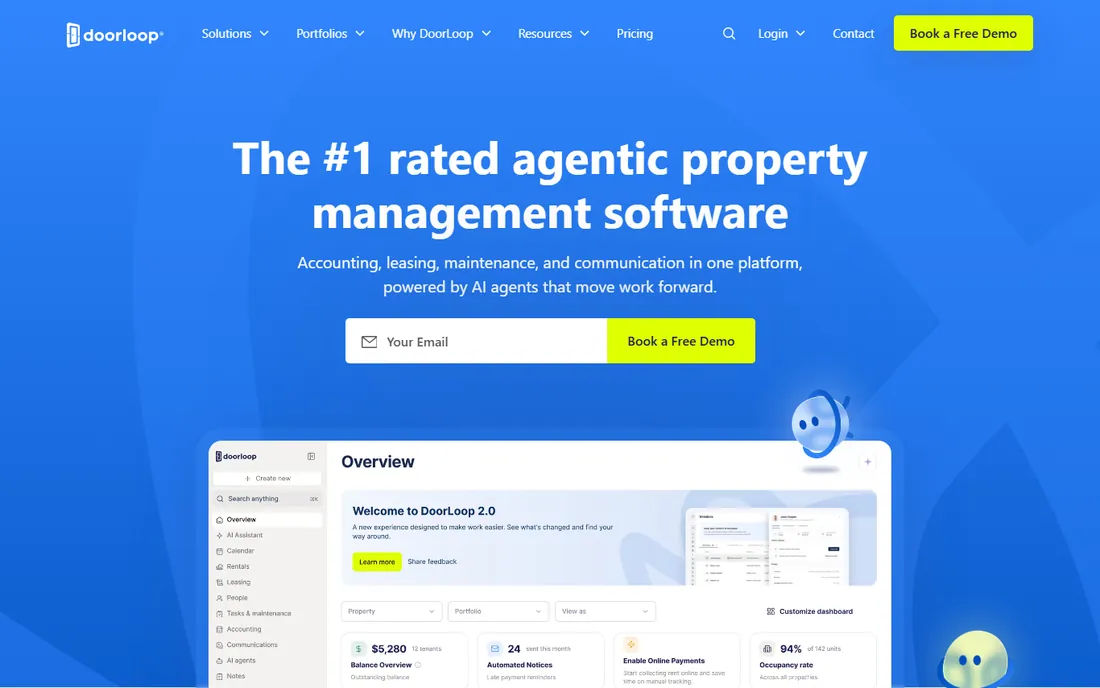
DoorLoop positions itself as the modern alternative to legacy property management software: easier to learn, faster to implement, with leasing, collections, maintenance and accounting in one system. Migration help is a selling point for investors escaping spreadsheets or outdated tools.
Pricing requires a conversation, which is a mild annoyance. The product fits the growing investor best: past the stage where Stessa suffices, not yet at AppFolio scale. If Buildium feels dated and AppFolio feels huge, DoorLoop is the middle path worth quoting.
What we like- Modern interface that owners and tenants both find easy
- Covers leasing, rent collection, maintenance and accounting
- Good migration support from spreadsheets and legacy tools
Watch out for- Pricing is quote-based rather than published
- Younger than Buildium and AppFolio, so the track record is shorter
- The sweet spot is mid-size portfolios, not tiny ones
Schedule E is the whole game
Every tool here lives or dies by one report: Schedule E, the IRS form for rental income and expenses. The investor-specific tools generate it natively, categorized by property, which turns tax season from a spreadsheet ordeal into a review exercise. Generic accounting tools can produce the numbers, but you will map the categories yourself.
This is also why free matters less than it seems. A $12-a-month Stessa plan that produces a clean Schedule E is cheaper than the accountant hours you would spend untangling a free spreadsheet. Judge these tools by tax-time output first, monthly price second. The cheapest software is the one your CPA does not have to fix.
The niche tools win under about 20 units. Past that, or when the business gets complicated, generic accounting earns its keep: multiple LLCs needing consolidated reports, cost segregation studies, 1031 exchanges, partners with different ownership splits, or employees on payroll. QuickBooks Online and Xero handle entity structures the landlord tools cannot.
The transition does not have to be abrupt. Many investors run Stessa or Baselane for property operations and hand clean reports to a CPA who keeps the official books in QuickBooks. That hybrid works until the portfolio justifies consolidating. When your CPA starts rebuilding your books every April, it is time.
Frequently asked questions
What is the best free accounting software for landlords?
Stessa: unlimited properties, automated transaction import and Schedule E reports for free. Baselane's free core adds banking and rent collection. REI Hub and Landlord Studio also offer free tiers. For most landlords, Stessa's free plan is the starting point.
Do I need double-entry accounting for rental properties?
Not legally for most small landlords, but your CPA will prefer it. REI Hub, QuickBooks Online and Xero use double-entry; Stessa and most landlord tools use single-entry, which is simpler but less rigorous. If an accountant does your taxes, ask which they want before choosing.
Can QuickBooks handle rental property accounting?
Yes, with setup. Use classes or locations for properties, and consider a real estate add-on for Schedule E reporting. It is proper accounting that scales, but it needs configuration the investor-specific tools do out of the box. Best for larger or multi-entity portfolios.
How should I track Airbnb income for taxes?
Use a tool with STR payout imports: REI Hub and Baselane both import Airbnb and VRBO payouts with fees and adjustments. Short-term rental income has different tax treatment than long-term rent in many cases, so keep it on separate properties or categories and confirm the treatment with your CPA.
What does real estate accounting software cost?
Free to about $62 a month for most investors: Stessa, Baselane, REI Hub and Landlord Studio all have free tiers, with paid plans from $12 to $35 a month. Buildium starts at $62 a month for management features; AppFolio and DoorLoop are quote-based. Generic tools run $25 to $38 a month plus any real estate add-ons.
Should I just use a spreadsheet?
For one property in year one, a spreadsheet works. Past that, the bank imports, automatic categorization and Schedule E reports of dedicated software save more time than they cost. The break-even is roughly two properties or one tax season: if reconciling the spreadsheet takes a weekend, the software has paid for itself.
How we chose
We started with the searches investors run: accounting software for landlords, rental property bookkeeping, Stessa vs Baselane and Schedule E software. For each candidate we verified it serves real estate investors specifically or is widely used for rental portfolios, confirmed the pricing from vendor pages and recent reviews, and weighed property-level tracking and tax reporting above generic accounting features. Unverifiable prices are marked "See website."
Sources we checked (4)
- https://ramp.com/blog/accounting-software-for-real-estate
- https://staystra.com/best-accounting-software-airbnb-hosts-2026/
- http://theclose.com/best-real-estate-software-for-investors/
- https://www.baselane.com/resources/best-software-for-real-estate-investors
Is your product missing or out of date?
We review this list regularly. Vendors can request a listing, send updated pricing or ask about featured placement.

Shihab Mia · Founder, Rankite
Shihab has spent more than a decade helping SaaS and e-commerce brands grow through search. He writes Rankite's software buying guides from pricing pages, documentation and public user reviews. More about Shihab.